Putins Rede zum Beitritt der Krim, 18.03.2014

Putins Rede zum Beitritt der Krim

18.03.2014

Quelle: http://www.chartophylakeion.de/blog/2014/03/18/putins-rede-zum-beitritt-der-krim/#.Uyhyb87N34x

Transkript und Übersetzung des Auftritts – apxwn

Rede des russischen Präsidenten Wladimir Putin am 18. März 2014 im Kreml vor Abgeordneten der Staatsduma, vor Mitgliedern des Föderationsrats, Gouverneuren des Landes und Vertretern der Zivilgesellschaft bezüglich der Bitte der Republik Krim und der Stadt Sewastopol um Aufnahme in den Bestand der Russischen Föderation

vvp_kurok

Guten Tag, sehr verehrte Mitglieder des Föderationsrats, sehr verehrte Abgeordnete der Staatsduma! Sehr geehrte Vertreter der Republik Krim und der Stadt Sewastopol – ja, sie sind hier, unter uns, als Bürger Russlands, Einwohner der Krim und Sewastopols!

Verehrte Freunde, heute haben wir uns zur Besprechung einer Frage hier versammelt, die lebenswichtig und von historischem Ausmaß für uns alle ist. Am 16. März hat auf der Krim ein Referendum stattgefunden. Dieses Referendum verlief in voller Übereinstimmung mit demokratischen Normen und internationalen Vorschriften.

An der Abstimmung haben mehr als 82% der Wähler teilgenommen, über 96% sprachen sich für einen Anschluss an Russland aus. Diese Zahlen sind durchaus überzeugend.

Um zu verstehen, warum es zu genau dieser Wahl gekommen ist, genügt es, die Geschichte Russlands zu kennen und zu verstehen, was die Krim für Russland und was Russland für die Krim bedeutet.

Alles auf der Krim ist von unserer gemeinsamen Geschichte, unserem gemeinsamen Stolz durchdrungen. Hier liegt das antike Chersones, wo der heilige Fürst Wladimir getauft wurde. Seine geistliche Aufopferung – die Annahme des orthodoxen Glaubens – bestimmte die allgemeine kulturelle Basis, das Wertesystem und die Zivilisation voraus, welche die Völker Russlands, der Ukraine und Weißrusslands vereint. Auf der Krim gibt es Gräber der russischen Soldaten, durch deren Heldenmut die Krim im Jahre 1783 unter russische Herrschaft kam. Die Krim – das ist Sewastopol, eine Legende von einer Stadt, eine Stadt mit einem großartigen Schicksal, eine Festungsstadt und die Heimatstadt der Schwarzmeerflotte. Die Krim – das ist Balaklawa und Kertsch, Malachow und Sapun-gora. Jeder dieser Orte ist ein Heiligtum für uns, all das sind Symbole für militärischen Ruhm und Heroismus.
Weiter lesen

Posted in Crimea, Deutsch, Deutsch news, Languages, News | Tagged , , , , , , | 1 Comment

Fallen Crimean Tatar: Reshat Ametov, Simferopol

Image

Source

Reshat Ametov from Simferopol (photo confirmed by the Majlis) was found murdered on the evening of March 15 in Sunychne village, Bilohirst district.

As was reported earlier by Jemilev Mustafa, leader of the Mejlis of the Crimean Tatar people, Ametov went missing on the 3rd or 4th of March. The last thing known about his whereabouts is the fact that he went to the recruiting office and disappeared. His body was found with obvious signs of torture. Beside him were handcuffs, his head was bound in tape strips. On his body were visible signs of pain and torture.

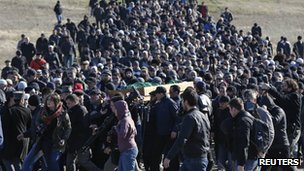
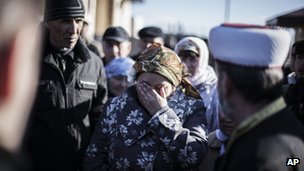
Hundreds of mourners gathered at a cemetery outside Simferopol on Tuesday for the burial of Reshat Ametov, whose murder sparked anger in the Crimean Tatar community which is bitterly opposed to Russia’s annexation of the Black Sea peninsula.

_73656760_021580457-1

Here is another photo of mourning Crimean Tatars attending the funeral of killed Ukrainian activist Reshat Ametov.

_73656762_021579161-1

Mr. Ametov disappeared when three men in military jackets led him away from the scene of a protest in the Crimean regional capital of Simferopol, witnesses told Reuters. One friend at the burial said that he had gone into town in order to enlist for the Ukrainian army amid escalating tensions with Russia.

4rgGsH9OrE8 Related Source

Posted in Crimea, English, English News, Languages, News, Pictures | Tagged , , , , , , , , , , | 3 Comments

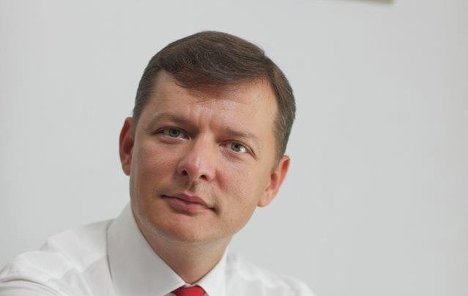
Oleh Liashko: Our Answer to the Agressor…

17.03.2014  8:52  ukr-online.com
Translated and edited by Voices of Ukraine
Source

The Russian government, in contrast to the rest of the world, has recognized the Crimean “referendum,” which it organized, and will now take advantage of its falsified results to legitimize its predatory activities in Ukraine.

What action can we take in this situation?

1. Never, under any circumstances, agree to the annexation of Crimea. Even if it is held a long time, we will return Crimea to the jurisdiction of Ukraine;

2. Denounce the Great Treaty of Friendship 1997 between Russia and Ukraine, to break diplomatic relations with Russia;

3. Denounce the Kharkiv Pact of 2010, to extend the right for Russia to base its Black Sea fleet in Crimea. Cancel the Partition Treaty of 1997 concerning the stationing of the fleet in Crimea;

4. Apply immediately for membership in the EU and NATO;

5. Establish European prices for the delivery from Ukraine to Crimea of fresh water, gas, electricity (for gas: $500 per 1000 m3, for water: $1000 per 1000 m3, for electricity: $500 per kW). Let Russia pay dearly for Crimea’s “independence”;

6. Establish the price for the transit of Russian gas to Europe – $500 per m3 and not $10 as currently. If Russia should refuse to pay, close the valves;

7. Introduce visa requirements for Russia. The EU should then establish visa-free entry for Ukrainian citizens and help Ukraine equip its borders with Russia;

8. The EU should refuse entry to European Union countries of Crimean residents with Russian passports;

9. Should Russia not halt its attempts to destabilize the situation in Eastern Ukraine and introduce its army for the “protection of the Russian-speaking population” in the Donbas, Kharkiv and Odesa Regions, our army and special forces are to use unconditional and strictest measures to stop the separatist orgies in these areas, organized under the leadership of Russian agents;

10. The Communist Party and the Party of the Regions should be immediately forbidden as agents of the occupiers. Parliamentarians who called for the plunder of Ukraine – Kolisnychenko, Tsaryov, Deych, et al. should immediately be stripped of their mandate;

11. Ukrainian citizens who participate in separatist demonstrations for annexation to Russia, will be considered agents of the occupiers, and should be stripped of their Ukrainian citizenship and be held responsible under the criminal charge of treason;

12. The broadcasting of Russian television and radio channels and Russian publications used as tools of the propaganda war against our country should be banned;

13. The full combat readiness of the Armed Forces and the full mobilization of military service citizens of Ukraine should be put into effect. Attempts to block the movement of the military or their technology will be equivalent to treason. The creation of detachments of the National Guard. Given the poor material and technical condition of our army, NATO and the United States should allot provide maximal help with current technology and weapons;

14. At the time of armed military aggression, the introduction of the death penalty for traitors, saboteurs, looters, murderers, deserters and spies.

I warn you in advance: the fight will be long and difficult. But if we do not fight, we will lose Ukraine!

Oleh Liashko, MP and leader of the Radical Party

Oleh Liashko, MP

Posted in "Voices" in English, Crimea, English, English News, Languages, Maidan Diary, News, Voices of Revolution | Tagged , , , , , , , , , , , , , , , , , , | 4 Comments

Pro-russische Extremisten beobachten das unzulässige “Referendum” auf der Krim

fnws's avatarEuromaidan PR

Aus dem Blog von Anton Schechowzow – 17. März 2014
Übersetzung ins Deutsche – Fotos im Originalbeitrag
Original (englisch): http://anton-shekhovtsov.blogspot.de/2014/03/pro-russian-extremists-observe.html

Wie ich in diesem Blog schon mehrfach dargelegt habe, hat das von Putin immer stärker sich dem Faschismus annähernde Russland schon seit längerem mit europäischen Rechtsextremen zusammengearbeitet, die in Russland ein Beispiel sehen, dem zu folgen sei.

Das illegitime “Referendum” in der Autonomen Republik Krim, das am Sonntag in der ukrainischen Region unter den von russischen Invasoren vorgehaltenen Waffen abgehalten wurde, hat meine Auffassung erneut bestätigt. Mit Unterstützung von international geächteten Staaten wie Nordkorea und Assads Syrien, jedoch nach eindeutiger Verurteilung der zivilisierten Welt, die die erschreckende Natur von Russland unter Putin zu verstehen beginnt, wurde das “Referendum” auf der Krim dennoch als “fair” und “zulässig bezeichnet – allerdings nur von einer Reihe von europäischen “Wahlbeobachtern” die von europäischen Strukturen von zweifelhaftem Ruf angeheuert wurden und offen erkennbare Verbindungen entweder…

View original post 751 more words

Posted in Reblogged | 1 Comment

Information Resistance: On Mobilization

Dmitry Tymchuk, Information Resistance 

Information Resistance

Information Resistance

March 17, 2014
Translated and edited by Voices of Ukraine

Regarding the announcement of partial mobilization in Ukraine (the post is written due to the media outcry of “Ukraine is declaring war on Russia!”)

We must understand that although the world-known rule says, “mobilization equals war,” our particular situation is very different. 

1. First of all, it will help finalize the staffing of the military units. Continuous reduction of the Armed Forces of Ukraine over many years played a rather nasty joke on us. The idea is (and the military are well-aware of it) that theoretically, we can mobilize even a million people, creating not just brigades, but entire army corps and national militia armies – we have enough weapons for that. But if the Armed Forces of Ukraine are formed out of the blue, then the “combat value” of such formations will be highly questionable.

In fact, these armies would be “cannon fodder,” incapable of carrying out combat missions effectively. As the army was being reduced, fewer and fewer young people served in the military each year, and subsequently, fewer received military occupational specialties and practical skills with weapons systems (and considering the level of combat training in the Armed Forces of Ukraine, even these lucky ones were hardly prepared for real action). Reservists were not summoned for training exercises (the so-called “guerrilla training”), where they could have refreshed their knowledge. Thus, we have a very limited military reserve that is truly combat-ready.

Therefore, it makes sense to send the mobilized personnel only to the preexisting units, which will be staffed to their full capacity. In them, the low preparedness level of the mobilized personnel will be offset by the presence of professionals. In fact, this is the logic behind the current mobilization (into the Armed Forces, that is, because the National Guard is topic for a separate conversation.)

2. Mobilization does not mean that we are entering into a full-fledged war. At least due to the fact that it is unclear how Russia intends to act in our Southeast.

If the invasion starts here, by the operational and tactical groups of Russian troops crossing our border (we do not see the formation of such units yet – we only observe a chaotic accumulation of Russians near our border), that will be a full-fledged armed conflict, i.e war. Then we can talk about counteracting and repelling the aggression, by means of the Ukrainian Armed Forces.

However, it is most likely (at least, that’s the picture we see today) that the Kremlin plans to carry out the same semi-guerrilla “non-classical” operation that we’re currently seeing in Crimea. That is, Russia is seeking to destabilize the situation in our eastern cities, forcefully seize government authorities with the help of local separatists, and then declare some sort of “eastern republics.” Then, out of nowhere (that is, across our holey, or practically wide open borders), Russian “little green men” would appear, aided by gangs (of so-called “self-defense”) staffed by locals.

Under these conditions, using the Armed Forces would be very problematic, as there would be no front line and no traditional armed confrontation between regular combat troops. This is where, we need such formations as the National Guard (Internal troops), geared towards search and neutralization of armed gangs, as well as neutralization of saboteurs.

Thus, the current mobilization in Ukraine is a vital necessity and an indication that the country is able to defend itself. However, at this point, it’s still difficult to say how precisely this tool will be used in practice.

You can find the original article (in Russian) at: http://flot2017.com/posts/new/mobilizacija_v_ukraine_chto_za_nej_stoit


Posted in Analytics, Crimea, English, Languages | Tagged , , , , , , , , , , , , , , , , , , | Leave a comment