Talkshows: Wer eingeladen wird und wer nicht

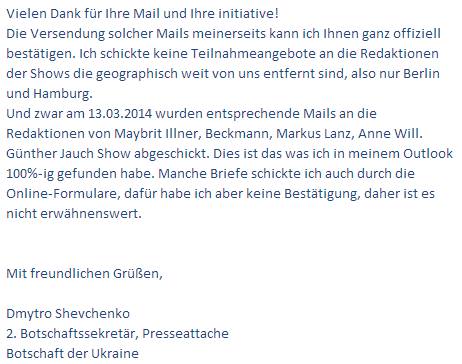
„Der 2. Botschaftssekretär der ukrainischen Botschaft, Dmytro Shevchenko, bestätigte mir gerade schriftlich, dass die Ukrainische Botschaft am 13.03.2014 Mails an die Redaktionen von Maybrit Illner, Beckmann, Markus Lanz, Anne Will und Günther Jauch Show versendete, in denen sie die Bereitschaft des ukrainischen Botschafters Pawlo Klimkin bekündete, an den politischen Diskussionen zur Ukraine teilzunehmen. Diese Mails wurden auch formal bestätigt, Einladungen gab es jedoch keine, genauso wenig wie Einladungen für Ukraine-Experten. Beliebte Gäste in deutschen Talkshows waren hingegen mit russischen Staatskonzernen verbandelte Wirtschaftsvertreter wie Alexander Rahr, Philipp Mißfelder und Eckard Cordes, die Vertreter der russischen Staatsmedien Ivan Rodionov (Ruptly/Russia Today), Anna Rose (Rossijskaja Gazeta), Alexander Sorkin (Stimme Russlands), sowie der Botschafter der Russischen Föderation, Wladimir Grinin und sein Gesandter Oleg Krasnizkij.“

Tobias Weihmann auf Facebook

1981909_10152372418817381_8075205133573900527_n

Posted in Posts - Deutsch, Voices of Revolution | Tagged , , , , , , , , , , , , , , , , | Leave a comment

Charis Haska: Nachlese der letzten Tage

Charis Haska: Nachlese der letzten Tage

Original: https://www.facebook.com/photo.php?fbid=645217615544933&set=a.225757664157599.53298.100001701013788&type=1

Ich hab weniger geschrieben, weil ich mit meiner Erkältung kämpfte, aber trotzdem genug erlebt. Und Krankheitstage haben den Vorteil, dass Erinnerungen in Ruhephasen bewusster rezipiert werden. So habe ich ein wenig für Euch gesammelt.

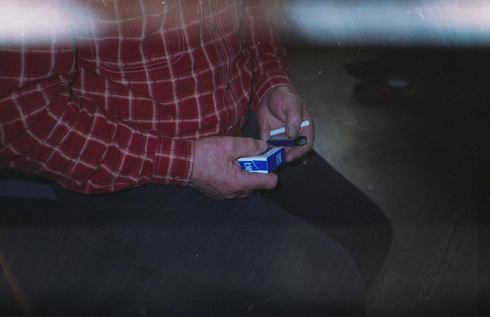
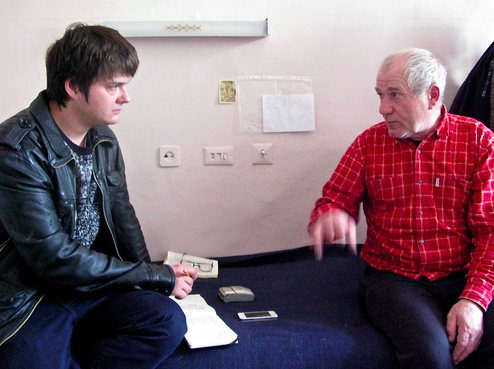
Der ältere Herr hält gern mal ein Schwätzchen mit mir. Ich denke, dass er früher ziemlich linientreu war. „Na, was halten Sie von all diesen Unvorstellbarkeiten die jetzt in unserem Lande vor sich gehen?“ möchte er wissen. In wenigen Worten sage ich, dass ich die Entwicklungen schrecklich finde. „Ja!“ meint er. „Das Volk wird immer ungeduldiger. Alle wissen, dass Putin sich nicht mit einem Bisschen zufrieden geben wird. So fordert das Volk Waffen. Aber wissen Sie, es ist wirklich gut, dass der Haufen Scheiße“ –
er, ein überaus gebildeter, gepflegter Mensch sagt „der Haufen Scheiße“! – „den Putin fabriziert, jetzt endlich zutage tritt. So kann nämlich der Westen umso besser begreifen, was für ein Verbrecher das ist. Und entsprechende Konsequenzen ziehen.  F ü n f z e h n    J a h r e    hat der sein Volk präpariert und zu Zombies gemacht. Im Nachhinein verstehe ich, wieso sein Fernsehprogram sich ganz und gar einerseits durch unglaubliche Seichtigkeit und andererseits durch maßlose Brutalität auszeichnet. Sogar an der Filmmusik ist das zu merken, immer dieser eintönige, aggressive Rhythmus. Was dieser Typ macht, das ist so schrecklich, wie im Märchen.“ – „Man sagt, dass Märchen immer ein gutes Ende haben…“ wende ich ein. Mit weit geöffneten Augen und im Brustton der Überzeugung sagt er: „Auch bei uns wird es ein gutes Ende nehmen. Aber das wird eine unglaubliche Anstrengung kosten.“ Ich huste und ganz besorgt gibt er mir verschiedene Gesundheitstipps. Ich bin immer wieder gerührt, dass hier auch die Männer einem jederzeit jede Menge gute Hausmittel raten können. Abschließend bietet er mir an, mir ein paar Zitronen vom Markt mitzubringen, damit ich schnell wieder gesund werde.

Mit einem unserer Nachbarn hab ich ordentlich was zum Lachen! In der Stadt hängen jetzt endlich jede Menge Wahlplakate. Das große Portrait von Poroshenko mit der Losung „Von Neuem leben!“ hab ich auf den ersten Blick doch glatt mit dem von Janukowitsch verwechselt. Das kann der Nachbar überhaupt nicht verstehen. Doch er hat einen tollen Schnappschuss mit seinem Mobiltelefon gemacht (siehe Bild): Auf das Plakat von Dobkin (einer der Kandidaten der Partei der Regionen, die um der Immunität willen kandidieren) hat im Regierungsvierte jemand folgenden Zettel in einer Klarsichthülle geklebt: „ Habt ein Gewissen! Hier sind Kinder unterwegs…“ Und darunter noch die kleingeschriebene Notiz: „Oder eignet Euch gründlich an, wie man Kindern auf anständige Weise erklärt, was das für ein Onkel ist.“ Wie ich diesen hintergründigen ukrainischen Humor liebe!

Der Kandidat der Grizenko-Partei hat sich auf leuchtend gelbem Hintergrund im blauen Jackett abbilden lassen. Slogan „Wir glauben- also werden wir´s machen!“ Ob nur ich bei seiner Gesichtsform und seinem Bartschnitt den Genossen Lenin assoziiere? Hab niemand dazu befragt. Neben seinem großen Plakat auf meiner Hundestrecke liegt seit zwei Tagen eine Werbezeitung der Batkiwschina, auf der ersten Seite Julia und Jazeniuk miteinander abgebildet, im Grase. Keiner hat sie weggeräumt. Ich finde seine Nähe zu Julia schade, denn Jazeniuk könnte nach dem, was ich so höre, tatsächlich ein verantwortungsbewusster Politiker sein. Batkiwschina macht jetzt außerdem mit bescheidenen, aber sehr romantischen DINA4 Plakaten in Massen in unserem Viertel Werbung. In der oberen rechten Ecke ein Strauß rote Rosen, am unteren Bildrand die schwarz- weiß gezeichnete Silhouette von Kiew. Wirklich schön. Aber das Wunder der Charité bleibt für mich trotzdem hochverdächtig und keinesfalls diskutabel.

Ich verstehe nicht viel von Politik, aber ich bete darum, dass die Wählerstimmen sich in der Fülle der Kandidaten nicht zu sehr aufsplittern.

Meine Geigenlehrerin ruft mich an und dankt für die SMS, in der ich ihr mitgeteilt habe, dass wir wegen Krankheit nicht kommen. Sie bemitleidet mich ob meiner kratzigen Stimme. In ihrem „Schade!“ wegen der weiteren ausfallenden Stunden ist tiefes Bedauern zu hören. Sie wünscht mir gute Besserung und einen schönen 9. Mai. „Ich hab davon gehört, dass davor gewarnt wird, am 9. Mai das Haus zu verlassen.“ sage ich. „Ja, es werden Provokationen befürchtet!“ sagt sie. „Haltet Euch von Parks, Menschenmengen und Demonstrationen fern. Auch vom Benutzen der U- Bahn wird abgeraten.“

Im Internet lese ich folgenden Aufruf von Jazeniuk: „ Hiermit wende ich mich an alle verschiedenen ideologischen Richtungen von Patrioten der Ukraine. Es ist erforderlich, sich jeglicher Handlungen zu enthalten, die die Nicht- Freunde der Ukraine für den Informationskrieg gegen unser Land ausschlachten könnten. Nach Möglichkeit halten Sie sich fern von jeglichen Massenveranstaltungen. Sollten Sie dennoch teilnehmen, so gehen Sie nicht auf Provokationen ein. Zeigen Sie geduldige Toleranz gegenüber Flaggen, Losungen und anderen Einstellungen.“ Per Gerücht habe ich gehört, dass die Kommunisten (Meine Informantin hat sogar gesagt: „Unsere Kommunistenidioten“.) trotzdem zu einer traditionellen Demonstration anlässlich des „Tages des Sieges“ aufgerufen haben. Wahrscheinlich beim Denkmal der Mutter Heimat. Im Internet finde ich freilich nichts dazu. Vielleicht ist die Veranstaltung ja schon abgeblasen. In den traditionell geprägten Herzen wird das Fehlen dieses großen Festes allerdings vermutlich ein ähnliches Unbehagen hervorrufen, wie Lenins Fall im Dezember 2013.

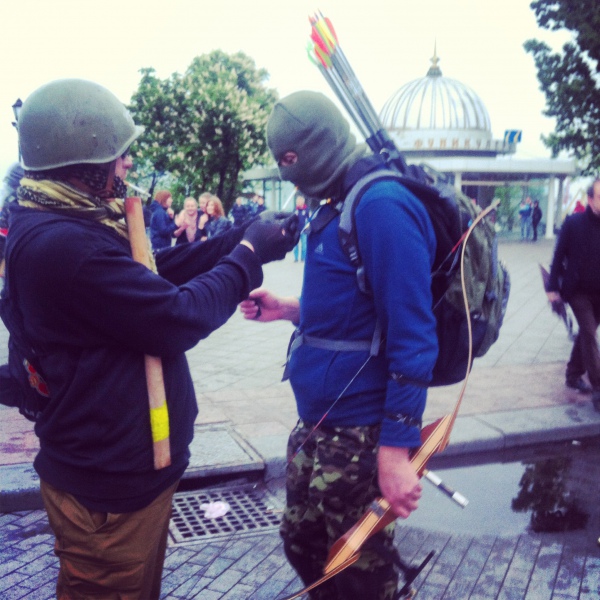
Kiew rüstet sich gegen die Provokationen. Der Maidan hat Aktivisten herbeigerufen, die schon nach Hause gefahren waren. Sie opfern die Zeit, die sie jetzt dringend zum Pflanzen und Pflegen ihrer Ernte brauchen könnten. Unser Lazarett bereitet sich auf die neue Aufnahme von Verletzten vor. Dass ich allerdings gestern Abend an der Kirche einen ganzen Schwung von Lazarettvolontären getroffen habe, hatte noch einen anderen Grund. Einer unserer Verletzten ist nach seiner wohl erfolgreichen Augenoperation aus dem Ausland zurückgekehrt. Aber: Die Splitter in seinem Bein von den extra mit Splittern besetzten Granaten steckten noch. Bis gestern ist er damit herumgelaufen. Was für Schmerzen muss er ausgestanden haben! Und zieht es nicht Langzeitschäden nach sich, so lange verletzende Fremdkörper im Körper mit sich herum zu tragen? Gestern Abend also hat ein Chirurg vom Maidan ihn in unserer Kirche operiert. Er habe seit dem Februar schon unendlich viele ähnliche OP´s durchgeführt und tief sitzende Splitter gezogen, wurde mir gesagt. Ich frage: „Wie kann man nur so viel Zynismus aufbringen, seine eigenen Staatsbürger mit solch gefährlichen Geschossen zu bombardieren?“ – „Und sehen Sie, noch keiner von denen, die das getan haben oder es angeordnet haben, ist bis jetzt verurteilt. Während solche wie wir binnen zwei Stunden verurteilt wurden.“ sagt mir ein Aktivist traurig.

Posted in "Voice" auf Deutsch | Tagged , , , | 1 Comment

A Masterclass for Donetsk: How the “couch squadron” in Odesa came to the defence.

By Ekaterina Sergatskova, UP–Zhizn (Life)
06.05.2014
Translated by Voices of Ukraine
Edited by Alex Howard for VOU
All photos by the author

7961f51-300On the night of May 6th, Molotov cocktails were thrown at several road blocks in Odesa including the one that had been hit by a grenade from pro- Russians in the middle of April.

According to the founder of the self-defense group, this will not impact the defense of the city because “rapid response units” are already being formed.

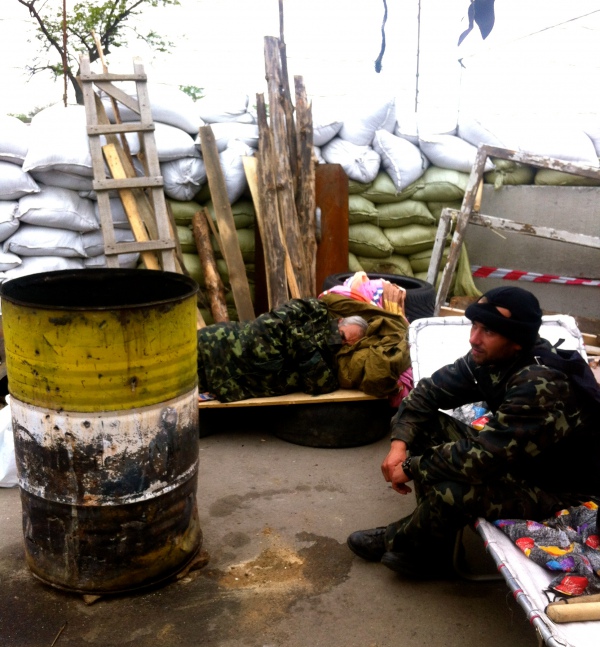
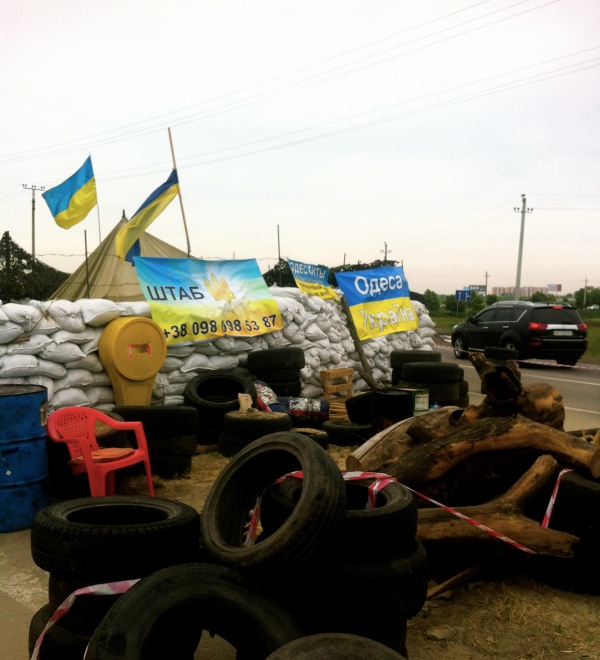
A roadblock with the Ukrainian flag has been standing at the six kilometre point on one of the roads to Odesa for a month. Behind the sandbags are a couple of tents, a small kitchen and some old couches brought from home by Euromaidan activists. This was one of the first and most basic points of defence on the approaches to Odesa.

Image

Valentina, a middle aged woman in a tracksuit with a white headscarf keeps watch at the checkpoint. When asked who is in charge she answers: “We are all in charge here. Let me see your documents, so we know who you are.” So dedicated is she, Valentina continues, “Please understand, we are not here for a laugh. It’s turned out this way. They suggested that I should go to a health resort after I was taken off a drip, but I refused. I can’t even remember what the date is today. The country has a lot of problems.” Valentina shows the spot where the grenade went off: a small crater in the asphalt. “That was when the Colorado beetles (pro-Russians) threw explosives here. I can show you the blood on the tent. What else? You can see, today they put flowers there.”

Image

Another activist, Viktor Kiiko first worked in intelligence and then as a police officer. On May 2nd along with other pro-Ukrainian activists at the front of Grecheskaya Street, he got a concussion from a grenade explosion.

“They told me to rest, but there was no time. My boys were there, how could I abandon them? My place is here, at my post.

“My family is provided for.” Viktor explains. “I went to work as a police officer out of stupidity, even though everyone said I couldn’t make a difference. They paid 1,450 hyrvinas, everyone was surprised at how I lived on so little. I couldn’t put things in order, unfortunately, but I was constantly told I had to give people drugs. I understood what they wanted me to do so I resigned. And now my army experience is coming in useful.

Although in the army no one throws grenades at you, except police officers, and that as a joke. Now with what is happening, I have seen the kind of dogs we live with. On the May 1st, some Antimaidan activists ran up to us, asked us not quarrel with them and even joined us. But the next day they were the first to attack us.”

Image

The Civil Security Council Group was organized as soon as separatist organizations started moving into eastern Ukraine. The leaders of public opinion and activists in Odesa united and set up a call centre, medical services, citizens’ patrol and about 15 roadblocks. Each day about thirty local residents go on duty.

“We have up to a thousand active people, a huge mobilized resource” Says former paratrooper and surveyor, the group coordinator, Yuri Kozariz. “These are successful engineers, lawyers, journalists: people who think that it is now important to protect Odesa.”

According to Kozariz, the self-defense unit is prepared at all times to repel aggression against Odesites, as the group is able to quickly mobilize.

“The events that occurred on the May 2nd demoralized that section of Odesans who went to the so-called federation side. They understood that it was serious, that people were ready to defend their rights. Separatism is a punishable offence. We basically did the secret service’s job. If they [the security services] had organized earlier, they would have got to the assault, there were armed people there, and we would have avoided such losses,” Yuri believes.

Image

Victor Kiiko

According to him, what happened on May 2nd was unprecedented for Odesa because “this is a business city, it’s impossible to rouse people up.”

“It had to be something out of the ordinary to make the people of Odesa react like that. These locator points of separatists were a malignant tumor for Odesa. But we were able to restore the status quo.”

Image

“For days, Russian journalists were telling me: “You have soul. You will win if you stick it out to the end. They have no soul, they only have insolence and brazenness. So we say: Odesa is a Masterclass for Donetsk. I have the distinct feeling that people understand why they are defending themselves. They are decisive and are prepared to defend their rights. We will take on anyone who comes here.

Ukrainians are waking up now, their sense of active citizenship is waking up. I think it is very like the Cossacks. It is an ant colony which organizes itself, and the activities are not going through one leader who can be blocked or stolen.

Our activity cannot be stopped. Any aggression will be met with an active mobilization of citizens. So our couch squadron is turning into a combat squadron.”

Source: life.pravda.com.ua

Posted in "Voices" in English, English, Eyewitness stories, Languages, Media, Odesa, Opinions, Others, Pictures, Regіons, South&Eastern Ukraine, Voices of Revolution | Tagged , , , , , , , , | 1 Comment

Mychailo Wynnyckyj: Thoughts from Kyiv – 7 May 2014

Mychailo Wynnyckyj PhD Professor at Kyiv-Mohyla Academy

Mychailo Wynnyckyj PhD
Professor at Kyiv-Mohyla Academy

It would seem that President Putin may have blinked in the face of pressure from the West today. After meeting with OSCE Chairman and Swiss President Didier Burkhalter, Putin suddenly announced that he was “asking” separatist forces in Donetsk and Luhansk (whose armed insurgency, according to the Kremlin’s official position, is being waged with no Russian involvement) to delay the referenda on independence of their oblasts previously planned for Sunday May 11. Even more surprisingly, the Russian President referred to the May 25 Ukrainian Presidential election as “a step in the right direction” – thereby directly contravening yesterday’s statement by Foreign Minister Lavrov in which the diplomat doubted the legitimacy of Ukraine’s planned vote. Most importantly, Putin promised to move Russian troops away from the immediate proximity of Ukraine’s borders – NATO has yet to confirm troop movements, but the prospect of a withdrawal is promising.

At first glance, the Kremlin seems to have (finally) made a real step towards de-escalating the current crisis in Ukraine – and the western media will be quick to jump on today’s “Putin-the-peacemaker” story. “Russia Today”, paid Russian bloggers, and sympathetic pro-Russian academics in the West will all “spin” the story in the most positive of lights: soon we will inevitably be hearing of the “Putin plan for peace in Ukraine,” and we’ll read criticism of western leaders who unduly mistrust the Kremlin… Of course, the invasion of Crimea will be forgotten, as will obvious supplies of military hardware to pro-Russia militants in Ukraine (not to mention evidence of Russian military personnel and commanders on the ground in Donetsk oblast). After-all, the EU and the US need to do business with Russia!

My skepticism of western journalists’ immunity to Russian spin is based both on observing visiting reporters here in Kyiv, and on reading/viewing news reports from Ukraine in influential English-language media. During the six months since the start of Ukraine’s revolution, and throughout the recent period of Russia’s sponsorship of armed conflict in Ukraine, the Kremlin’s information-war machine has been working overtime. The result: newly arrived reporters in January/February would inevitably seek out “right wing” activists, and in today’s context, we find journalists travelling to Slovyansk (the eastern city that is currently the focus of Ukraine’s Anti-terrorist Operation), and openly displaying frustration at not being able to find evidence of any CIA advisors or NATO military equipment among Ukrainian troops.

Western journalists have been trained to believe that all conflicts must have (at least) two sides. Objective reporting, therefore, requires a journalist to seek “balance” – stories should never simply present one side as “good” and the other as “bad” because that represents biased news. However, when sound bites and quotable quotes are readily available in immense quantities from one side, and messages come in a poorly packaged trickles from the other, biased reporting inevitably results. Last Sunday, the UK’s Guardian published two articles detailing the work of Kremlin-sponsored “trolls” who deliberately swamp the online comments sections that follow news stories on the Ukraine-Russia conflict with aggressively pro-Putin posts. On Monday, the NY Times went a step further: apparently, recent news coverage in Germany has been so pro-Russian (RT reports have simply been republished as fact – without verification) that the press seems to have affected public opinion to an extent sufficient to warrant concern as to the loyalty of Germany’s political elite to common defense within NATO, and (in a frightening flashback to the mid-20th century) to the legitimization of “great power” discourse that disregards smaller countries geographically located between Germany and Russia.

Discourse and symbolism are at the center of this conflict. It is for this reason that investigative journalism that seeks to identify economic motives behind Russia’s expansionism, in my opinion, misses the mark so widely. (e.g. recent stories that identify Slovyansk as being at the center of a massive shale gas deposit; oil and gas deposits off the Crimean coast are sometimes cited as the motive for annexing the peninsula to Russia, etc). From an economic standpoint, the occupation of Crimea clearly makes no sense: after water supplies from mainland Ukraine were cut-off last week (according to some reports this was done by the Russians themselves), all agricultural production on the peninsula ceased; beaches that normally should be packed with Ukrainian May holiday vacationers are deserted – this year’s tourist season will be a disaster, and so massive inflows of cash from the Russian state budget will be required to keep the Crimean population from starving. The mines of the Donbas (heavily subsidized by Kyiv) are clearly of no interest to Russia either.

If economic motives are obviously not the reason for Russia’s aggression, it baffles me why western journalists (and politicians) seem to believe that economic sanctions will prove sufficient to stop Putin’s expansionism. Perhaps it is time to stop fooling ourselves (and retranslating the Kremlin’s economic spin)?

I submit, that US Secretary of State John Kerry was fundamentally correct in his characterization of the Kremlin’s policies at the beginning of the current crisis, as being typical of 19th century thinking: Russians equate greatness with landmass. Whereas since the end of WW2, western countries have built a “culture of roads” (i.e. a civilization that enables trade, and values economic growth as a measure of a country’s success), Russia continues to live in a “culture of borders”. The first thing one is taught in a negotiations course in a business school is to try to understand your counterpart’s frame of reference. Clearly, the paradigm of decision-making in the West is economic. But Russia’s paradigm is different: Russia wants to be big: physically large. And until that changes, the civilizational cleavage between Russia and Europe will not be resolved.

During a Skype interview with a US-based radio program several months ago, I first described the Maidan phenomenon as representing a “civilizational” cleavage between Ukraine and Russia (at the time I was paraphrasing sociologist P. Sztompka’s description of the 1989 Velvet revolution in Poland which represented a “civilizational break” with that country’s socialist past). My opponent in the radio debate was a US-based Putin apologist, for whom the idea of Ukraine belonging to a different “civilization” from Russia was highly offensive; he called me a fascist, and ended the debate by emphasizing that his ancestors had been sentenced to Nazi death camps. Apparently, this reference was meant to imply an equation between my views and those of Maidan’s “right-wing radicals” whose symbols (echoing the Kremlin’s propagandists) he referred to as “neo-fascist”.

In the aftermath of Maidan, I have asked myself many times: who is the real fascist here? Any self-doubt I may have had was dispelled on April 16 when the Russian-backed Prime Minister of Crimea (Aksionov) posted on his Twitter (presumably in jest) that after the Russians annex the US, a place will be found for Obama in the Moscow zoo – among other black-skinned monkeys. There is a saying in Ukraine: every joke is only partly a joke… Six weeks have passed since the ceremony in the Kremlin when the “annexation document” was signed by Putin and the aforementioned “Prime Minister”. Last week, much feared (and predicted) repressions against Crimean Tatars began with Medjlis leader Mustafa Dzhemilev being denied entry into both Russia (refused at Sheremetevo airport) and into Crimea (refused at the “border” between Kherson oblast and the peninsula); yesterday, local Crimean Tatar leaders were charged by a Russian prosecutor in Bakhchysarai with fomenting anti-state activities. She explicitly threatened to ban the Medjlis (a proto-government organization that unites all Crimean Tatars) if its leaders continue to “foment unrest” against the Russian state.…

The terms “fascist”, “Banderite” and “nationalist” have been voiced regularly by Russia’s leaders in disparaging remarks against the post-revolutionary Kyiv government. In fact, as Andrew Wilson pointed out in the title of his book (published in the late 1990’s), Ukrainian nationalism has always been a “minority faith”. Recently, however, thanks to the policies of Mr. Putin, much of the regional divisiveness that had plagued Ukraine previously, has evaporated. When one sees Russian-speaking Kharkiv “Metalist” football fans marching through their eastern city (approximately 85 km from the Russian border) dressed in blue & yellow, carrying both Ukrainian and red & black (nationalist) flags, singing the national anthem, and then chanting “Putin – khuylo” (which roughly translates as “Putin – you big dick!”), one begins to believe in the reality of a united Ukrainian nation…

Much of the current conflict is symbolic. Clearly the deaths of 46 people during this past weekend’s violence in Odesa and in Donetsk oblast are very real, but in the big picture, their sacrifices are highly symbolic. At the end of February, over 100 Ukrainians in Kyiv paid the ultimate price in their fight for freedom – today they are remembered as heroes whose legacies dare not be betrayed. A similar symbolic weight will surely be attributed to those who gave their lives in Odesa on May 2, and to the military servicemen who have fallen (and are yet to fall) in action against the enemy in Donetsk oblast.

In December, at the start of Ukraine’s revolution, I first wrote about my experience of what it felt like to be at the epicenter of the birth of a nation. In those days and nights Kyiv became truly Ukrainian (i.e. no longer “Slavic”, “(post)Soviet”, “Rus”, etc.). The capital paid a price for this collective process of self-identification – initially in emotions, and then in deaths. Must the populations of Odesa, Kherson, Mykolayiv, Donetsk, and Kharkiv all pay the ultimate price in order to truly feel themselves part of this great nation? Viewed from Kyiv, it seems they are being forced to. Perhaps someday, when Ukraine’s borders have finally become stable, and we will have decisively defined the line of civilizational cleavage between ourselves and Russia, we will be able to evaluate whether the price was worth it.

Until today, I was convinced that the Putin plan for Ukraine involved holding referenda in Donetsk and Luhansk on May 11, and then immediately launching a direct military intervention by Russian forces into Ukraine’s southern region (Mykolayiv, Kherson, Odesa, and Zaporizhzhia) during subsequent days. Since the beginning of April, the Kremlin has tried to gain control over Ukraine’s southern region by using the same tactics as had been employed in Crimea and in the east (i.e. staging a “popular uprising” under the cover of bribed police commanders supported by highly trained and armed imported commanders of the insurgency). But popular resistance in Odesa last weekend, and the botched covert operation in that city’s Trade Unions building (where Kremlin responsibility for mass deaths is just too obvious to deny), seems to have led to a change of plan. I was convinced that that plan was invasion, but Putin’s comments today allayed my fears.

The Donetsk and Luhansk referenda are now likely to be held on the same day as Ukraine’s May 25 Presidential elections – a fact that will cause major problems both for the Kyiv government and for western diplomats. Certainly the EU and other western powers are eager to see the Presidential elections take place in a free and fair way. If an illegitimate referendum is held in the same polling stations (with the same voter lists) in Donetsk and Luhansk, and western observers are present, it will be exceptionally difficult to have the results of the Presidential vote declared legitimate while simultaneously declaring the separatist ballot to be flawed. More spin from the Kremlin propaganda machine is very likely on this point during the coming days.

Certainly, if none of the Presidential candidates receives more than 50% of the vote in the May 25 election and a run-off between the top two finalists must be held on June 15, with a referendum result in hand (“properly” counted by pro-Russia loyalists in the east), the temptation to intervene militarily in Ukraine will again be very high for Putin. That’s the bad news… The good news is that the next 3 weeks we are likely to have some measure of peace.

I continue to be convinced that Russia’s policy towards Ukraine is (and for the foreseeable future will remain) expansionist, imperialistic, and aimed at destroying its southwestern neighbor. This policy cannot be countered merely with economic sanctions: Putin will sooner starve his own population and cripple his economy, than recognize Ukraine’s right to exist. But he is patient. And so must we be…

God help us!

Mychailo Wynnyckyj PhD
Kyiv-Mohyla Academy

May 8th, 2014, 3:30 a.m. local time

Source: Mychailo Wynnyckyj on Facebook
Posted in Analytics, Opinions, Others | Tagged , , , , , , , , , , , , , , , , | 4 Comments

PROJECT POSTCARDS FROM MAIDAN: Volodymyr Popadiuk from Lviv Oblast

03.13.2014 Postcardsfrommaidan.org
Translated by Voices of Ukraine
Edited by Alex Howard for VOU

Postcards from Maidan is an art initiative that helps facilitate the psychological rehabilitation and physical recovery of patients. Artists visit the wounded and use drawings as a storytelling mechanism of Maidan. The wounded are later presented with the drawings. This is the story of one Maidan protester. It is story #14.

Screen Shot 2014-05-04 at 3.48.50 PMVolodymyr Popadiuk, from Lviv Oblast, was beaten by Berkut riot police.

“I spent three months on Maidan. I did come back home at times, to get washed up and change my clothes. Last time, I was beaten on Shovkovychna Street, on February 18, 2014. I came to back to Lviv for a funeral on February 23, and that’s where I felt my head spinning, and so I came back here.

I was beaten around 2 or 3 am, when the Berkut police [Ed. note–now disbanded riot police] started chasing us. I stood up for a young guy, he was dragging his shield, I don’t know if they beat him or it was a grenade. He could barely walk, so I took his shield and fended off four Berkut policemen from him. Well, I pushed two of them on the ground, and two of them went around to get me, and that’s it. I don’t remember what happened after. I came to the Lvivska Brama, but it was impossible to walk through there, since Berkut was nearby. So I walked to the Hotel Ukraine. There were about 12 of us. There was a slope and a chain link fence there, I untangled it and we jumped to Maidan over the trash containers. A woman, she must have lived nearby, she was great, she opened the gates for us and we came to Maidan. If we were left along with those animals back there, who knows [what would have happened]… We talked to them, they had those crazed eyes of a bull. A woman talked to one, and he almost hit her.

Screen Shot 2014-05-04 at 3.49.12 PM

I was with Galya and my brother. He worked at a dispensary on Hrushevskiy Street. Berkut policemen threw a grenade inside, came in, and stomped on the medications. I called my brother and asked where he was. He was going to bring some medications to the Trade Unions House [Ed. note–the building that was burnt down in February]. The next day, he and I went to Prorizna Street, where they put a bandage on my head. I asked them not to sew up my head, that it would heal on its own. Hell resumed on Maidan that very day, I couldn’t help but go there. I went there, I don’t remember how long I stayed there for, my head started spinning. I went to Mykhaylivskiy Cathedral, we laid down there. Svitlana and her husband Leonid took us in, she applied a head bandage, we woke up in the morning, cleaned up, and [found out that] she laundered everything, because my clothes were covered in blood.

I felt so sorry for that young man on Shovkovychna Street… I ran towards him. I couldn’t have done anything else, otherwise they would have killed him then and there.

Afterwards, I remember how a man carried the lad. His eye knocked out, his skull damaged, blood nearly bubbling, we brought him to the emergency room…

Just as we arrived at Shovkovychna Street, they had forged iron gates there–a man let us in. We were saved for the second time. He hid us in his office. We waited over there, since Berkut was already near the Zhovtneviy Palace. What a great guy, he wasn’t afraid to open his office and hide us there.

We would have held against Berkut if people hadn’t panicked. Because when people panicked, Berkut ran after us and attacked us from behind. Four Berkut policemen against one [protester]. The person is already on the ground, why would you?”

Screen Shot 2014-05-04 at 3.49.03 PM

Artist Dobrynya Ivanov talked to Volodymyr Popadiuk at Oleksandrivska Hospital. Dobrynya took a photo of the protester during their converstation.

Source: Postcards from Maidan 

____________________

Postcards from Maidan is an art initiative that helps bring support through truthful images of Ukrainian protests in different regions of the country, and also tells the stories of people who suffered during events on Maidan this winter in Kyiv.
The project consists of two elements:
#postcards from maidan
The Postcards Project contains a series of cards based on works of contemporary artists. Artists who participated in protests on Maidan create works reflecting on the events and as a message to fellow citizens. These cards may serve as support and a means to bring the spirit of protest to one’s relatives and friends in any part of Ukraine or the world. They are distributed on Maidan and available to everyone for free download in a format suitable for printing.
#stories from maidan
In The Stories Project, contemporary artists visit hospitals, talk to people [protesters/activists] and work on an artistic embodiment of their stories from Maidan. Activists receive these works as gifts by which to remember the events. This project is documented; the stories may later be used by various media. Through social networks, with the help of journalists, volunteers and the project’s website, organizers of this project help to recover lost contacts and enable protesters to learn about each other.
Postcards from Maidan was founded by Kadygrob_Taylor Platform for Contemporary Art, an independent non-profit.  Source: http://postcardsfrommaidan.org/about
Posted in "Voices" in English, Beyond Politics, English, Languages, Project Postcards from Maidan, Voices of Revolution | Tagged , , , , , , , , , | 2 Comments