Štefan Füle: What does Maidan mean?

By Štefan Füle, European Commissioner for Enlargement and Neighbourhood Policy
09.11.2014 – Dinner discussion during Yes Ukraine [Yalta European Strategy, September 11-13, Kyiv, “New Ukraine, New Europe, New World Building and Defending.” European Commission – SPEECH/14/591

President Kwaśniewski, distinguished guests, ladies and gentlemen,

This is my fifth time to attend the annual meeting of the Yalta European Strategy, but regrettably, following the illegal annexation of Crimea by Russia, we’re not in Yalta. Allow me to stress very clearly here and now– we have not forgotten about Crimea, it will always remain on the radar of our policy until international law is fully restored.

As I was reflecting on the topic of this evening’s discussion, I recalled my visits to the Maidan and my thoughts immediately turned to the brave people that I met as I walked among the tents in freezing temperatures of minus 20 degrees – people showing huge discipline and solidarity.

I recall sipping hot tea with them and warming our hands over a fire in a barrel. I recall walking on Maidan in the peace of the night, the air filled not only with the biting smoke from the makeshift stoves but also filled with the determination of the people not to let go of the chance of a better future.

My thoughts also turned to people injured in the clashes that I met in the hospitals; to the people beaten for expressing their views and also policemen injured in an action ordered by their failed superiors.

Dear friends,

If you ask me what Maidan means, I would say it was first of all about dignity. Lack of accountability and accumulation of wealth in the hands of few at the expense of the prosperity of the whole country made people show massive support for reform and modernisation. They demonstrated for a better future for their own country, a future free of corruption and where rule of law and human rights are respected. For many, this corresponded with a future based on European values, which as Europeans themselves, they share.

Maidan happened at a time when in the European Union, there are some who express scepticism about the European integration process, tending to take its benefits – peace, democratic accountability, respect for human rights – for granted. Maidan reminded us all that the value of democracy can never be underestimated – you have to take care of it and, sometimes, you have to take strong stance and defend it.

The wish of Ukraine to develop closer ties with the European Union was sovereign choice. Yet instead of respecting this choice and accepting that it was not at the expense of Russia, Moscow opted for confrontation, creating the most serious crisis in Europe since the end of World War II.

We have been witnessing economic coercion, threats and open military aggression, meant to dissuade the Ukrainian people from taking up new opportunities, but also meant to dissuade us from defending their freedom of choice, to convince us to drop our policies, values and principles, and accept the logic of the spheres of influence. But this would be equal to ignoring the lessons of the last century on this continent. The logic of zero-sum games is outdated and has no place in today’s world. We have to find ways to explain to Russia, that respect can be regained if we work jointly on a vision of cooperation on the European continent without dividing lines. Is it possible or realistic? I think yes! Our European house is broken and the time has come to fix it – not at the expense of anyone but with the involvement of all.

Dear friends,

Let me also want to use this opportunity to send a strong message of support to the people in Eastern Ukraine who have suffered so much during the conflict. No matter where you are, be it in Kharkiv, Mariupol, or Donestsk, our thoughts are with you and all those defending the integrity and sovereignty of Ukraine.

I also strongly encourage the Ukrainian authorities not to lose contact with the people of Eastern Ukraine, many of whom are fearful and anxious to know what is happening. In some cases friends and families are split because they feel under pressure to choose between two sides in the conflict. They need your understanding of their suffering and reassurance that there is no need to make such a choice. Because Maidan has never been about dividing the country but about uniting people in their aspiration for a better life.

They also deserve capable and accountable self-government to efficiently manage the economic and social development of their regions and cities.

Dear friends,

Maidan has created a chance for a better life. Ukrainians will be able to use all its potential only if its spirit of dignity, unity and accountability accompany your actions throughout the whole country.

We in the European Union do not run revolutions. We have neither the intention nor the capacity. But we have strong political will and powerful instruments to help people to deliver on their expectations and make sure that the ideals of revolution are not stolen.

Regardless of how many difficulties lie ahead of us, I am sure the values Maidan has fought for will prevail and Maidan itself will be remembered as one of Europe’s defining moments.

Source: europa.eu press release

Posted in "Voices" in English, English, Maidan Diary | Tagged , , , , , | Leave a comment

Vitaly Portnikov: Saving yourself from the wreckage. A turning point in NATO’s policy towards Ukraine.

By Vitaly Portnikov, journalist
09.05.2014
Translated and edited by Voices of Ukraine

The NATO summit in South Wales showed what the policy of the Alliance will be in relation to Russian aggression against Ukraine.

Will NATO help Ukraine? Just a few weeks ago, the North Atlantic Alliance obviously did not want to get involved in the conflict, and the leaders, members of NATO, hoped that they would be able to appease Vladimir Putin with the help of sanctions. The last NATO summit demonstrated how close the alliance is to the military line – because the creation of “trust funds” that would help modernize Ukrainian Armed Forces – is not a political declaration anymore, but a preparation for the creation of an anti-Putin coalition modeled after the anti-Saddam or anti–Gaddafi coalition. This coalition does not necessarily have to involve all the countries – members of NATO, but the alliance does not prevent anyone from providing Ukraine with the necessary military assistance. And this is a real turning point.

Such a critical juncture did not even happen after the downing of the Malaysian “Boeing.” No one in the world had any doubts that the plane catastrophe was carried out with a weapon supplied to insurgents by their Kremlin supervisors, perhaps even seconded to the territory controlled by the DNR [Donetsk People’s Republic] by the Russian military. But at the same time, there was hope that this disaster would demonstrate to Vladimir Putin the sheer level of danger of a further escalation of the conflict and force him to find a peaceful solution to it.

The West started to form an anti-Putin coalition – similar to the anti-Saddam [coalition]. Participation of all of the NATO countries is optional, but the Alliance now has no objection [to such involvement], the degree of participation is determined by each country.

Western leaders have miscalculated again. Not only has Putin made ​​no reasonable conclusions, but also he continued to develop plans for the further occupation of Ukrainian territory – this time with the help of the regular army, since the mercenary forces are clearly no longer enough. In this sense, the downed Malaysian Boeing did not become the turning point. Novoazovsk did, because after its capture, even the biggest of Russia’s well wishers will not be able to take Moscow’s tales of “militias” and the oppressed population of southeastern Ukraine seriously. And it became clear even to these well-wishers that it’s time to move from words to business. Serious business.

However, it would be incorrect to state that the West only limited itself to words. But the main calculation was for the cumulative effect of sanctions, which, sooner or later – although rather late – will lead to the collapse of Putin’s regime. Now the question is if there is [still] time to expect this cumulative effect and how much foreign territory will the Kremlin dictator occupy before his regime collapses. At the same time, there are understandable concerns about the rapid collapse of Russia. If the building of the Russian statehood, which lost its economic foundation, collapses as a result of harsh actions by the West right on the heads of the happy winners, then will they be able to dodge the debris? Or rather, not even that – will we all be able to dodge the debris?

And this is not a rhetorical question, because the weakness of the Russian economy allows for the question to be asked this way. So now the West’s strategy looks like this: we are all trying to stop Putin, moving the process from the military into the political channel, at the same time arming the Ukrainian army – so that it can give a fitting rebuff to the aggressor, and convinced of the inevitability of Putin’s transition of the situation again in the same political direction. And we continue to pressure [him] with sanctions, tightening them with every new inadequate move of the Russian president.

The strategy is good, of course. But there is catastrophically little time to implement it – and it [the strategy] does not prevent the death of Ukrainian citizens, who are forced to defend their land against a prevailing army superior in numbers, equipment, and in the indifference of [Russian] society to the deaths of fellow countrymen. That is why a victory over such an enemy will be a difficult victory, but its day will forever remain a holiday in the history [of Ukraine], with tears in [people’s] eyes.

Source: Liga.net

Posted in Analytics, English, Vitaly Portnikov, War in Donbas | Tagged , , , , , , | 1 Comment

Semyon Semyonchenko: Thoughts from Washington, DC

By Semyon Semyonchenko, Commander, Donbas Battalion
09.16.2014
Translated and edited by Voices of Ukraine

Photo source: espreso.tv interview , Sept. 13th.

Photo source: espreso.tv interview, Sept. 13th.

Today I was in many places and met different people. Including in the Pentagon, at the office involved with psychological warfare. Which is what we failed in, when we allowed them to create a sanctuary for terrorism out of a mining region within three months. Below are excerpts from the book on psychological warfare. Read it and find out what is happening now with Ukraine. Understand from where and why the words appear about the “threat of Russian tactical nuclear arms,” “crap, they betrayed us,” the propaganda of desertion: “Guys, well done, you rescued yourselves,” why yesterday’s volunteer [battalion] commanders  and civil society activists get transformed in the Ukrainian media space, by Russian example, into furtive, cowardly idiots.

“The essence of war in the usual sense of the term has been studied comprehensively. But the psychological warfare peculiarities are understood only by specialists. Meanwhile, one of the main purposes of any conventional war is precisely to change the psychology of the enemy. What does it mean, “to make him surrender at the victor’s  discretion” or “adopt the proposed settlement plan” of a problem? This implies, among other things, the creation of his belief in the meaninglessness of further resistance, to deprive one’s faith in his success, i.e.: to change the psychology.”

Very precisely, the essence of professionally organized psychological warfare is expressed in the teachings of the ancient Chinese philosopher and military leader Sun Tzu (VI century BC).

They are as follows:

1) Disintegrate everything good that there is in the country of your enemy

2) Engage the prominent enemy’s actors in criminal enterprises

3) Undermine the prestige of the enemy commanders and then present [them] at the right moment for public shaming

4) For this purpose, make use of a cooperation with the most vile and heinous people

5) Foment quarrels and conflicts among the citizens of a country hostile to us

6) Incite the youth against the elderly

7) Disturb, by all means, the regular supply of troops and their maintaining of order

8) Shackle the will of the enemy soldiers with songs and music

9) Do your best to devalue the traditions of your enemies and undermine their faith in their gods

10) Send women of easy virtue [prostitutes] to augment the case of disintegration

11) Be generous with offers and gifts for buying off information and personnel

12) In general, do not save on either money nor promises, as they bring excellent results

It doesn’t matter what they say. The main thing–is what we think. Our souls and minds are the main object of the attack. Whatever the Verkhovna Rada [Ukrainian Parliament] failed to pass, whatever they decided for us–this will not happen until we want it most ourselves. Let’s stick together and be participants rather than spectators. And all will be well.

Glory to Ukraine

Source: Semyon Semyonchenko FB

* * *

This should have happened two months ago. Society was not ready and therefore the ATO [anti-terrorism operation] continued. Meanwhile, they started to work on the people. First there was the intimidation by the army of the Russian Federation, followed by a series of military defeats in which nobody was brought to justice. Then they started talking about the threat of the use of tactical nuclear weapons. And this scared people even more. Mobile phones were declared as the cause of the defeat, and those who demanded justice were labelled as agents of the Kremlin. Then they started shutting up those who could say “No” in the future, who could call for action. Campaigns were run to discredit all those who would be dangerous. The soldiers captured at Ilovaisk remained as hostages. And now they have covered up their faces and voted. It does not matter what they think. It matters what we think. If we do not allow ourselves to be turned into spectators, if we will be active participants, then Ukraine will live. Thus, Donbas is neither the beginning nor the end. It might be very difficult. Black will be called white, and white be called black. The betrayal of out national interests will be called a victory.

Thank God,
There are forces in the country with whom we need to unite and fight for the future. Back to back. The main thing is not to let yourself be deceived and not to forget about the goal. Do not allow them to turn you into spectators. Everything depends only on us. And this is a long game.
Hold on.

P.S. I want peace. But there is a price higher than war.
We need to change the system of government. Now THIS – is our reality. Now we all need to calm down and think clearly about our next steps.

Do not disturb the hysterics and the trolls – the antivirus is enabled.

Source: Semyon Semyonchenko FB


Posted in "Voices" in English, Analytics, English, Others, South&Eastern Ukraine, War in Donbas | Tagged , , , , , | Leave a comment

Dmitry Tymchuk’s Military Blog: Summary – September 16, 2014

Dmitry Tymchuk, Head of the Center for Military and Political Research, Coordinator of the Information Resistance group
09.16.2014
Translated and edited by Voices of Ukraine

Brothers and sisters!

information_resistance_logo_engHere’s the Summary for September 16, 2014 (for previous summary, please see Summary for September 15, 2014).

The bad news:

1. The DNR and LNR [Donetsk and Luhansk People’s Republics] terrorist organizations announced the creation of the ‘united armed forces of novorossiya’ with a single ‘commander-in-chief.’

Of course, they can create even intergalactic forces of space marines, as the name ‘united armed forces’ definitely sounds too luxurious for this gathering of drug addicts and criminals. This is not the point. The point is that Russian soldiers in Donbas have obviously grown weary of ending up under the mortar fire of drunken mercenaries and dying from ‘friendly fire,’ therefore they have been pressuring their ‘associates’ through Moscow for quite a long time, so that the latter create single bodies of government over their gangs. The last straw was the mercenaries’ recent artillery attack on the Russian DRG [sabotage-intelligence group] near Debaltseve.

The creation of a single command for insurgents solves the issue of some sort of cooperation among the Russian-terrorist army. For us it is very bad, as in this case the effectiveness of the enemy is greatly increased.

True, it’s definitely uncertain whether the Donbas big daddies and the small criminal krill will accept the rules of the game in action, not words. Everyone there fancies themselves a prince and Clausewitz (if they are familiar with this character, which is doubtful in general).

2. Despite the agreements Russia signed with the EU and Ukraine on September 12, Russia intends to impose customs taxes on Ukrainian goods.

The Russian Ministry for Economic Development claimed the Russian government was to approve the order regarding customs taxes for Ukraine, and only then postpone its application, should Kyiv and Brussels keep their promise to defer the implementation of the free-trade zone section of the Association Agreement.

Well then, yet one more reason to become more convinced that we should make every possible effort for Russia, in terms of economic cooperation, to end up further away from us than Zimbabwe. Export and import dependence on Moscow can only be acceptable in terms of bulk-buying balalaikas and matryoshkas. Everything else is a crime against Ukraine’s economic security.

The good news:

1. The Verkhovna Rada voted for the resonant bills on the special status of some areas of Luhansk and Donetsk oblasts [regions] and for amnesty to the insurgents.

Local elections in the currently occupied districts are to be held on December 7, 2014, a special procedure for local self-government is introduced herein for three years, guarantees are given for the free usage of Russian and other languages, the state will finance the support of the socioeconomical development of these districts. People’s militia units will be set up here, by decision of local councils. The amnesty law prescribes exemption from liability to ‘members of armed formations’ and those who opposed the antiterrorist operation.

On one hand, these laws strongly smack of just handing over Donbas. On the other hand, it is an absolutely necessary step. It’s worth looking truth in the eye: we could have finished what we started and crushed the mercenaries into fine powder (which was where everything was headed), had Putin not sent hordes of his regular troops to Donbas. Ukraine turned out to be incapable of resisting this infestation. Of course, we can carry out general mobilization, put hundreds of thousands of our citizens at gunpoint, and flood Donbas with blood – but this is hardly the best option.

Personally, I thought and still think that the Donbas problem cannot be solved by peaceful means (theoretically, we can give Donbas ‘freedom,’ and then gradually and quietly tighten the bolts, but Russia will definitely not allow for this to happen). We need a different army for victory, which we have yet to create, but the good strong foundation of which has been laid during the current military action. Which is why the special status law is an ellipsis, but not the point (although, there are many questions in this regard – for example, about the financing of these territories). The most important thing is not to forget about this topic, citing economic hardship and other circumstances.

What is no less important is whether Kyiv’s gift will satisfy Moscow and the militants. This is another question…

In any case, while there are debates going on, it is necessary to swiftly create a fortified line of defense along the border of the occupied territories. It will not hurt in any case.

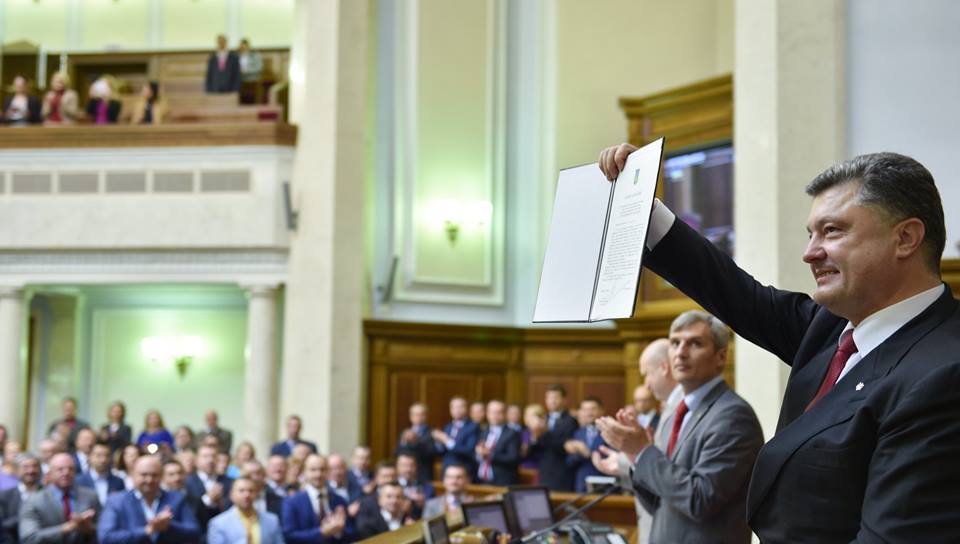
2. The Verkhovna Rada [Ukrainian Parliament] and the EU Parliament simultaneously ratified the Ukraine-EU Association Agreement.

355 votes for. EU Association Agreement has been ratified – trade pact a 'first step' towards membership. President Poroshenko: "A few generations of Ukrainians were seeking this moment." Photo source.

355 votes for. EU Association Agreement has been ratified – trade pact a ‘first step’ towards membership.
President Poroshenko: “A few generations of Ukrainians were seeking this moment.” Photo source.

Despite all the reservations – it is a strategic victory for Ukraine. This is where Maidan began. For us, the path towards this agreement became not only the fight between ‘good versus evil’ within Ukraine – the forces of light against Yanukovych’s dictatorship, but also with an external aggressor. None of the countries of the EU and their partners have given so much effort (and the lives of the best of their sons) for their choice and for a place within the European family.

But, we all understand perfectly well that the Agreement – is still far from [the membership of] Ukraine in Europe. The revolution within our minds is far from over. Separate thanks go to Putin – with his aggression he pushed many of our compatriots towards the EU much more powerfully than all the talk of democracy and European values put together.

3. And another legislative initiative – I guess this is the day for it. With great difficulty, the Rada adopted the long-suffering, but more than expected law on lustration.

Many of the members of the Parliament did not want to pass the law to lustrate the government. But ordinary Ukrainians stood beneath the walls of the Rada, those who care about the future of the country. And the Speaker of the Parliament was forced to tell the members of Parliament that they would not be let go from the session hall before the law was accepted. They accepted it.

It remains of interest how effective this law will be in reality. We see today how boys who only yesterday licked clean the boots of Yanukovych’s clique, from time to time emerge in high posts. But the work of the law depends on us, regular citizens of Ukraine, and civil society – thank God, it exists in the country today.

Source: Dmitry Tymchuk FB

Posted in Dmitry Tymchuk, English, English News, South&Eastern Ukraine, War in Donbas | Tagged , , , , , , , , , | 2 Comments

Andrey Makarevich’s new song: My Country Has Gone Insane (VIDEO w. English subtitles)

Reported by Radio “Echo of Moscow”
09.06. 2014
Translated and edited by Voices of Ukraine

My Country Has Gone Insane
Song and lyrics by Andrey Makarevich, Russian rock musician

[We] do not choose a place to be born,
But we will never break off this thread.
And now my country has gone off to war,
And I could not make her stay her hand.

Power, pleasure for some,
Rags and jail cells for some,
While I can’t overcome my pain.
My country is beyond my help,
Now that it has gone insane.

So how do we live here, and what do we think
When everything’s out of it?
You don’t have to grow any angel wings,
Just try and don’t be a shit.

And if I know something, well, this is it –
It’s time to choose and decide.
And if you choose that you won’t be a shit
Then it’s easy to live and to die.
It’s easy to live and to die.
To live… and then never die.

Source: Echo of Moscow Radio
(If you are not seeing the subtitles turn them on under the “cc” [closed captioned] function in the bottom right of the video frame)

Posted in "Voices" in English, English, Music, Video | Tagged , | Leave a comment