PROJECT POSTCARDS FROM MAIDAN: Natalia Fomicheva from Moscow

03.27.2014 Postcardsfrommaidan.org
Translated and edited by Voices of Ukraine

Postcards from Maidan is an art initiative that helps facilitate the psychological rehabilitation and physical recovery of patients. Artists visit the wounded and use drawings as a storytelling mechanism of Maidan. The wounded are later presented with the drawings. This is the story of one Maidan protester. It is story #20.
Screen Shot 2014-04-27 at 5.30.16 PM

Natalia Fomicheva,
62 years old, from Moscow.

“I am from Moscow, was born in Russia, North Ossetia. Near the little house where [Alexander] Pushkin was born. I would like to tell you that all my life is interconnected with the name of my favorite poet–Pushkin. Wherever I lived, I lived either on a Pushkin Square or a Pushkin Street. I lived in Tajikistan for 45 years, at the very border with Afghanistan. I worked as a teacher, I taught Russian – taught children to read, write and speak in Russian. After the collapse of the Soviet Union, a civil war started in Tajikistan, it was very cruel. I suffered horribly through this war – my relatives and friends were killed, many people left. Many came to Crimea. Today, my soul hurts for them–they survived a horrific war in Tajikistan and now they have tears in their eyes again. Panic, fear, and horror again. I ran from Tajikistan twice, I took my children and the children of others, hoping that Moscow will award us refugee status and I would be able to obtain some minimal living quarters and raise my children [there]. Unfortunately, Moscow did not give me refugee status, because I didn’t have my passport on hand–they took our passports. We were sent back, to Tajikistan. Just talking about it hurts me a lot. It happened in 1994-1997. We viewed Moscow as a cultural center, we went there to obtain new knowledge, visit museums. And when we came there, we were simply kicked out–we were shocked.  

My civil husband is a Ukrainian. He owns a piece of property–an apartment–in downtown Kyiv. When his Mom died, he was beaten and was not given the opportunity to take back his own apartment. After my husband’s death, he was very sick, I sued [those people], and the court case lasted a very long time.
Screen Shot 2014-04-27 at 5.30.36 PM

I was outraged by such lawless actions. I came to Maidan [Independence Square] every day. I am a historian by profession. I was interested in the following: why did people come to Maidan and what do they want. And when I visited the tents and talked to people, I asked them what they wanted. At first, they responded, “Why would you care?” And then I said, “I am from Moscow, and I’d like to know what is happening.” And every one of them told me about their misfortunes that had brought them to Maidan. It’s mainly this: to fight corruption and protect their rights, the rights of their children and the elderly. And today, I am convinced yet again in what a terrible state the Ukrainian people have found themselves. Where there are no medications in the hospitals, and people bring their own. When I came to Maidan, imagine this, I saw the events in Tajikistan and how people were sent out on airplanes. I have not seen happiness and laughter for a long time after this. Then I went to [North] Ossetia through Abkhazia. I wound up in a war in Abkhazia. My passports saved me. My passport said, “Ukrainian [by ethnicity].” Because that’s what my grandfather had in his passport, and I used my grandfather’s information in my passport. When I came to Maidan and saw the youth there, that people sing songs–I was so elated. And when suddenly they started beating those people because they wanted to voice their words–I was outraged to my whole core. And then, I started asking whom and how I could help. When I started approaching people in tents and talking to them, I felt how happy they were. So happy that I am from Moscow, that I am a Russian, that Russia supports us in our fight with Yanukovych’s gang. “Of course, they support [you], I said, but not everyone knows the truth you bring from Maidan.”

They stood up for normal, human life. We hugged, danced, they treated me with food, and I brought them cigarettes. I got to know many people on Maidan. I started coming to Maidan often. When I came there–it was like a breath of fresh air for me. Maidan–is the word of truth. For the first time in many years, I hear the truth out in the streets. I have never heard things like this in Moscow. I started attending, helping, and speaking from stage. There were always so many people [on Maidan]. I missed my visa expiration day on February 3, [as a Russian citizen] I must leave [Ukraine] every three months. I left the next day, of course, they took me off the train, and interrogated me, “Why have you violated [the visa terms], why are you going.” I said that I was leaving Kyiv and coming back to Kyiv. “How so?” they ask. “I have a sick aunt in Kyiv, and a court case,” I answered. They still took me off the train, despite my age (62 y.o.), despite the fact that I was ill. Of course, I forgot my medications on the train. They kept me in a cold hallway for six hours. Even though usually this process takes about an hour. They let me go, but I had already caught a cold. And I’ve been sick ever since.

I came back [to Ukraine], and was off to Maidan right away. Even though I was sick, I wanted to do as much s possible. I wanted to gather as many fellow countrymen as I could, and to show that we are friendly nations.

I was on Maidan on February 18, 2o14. It was the most terrible day. So many people, so many young people died…

Putin starts to move in his troops, not even 40 days [since their death] passed–this is not the Christian way. I am proud that I did not vote for Putin, when he seemed like the “most peaceful President” back then. Today, I am ashamed to say that I am from Russia. I saved children from Afghanistan, and by the way, Russia accepted only a very small number of children [from there].
Screen Shot 2014-04-27 at 5.30.27 PM

I always have my passport and my certificate with me. If I got killed on Maidan–they should know that a Russian citizen was killed.”

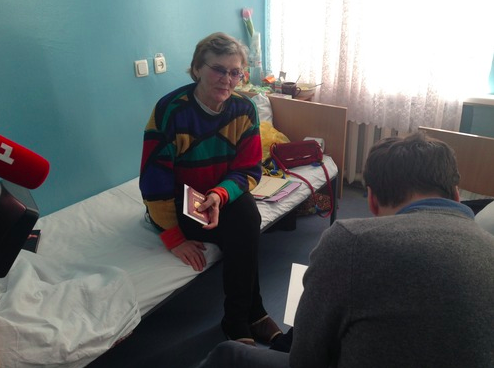
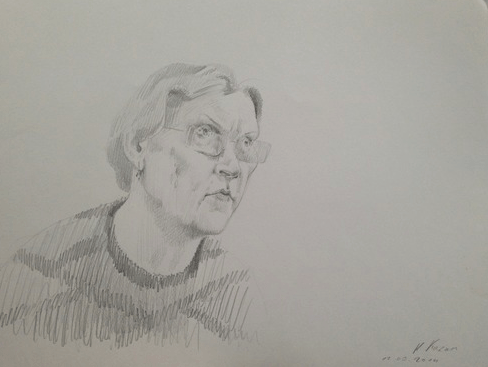
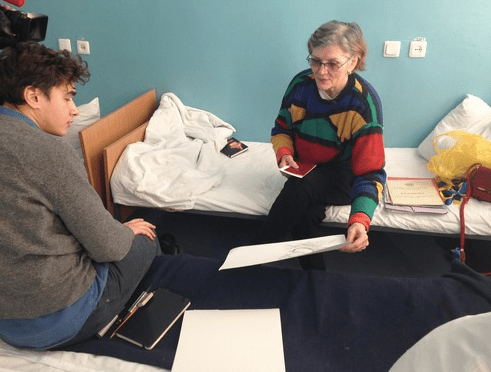
Artist Mykyta Kaidan talked to Natalia at Oleksandrivska Hospital.  Mykyta created the protester’s portrait as a gift.

Source: Postcards from Maidan 

____________________

Postcards from Maidan is an art initiative that helps bring support through truthful images of Ukrainian protests in different regions of the country, and also tells the stories of people who suffered during events on Maidan this winter in Kyiv.
The project consists of two elements:
#postcards from maidan
The Postcards Project contains a series of cards based on works of contemporary artists. Artists who participated in protests on Maidan create works reflecting on the events and as a message to fellow citizens. These cards may serve as support and a means to bring the spirit of protest to one’s relatives and friends in any part of Ukraine or the world. They are distributed on Maidan and available to everyone for free download in a format suitable for printing.
#stories from maidan
In The Stories Project, contemporary artists visit hospitals, talk to people [protesters/activists] and work on an artistic embodiment of their stories from Maidan. Activists receive these works as gifts by which to remember the events. This project is documented; the stories may later be used by various media. Through social networks, with the help of journalists, volunteers and the project’s website, organizers of this project help to recover lost contacts and enable protesters to learn about each other.
Postcards from Maidan was founded by Kadygrob_Taylor Platform for Contemporary Art, an independent non-profit.  Source: http://postcardsfrommaidan.org/about


Posted in "Voices" in English, Beyond Politics, English, Languages, Maidan Diary, Media, Pictures, Project Postcards from Maidan, Voices of Revolution | Tagged , , , , , , , , | 1 Comment

In Lviv, security forces detained three raiding parties from Donbas

04.28.2014 Delo.ua
Translated and edited by Voices of Ukraine

Screen Shot 2014-04-28 at 4.14.41 PMThe largest of the identified subversive groups consisted of 12 people. According to the SBU, all detainees are Ukrainian citizens. 

The Security Service of Ukraine (SBU) has detained three raiding parties from Luhansk and Donetsk Oblasts [regions] in Lviv Oblast. According to the ZAXID.NET report, citing sources at the SBU. As noted above, the largest of the identified subversive groups consisted of 12 people. There were no citizens of other countries, Russia in particular, among the detainees.

Meanwhile, the SBU administration in Lviv Oblast hasn’t yet made an official statement regarding this information. “Until May 10, we will not comment on anything. I can neither deny nor confirm this information,” said Oresta Kutna, the press secretary of the administration, citing the secrecy of the investigation.

Earlier, security forces detained a commando group in Luhansk Oblast. They also confiscated an arsenal of weapons and ammunition from the detainees.

On March 22 in Odesa, a subversive group was arrested that planned the capture of army armories and administrative buildings, as well as intended to use weapons and explosives against the current government.

Source: delo.ua 

Posted in English, English News, Languages, News, Other, Regіons, South&Eastern Ukraine | Tagged , , , , , , , , , , , | 1 Comment

The Rear Line

50509By Sergei Rachmanin, Deputy Editor ZN.UA
04.24.2014 ZN.UA
Translated and edited by Voices of Ukraine


“Donbas is Donbas!” This graffiti on the wall of one of the buildings in, I believe, Druzhkivka, stood out sharply among other examples of political graffiti in Donetsk Oblast [region]. I saw this slogan only once. But it probably most accurately reflects the mood of the local residents.

Image

“Is there a wall between us?”

The broken bus stops are painted the colors of the so-called DNR (Donetsk People’s Republic) and decorated with the inviting [slogan] “Donbas, rise!” A sign scrawled on a grim-looking fence with, “Freedom to Gubarev (the arrested “people’s governor” of Donetsk–Ed.) and to the patriots!,” is sharply offset by the more mundane “Dumping prohibited.” “Donetsk is Russia!” neighbors “Donbas is Ukraine,” “Donbas against federasts”–with “Fascism will not pass!” The Ukrainian trident [tryzub] on a school fence in Kramatorsk is several hundred meters away from a cut-up billboard of “Ukraine is united.” In smaller towns you can see not only “F**k Yatsenyuk” but also “F**k Putin.” In other words, a full spectrum of opinions, although with a bit more anti-Ukrainian “wall art” than pro-Ukrainian. 

The walls are at war. The people living behind them, largely, don’t want war. In Ukrainian soldiers they see not protectors, but a threat to their safety (“they can go away, we’ll sort this ourselves!” ”Why these tanks, to shoot at us? What for?”). They often see the paratroopers and the National Guard troops and instinctively fear them. As dangerous outlanders. They don’t see a threat in Russian soldiers (“They won’t shoot at us!” “They’re brothers!” “So what, they’ll come and they’ll go!” “What, they’ll start to conquer Donbas? Never!”), because it’s like they don’t really see them. They don’t want to see foreign soldiers in the armed men who have cosily set up camp in Sloviansk and in the Kramatorsk mayor’s office. (“Come on, they’re our guys!” “You were brainwashed in Kyiv!”). They admit that they watch pretty much only Russian TV, and at the same time they happily criticize the Ukrainian TV that they don’t watch. They happily describe having personally seen something which, as it later turns out, they heard from someone else (“they shot up a family at a checkpoint…,” “they robbed blind…,” “they’re all on drugs, these Guardsmen…,” “Right Sector in Sloviansk is killing women…,” “my friend told me, he wouldn’t lie…”). They complain that “no-one hears Donbas,” but in disputes, they themselves prefer not to hear arguments that don’t fit into their own understanding of what is happening. We are of course, not talking about everyone. Just the majority from what I personally saw and heard during my short trip to the Donetsk region. 

I did not go there for news, or for revelations. In two days you cannot find answers, cannot see everything, and cannot convince anyone to change their mind. Rather, I went to get the feel of it all. 

To see, to smell, to hear, to take in. “This is Maidan, but under different slogans…” True or not? At least at first impression…

Although no, I lie a little. One question to which I did want something resembling an answer: “Where does homeland begin?” Not such an idle question, by the way. I asked different friends of mine, are they ready to defend the Fatherland? Where does the aggressor have to be for you to want to exchange the couch for the trench? Of course the answers included the places you grew up in. Quite naturally Kyiv. Also–Chernihiv, Vinnytsa, sometimes–Kharkiv. Donbas was not mentioned even once. Maybe that’s a pity? 

“Was driving this guy once. He said he was from Belaya Cerkov. Said he came to defend Ukraine.” In the words of the elderly taxi driver I did not hear either condemnation or support. More like irresolvable doubts. 

Peace to the Lenins, war to the palaces

A café on a street in Kramatorsk with the proud name “Palace” and logically abutting the street bearing the name of the XIX Party Congress. Three prim middle-aged blondes clad in make-up are lazily discussing the latest political events. In particular, tomorrow’s possible assault on neighbouring Sloviansk. (the next day Sloviansk really would see action. I still don’t know: either Kramatorsk has good street intelligence, or the country has bad counter-intelligence). “How long this war has gone on for, I still have not seen a single tank…”–complains one of the ladies. “Those weren’t tanks, they were BMD. Combat vehicles of the Airborne…”–lectures the other. 

Specific war jargon actively and insensibly becomes commonly used. Local friends state that words and phrases like CTO (Counter-Terror Operations), AAB (Airborne Assault Brigades) or “AK 100 Series” are used not only by ex-army types, but by women at the checkouts at train stations, and by train conductors on the “Donetsk-Kyiv” line. I would not be surprised if in the foreseeable future the residents of Donbas will learn to distinguish the sounds of an Mi-8 “Hip” from an Mi-24 “Hind” helicopter by ear. 

The word “war” is used rarely, and not quite appropriately. It is used to describe the whole array of different-calibre troubles that have befallen the region. For example, the checkpoints. The “official” ones, with concrete blocks (which by night unsuspecting motorists crash into) and bored policemen in bulletproof vests and with AK-74U submachine guns. And the “separatist” ones, usually quite comical, often consisting of a pile of tyres randomly thrown together and decorated with colourful flags. On one of these, I counted over a dozen flags (Russian tricolors, the colors of the Donetsk Peoples’ Republic, standards of the Donetsk Oblast, I could not identify the others). There were far fewer people at this “checkpoint” than there were flags. A couple of blokes with cigarettes in high-visibility vests and tracksuit bottoms are quite a colourful sight, but not a very impressive one. Although some “checkpoints” are quite a bit more serious. With strong-headed guys with hunting rifles attached to rucksacks, nearby tents pitched alongside the roads. 

“War” is also the careening jet fighters, and the fluttering helis, and the captured BMD, and the shooting in Sloviansk, and the explosions in the vicinity of the Kramatorsk airfield. And the captured administration buildings. And the increasingly fashionable camo. And the soldiers, wandering around seemingly aimlessly along the local roads. Suddenly appearing and just as rapidly disappearing. Which only reinforces the sense of irritation in some and panic in others. 

And also “war” is the rise in prices, closures of workplaces and the rising sense of alarm. And for all of this it is traditional to blame Kyiv. The abstract Kyiv which “meddles with our affairs” and “does not hear us.” 

The contradictions between the popular sentiment “they don’t hear us” and the quite popular “don’t come here, we will sort things without you” seems lost on the locals. Many here are ready to talk and even to argue, but few are ready to listen. 

Some tendencies, which were identified in social studies run by KMIS for ZN.UA and published in the last issue of our weekly, have found an unrepresentative but quite clear confirmation. 

“Gas prices have risen. Gas prices have risen. Mines are closing. Why is Kyiv deciding for us?,” –protests an ex-paratrooper, now a miner, wearing birch camo at a DNR checkpoint near Krasnoarmiisk. The idea that the cause of his blame should be not so much Turchynov and Yatsenyuk, but more Yanukovych and Azarov, is not accepted by him and his comrades. “They are legitimate, and this is a junta.” In the course of a short and heated discussion it is revealed that he has a long list of grievances not only for “his” president but also for “his” mayor. But. “Let us elect our guys, we will elect them, and then we will control them. We will not let them rob and build palaces.” The question of what stopped “them” from controlling “their” guys, before now, meets no answer. Later a resident of Krasnoarmiisk will explain how 3,000 local miners really did end up without a job. According to him, the factories that were privately owned by the “family” have stopped working. But the rage of the unemployed is directed at Kyiv. Because it happened now, on their watch. And these people are potential “recruits” for the separatists, who effectively use this kind of discontent. 

Taking at least some responsibility for “their” lot is not something people here are ready for. This is true whether they are “pro-Russia,” for “Donbas for Donbas” and for those who cannot imagine “separating from Ukraine.” The fact that people from this particular region have for quite a while held virtually all government posts in all branches of government is not taken into account. This is shown by KMIS data and this I understood from personal interaction during the course of my stay in the region. The cause of this: whether “regional” patriotism, propaganda or just a general unwillingness to find complex answers to painful questions–remains a mystery. 

The majority here (again I refer to KMIS data) categorically deny any oppression of the Russian language. And nearly everyone insists on making Russian the second official state language. The question “what for?” is met at best by a confused shrug of the shoulders. At worst–a defiant “do not lecture us on what language to speak in!” But who’s lecturing?…

When a talkative bloke from the mining town of Dymytrov, seemingly my peer, found out that I was from Kyiv, he declared that he is against the ban (?) on the Russian language and the demolition of Lenin statues. Who’s demolishing them?

“Well, your Banderite lot want to. We, Soviet people, are against this.”

A couple of hours before that, the inhabitants of a checkpoint in Krasnoarmiisk were convincing me that the National Guard units deployed nearby are–“Western Ukrainians who were given weapons by the government.” 

Recently, during a trip to Kharkiv, one completely normal person not only passionately argued against the possible (?) demolition of Soviet monuments, but unexpectantly for me, used “banderites” to refer to the police from neighbouring Poltava. The man from Donetsk, incidentally, called paratroopers from Dnipropetrovsk “collaborators of the occupiers.” 

I will be honest. I really did not like the presence of Lenin’s statue in Kiev. And I really did not like the manner in which that statue met its end. But. The line of the so-called “Leninfall” from the winter revolution may well be a demarcation line between the “soviet” and the “not soviet” Ukraine. I do not propose to see this hypothetical divide as the national border of a future Ukraine. And not simply because I am against borders in general (an unforgiveable idealism, given today’s murky geopolitical realities). 

I am talking about something else. Maybe this hypothetical curve in the minds, hearts and souls is the dividing line between a Ukraine which people are ready to defend and a Ukraine which some are not ready to defend, while others are ready to give up. In all honesty, I don’t know. I am pondering the question. A painful question. Like any in this accursed time. 

“Maidowns” and “anti-Maidans”

There is another detail which is, quite possibly, subjective. The word “maidowns”  [Maidan + Down syndrome, pejorative] is used by many of my company neutrally, without even a hint of negativity. In the same way, many of my Russian friends openly used the words “khokhol” or “Khokhlyandia” and were genuinely surprised that these words could offend some people. 

Generally the meaning behind words and concepts here is different. School kids at checkpoints do not cause shock among the locals. But an aircraft flying low over the city does. Even those who are categorically against secession actively use the word “referendum.” The question “what does this mean for you?” always leads to a long pause. In the best case, the pause ends with a confusing monologue about the autonomy of the region, the Russian language, the right to self-determination (whose?) and stories about money which Kyiv takes away. Some (which is, to be honest, remarkable) by “regional independence” mean the status of an autonomous republic. Like in Crimea. The question whether they want to repeat the fate of Crimea nearly always leads to a “no.”

The phrase “Kyiv steals” is everywhere. A dislike for the capital is commonplace. Its form and addressees vary. The forms of dislike vary also. 

Another peculiarity. Turchynov and Yatsenyuk (more rarely – Tymoshenko) are mentioned more often than the “great and terrifying” “Right Sector” and other nationalists. The first get contempt, the latter–hatred. In the mysterious and frightening Right Sector they see enemies, cruel, merciless and conniving enemies. Who are simultaneously worthy of soldierly respect and merciless reprisal. The leaders they see as simple saps, unworthy of pity.  The complex attitude towards Ukraine and Ukrainian is directly related to the subconscious division between “us” and “them.” The memory of the abstract “Berkut” wounded at Maidan creates more sympathy than for Donbas’s own, brutally murdered for the courageous defence of the Ukrainian flag. 

Another surface observation. A definitive machismo in the attitudes. And not just among the men. People who are ready to flee the Oblast [region] after alarming news from Sloviansk cause sympathy mixed with disgust. People willing to go out there and fight “benders” cause at least understanding, at most–respect. Both among those who are “for” and among those who are “against.” Because it is “manly.” 

Strange tidings: everywhere you ask – all are against war and violence. And yet nearly everyone laughs at the impotence of Kyiv and unwittingly (sometimes knowingly) respect the actions of the Kremlin. Refrain: maybe wrong, but bold… 

A car pulled up to the mayor’s office in Kramatorsk with the numbers of the local police department and a sign “people’s militia.” Out came sturdy men with AKs of Series 100 (from brotherly Russia with love!), at least one of them talked with a clear Russian accent (the rest were quieter). They proudly proceeded to the building decorated with a pathetic, useless barricade around which lurked about two dozen locals. Nervous, jumpy and outrageously unsure next to the prideful guys in camouflage, who walked straight through blatantly open ground without hiding, camouflaging and obviously proud of themselves. They deliberately slowly walked beyond the “redoubt of the separatists” which, were there the will to do it, one could take apart in ten minutes. 

“Yes, the police at best do not interfere, at worst – support the separatists. Yes, local criminals are at work for Russian recruiters. Yes, large numbers of the people are against all this, but they are afraid. And the aggressive minority is organised and motivated. But both those for and against are considering the will and force of Kyiv. Each concession, each retreat of the capital, increases the problem. Donbas likes force. And does not forgive weakness. Donbas is not yet a front line. But it is a very bad rear which for some reason nobody is fortifying.” The opinion of a local reserve officer is subjective but, in my opinion, deserves citing here. 

Heroes are heroes everywhere. Thugs are thugs everywhere. Locals are locals. The region is not significant. But for me the difference between the theoretical Ukraines are probably also in the readiness of the local people, who are always in the majority, to go out and protest. Instead of awaiting whose power to submit to. The difference between a strong and a weak government is in the ability to make decisions. Not in the readiness to play on popular sentiment for short-term political gain. 

I may be wrong, but Kyiv’s readiness to make concessions and run a referendum on federalization and the status of the Russian language is a mistake. Individual supporters of unification see it as a weakness of the central government; numerous opponents of Kyiv see it as a key to future success. 

“We have what you have–protests, occupations, demands, weapons. How are we any worse?”–argued one lively Donetsk local. “You also stood for three months in the cold? You fought, dug in, bandaged up and buried your comrades? Drew thousands each week?” “No, we’re achieving what we want with less effort. You’re the ones who need a ‘great’ Ukraine. We just need our Donbas.”

Do you know where homeland begins? And what do you, personally, understand by the word “ours” when applied to the Fatherland? No? Now is a good time to ponder it.

Source: ZN.UA

Posted in "Voices" in English, Analytics, English, Eyewitness stories, Languages, Opinions, Others, Regіons, South&Eastern Ukraine, Voices of Revolution | Tagged , , , , , , , , , , , , , , | 3 Comments

Tymoshenko salutes G7 tightening sanctions vs. Putin’s regime

04.27.2014
Translated and edited by Voices of Ukraine

Screen Shot 2014-04-30 at 6.59.28 AM

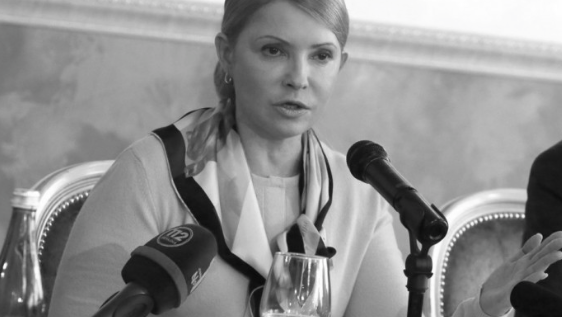
Yulia Tymoshenko, Presidential candidate nominated by Batkivshchyna faction, noted that she supported the G7 decision to immediately increase sanctions against Russia and believes such measures will stop Putin’s aggression against Ukraine.

She said that during an interview with The Associated Press TV service, reports Censor.NET citing Batkivshchyna’s press service.

“Now is high time for the third round of sanctions. That’s why I welcome the decision to impose them and hope that, as was announced today, these will be sanctions concerning Russia’s banking system and energy sphere,” –she said.

“I believe they’ll be effective. The power and intensity of these sanctions will stop Putin’s aggression against Ukraine, (Russian) soldiers will withdraw to their territory and the destabilization will stop,” –Tymoshenko added.

Yulia Tymoshenko said that all the democratic world should stand together to combat Russia’s imperial plans.

“Putin not only dreams of conquering Ukraine and the Eurasian space, he dreams of a global dictate,” – she noted.

To recap, on Saturday the White House’s website posted a statement announcing the G7 decision on immediate intensification of targeted sanctions against Russia.

Source: Censor.net.ua 

Image source: Tymoshenko.ua  

[Editor’s note: As a reminder, after the sanctions by the U.S. and Europe targeted energy and defense companies,  analysts have noted that these sanctions did not include major companies like “natural gas producers Novatek and Sibur, construction company Mostotrest, and media companies NTV, OTR and CTC Media.”]

Posted in Analytics, Languages, News, News summary | Tagged , , , , , , , , | 1 Comment

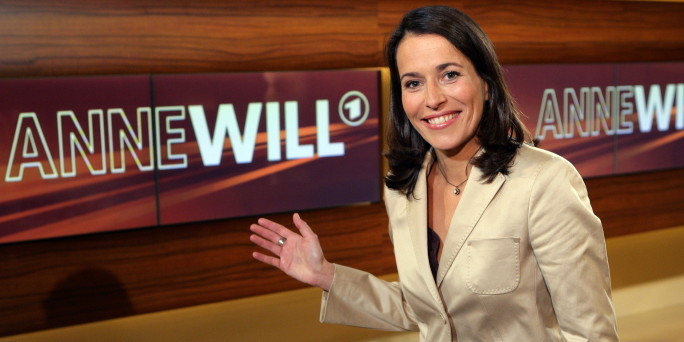
Anne Will liebt es Russisch

chornajuravka's avatarEuromaidan PR

By Thomas C. Theiner

Anne will es RussischÄ Anne will es RussischÄ

Heute Abend wird auf NDR die neueste Ausgabe der Talk Show von Anne Will ausgestrahlt. Thema: “Geiseln, Terror, Kriegsgefahr – Ist die Ost-Ukraine außer Kontrolle?”, aber es werden keine Ukrainer zu Wort kommen.

View original post 277 more words

Posted in Reblogged | Leave a comment