
NEWS BRIEFS: Hennadiy Kernes, Dmytro Firtash, Rinat Akhmetov, Oleksandr Turchyov

Kernes undergoes long spine surgery in Israeli hospital

Kharkiv – Kharkiv Mayor Hennadiy Kernes, who’s being treated in an Israeli hospital after an attempt on his life, has had spine surgery, the Kharkiv city council press office said in a statement citing Deputy Mayor Svetlana Horbunova-Ruban.

Source: KyivPost, 04.30.2014

BBC: Who is Ukrainian oligarch Dmytro Firtash?

One of Ukraine’s richest men, Dmytro Firtash made his fortune in the Central and Eastern European chemical and energy industry, emerging as a middleman in the trading of Central Asian gas after the collapse of the Soviet Union. The gas tycoon’s business interests centre on his Group DF (Group Dmytro Firtash), one of the biggest players in the European energy market with branches in many countries including Austria, Germany, Switzerland, Tajikistan and Ukraine.

Source: BBC, 04.30.2014

Reuters: Ukraine’s richest man says has faith in industrial east

Ukraine’s richest man, Rinat Akhmetov, said on April 30 he has no plans to sell his businesses in the country’s industrial east and his faith was unshaken in a region increasingly in the hands of pro-Russian separatists. The 47-year-old tycoon said he’d continue to invest in Ukraine, which must find a way to unite again as rebels seized more buildings across the Donbas coal and steel belt around the eastern Donetsk and Luhansk.

Source: KyivPost, 04.30.2014

Chairman of the Verkhovna Rada of Ukraine Oleksandr V. Turchynov met with the delegation of pre-electoral mission of the PACE Special Committee on Observation of Early Presidential Election in Ukraine

Source: Verkhovna Rada of Ukraine, 04.30.2014
Posted in English News, Links, News, Reblogged, Regіons, South&Eastern Ukraine | Tagged , , , , , , , , | Leave a comment

VITALY PORTNIKOV: We have been citizens of a country where there has never been a real security force.

By Vitaly Portnikov
04.29.2014  21:12 espreso.TV
Translated and edited by Voices of Ukraine


Journalist Vitaliy Portnikov in his video blog on Espreso.tv discusses the collapse of Ukraine’s security system and the necessity to create a new one.

[youtube https://www.youtube.com/watch?v=z0vdF0tykRE]

What is happening before our very eyes in Eastern Ukraine has also demonstrated a serious crisis in the local administrative structures. Nowadays many people are hurling accusations at the central government and security forces in Kyiv. Nevertheless, one should realize one simple fact: without the real engagement of the security forces in those areas which are now under attack by terrorists and saboteurs, we cannot expect a stabilization of the situation there.

Security forces are a mirror of the society in which they function and reflect who has real power and who makes the decisions. In Donetsk and Luhansk the power certainly does not lie with the Ukrainian government. We see quite clearly how the security forces are thoroughly influenced by local oligarchs, the family of the former president Viktor Yanukovych and finally the local elite, all of whom talk in Kyiv about national unity but, in Donetsk and Luhansk, do everything to raise their authority in the eyes of Kyiv or the eyes of Moscow.

Those who speak of “the police with the people” should recall the Maidan where the security forces were separated not into those who supported the protest and those who didn’t, but into those who were ready to beat and shoot their own countrymen and those who remained neutral. And all that in the Ukrainian capital which upheld the Maidan. We have to realize that the security furnished by the Ukrainian militia forces and other structures is an exaggeration. In a corrupt state, security forces are simply the oligarchs’ private police force.

That is why in recent times if you had to deal with either the police or a band of criminals, it was almost the same thing. Fear of those who are supposed to protect you – that is the normal condition of post-Soviet society. Why should it be otherwise in Donetsk and Luhansk when these regions were, for many decades, easy prey for organized criminal bands which, in the end, transformed into oligarchic rule? The very procedure of selecting persons for those organizations should provide for the installation of those who would protect the country and its citizens and not those who would protect oligarchic interests and look at a public office as an opportunity to become rich. 

Naturally, there are also decent people within those organizations as we saw after Horlivka.

But that is not how the system works. The system must be reformed and its personnel must be changed. Another question: is all this possible under what is, in fact, martial law, constant claims about the situation by the Russian Federation, the appearance and ongoing recruitment of new saboteurs and mercenaries? This is a major question.

And so, we all have to learn a lesson from what we are witnessing and realize the fact that we have been citizens of a country in which there was never a real security force. Now we have to create that force and hope that it will protect us and keep order in our country.

Source: Espreso.TV

Posted in Analytics, English, Languages, Opinions, Regіons, South&Eastern Ukraine, Vitaly Portnikov | Tagged , , , , , , | 1 Comment

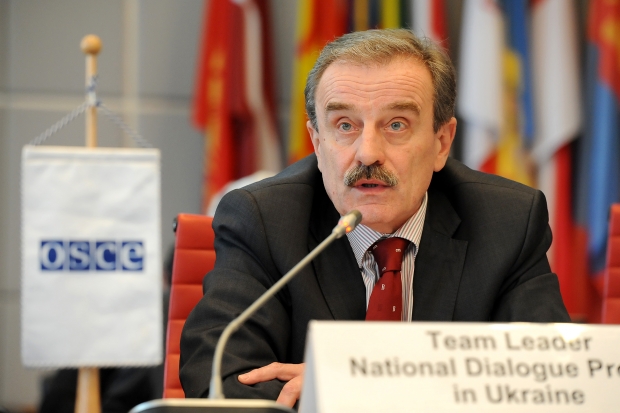
Leader of OSCE National Dialogue Project in Ukraine presents recommendations to Permanent Council

Image

OSCE Project Coordinator in Ukraine

VIENNA, 30 April 2014 – Ambassador Hido Biščević of Croatia, Team Leader of the OSCE’s National Dialogue Project in Ukraine, addressed the OSCE Permanent Council today. He presented recommendations on how the OSCE can contribute to social cohesion and tolerance amid the current crisis.

The project was implemented over a four-week period from late March at the request of the Ukrainian authorities. Experts were deployed to Odesa-Kherson, Kharkiv-Luhansk, Dnipropetrovsk, Donetsk, and Lviv. They spoke to a wide range of people from state institutions and civil society to assess their views and concerns and to identify entry points for the OSCE dialogue facilitation.

“People in Ukraine share many concerns, regardless of where they live, what language they speak, how old they are, or what socio-economic position they hold,” said Biščević. “In that sense, the challenge of dialogue is as much tapping into commonalities as it is to bridge differences.”

He said many interlocutors favored some form of decentralization, together with stronger institutional links between government and civil society and greater inter-regional co-operation.

“The primary recommendation is for the OSCE to promote and support a broad-based national dialogue in the context of the constitutional process in Ukraine,” said Biščević. He stressed that the OSCE can merely provide assistance in a process that has to be fully owned and led by Ukrainians.

OSCE support could take the form of organizing expert meetings in Kyiv, which would generate input for the draft constitutional amendments, he said. At the local and regional level, the OSCE could support a process of public consultations to gather people’s concerns and expectations with regards to the constitutional process and the future of the country, he recommended.

Biščević also recommended that the OSCE facilitates dialogue as a means of de-escalation at the local level. This could include, for example, the Special Monitoring Mission helping in the peaceful handover of illegally occupied buildings and public spaces.

He also highlighted the need to strengthen national cohesion in the long term. The OSCE could organize activities, including through the OSCE Project Co-ordinator in Ukraine, bringing different segments of Ukrainian society together to promote people-to-people contact.

“I am convinced that stability, progress and prosperity in Ukraine can only be enhanced by the willingness of people to listen and to talk to each other,” concluded Biščević.

The National Dialogue Project in Ukraine was implemented by the OSCE Project Co-ordinator in Ukraine. A core team of five people was based in Kyiv and five teams of two experts each were deployed to locations agreed in consultation with the Ukrainian Ministry of Foreign Affairs.

The OSCE Permanent Council is one of the main regular decision-making bodies of the Organization bringing together representatives of all 57 OSCE participating States. It convenes weekly in Vienna to discuss developments in the OSCE area and to make decisions.

Posted in English News, News | Tagged , , , , , , , , , , , | 1 Comment

Donetsk blogger: attack on Ukrainian rally was attack by Russian nazis upon Ukrainians for being Ukrainian. Ethnic cleansing.

chornajuravka's avatarEuromaidan PR

A blogger shares a powerful realization after witnessing the brutal beatings of participants of a peaceful pro-Ukraine rally in Donetsk by pipe wielding pro-Russian/Russian thugs on April 28. The clincher was when he read the story in a major Russian paper, with the headline claiming that it was Ukrainian nationalists who attacked an anti-fascist rally….

View original post 388 more words

Posted in Reblogged | Leave a comment

EU–Russia energy co-operation successfully continues – Russia laughs at would-be sanctions from EU again

chornajuravka's avatarEuromaidan PR

By Vitalii Usenko, April 30, 2014gas

It appears that work on the South Stream pipeline project will continue, reports ITAR-TASS. On April 29, 2014, South Stream Transport BV signed a contract for the construction of the second line of the offshore section (including the Crimean Black Sea shelf, currently occupied by Russia) of the South Stream project with Swiss company Allseas Group. The contract also foresees deepwater laying of the pipeline, so an additional contract was signed with Saipem, an Italian oil and gas contractor, to ensure construction. On the same day, Gazprom signed a memorandum on the construction of an onshore section of the South Stream in Austria, according to Alexei Miller, CEO of Gazprom. Additional agreements to build the onshore sections of the pipeline,have been signed agreement with Bulgaria, Serbia, Hungary, Greece, Slovenia, and Croatia.

View original post 301 more words

Posted in Reblogged | Leave a comment