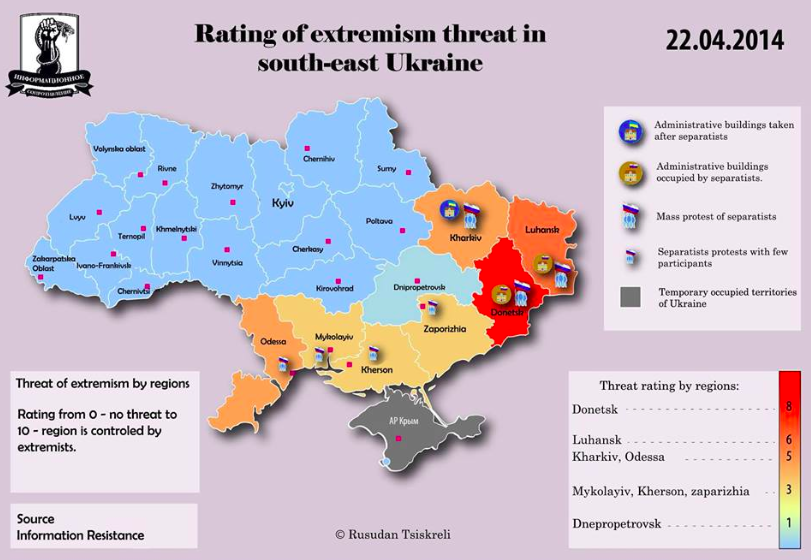
Report by the Alfa section of Information Resistance group:
04.22.2014 Facebook update
Translated and edited by Voices of Ukraine
Source: https://www.facebook.com/dmitry.tymchuk/posts/486969048098422?stream_ref=1
 Between April 18 and April 22, the Alfa section (coordinators of the Information Resistance group) have monitored the situation in the southeastern oblasts [regions] of Ukraine.
In Donetsk oblast, we have observed the course of the anti-terrorist operation (ATO). In Kharkiv, Luhansk, Dnipropetrovsk, Zaporizhya, Odesa, Mykolayiv, and Kherson oblast – the potential and prospects of an extremist (separatist) movement, respectively.
Here’s our brief report.
NOTE:
a) This report doesn’t include the coverage of a number of aspects related to the actions of Ukrainian security forces.
b) The extremism threat in regions is evaluated at a 10-point scale (0 – no threat, 10 – region is controlled by extremists).
1. Regarding the situation in Donetsk, Luhansk. Kharkiv, Dnipropetrovsk, and Zaporizhya oblasts.
In Donetsk oblast, as a result of an actual “reformatting” of the ATO with shortcomings in the conduct of its realization (see #3 of the report) extremists have reached a series of important successes that negatively affect the stabilization of the situation in the region.
Sabotage committed by extremists in Sloviansk that were accompanied by loss of life, as well as actions in Kramatorsk were aimed at creating a pretext for Russia to come up with another statement that Ukraine is in a “civil war.” In response, the Ukrainian authorities unfortunately failed to provide convincing evidence that the pro-Russian sabotage is perpetrated by extremist forces.
Lack of effective actions within the ATO (SO – Stabilization Operations) – in particular, the absence of blocking the foci of extremism which allows extremists to move freely around the region, destabilizing the situation at various localities.
The local population, most of whom didn’t initially have a particular dislike for separatists, has been abruptly changing their opinions. In Sloviansk and Kramatorsk, the extremists in “power” have practically turned these cities into a chaos territory. With no guarantees of the observance of basic human rights, the locals are much more inclined to favor a unified Ukraine, and the observance of law and order.
As expected, the extremists, having achieved some success in Donetsk oblast, are trying to destabilize the situation in Luhansk and Kharkiv oblasts. Their mission is to proclaim the “people’s power,” announce the “referendum” regarding their independence from Ukraine, and appeal to Russia to bring its troops and to ensure that such a “referendum” takes place akin to the Crimean scenario.
However, even with separatists creating conditions for Russian invasion, we estimate the probability of this invasion in eastern regions in the nearest future as fairly low (30%). Calls for Russian troops to enter – that is blackmail aimed at Ukrainian authorities to force them to make the “referendums” happen.
Meanwhile, such a “vacillation” in the situation gives Russia the opportunity to apply diplomatic pressure on Ukraine and provide separatists with an opportunity to hold the abovementioned “referendums.”
 In Zaporizhya oblast, the situation is tense but the local pro-Russian forces are predictably unable to “agitate” the situation without interference and direct participation of Donbas separatists and predictable Russian saboteurs.
In Dnipropetrovsk oblast, after all attempts of extremists to destabilize the situation, local authorities in collaboration with security forces and the local population are quite confidently in control of the situation.
As part of the ATO (SO), it is necessary to ensure the securing of Donetsk oblast. In Donetsk oblast itself, it is necessary to block the “center of tension” – the town of Sloviansk, as well as the captured administrative buildings in other localities. It is also necessary to ensure control of railways and districts by organizing patrols – both by security forces and representatives of local patriotic movements.
Major forces engaged [in the ATO/SO] are the Armed Forces of Ukraine and Interior Forces/National Guard. Special units of the Interior Ministry and the SBU [Security Service of Ukraine] must be in readiness to conduct operations for neutralization of extremist groups in the blocked areas (currently such operations are extremely problematic due to the signing of the Geneva Agreements by Ukraine).
It is necessary to take measures in Luhansk, Kharkiv and Zaporizhya to prevent unauthorized rallies and seizure of public authorities. It is necessary to support initiatives of the local population to establish self-defense units controlled by local authorities, which are able to withstand pro-Russian extremists, help organize checkpoints at the entrances to towns, as well as organize joint patrols with the law enforcement.
Intelligence agencies need to organize strict control over the actions of local law enforcement, in particular, initially defining the loyalty of those in power, and patriotism of commanders (chiefs) of structural units.
Extremism Threat Assessment:
Donetsk oblast – 8
Luhansk oblast – 6
Kharkiv oblast – 5
Zaporizhia oblast – 3
Dnipropetrovsk oblast – 1
2. Regarding the situation in Odesa, Mykolayiv, and Kherson oblasts
Odesa is the center of instability in southern Ukraine. According to our assessment, pro-Russian extremist forces in the city lack the capacity necessary for serious “agitation” of the situation and actions necessary to annex Odesa oblast from Ukraine.
However, we observe that there is quite a substantial part of the population that can participate in the pro-Russian actions if they are initiated and supported from outside [of Ukraine]. Those may be infiltration of Russian subversive groups of the GRU of the General Staff of the Armed Forces of the Russian Federation from Transnistria into the oblast, arrival of extremist groups from Donbas and Crimea, a sharp increase in funding of Odesa pro-Russian forces and activation of the FSB of Russia network in recruiting local citizens for their participation in the separatist actions.
In Mykolayiv and Kherson, the situation is more stable. Here, a much more serious outside interference is needed to initiate Russian “southeastern script.”
Thus, local pro-Russian forces are able to initiate the process of destabilization of the situation in the South only with strong support from the outside.
Local public authorities, local communities and law enforcement agencies are taking steps to strengthen control over the region. The central government must support these initiatives and the implementation of resource coordination [of their activities]. The South [of Ukraine] is rather inert. In the case of pro-Russian extremism, it plays into the hands of Ukraine. But in the case of pro-Ukrainian activists, they need comprehensive support of their actions to ensure that their efforts to counter extremism are given effective consideration.
We propose to create a coordinating body to counter separatism with a location in Odesa, which would be represented by local public authorities, law enforcement and activists of all three oblasts. Ideally, there should be a similar coordinating body that would work in all of southeastern Ukraine. Central government must establish a direct relationship with this agency to provide it with necessary resources and ensure direct interaction with the leadership of the security forces.
The loyalty of local law enforcement officers requires special attention – many of them are “at risk.” An urgent examination of the situation in each individual structural division and, if necessary, the transfer of law enforcement officers from other regions is needed.
Extremism Threat Assessment:
Odesa oblast – 5
Mykolayiv oblast – 3
Kherson oblast – 3
3. Regarding the ATO [anti-terrorist operation]
The anti-terrorist operation still has not received it’s full-fledged format as an ATO, and it’s forecasted not to receive it.
At the initial stage of the operation, the Ukrainian government introduced restrictions on the special forces (guarantees that there would be no victims among the “civilian population,” which is nonetheless armed and commits acts that fall under the definition of terrorism), which initially did not allow them to conduct the ATO. After the Geneva Agreements were signed by Ukraine, these restrictions have received the status of hard conditions.
The main problem is that law enforcement officers are prohibited from using weapons to kill. The situation in Mariupol, when the National Guard unit resisted the armed attack of extremists on the military unit – was one of the very few exceptions. In reality, military personnel can use weapons only in cases clearly provided for in the Charter of the Garrison and Guard Duty with latest amendments in accordance with the Law of Ukraine # 877-VII (877-18) of March 13, 2014. But even in these situations, they are not prescribed to use weapons to kill.
We have documented cases when the [military] command collected written statements from the personnel to avoid using weapons to kill. In a number of cases it has influenced the course of events as well as the overall effectiveness of the Ukrainian Armed Forces units in an extremely negative way.
Meanwhile, the ATO format has essentially (especially after the signing of the Geneva Agreements) moved into a format of Stabilization Operations – SO) in Western terminology. Meanwhile, according to the SO, the main tasks include blockade of settlements as well as areas in which extremists are situated, organization of guard service at checkpoints, patrolling of areas, etc. The main forces should be the units of the Armed Forces of Ukraine.
According to reasons we have been unable to clarify, the military command failed to take measures necessary for the conduct of the SO. Whereas the commanders and the personnel of bases and units involved demonstrate readiness for such actions.
To conduct the ATO (SO), the military leadership does not need to reinvent the wheel – the Armed Forces have the experience of participation in similar operations. This, for example, includes many years of experience in Kosovo as KFOR contingent, and especially as part of the Multi-National Force in Iraq. According to the resulting actions by each contingent, compulsory reports were drafted with recommendations regarding the methodology for organizing activities in various areas. Military leadership need only examine these reports and develop common recommendations regarding the activity of APU [Armed Personnel Units] in Donbas.
But most importantly, [military leadership] must clearly articulate the order to use troops, identify goals and objectives of an ongoing operation, [determine] the order of interaction between departments of the Armed Forces of Ukraine, as well as with units of other armed forces and intelligence services of Ukraine.
4. Regarding the situation on the state border
Russian border and the border with Transnistria.
At the state border with Russia, the border control has been tightened, army units along the border have built a defense line, covered by antiaircraft defense. Thus, the penetration of extremist groups from Russia into Ukraine, moving by railroad and ground transportation has been prevented, measures to resist possible direct military aggression from Russia, have been taken.
However, there is still a real possibility of Russian subversive and reconnaissance groups (SRGs) entering the territory of Ukraine in separate areas of the border. In response, measures are currently underway, including on engineering maintenance and control of border areas by the State Border Service of Ukraine, the Armed Forces, intelligence services and law enforcement.
Administrative border with the Autonomous Republic of Crimea [ARC].
Here, measures are to organize the border control by the State Border Service, and blocking the isthmus by units and resources of the Armed Forces of Ukraine.
The State Border Guard Service of Ukraine, unable to implement border control on the territory of Crimea because of its annexation, fully implements it on the administrative border of the ARC and Kherson oblast (control of the “second line”). Stationary checkpoints across the state border are currently not being equipped until the decision to do so is made by the Ukrainian government. However, the existing border posts are equipped with computers that use databases of the State Border Service [of Ukraine], citizens leaving Crime undergo a rather considerable passport control, persons without Ukrainian citizenship are not allowed into the mainland (they are invited to cross the border in other places).
At the same time, Crimea remains a potential springboard for rapid deployment of subversive groups and extremists into mainland Ukraine.
Conclusions.
There is a need to intensify efforts in the border areas to prevent infiltration from the territory of the Russian Federation and Transnistria by subversive and reconnaissance groups. By now it appears advisable to connect units of the Interior troops from the Interior Ministry/National Guard for search, blockade and neutralization of subversive and reconnaissance groups and armed gangs.
It remains an open question as to the ability to counteract penetration of subversive and reconnaissance groups as well as extremist formations from Crimea into mainland Ukraine if they land on the coast of the Black Sea and the Sea of Azov in Kherson oblast.