By The Sakharov Center
3.28.2014 18:28 slon.ru
Translated and edited by Voices of Ukraine
Source: http://slon.ru/calendar/event/1077275/
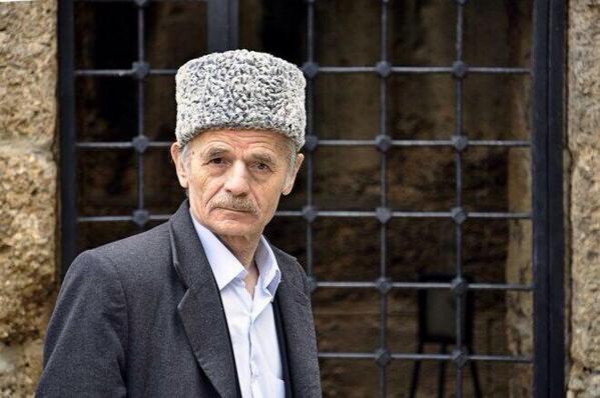
Mustafa Jemilev – the Soviet political prisoner, human rights activist, and until recently the Chairman of the Mejlis, the highest representative executive body of the Crimean Tatar Peoples operating during the period between sessions of the qurultay, a deputy of the Verkhovna Rada [Parliament] of Ukraine from the “Fatherland” [Batkivshchyna] party and still the informal leader of the Crimean Tatars. He is 71 years old, but today he is one of the most noticeable and influential politicians in Crimea and Ukraine. In the run-up to a referendum, Vladimir Putin considered it necessary to communicate personally with him, the legendary fighter for the rights of the Crimean Tatar nation. The telephone conversation between them, which took place on March 12, didn’t lead to a rapprochement of positions, the press service of the head of state didn’t extend any official statements about it, but for the President of Russia it undoubtedly was an important symbolic gesture towards all Crimean Tatars, if not hoping to get support then to be convinced of some restraint in their position.
Jemilev – an opponent of Crimea’s exit from the structures of Ukraine, calls the new authorities [military] occupiers, didn’t accept the results of the March 16 referendum, and insists that neither he nor his people accept them either. A symbolic gesture is not something that can satisfy him. Ahead lies the moment of truth, in an extraordinary session of the qurultay of the Crimean Tatar people, planned for March 29, and then perhaps a popular vote of the Crimean Tatars “national referendum on the issue of self-determination,” which Jemilev talks about.
Of all the figures of the human rights movement in the USSR during the 1960-1980’s, Mustafa Jemilev is the most active today as a politician. In the 70 years since the deportation of the Crimean Tatars, the consequences of Stalin’s crime again arise, and history does not let Mustafa Jemilev retire. At the beginning of the new period of the biography of Jemilev we decided to recall one of the central episodes of his past, the Omsk process of 1976, and to speak about it in Andrey Dmitriyevich Sakharov’s words.

Andrei Sakharov
Sakharov was older than Jemilev by twenty two years. It seemed, they were divided by an abyss. One – the ingenious physicist, the academician, thanks to his scientific talent, had risen to the top of the Soviet military-political elite and from there, stepped further on to a more important problem – the struggle for human rights, the highest goal. In 1975, he received the highest mark of global recognition for his humanitarian merit – the Nobel Peace Prize. The other – at six months old, together with his family and fellow countrymen he survived a brutal deportation from Crimea to Uzbekistan. He grew up in exile, was expelled from the university for his bold advocacy of the protection of the rights of the people. At the age of 26 he became one of the founders of the Initiative Group of Human Rights in the Soviet Union (the first to openly declare itself a human rights organization in the USSR), and then spent many years in prisons.
Mustafa Jemilev was first tried in 1966 for refusing to serve in the Soviet army. “A state that violates the rights of its citizens, cannot rely on the fact that the citizen will carry out his duties,” – for such a position Jemilev paid with one and a half years of imprisonment. The next time – he received three years in a high security colony – he gained the following term in the 1970’s for “dissemination of false fabrications defaming the Soviet state and social system.” Together with the young Crimean Tatar activist, were Moscow human rights defenders General Pyotr Grigorenko and the poet Ilya Gabay. The first the court sent to a psychiatric special hospital, the second together with Jemilev during the process demanded verification of the facts set forth in the documents for which they were tried, denying the presence of libel in them; the court declined to verify the facts. The transcript of this process was dispersed in a “samizdat,” and the last word of Mustafa Jemilev’s has become one of the most striking documents in the history of the human rights movement in the Soviet Union:
“Whatever repressions and persecutions I have been subject to, I can firmly say that no one, never, under any circumstances, will be able to force me to give up the duties imposed by honor, dignity and national civic duty.”
That these were not empty words, Mustafa Jemilev proved all of his subsequent life.
The next time he went to jail for a year in 1974, formally – for failing to participate in military training, but in fact because authorities became aware of his intention to go to Moscow during US President Nixton’s visit to the USSR, to give him a letter on the problems of Crimean Tatars.
The discrimination of the Crimean Tatars lasted even after the formal withdrawal of their stigmatization as traitors, the unofficial ban on their return to Crimea, brutal persecutions of families who dared to violate this prohibition, repression against activists – all of this was well known to Sakharov. In 1975 during his Nobel lecture, announced by Elena Bonnaire, Sakharov talked about it from a podium in Oslo and mentioned Mustafa Jemilev’s name among other Soviet political prisoners whom the whole world needs to know about. In the 1976, having learned that in the three days prior to the termination of his term of imprisonment a new criminal case had been opened against Jemilev and that he was holding a months-long hunger strike in protest, and was undergoing the painful procedures of forced feeding, Sakharov went to Omsk hoping his presence in court would support Jemilev and draw attention to his fate. They were not personally acquainted then and even during the process could not meet. The academician and Nobel laureate was not allowed in the meeting room of the regional court. Only during the defendant’s last words, when the noise heard from the corridor, of dispute and scuffle resulting from the removal of Jemilev’s brother Asan, did the sister of the defendant Wasfi Hairov throw some words in the Tatar language together, letting Mustafa know who was behind the door: “These are our friends. The loudest voice is Sakhar (that is, “sugar”).”

A young Mustafa Jemilev
By that moment Jemilev had refused voluntary food intake for more than nine months. He was very emaciated, his health was undermined. After the verdict, before being sent to the colony, he was given a meeting with his brother. His brother showed Mustafa through the glass a card where Sakharov had written by hand, please stop the hunger strike. As Jemilev remembers, he was thirty- three years old and Sakharov addressed him as “son.” Jemilev agreed to withdraw his hunger strike.
Even in our time, the special edition devoted to the Omsk process in which the indictment, conviction, detailed records of what was happening in court, is published. But in May of 1976 a report on the trial of Mustafa Jemilev and the campaign in his support was promptly put into the “The Chronicle of Current Events” – a samizdat newsletter through which the facts of human rights violations in the USSR were made public. These materials were supplemented by the “Memoirs” of Sakharov. Much in those events is surprisingly similar to today’s current political processes.
“Two courts were appointed on April 6, 1976 – over Andrey Tverdokhlebov in Moscow and over Mustafa Jemilev in Omsk at the same time. Undoubtedly, it wasn’t a casual coincidence: KGB wanted to deprive everybody, including me [Sakharov], of an opportunity to be present at both courts. I decided that it is more important to go to Omsk. In Moscow, at that time, there were still many people who would go to the courthouse for the trial of a famous dissident. In Moscow there are foreign correspondents, in Omsk there is nothing like this present. There was the danger that almost no information about the process in Omsk would generally be available to the public or become available in the near future. I made a statement about this decision, and with Lucy (Yelena Bonner, Sakharov’s wife – The Sakharov Center) took off for Omsk (3:00 flight tickets were not easily bought but with the help of my “heroic” book).
(… ) 1976 marked the end of another prison term that Jemilev was serving in a penitentiary near Omsk. Six months before the end of this term, another case was opened against him, on charges of “deliberate slandering of the Soviet state and social regime” – allegedly, he was saying that “Crimean Tatars had been forcibly removed from Crimea and they are not allowed to return.”
Essentially, that was exactly the case; Mustafa wrote about it many times in documents he had signed, and, naturally, he could have said that as well – but the investigation needed a witness. Upon arriving in Omsk, the KGB investigators focused their efforts on Ivan Dvoryanskyi, a prisoner in the same penitentiary, serving a 10-year term for involuntary manslaughter (committed under the influence of extreme emotional disturbance) of a man who, he believed, had insulted his sister. At first, Dvoryanskyi resisted the investigators’ pressure and sent a note to the outside, detailing the threats and promises he was receiving. Several months before the trial, Dvoryanskyi was separated from other prisoners and put into solitary. We don’t know what happened to him there. A month later, he gave the necessary testimony, which became the foundation of a new case against Mustafa Jemilev. Since the opening of this case, Mustafa had been on a hunger strike, which concerned us greatly. Among the people present at the trial were the attorney Shveisky from Moscow, Mustafa’s family (mother, brother, sisters), and Crimean Tatars from Tashkent. Shveisky had previously defended V. Bukovsky and A. Amalrik, and we knew that he was able to find the perfect middle ground between the demands of legal and professional ethics (being a wonderful attorney) and the work realities of a Soviet attorney representing a dissident.
Naturally, not everything about this middle ground was to our satisfaction, but it was much better than nothing. During our first visit, the trial was cancelled under some ridiculous pretext (we believe, a burst water pipe in the pretrial detention facility). Clearly, the authorities wanted us to leave and not come back (this wish of theirs only served to confirm my belief that I had made the right choice). The delay was particularly worrisome for us because we did not know what state Mustafa was in, considering his ongoing hunger strike. Even though taking this long journey for the second time was tiring and expensive (not only for me and Lucy, but for everyone who attended the trial), we were bent on not backing down, and on April 18 (if I’m not mistaken), took a flight to Omsk again. (Sakharov is, in fact, mistaken, as the trial of Mustafa Jemilev was held on April 14-15, 1976. – The Sakahrov Center).
An amusing incident took place when we were checking into the hotel.
After seeing my name in my passport, the receptionist threw it aside nervously and declared,
“To a scumbag like you, I wouldn’t give a piece of bread, let alone a room.”
In the hallway behind us, Crimean Tatars stood silently – they already had accommodation. They were used to ignoring similar insults when addressed to them, and now were watching to see what would happen to me. Then the receptionist started fussing.
“Oh, oh, I’ve been shaken up so badly, my heart is aching. Does anyone here have any validol [popular Soviet OTC cardiac drug]?”
The Tatars remained silent. I said,
“We have no validol, but, Lucy, dear, we should have some nitroglycerin.”
“No, I’m scared of [nitro]glycerin.”
We went with the Tatars, to their room – we had things to talk about. Half an hour later, the same receptionist came back.
“Comrade Sakharov, here are the keys to your room. When you’re free, please come downstairs and fill in the form.”
Undoubtedly, I got the room by order of the [K]GB, who did not want a scandal, while the earlier episode was the result of a personal initiative of a “true Soviet citizen.”
At the end of the day, Sasha Lavut arrived from Moscow (Alexander Lavut was a member of the Initiative Group for Human Rights Protection in the USSR, permanent editor of the “Chronicle of Current Events” section dedicated to the persecution of Crimean Tatars. – The Sakharov Center). The following day, the trial begun. Originally, in addition to the hand-picked audience and the GB people, all of Mustafa’s relatives were allowed into the courtroom – his mother, brother Asan, and sisters. The situation inside the courtroom and, as a result, outside, started heating up by the second, right away. Mustafa, who was continuing his hunger strike, could barely stand. The judge kept interrupting him, barely allowing him to get a word out. Then the judge got particularly furious when Dvoryanskyi withdrew his earlier, so painstakingly acquired, testimony. The prosecution’s case was collapsing! The judge found offense in some statement made by Asan, and removed him from the room. Then Vasfiye (Mustafa’s sister) was removed, after trying to let Mustafa know that Sakharov was in Omsk (she used a Tatar word meaning ‘sugar’ [sakhar – Russian for ‘sugar’]). Finally, on the second day of trial, Mustafa’s mother was removed from the courtroom as well. When she was denied entry after the break, she covered her face and cried. I yelled,
“Let the mother in, her son is on trial!”
The GB people standing by the door responded with sneers and started pushing us away from the courtroom doors. At that moment, Lyusya [Lucy] forcefully hit a tall bruiser in civilian clothes in the face, who was in charge of the situation, and I hit his subordinate: both were undoubtedly from the KGB. We were instantly attacked by the policemen and Druzhinniks [members of Druzhina], the Tatars shouted and rushed to our rescue – a total dogfight ensued. I and some Tatars were dragged outside, and thrown into avtozaks [paddy wagons] that were waiting for us. I found myself next to a Tatar girl and one of the policemen who earlier dragged me way. He turned out to be a Kazan Tatar, and the girl immediately started to chide him loudly. The policeman was sheepishly wiping his face, sweaty after the fight. At this point, they pushed Lyusya into a small room. They dragged her very rudely, pushing her, her arms were all in bruises and bloodied contusions. I was taken to the police department, they tried to interrogate me; I refused, demanding to see my wife. In an hour – an hour and a half, I was released, and meanwhile Lyusya was brought to the same police department I had been at earlier. There, Lyusya started demanding to see me, and they sent a car for me (I managed to walk all the way to the court building by then). Finally, we saw each other again. Lyusya began to demand to be seen by a doctor, to examine the injuries inflicted on her.
They brought some outpatient hospital employees, but they announced (probably rehearsed) that they could provide medical assistance but not issue any type of notes. They released Lyusya and I, informing us that there could be a criminal case open against us, and this was after Mustafa Jemilev was sentenced to two and a half years in prison. Moreover, the court stated that the original testimony – against Jemilev – by Dvoryanskyi is truthful, and his refusal from this testimony in court – was the result of psychological pressure exerted on him by the defendant. We don’t know what consequences Dvoryansky had to face because of his heroic act. (The transcript of the interrogation of Vladimir Dvoryansky was one of the cornerstones of the Omsk trial. In the end, the court made a special ruling to press criminal charges against the witness Dvoryansky, for false testimony, i.e. for his refusal to confirm his earlier testimony against Jemilev. On May 18, Sakharov and Grigorenko propagated a statement in defense of Dvoryansky, which said, “The court’s ruling is the payment for honesty, for the repentance of a man who falsely accused a fellow inmate and his subsequent courage to admit the lie. The court wants to create a precedent of making an example of someone who refuses to lie by order of punitive agencies. The court hands the defenseless prisoner over to the people who had forced him to give false testimony necessary for the investigation.” In September 1976 , Vladimir Dvoryansky was convicted, and an extra year was added to the ten-year term he was already serving. – The Sakharov Center.)
On the same day, a TASS message was sent overseas (via teletype), with a vivid description of a brawl started by Academic Sakharov and his wife in the Omsk courtroom (where we had never set foot, and where even the mother of the accused was denied entry). This message, and silence from us, had caused some worries across the world. Our silence was caused by the fact that inter-city telephone communication in Omsk, particularly with Moscow, had been cut off for the duration of the trial. We have a saying that goes, “The company doesn’t care about the expenses,” but in this case, that would be putting it mildly. In general, I believe that we fulfilled our task, which was to draw the global community’s attention to the Jemilev trial.
From the Jemilev family’s account of the trial. The judge declared,
“Jemilev says that Crimean Tatars are not granted [residential] registration in Crimea. So what? No one will register me in Moscow, but I’m not complaining.”
Such is the logic of a lawless state, where an agent of the law uses one example of lawlessness to justify another. I talked to the judge during my first visit to Omsk, trying (and failing) to find out why the trial was being delayed. The judge looked like a fairly regular person, with personal merits and flaws, war veteran, active officer, family man, and someone who, I was sure, believed he was doing an important and difficult job. But what was his role in Jemilev’s case, and probably, in some “regular” criminal cases? I can’t really find any words…
On the day following the verdict, Jemilev’s family decided to demand a meeting with him. I wrote a letter to Mustafa, imploring him to stop his hunger strike, which was going on 9 months (with forced feeding). Perhaps, it was this letter, of which the higher-ups were aware, that resulted in the family being granted the meeting. Mustafa decided to stop the hunger strike. I was very glad about that.”
The Omsk trial was not the last trial in the biography of the human rights activist Mustafa Jemilev. In 1979, soon after his release, he was convicted again, this time for fabricated “violations of administrative supervision regulations.” This time, he was tried in Tashkent. Sakharov flew there as well, and the comedy with the sudden change of the trial date was repeated. The new verdict was – five years of exile.
“During this visit, I met many activists of the Crimean Tatar movement residing in Tashkent,” Sakharov writes. “Most of them had served several years in prison. They were fascinating people, deeply committed to the idea of returning Crimean Tatars to the Crimean land, to which they were tied with thousands of historical bonds. They did not try to conceal that in their midst, there were strong disagreements and passionate arguments as to the tactics of their struggle and its realistic prospects. But they agreed on one thing – only legal, non-violent means, exercised within the existing state structure, were acceptable. One of the pressing issues was the attitude to the general human rights movement. Some believed that contacts with us (such people as Lavut and Sakharov) mixed the simple and obvious Crimean Tatar cause with a number of other complex problems, therefore complicating it. They were obviously concerned that repressions against human right activists would ricochet towards them. Others (the majority) believed that the Crimea Tatar cause was an organic part of the entire complex of human rights issues in the USSR, including freedom of movement, information and beliefs, and therefore, we would only be able to succeed by working together.”
History showed who was right at the time. But history is not finished yet, it continues today, right before our eyes. A new knot of history is being wound around the Crimean Tatar people.
——————–