07.05.2014
Written and translated by Sophia Isajiw and edited by Voices of Ukraine

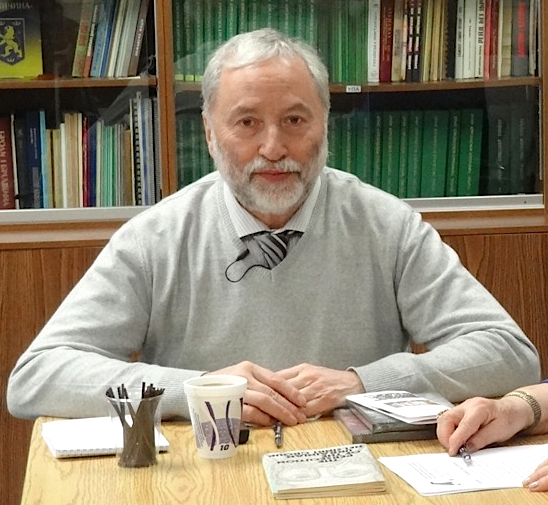
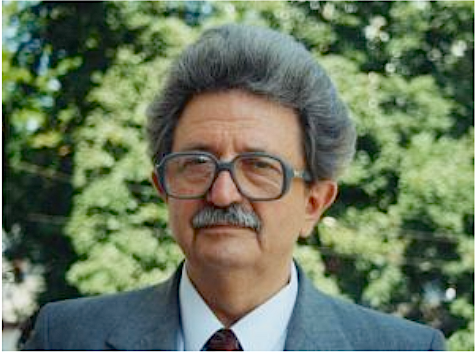
Josef Zissels at UCRDC. Photo: Bozhena Gembatiuk-Fedyna.
TORONTO, Canada. May 2, 2014
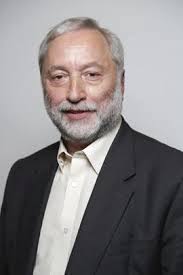 Josef Zissels, a former Soviet political dissident, Vice-President of the World Jewish Congress, Chairman of the Vaad (Association of Jewish Organizations and Communities of Ukraine), Chairman of the Euro-Asian Jewish Congress, Freedom Prize, and Order for Courage winner visited the Ukrainian Canadian Research and Documentation Centre (UCRDC) in Toronto, Canada to give a 3 hour interview for its Oral History Archive. He
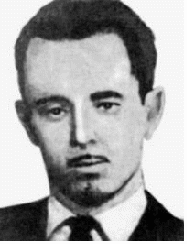
 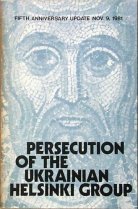 was interviewed by Iroida Wynnyckyj, UCRDC Archivist and Christina Isajiw, the former Head of the Human Rights Commission of the World Congress of Free Ukrainians. Isajiw had worked on behalf of Zissels while he was a political dissident in the 1980s and presented him with a book on dissidents that was used in the West to aid their release entitled, Persecution of the Ukrainian Helsinki Group, in which his photo and bio appear as a member of that group.
During the interview, Zissels was relaxed and open while answering questions and sharing insights that he has obviously thought long and deeply about. He is clearly someone who has truly found his own identity and place in the world and speaks from it with a quiet confidence. Approachable and sincere, reflective with a gentle sense of humor, he is clearly committed to the truth, and just as equally to Ukraine. Candid, profound, fair, he could easily have continued sharing stories and views for another three hours and those present would have happily listened longer. There is a kind of intelligent sincerity of honest thought in how he speaks which is deeply refreshing and quietly riveting to listen to in person.
What follows are some of the insightful highlights from this conversation, in the order they arose within the interview; all quotations are Zissels speaking.
Zissels’ basic biography is fairly well known now. He was born in Tashkent, Uzbekistan in 1946. His family moved in 1947 to Chernivtsi, Ukraine. His father was from Bessarabia, from Kishinev [Chișinău], and moved because he had wanted to throw off the shackles of Soviet rule. His father had two brothers, one who served in WW1, a businessman in Moscow who died in 1925, shot by Chekists. His younger brother, as it turns out in the twists of family life, was a Chekist who worked in Odesa, a pensioner after Stalin died, who worked in Leningrad as the Director of a fur factory. Zissels did not know him. His father served in the Romanian army, played violin, rode a horse and died in 1965 when Zissels was 19 and had not had a chance to talk to him much about father–son things. Zissels in fact knows more about his mother’s side: she had 9 brothers and sisters, was much beloved and when she died, as he says, all that love transferred onto him. He has a brother and sister, who are younger and emigrated to Israel. He graduated from Chernivtsi University. He was arrested in 1979 and 1984.
Josef Zissels remembers his childhood well, schools then were divided into boys and girls and there were many Jews in Chernivtsi, many of whom spoke Russian. His family spoke Russian and Yiddish at home, but when his parents didn’t want the children to understand them they switched to Yiddish. They did not teach the kids Yiddish because it was both forbidden in Soviet times and also not desirable to do so then. School was in the Russian language, there was only one school that taught in Ukrainian. Zissels says because both his parents died when he was young, they were not around long enough to instill in him what he calls “the great caution,” the Jewish instinct for self-preservation–to not push ahead in political questions, to work, make money and not “crawl into politics.” The pull toward knowledge and education was passed on to him, one has to learn well and he had a proclivity to physics and math, but he did not have a “stereotypical Jewish upbringing” in that he was not imbued with this caution toward self-preservation–and as he says, therefore he became an activist.
“I could not memorize and repeat what I could not prove to be true…I realized there is official history, and there is other truth.”
On Kishenev University of Foreign Languages:
He took math and physics and the final class was the History of the Communist Party. In the winter of 1964-5 he felt some push back against it, felt “anti-it,” it did not sit well with him, he was not learning it easily. As he says in Ukrainian: “В мене не лізе та історія комуністичної партії.” It did not “go in” easily. He could not remember it. He was mostly very focused on Physics and Math and not really active socially, nor did he even know literature so well until later.
He believes that maybe because he did not have that instinct for self-preservation, that is to answer questions well, know everything and not stick out, that he already knew then that he did not fit in, that he was different from others in class. He understands now that it was then he differentiated himself because, as he says: “I could not memorize and repeat what I could not prove to be true.”
In the fall of 1965, the Soviet KGB wrote up its first report on Zissels as the result of a philosophical debate in school where he was not towing the Party line. He says: “I did not understand what can or cannot be said, and I started searching for truth, amongst those afraid to say it. I realized there is official history, and there is other truth.”
On Samizdat and Soviet Truths
It was a Russian family friend, Mykhailo Volodymyrovych Goldberg (who in 1941 was arrested in Moscow because the phone number of a German diplomat or writer was found between the pages of his notebook so he spent 7 years in prison for this) who told Zissels, still a student, a lot about the 1940s, Moscow history, Stalin’s repressions, and most especially, introduced him to the world of the Samizdat [also called samvydat and samvydav], and specifically the “Khronika.” Samizdat literally means “self-published,” or as Vladimir Bukovsky famously summarized it, “I myself create it, edit it, censor it, publish it, distribute it, and get imprisoned for it.” The “Khronika tekushchykh sobytii” (“A Chronicle of Current Events“) is one of the most important samizdat journals started in 1968 by a group of Moscow dissidents which survived for 15 years and published 64 issues. Ukrainians were written about here also: Vyacheslav Chornovil, Levko Lukyanenko, and others, and human rights figured prominently in its pages.
Click on images to enlarge or run cursor over image to read names in each photo:

Viacheslav Chornovil

Levko Lukyanenko: “There’s nothing higher than national interests. They are the pinnacle that stands above all other human aspirations.”
In 1968, the Russian army invasion of Czechoslovakia influenced Zissels’ world vision a great deal and in the late 1960s he read Ukrainian samizdat writers who were against this Russian action. By the 1970s, he started meeting with the writers and talking to them.
“I became increasingly anti-Soviet, physics became less interesting because I understood that in a country in which one lives one can’t just study pure educational pursuits, you can’t just do your work in a job. You have to be responsible for the effects of your subject of study. I understood that the crystals I grew in a lab would end up in rockets that would fall on possibly innocent heads. And I can’t influence this because I live in [Soviet] Ukraine where you can’t influence your government.” So he already wanted to change at this point and was less interested in where he worked and what he did. Rather, he wanted to take on “public and social questions.”
Because of how he differentiated himself at school he did not get a positive recommendation for his graduation certificate and by this time there were people already following him around. So he redid his degree and became a radio engineer, doing “technological work on the ideological front” as he calls it, with a smile. A community conflict developed in Chernivtsi when he helped a friend whose family was emigrating in 1971, who was being critiqued at school and pushed out of work. Zissels stepped in to advocate for him because by then he knew the Declaration of Human Rights and took a democratic human rights position to defend his friend’s decision to follow where his family wanted to go; this opened a local conflict.
He also would disseminate the samizdat truths from Moscow and started anti-Soviet work. So, why do this, why take such risks again and again? Zissels reflects:
“When you do this, you can have different reactions in yourself: you can stop, which is a normal human reaction–you see that they follow you everywhere and you are not free anymore.” But he did not have the self-preservation gene. On the contrary, he just wanted to know the truth. “I want to talk on the themes that are interesting to me. If you won’t let me do this, it only makes me more stubborn to know.”
Because of this, he got even more interested in dissidents in the 1970s–“Ivan Svitlychniy, a beautiful person who was getting sick but gave a lot personally, and his sister Nadika Svitlychna, Mykola Horbal, Olia Matusevic, Petro Vins–and this was very interesting to him. So was the fate of Ukrainians and especially the problem of the use of psychiatry [and psychiatric drugs] on political prisoners put into Soviet psych wards:
“This is a very painful question. Justice is a big category in Jewish tradition. The world should be just, this God determines, and if you walk on that path, this is God’s path. You are walking toward justice.”
And he believed this was the most unjust thing to put people into psychiatric prisons for the fact that they say things or have views:
“If you are a political prisoner you are at least in your own milieu of like thinkers. When they take you to a psych ward, you are the only one. They put you in serious psychotherapy that influences your health and that kills you. And there is no end term to this. If you are not ‘cured’ while there, then it can go on for many years, you can die there and few people know. Psychotherapy influences…kills you. Individual families of those in psychiatric wards want even less to voice their concerns, they are afraid, it can make it so this person is never let out if they protest. Leonid Plyushch said they would just move them to other wards and they would be lost to the families, who would not know where they were. It’s a very painful subject and not often talked about.”
There were 17 special Psychiatric Wards in the Soviet Union; in Ukraine there was one, in Dnipropetrovsk. Mykhailo Lutsyk who was there for some years said: out of 1,030 people there, some very sick, one tenth–that is, over 100–were political prisoners.

Leonid Plyushch

Mykola Horbal

Nadiya Svitlychna

Ivan Svitlychny

Petro Vins

Mykhailo Lutsyk

Zinoviy Krasivsky
Josef Zissels began making a card archive of psychiatric prisoners. In 1978 he had over 80 cases in his archive. He would make 2 copies, the second his wife gave to Zinoviy Krasivsky for safe keeping, but he does not know what happened to this copy. When Zissels had his confiscated materials returned later it was not there, it could have gone to Kyiv or Moscow, but it’s not so important, because he gave all this information to the Helsinki Commission.
In 1978 Josef Zissels had his first KGB meeting at which he decided he would not answer to any question, not one. He was charged with slandering the state, disseminating a samizdat under 187-1 of the UkrSSR Criminal Codex, “Dissemination of patently false statements defaming the Soviet political and social system.”
“I was not a victim, I did not feel like a victim. I was ready, this was my work, this was my case, and I was ready,” he says of this event.
He goes on to further explain what this means: “Mykola Horbal was a victim, he was putting out his thoughts as poetry verses, he did not have a chance for conscious resistance or struggle against the government. Later when he went through, he was grateful he was imprisoned because he met interesting people in prison, learned a great deal, but he was not anti-soviet originally. [Doctor of Psychiatry] Semyon Gluzman: who said Pyotr Grigorenko and Leonid Plyusch were normal, healthy people. He did not set himself out to fight against the authorities. He was working in his faculty as an honest psychiatrist. “That was also a different position from my own,” says Zissels, “I was really deliberately working against the government.”

Dr. Semyon Gluzman

Pyotr Grigorenko and Jimmy Carter. September 20, 1978.
In his closed court trial in May 1969 that lasted three days because the Soviet authorities wanted to make a show of it, he conducted himself like a conscious resister:
“And even when the judge was somewhat offended by my behavior, I said ‘I’m doing my work–you do your work, do your work to arrest and put us into prison, those of us who protest this government.’”
“I was very clear about fighting and resisting this government. I might have had some romanticism, some idealism, but it was what it was. I was 33 years old when they imprisoned me, 32 when arrested.”
“I had this romanticism that a decent human cannot live in freedom. She necessarily falls into conflict with the government because she wants truth and she wants justice. This is not possible in freedom, because one way or another they will take you to prison or to a psychiatric ward.”
“I think if I wasn’t Jewish, if I’d been Ukrainian, it would have been worse, they would have given me Article 62, because Ukrainian nationalism was severely punished then, but I was Jewish and they just could not understand why a Jew would need to do this; if I’m a Jew I should be a Zionist.”
He was imprisoned under Article 187-1 (both times) which included a sentence of 3 years reinforced-regime labor camp for “slandering the state.” He was in prison for 3 years because he said it was “his work.”
On Joining the Ukrainian Helsinki Group
In the summer of 1978, “I, Mykola Horbal, Volodymyr Malynkovich, Olia Heiko, went to Oksana Meshko, in July of 1978 in Kyiv and said look, everyone from the [Ukrainian] Helsinki Group is sitting in prison right now (except for Oksana Meshko) and we don’t want to break the chain, we have to show that there is a continuation of it and all four of us want to step into the Helsinki Group to show that there is a continuation of the work. And she said it’s not necessary, they will immediately put you in prison. And we said, we are ready for this, it’s our resistance, we want it. She said, ok, I’ll accept you into the group but I won’t announce your names because they’ll imprison you. And I joked, from whom are we hiding? The KGB will know earlier than everyone else that we joined the group but why are we hiding from them? … It was an absurd life … So we were part of the group from the summer of 1978.”

Olha Heiko

Volodymyr Malynkovych

Oksana Meshko
On Prison
“In Chernivtsi prison I had no problems with other prison mates, these were criminals, killers, armed attackers, people with long sentences, no political prisoners. I was in the general cellblock, not in solitary, later I was put in a cell for two. These were young people that fell in there, hooligans, thieves, not political. On rare occasion, there were religious people who refused to go to the army and felt they were political prisoners. This is very symptomatic information. Many there were from Donetsk and Luhansk, a third of them. These Oblasts–Luhansk, Donetsk, the Donbas–were very criminalized even then. And these murderers and attackers, narcotics peddlers in the 70s were all from there.
I wrote a lot in prison. I read a great deal, had a good library because it’s an old city and there were some very interesting books confiscated there. Then I had a very interesting episode, because, when I was researching my case, usually before a trial you can better inform yourself of your case so you see your file, I saw the signature of my Prosecutor, Yevtohov, and that he had queried the Dnipropetrovsk mental hospital. He took my card archive and made inquiries whether these people were there and if the hospital confirms this information. Then I saw the answer, 2 answers, from the hospital, and yes, close to 40 cases were confirmed that were really as I wrote, and most importantly, they wrote where they took the people after moving them.
So I was sitting in prison and finding information which I could not get while free. This is a kind of absurd comedic situation, that you can find yourself behind bars and there get all the information that you need for the work you do [on the outside]. I wrote this all up and sent it out so that even from prison I was able to give information that went out into the world. Information that they had been searching for in the outside world, of where these people had disappeared to. It felt good I could do that.”
Zissels was released on Dec. 8,1981
On Family Life and Friends
On his family, he admits all of this was difficult over the years. His wife is a Physics Engineer, who specialized in optics, and could not maintain employment in this field so she had to go into electrical engineering. His first son was born in 1971 and was 5 years old when his father went to prison.

Valentyn Moroz
For dissident families we know that this life of course creates conflicts in families–for Valentyn Moroz it did so also, and Vyacheslav Chornovil. Why should the outlook of the father influence the children? Zissels’ son was told in grade school that his father is an enemy of the state. In an article it was written that ‘he loves samvidav and doesn’t like Pushkin.’ “It was absurd. This was the absurdity of our life then,” he says. Zissels has four children, only one son. “But in the family it was very difficult. And I always say this. I belong to an unpopular group: “дегрезаторів” [“dream deprivers”]. Our life as dissidents, when we step out according to our conscience, and we consider that god is leading us to this, but it causes many problems in the family and with the spouse because then they start pulling them [to go] into the KGB or in for questioning and the order of their lives [is disrupted] and not everyone is ready for this. Some are, some completely are not.” The KGB pulled all his friends in for questioning (in 1976) in Chernivtsi so when he got out a lot of them stopped seeing him. He himself was afraid to hang out with his friends because after, they were targeted by the KGB, so he stopped being friends with many.
On His Second Imprisonment
“When people ask me ‘why did they imprison you a second time?’ I say, because I was not reformed the first time.”
“I returned full of energy, ready to continue my life doing more of the same. But this was not greeted positively the second time. My wife went through the first time well, she was well-supported by many who helped, but morally it was tough for her, she was worried about our son who was 10 yrs old when I was released. He didn’t have a normal childhood. Searches, arrests, how is this normal for a child?” Zissels’ wife wanted to move to Israel.
On Not Emigrating to Israel

Mykhailo Horyn
Zissels did not want to move to Israel.“I felt that this was mine, that I was here, and that I was realizing myself only here. I was very hooked on the Ukrainian cause. All of my new friends from my underground dissident life, almost all were Ukrainian. I was very… even only for breathing… Mykhailo Horyn made a great impression on me. I was interested in a lot of general, democratic questions, and he was the first [person] who turned my attention to the national question, even to my own Jewish questions which I knew a little about, was a little interested in–I was helping Jews whom they would not allow beyond the border. But I wasn’t so deeply invested in even my own Jewish question, and he was the first who turned my attention to the fact that it’s very important. And I’m very grateful to him for that. Because I later realized myself as a Jewish–Ukrainian leader only because he returned me to his own national problematic and not only to the general democratic one. And my interests are very branched–Jewish, Ukrainian, democratic–and I retain this to this day in my leadership. But I’m very grateful to him for this. Because it’s very important. With him I understood a straight, possible (but not everyone comes to this immediately) truth. That it’s not possible to go to general human rights if you don’t pass through [an understanding] of your own religious and ethnic questions. There’s only this path.”
Who Is He Now?
“Until 1991, we all thought of ourselves as Soviet Jews, we were very assimilated.” He explains this further, that Soviet anti-semitism created an awareness of who they are as Jews, that they didn’t know religion or history so well but they knew this. “Only after 1991 did we start to freely learn about the religious, cultural, traditional aspects of our lives and to develop as Ukrainian Jews. It’s a very slow path to develop schools, synagogues, etc. Realize, that only after independence can you develop this, after you kick out the Communist enemy.” Only after independence in 1991, when the Soviet Union fell, could they really start to freely develop these national and other identity questions. And they started to develop as Ukrainian Jews: Jewish questions, Jewish schools, to go to synagogue. And to this day, Zissels says he is “grateful to Horyn and other Ukrainians who turned my attention to these questions.”
In 1976 he was told to: “leave the country or we will imprison you” and he chose the second. And when they realized that he would not stop they imprisoned him again. They never once asked him to become KGB, they wrote him off as an enemy from his early days. They also wouldn’t let his wife go to Israel without him, they wanted to get rid of him because “Chernivtsi is a quiet town and did not need dissidents.”
From 1982-84 when he was in prison a second time, this time period was very hard, he says it was a black period when a government turns up the heat knowing that it’s going down soon. In Chernivtsi they found nothing new on him, but said he spoke against the state while in prison. He did, but then curiously enough, his former prison mates wouldn’t go to court and say so. He did another 3 years, and this time did not feel romantic about it. His wife asked him not to be so active, the first time through she did everything he needed, but the second time she did not want to. He felt guilty in front of his family, he could not fight himself though, change his outlook or feelings. As Zissels says about being a dissident:
“You feel it’s your path, god helps you, but you create a lot of emotional suffering for your family and loved ones. The satisfaction that you are doing your calling and that you feel needed, this blinds you. And we were very guilty in front of our families and loved ones, and I don’t relate to this as heroism, because you are doing your own needed thing, but you shouldn’t pressure others into it too.”
In 1986 he was part of a “criminal intelligentsia” and had a normal life, did electrical work, ate, read papers…and then they wanted his signature (on a confession). “Because I’m so stubborn, I would not sign it. Nobody thought that Gorbachev’s government would go so quickly, in 3-4 years.”
At one point, he did say to Mykola Kushnir, who was a captain and made his entire career in the Soviet military on Zissels, becoming a general because of him because there were no other dissidents in Chernivtsi, that the “Soviet Union will fall, Ukraine will be free and Germany will unite (east and west).” This was at the beginning of 1982. Kushnir said this would never happen and added a year under administrative oversight to his sentence–meaning, Zissels couldn’t go anywhere, had to be home by 7pm, had to work. As fate would have it, it did happen and Zissels was able to look Kushnir in the eye and remind him of it publicly years later at a conference in Crimea.
As a result at this time, Viacheslav Chornovil and Zinoviy Krasivsky came to visit him, and Zissels started working actively on a renewal of Jewish life. In 1987 he created the first Ukrainian Jewish organization in Ukraine in Chernivtsi. It was the second such organization for Jews in the world, the first was started in Estonia, but it was the first such organization in Ukraine. And in 1987 the national movement started in Ukraine. In 1989 he was part of RUKH in Kyiv, part of Verkhovna Rada [Ukrainian Parliament] and in 1990 the Ukrainian national movement was not just ethnic but multi-ethnic, it included everyone who lives in Ukraine, and these were very active times. They started the Euro-Asian Jewish Congress, and by 1991 he realized they needed to create these organizations in each country (Latvia, Lithuania, Estonia, etc.) before it all fell apart from internal/regional differences.
On Europe and Eurasia
There was a realization, as dissidents, that there were no Belorussians, no Central Asians, no Azerbaijanis imprisoned with them and that these were symptomatic points in history, which Zissels now calls “an identifiable fault between Eurasia and Europe.”
“Ukraine for hundreds of years finds itself in a geographical position where two possible centers of civilizational identity influence her. European identity and Eurasian identity. The divide along the Dnipro River is not right. In our hearts we are both.” Although Zissels does say that with certain EurAsian ideologists and Communists there is little in common and even less to talk about, that there are identifiable differences.
“After the Orange Revolution in 2004, they couldn’t do lustrations and power went to the Communists, to Kravchuk, he was the Commander of the Communist Party when I was being imprisoned.” And Zissels doesn’t understand what there is for them to talk about even though Kravchuk was then, and is still very civil to him even now.
“When we were happy to be formally independent nations, Russians were for the most part unhappy, this for them was a big tragedy. They lost their power. Power [for them] is when you are feared. Fear means respect. From another perspective, in Eurasia there is no respect, they don’t respect you for being so smart, so cultured, or for your philosophy, or economic ability. But if they are afraid of you, that’s a very important sign of Eurasian identity. If we don’t understand this today, we won’t understand why Russia acts the way it does towards Ukraine and the whole world.”
In 1991 the Jewish organizations already started to disperse. Zissels stepped out as a Ukrainian Jew vs. Soviet Jews and in his first book said he thought they should disperse into different groups, should divide on different models of their lived reality. So Jewish groups started to differentiate and separate according to their own local realities and futures.
In 1991, only 18% wanted to be part of Russia. And, during the 2014 “referendum” in Crimea, Zissels said to his Crimean friends when they were talking it over:
“Why is it [Ukraine] not enough for you? You live in a democratic country, you speak whatever you want, you gather as you please, you can espouse whatever viewpoint you want. You have to teach Ukrainian–you don’t like that. So I said to my Russian speaking Jewish Crimean friends, what’s not enough? Just that you have to teach Ukrainian. But you are now falling into an undemocratic country, where you won’t have to teach Ukrainian, but you will live in a non-democratic country. Is that worth trading for? And there are 30,000 Crimean Tatars, who are all largely Russian speaking, but are huge patriots of Ukraine.”
“The Ukraine revolution’s third stage is less ethnocentric than in 2004. Now what is forming is a Ukrainian political nation in place of the ethnic nation. Some might like that, some might not.
Of the 50 Maidans across Ukraine at the time, half of the people there spoke Russian. So it’s not about the language. People want to live in a European state with laws that work, that are not just a formality. They want, not only no corruption, but to live a life of dignity. Russians have a negative feeling of greatness, that people are afraid of you. Putin gives people a chance to again feel powerful that others fear them. But this is a disease. Not a normal life, it’s paranoia, fear. But there are those Russians who really do support Putin and we have to recognize that. It’s a matter of identity, not just propaganda. Some Russian speakers really do, because they feel Eurasian. One is not born with this feeling, this comes through upbringing and the general society, tv, and media.”
“So, our first task is to unite efforts to create an information front. We should uncover those lies, we should write the truth about Ukraine and about Eastern Ukraine. We have to put money toward counter propaganda and to the degree to which we don’t put money toward it is the degree to which have to deal with Russia.”
“Even those who are against Putin’s corruption, support the aggression, it’s revanchism. This Russian messianic idea to be the third Rome (to reunite Alaska, Jerusalem…), where force decides everything. Back in 1941, 60 million people died in WW2 so we would not have another world war in which force decided everything. Everyone wants to negotiate and make money off of this with Russia.”
“Since 1991 we [the Jewish community] have been rebuilding and no one stands in our way in Ukraine. No one. They may not help us as much, but that’s because Ukraine is still weak. It can’t even help Ukrainians. It might not help us because it’s a weak state still, but as I always say to people, you can’t expect the state to do everything.”
About Maidan
Zissels stepped out on Maidan in Kyiv three times.
Zissels speach at EuroMaidan on the Day of Dignity, December 15, 2014: “To Freedom, Ours and Yours.”
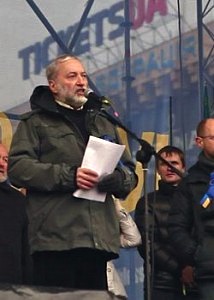
Josef Zissels speaking on Maidan, Kyiv.
“It’s very important that Jews take part in Maidan. Jews took part in Maidan, yes. Three died on the barricades of Maidan. But I don’t want to exaggerate the role of Jews on Maidan. I’m a realistic person. I was the first of the Jewish leaders to help Maidan, the only one. But there were 3-4 Jewish leaders who upheld Yanukovych too (with their calls and articles) not very actively but the world saw it, and once they did this it raised the anxiety in the Jewish community. They said that anti-Semitism was growing. I knew that this was not true, and I wrote and spoke everywhere that there is no growth in anti-Semitism in Ukraine. Over a seven year period we see that it has been decreasing, I will give you our reports. [EAJC Xenophobia Monitoring, EAJC Analytics]. We are the most professional organization that monitors and analyzes anti-Semitism. And we’ve seen that for seven years anti-semitism has been decreasing. And it continues–some leaders are publicly saying it is growing–and this is a lie. And every day we worked on correcting these lies. I sat until 2 and 3am on my computer and we published positive Jewish reports about Maidan.

Jewish flag on Maidan in Kyiv.

Josef Zissels, Vitaly Portnikov and Arseniy Yatsenyuk on stage at Kyiv’s Maidan in December 2013
Jews spent time on Maidan, they saw that there was no anti-Semitism, they went on stage, a rabbi went onto the Maidan stage with prayers for peace, and Jewish artists, writers, the Open University was working on Maidan where they also gave lessons on Jewish history. And all of this was very positively received. And look, it’s very symptomatic. Those Jews that were on Maidan, like me, we were identified with the community – that the Jewish community supports Maidan. And those that were against, they said about some of them, “monster in the family” [Russian saying]. And this is a very important aspect. Because amongst us in Ukraine, today, we see our allies. Although, as I say, I don’t want to exaggerate the role of Jews in that protest and on Maidan. It was not large, we’ll say that immediately. Because a great many [of them] were afraid, there were many stereotypes, propaganda influenced many. Every day, it was required of me to correct this, but we see that even those who are in towns in America did not publish this information, these materials were not published everywhere. Ukrainian sources published this information, but Jewish ones did not. There are a great many stereotypes, from the past, and a great many provocations and propaganda from Russia. And this is very important because I see that these processes that come are very painful and problematic, I see they are positive for the Jewish community. Because Ukrainians see now with whom they can live for their future because we worked with them together in this cause. And to exaggerate the meaning of this is not possible.”
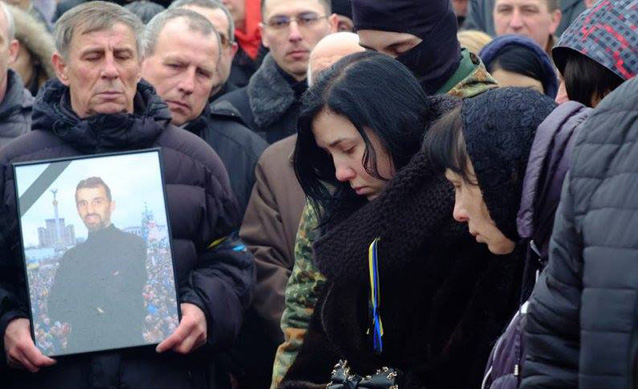
Alexander Scherbatyuk, 46, was shot by police snipers on Thursday, February 20, 2014 as he and fellow Afghanistan War veterans helped lead Self-defense battalions during the protest’s bloody struggle against Berkut government riot police on Maidan in Kyiv. http://www.eurojewcong.org/20/10807-ukrainian-jews-mourn-shot-maidan-protester.html
On Not Emigrating to Israel – (revisited)
“I never wanted to leave Ukraine and go to Israel. How can one ask why did one not want to emigrate to Israel? You can ask why did you want to–because people have reasons to go. I say that I live there, I live there and I realize myself fully there. I am one hundred percent self-realized in that life. Even though there have been tough terms there, even in them I have been fully realized there. And what else does a person need, if not to be self-realized?”
Zissels explained warmly about his friends and family in Israel, that when in Israel, he feels very comfortable: “I have a dual reality, I feel both Ukrainian and Jewish, that is, I am both Jewish and Ukrainian, and this has no contradiction. We are Ukrainian Jews, maybe there are not many like me but we are here. Just like Canadian Jews, American Jews, and British Jews. They are patriots of their countries, they have different ethno-religious origins. But they are a part of their country and part of their political nation. And there are more and more people becoming like this, slowly, but nonetheless, it’s ongoing. And such events as Maidan, speed this process up. I see we already have differences with Russian Jews. I’ll tell you why I emphasize that I’m a Ukrainian Jew. Because for the past 10 years or so, I’m pulled to return home, to Kyiv. And I feel a relief when I fly home. And I can speak Ukrainian, it’s very pleasant for me. Many of us Jews who live in Ukraine, are already Ukrainian Jews. We already have discussions, fights with Russian Jews who support Putin.
On being called the neologism “Zhydobanderivets” publicly on Hromadske TV and not reacting
“Why react? I’m glad of it. Because this is nothing new to me. Back in 1978 when they were imprisoning me, the KGB couldn’t understand me–‘as a Jew he should be a Zionist’–they had these stereotypes but I became part of the Ukrainian Helsinki Group, a Ukrainian national group, and therefore back then I was already a Zhydobanderivets. And I and others like me were glad of this, that we could joke like this. I can’t say I use this term every day, but I am not ashamed of it.”
On the Role of Youth
“I saw immediately on all the Maidans, that Jewish youth was closer to Ukrainian youth, helped more than those who were older; youth is always closer, more sincere, desires justice more, etc. Always, especially during times of this education campaign, which in life has been going on for more than 200 years, Jewish youth, not just Jewish but in all communities, the youth is closer to the local national and social movements, they take part in them more than older people who are more conservative and keep to their religious and national outlooks.
We are now feeling that in Ukraine it will be comfortable for us Jews to live. Not only because we have rights in a democratic country, but we have fought for these rights together, if not now then when we were united against the Soviet army.
Ukrainians understand their history better and Jews understand theirs, and not necessarily each other’s, even though they live side by side. We have community projects of various kinds.” In 2000 Zissels created a conference on the problems of tolerance in Ukrainian society. “We realized we live in separate quarters with little correlation between them.” So they started doing joint projects together as a result: children’s and youth [“Roots of Tolerance”] camps or clubs where youth are mixed began in 1997 in the Carpathians, in Donetsk even, in various parts of Ukraine. The state can’t fund these projects well, even where it wants to. So he finds money in foundations and private donations. These camps allow youth to grow up together and respect each other. “We now have leaders who were kids in our camps. In Donetsk, all those who went through these camps helped on Maidan. And we have to do more of these so there is more correlation and communication between different youth.”
On Russians and Russian Language in Ukraine
“It’s absurd, it’s straight lies that there are any kind of laws against speaking Russian in Ukraine. Of course not. Everyone speaks whatever they want.”
In studies (Natalia Panina and Yevhen Volovakha) on how Ukrainians relate to other ethnic groups, they used the Bogardus Social Distance Scale (American, from the 1930s to show ethnic distance between groups and how they integrate into American society).
“And over 20 years, we see in Ukraine that the best relations are with Russians. So why suddenly the problem with separatists? Why can Ukraine not resolve the problem?
Ukrainians psychologically can’t shoot into Russians, they can’t kill them. Ukrainians can die, and Maidan showed this, that Ukrainians can die by the hundreds of thousands for their vision of the future. But they can’t yet kill others. This is important, because in this kind of protest, the one who wins is not the one who is able to kill, but the one who is able to die. And I believe that this will win it for the Ukrainian cause.”
“In this kind of protest, the one who wins is not the one who is able to kill, but the one who is able to die.”
On Anti-Semitism and Sanctions
“I spoke little in Europe, when I did everyone was asking me about the Jews, about anti-Semitism, I became angered already, why do you ask about Jews, deal with your own: in Germany there are a hundred more cases of anti-Semitic incidents. Here, allow us to help you with your problems of anti-Semitism, you have a hundred times more incidents in Germany.
Look at the Crimean Tatars, they have fallen into another tragedy, they haven’t even gotten out of their most recent tragedy, and here another 2,000 have left Crimea again. Europe lives by different instincts. And a lot of people live here also who believe that propaganda that there is growing anti-Semitism. It makes me want to start shouting about it already. How many Ukrainians do Russians have to kill before you understand what this is about? This is not an issue with Crimea, with Ukraine. But with you yourselves. You want to let it go, but I’ve already said, here in New York, in Brighton, in Brooklyn there are many Russian speakers. What are you waiting for, for Putin to come here to you and say he’s protecting the rights of Russian-speaking people? You can’t feel this any earlier and remember how it was in 1935 when Hitler came to power.
“How many Ukrainians do Russians have to kill before you understand what this is about? This is not an issue with Crimea, with Ukraine. But with you yourselves.”
And this is a big problem of our world, this softness and compromise, people don’t want to go to war, and this is good that they want to live in peace. A lot of people, but sadly, not the whole world. There are many parts of the world, in Arab countries and in China who live a very difficult life. And they have a different feeling of the world. And even Russia, and they want to fight, because they don’t respect the life that they have. Because they have a difficult life. And the West fears losing the comfort that it has. And this desire to sacrifice gives an advantage to Putin’s aggression. And they want to sacrifice so as not to let Ukraine, Moldova and Georgia into Europe.”
“Sanctions should be such that all Russians in their own lives, everyone, understands how bad it is to uphold this revanchist aggression. And the economic level of every Russian should fall so that this red button reaches a point of social explosion. So that they themselves feel they want to stand up because these politics lead to their economic ills, among other things. This is the only thing they are sensitive to. They’re willing to sacrifice democracy, which they almost don’t have anyhow. They’re even willing to sacrifice economic gains, a feeling of dignity they would sacrifice, because Putin gives them something else, he gives them a feeling of greatness, and the fear of others before them. This is a sickness but it works. Because millions of people think like this. As long as this red button isn’t working in them, as long as they have socio-economic wellness, they won’t stand up against that politics. That’s why economic sanctions should be very powerful from the West. One has to convince the West of this.”
On what’s needed next and NATO
“First above all, the informational front, then the economic. And the position of NATO that is changing, today it was that the representative of the Secretary-General of NATO said that NATO already sees Russia not as an ally, not as a partner, but as an adversary. This is very important. NATO as an organization is created to protect democracy and Western civilization ought to clearly and transparently announce that it will protect democracy at any point on the global sphere. Because you can’t sacrifice democracy in some country that is not a member of NATO. Because if today they capture a country there, tomorrow they will come here. And this is easier to stop there than it is if they come here. And this is very important, and NATO is starting to understand it. NATO is not ready to fight, but it’s important for us to maintain this consequent position, that they are ready to protest up to armed confrontation. Because NATO and the West are a lot more powerful than Russia both on the economic plane and on the plane of war. Simply that audacity which is working now, with NATO laws and principles, only these give advantage. How can you compromise, or have to negotiate? You’re meeting in a dark alley with a bandit, who is pulling a weapon on you. How can you sit behind a negotiating table with him and say, ‘Ok, C’mon, we’ll negotiate, and possibly we’ll find some compromise.’ He wants to rob you! And if there is no police reach that can curtail him, or even apply weapons against him, all of your postmodernism, all of your vast civilized compromising, are worth nothing. Understand with whom you are dealing, you are dealing with bandits.”

Josef Zissels, UCRDC Archivist Iroida Wynnyckij, former head of Human Rights at WCFU Christina Isajiw, and UCRDC Archive Videographer Andy Holowaty. Photo: Bozhena Gembatiuk-Fedyna.
RELATED INFORMATION:
Jerusalem Post: Jewish group cuts funding for Kiev office over criticism of Putin
EAJC: The Jewish Division of Ukraine’s Heaven’s Hundred
EAJC: VAAD Ukraine: Panic in Ukraine Created by Provocateurs
Voices of Ukraine translation: STATEMENT of Vadim Rabinovich
President of the All-Ukrainian Jewish Congress
Co-Chair of the European Jewish Parliament
Ukrainian Policy: Minorities on Maidan: An interview with a Jewish Euromaidan self-defense unit leader
JTA: In Kiev, an Israeli army vet led a street-fighting unit
Vitaly Portnikov: The Jews and the Maidan
 Here’s the Summary for July 7, 2014 (for previous summary, please see Summary for July 4).







 Voices of Ukraine