Dmitry Tymchuk’s Military Blog: Summary – July 8, 2014

Dmitry Tymchuk, Coordinator, Information Resistance
07.08.2014
Translated and edited by Voices of Ukraine

Brothers and sisters!

information_resistance_logo_engHere’s the Summary for July 8, 2014 (for previous summary, please see Summary for July 7).

The bad news:

1. The SBU [Security Service of Ukraine] operatives detained five members of a subversive group, which planned to blow up railway tracks in Zaporizhzhya Oblast. The failed saboteurs received specialized training in demolition at a training camp in Russia’s Rostov Oblast.

A “mined terrorist war,” was declared by pro-Russian insurgents to the Ukrainian nation; having covered Donbas, it’s spreading beyond this territory.

I really hope that after we strangle and exorcise this scum from Ukraine, it will engage in its favorite occupation in a place it crawled out from–in Rostov Oblast. And better yet, in the suburbs of Moscow.

2. The Luhansk terrorists experienced a seasonal exacerbation. They claimed (and one should take a moment to reflect on this flight of morbid imagination) that… [they] are considering “freezing the deposits” of Ukrainian citizens throughout the territory under their control. As in, we will refund you with interest, when we have the money.

Is it just me or are these “LNR” [Luhansk People’s Republic] clowns subtly taunting residents of Luhansk with this idea? Well, they must be: you are stopped in an alley at night by some bloke with an automatic machine gun, he takes all your money and then says, supposedly, ‘bro, I have frozen your deposits. As soon as I get my business running–I will give it back with interest.’

Such songs from the mouths of robbers and rapists are nothing but black humor. It would be funny if it weren’t so sad.

soldier

The good news:

1. The RNBO [National Security and Defense Council] estimated today that from the beginning of the ATO the territory controlled by terrorists decreased by half.

I would say this is a pleasing, but at the same time, a very cautious statement. Since the insurgents don’t have this many forces and means to completely control the entire territory “attributed” to them.

The ring around the terrorists is tightening. The only bad thing about it is that it’s too early to call it inviolable yet: the insurgents have direct access to the Ukrainian border with their bloodthirsty Mother–Russia. Once this devilish umbilical cord is cut, and the ring gets closed, there will be only one step to our victory.

2. President Petro Poroshenko promised not to use aviation and artillery in Donetsk. The Russian “Caucasus methods,” employing the tactics of a scorched earth policy–is not for Ukraine.

Here I would like to add that the RNBO statement regarding the plans of the ATO forces to block Donetsk and Luhansk caused unhealthy excitement in the media, especially the foreign media. Everyone fancies a blockade.

Today, I’ve grown tired of explaining to journalists that nobody is going to set up a “besieged Leningrad.” It’s only a matter of preventing an influx of mercenaries and weapons into these cities. Indeed, without such a blockage of major hotbeds of terrorism (simultaneously with the complete blockade of the state border), the ATO could go on forever.

3. The office of the High Representative of the Union for Foreign Affairs and Security Policy [Maja Kocijančič] announced today that Ukraine has the right and duty to defend sovereignty, law and order within its borders.

This is the Brussels response to the statement by the Russian Foreign Ministry about the need for a sharp reaction on behalf of the EU in response to the “forceful actions by the Ukrainian army” in eastern Ukraine.

I (think, like many of you) spend every day listening to the statements of European officials and politicians with mixed feelings. They will either sit under Putin or their conscience will prevail and they will support Ukraine. Frankly, I’m tired of both criticizing the Europeans or taking my hat off to them. They should finally make up their minds somehow. But for today’s [official] EU response–thank you, of course.

Source: Dmitry Tymchuk FB
 

Posted in Dmitry Tymchuk, English, English News, South&Eastern Ukraine | Tagged , , , , , , , | 4 Comments

March of the Vyshyvanky in Kharkiv: July 5, 2014

By Yelena Litvinenko
07.06.2014
Translated by Yelena Litvnenko and edited by Voice of Ukraine

Screen Shot 2014-07-08 at 10.44.00 AM

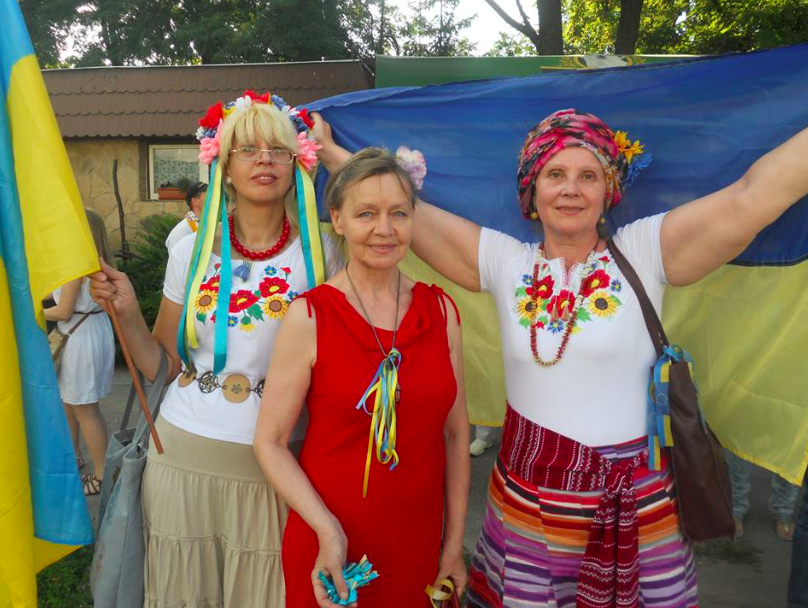
In Kharkiv (Eastern Ukraine), a March of the Vyshyvanky [traditional embroidered shirts] started near the Aviation University. Some people walked, some rode bicycles or drove their cars along the Sumska Street. The peaceful demonstration was guarded by the municipal policemen and Right Sector activists. The participants carried Ukrainian and Crimean Tatar flags. Everything associated with the unity of Ukrainian people was welcomed [at the rally], as well as songs, and letters and pictures for the soldiers. The vast majority of rally participants wore vyshyvanky, many people painted the Ukrainian flag on their cheeks.

About one hundred Ukrainian activists traditionally started with the national anthem, chanted patriotic slogans, handed out blue-and-yellow ribbons to passersby. They also demanded the lustration of the authorities, and called for making all perpetrators of corruption responsible. A vast majority of drivers and passersby welcomed the participants of the rally, and took blue-and-yellow ribbons with pleasure. Some people hung Ukrainian flags from their homes. A negative reaction was seen only in a small number of passersby.

In the video you see them also singing in front of the City Council building and at the Military Medical Center of the Northern Region in Kharkiv. They are yelling “thank you” over and over to the military guys hospitalized for injuries while fighting and, “Together to the end” and, “Glory to Ukraine, glory to the heroes.” Slava Ukraini. Slava Heroyam. Slava Kharkiv.

Source: Yelena Litvinenko FB 

Posted in English, Languages, Media, News, News summary, Pictures, Regіons, Social Media, South&Eastern Ukraine | Tagged , , , , , , | Leave a comment

Russia’s Long-range Anti-extremism Weapon

By Halya Coynash
07.08.2014
Source: Kharkiv Human Rights Protection Group
Re-posted with permissions

  Just so that there’s no trouble  …

A new law just signed into force in Russia envisages penalties of up to 5 years imprisonment for what are termed ‘calls to extremist activity via the Internet’.  With a leading Crimean Tatar newspaperdeemed extremist for using such unkind words as ‘annexation’ and ‘Russian occupation’, the dangers from this law are surely clear.  There is, however, more with the Kremlin planning measures aimed at detecting and nipping ‘extremist ideology’ in the bud.

Legislative carte blanche

The law signed by Russian President Vladimir Putin on June 30 imposes tough penalties for public calls to extremist activity and inciting enmity through extremist material on the Internet.  Legislative measures against ‘extremism’ were first introduced back in 2002. Their bite has been significantly strengthened since then, but the same dangerous lack of clarity remains as to what is meant by extremism.  Internet users are now wondering if they could receive visitations from the FSB or security service for re-tweeting or re-posting political anecdotes, cartoons or interviews with people the Kremlin doesn’t like.

Material is declared extremist by a federal court on application from the prosecutor or in the course of administrative, civil or criminal proceedings.  Any reliance on the judicial system to prevent abuse of such a woolly term is unwarranted.   In 2012, for example, the Federal List of Extremist Material included publications about Holodomor [the man-made famine in Ukraine in 1932/33] as genocide, as well as material about the crimes of the NKVD, the nationalist leader Stepan Bandera etc., with the classification approved by court rulings.

A number of opposition websites in Russia have been blocked by the controlling body Roskomnadzor. With respect to the website Lenta.ru, this was over an interview of a member of the Ukrainian right-wing nationalist party Right Sector.  The interview quoted a 2008 interview given by Dmytro Yarosh, head of the party, in which he stated that “”sooner or later we are doomed to fight the Moscow empire.”  This was deemed to constitute ‘dissemination of extremist material’ and contain statements aimed at inciting ethnic enmity.

The advantage of vague concepts like ‘extremist activity’ is that they can be applied or not as the relevant authorities choose.  The foreseeability which any law should provide is seen only in the fact that opponents of the regime can quite realistically anticipate that any behaviour will be labelled ‘extremist’.  The head of the Mejlis of the Crimean Tatar People, Refat Chubarov has just been banned from returning to his native Crimea over alleged ‘extremism’ with this clearly linked to his opposition to Russia’s effective seizure of the peninsula.

The law also gives the government responsibility for drawing up and implementing measures to forestall and counter ‘extremism’.  The Interior Ministry has already prepared a ten-year strategy for fighting ‘destructive ideology’.  Kommersant explains that since the main channel for disseminating ‘destructive information’ is the Internet, methods are needed to not only cut out aggressive ‘demonstrations of extremism’ but to also create a system of monitoring and counter-propaganda.

The main concept, the Interior Ministry explains is “while retaining and strengthening the enforcement bodies component in fighting specific manifestations of extremism, to radically heighten the effectiveness of countering radical ideology, placing reliable barriers in the way of its penetrating public consciousness”.

Impact from foreign and domestic destructive forces are first and foremost linked with the spreading of extremist ideology and aimed at destabilizing the socio-political system in the Russian Federation.”

The main instrument for the radicalization of society” lies in “protests which turn into mass riots”.  The main hotbed of destructive, including extremist, ideology is the Internet.  A law which recently came into force imposes stiff penalties for calls to undermine Russia’s territorial integrity, with this including calls to return the Crimea to its internationally recognized status as an autonomous republic within Ukraine.

It remains to be seen how stringently and / or selectively the new ‘extremism’ law gets applied,  Russians have already developed techniques for bypassing current blockades on websites and any measures directed at totally controlling the Internet these days are doomed to at least partial failure.

The likely impact of the ‘prophylactic’ measures should not be underestimated.  Even in Soviet times there were always people who fully understood how hollow the propaganda was.  Most learned to keep their heads low, while a considerable part of the population was duped.

The new measures are doubtless also aimed at ensuring that people do not stick their necks out and effectively censor themselves. ‘Prophylactic’ indoctrination via a largely subservient media is combined with chilling reminders of the likely consequences of bucking the system.   We are already witnessing attempts to crush protest among the Crimean Tatars and use charges of ‘extremism’ to neutralize or hound out vocal opponents of Russian annexation.  The scope for abuse, for real repression, is frighteningly broad.

RELATED READING:
• Russia resurrects Soviet ways in treatment of the Crimean Tatars
• Refat Chubarov also banned from the Crimea
• Crimean Tatar Mejlis newspaper accused of ‘extremism’
• Statement of Concerned Scholars Regarding the Current Predicament of the Crimean Tatars
• Crimean Tatars demand end to repression, call for international support
• Crimean Tatars defy ban on remembrance
• Russian Clamp on Crimean Tatar Remembrance
• Crimean Puppet government bans mass events on eve of Deportation anniversary
• OUTRAGE: Home of Mustafa Jemiliev searched
• Russian FSB search home of member of Crimean Tatar Mejlis

Posted in Crimea, English, English News | Tagged , , , , , , , , , | Leave a comment

A Day in Luhansk: War’s Crimes, Horrors, and Uncertainties

Tanya_Lokshina_webBy Tanya Lokshina
07.05.2014
Human Rights Watch

The ugliness of war makes getting at the truth no easy matter. In the fighting in eastern Ukraine, the pro-Ukraine media is blaming all abuses on anti-Kiev insurgents and pro-Russia media is demonizing Ukrainian government forces. The intense information war, with the media and social networks spewing all sorts of horrific myths and falsehoods, has buried rather than clarified the truth in a calculated attempt to prove that this side is righteous and that side is evil.

So, if you want to find out what really happened, you need to be there, speak in

Family walking past a blast crater in Kandrashevka, where 9 civilians died during an aerial attack by alleged Ukranian forces on July 2, 2014. ©2014 Human Rights Watch

Family walking past a blast crater in Kandrashevka, where 9 civilians died during an aerial attack by alleged Ukranian forces on July 2, 2014.
©2014 Human Rights Watch

detail to witnesses, carefully document casualties and destruction, examine shell entry points and fragments. When we read news reports about alleged civilian casualties from the July 2 aerial strikes in the Luhansk region of southeastern Ukraine, about 15 kilometers away from the Russian border, we hit the road straight away.

Ukrainian authorities denied responsibility for the attacks that hit the villages of Luhanskaya and Kondrashevka. They tried to blame the attacks on Russia first, suggesting that the villages were hit from a Russian jet, which sounded rather ludicrous as the region is controlled by pro-Russia insurgents. Then, they said that people died and homes were damaged as a result of insurgent fire from GRAD multiple rocket launchers. The latter version did not seem too credible either.

Before entering Luhanskaya village, we made a quick stop in Luhansk itself. Numerous media sources and bloggers claimed that fighting between Ukrainian forces and insurgents was in progress, but in fact the city seemed quiet, even sleepy, small children riding their bikes in the streets, shops and cafes bustling with customers. When we arrived at the local administration, however, this illusion of normalcy vanished immediately. Since April, insurgents have occupied the administration building, reportedly holding numerous captives in its basement. In the lobby, lots of men in fatigues with Kalashnikov assault rifles and combat knives were being waved through by security guards next to a sign, “Give up your weapon at this entry point.” Next to that sign, a picturesque poster featured two large photographs of a prominent journalist from Novaya Gazeta, Russia’s leading independent paper, describing her as an “enemy” and “provocateur” who was supposedly on the way to the region and had to be stopped.

Please continue reading here

Posted in English, English News, Eyewitness stories, Others, Pictures, South&Eastern Ukraine, War in Donbas | Tagged , , , , , , , , | Leave a comment

【情報レジスト・ティムチュック】 7月7日(月)のまとめ

10173325_481968728598454_1124228004_n

原文はこちら:フェイスブック情報レジストHP
7月4日の分はこちら

和文: S.J.

※ 3月10日からウクライナで活動しているボランティア情報局、「情報レジスト」(”情報で抗議する”)リーダが発信しているその日の記録を和訳したものである。※ ======================================

■ 悪かったこと ■

(1) 本日,ノヴォバフムトフカ近郊において,スラヴャンスク・ドネツク・マリウポリ幹線道路の上を走る鉄道橋が爆破された。爆破されたのは,貨物車が橋を通過している時であった。

更に付け加えると,国家安全保障・国防会議の情報によれば, Continue reading

Posted in Tymchuk日本語, 日本語 | Tagged , , , , , , , , , , | 3 Comments