Dmitry Tymchuk: Military update 04.01 #FreeSavchenko

information_resistance_logo_engDmitry Tymchuk, Head of the Center for Military and Political Research, Coordinator of the Information Resistance group, Member of Parliament (People’s Front)
04.01.2016
Translated and edited by Voices of Ukraine

(See end of post for acronym glossary)

Operational data from Information Resistance:

As the number of shelling attacks by Russian-terrorist troops in the ATO zone has increased, the enemy is making active use of armored vehicles (including tanks) and 122 mm and 152 mm cannon artillery – in addition to the “traditional weapons set” (small arms, grenade launchers, mortars of both the main calibers). Militants are gradually switching from individual shelling raids to the mass utilization of their weapons. The activity of enemy DRGs has increased sharply, as has reconnaissance on all levels, with wide use of UAVs and ELINT [electronic intelligence].

Militant activity remains the most intense in the area of Avdiivka. The enemy there is actively using mortars in permanent mode [meaning self-propelled and vehicle mounted], grenade launchers and heavy machine guns. Several times, militant infantry groups attempted to leave the “industrial zone” area, drawing closer to the ATO forces’ positions to an effective firing range. At the same time, terrorists made fire strikes from 152 mm artillery (hitting areas beyond Yasynovskyi Lane and northwest of the “industrial zone”). Those strikes came from the positions of five militant 152-mm “Akatsiya” self-propelled guns spotted south of Yakovlivka.
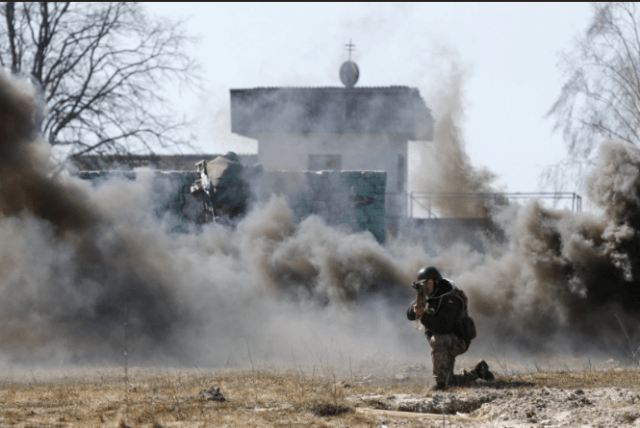
Ukrainian soldiers repel attacks in Avdiivka, March 31, 2016. Photo: Military TV of Ukraine

Ukrainian soldiers repel attacks in Avdiivka, March 31, 2016. Photo: Military TV of Ukraine

In the Zaitseve and Zhovanka area, terrorists fired up to 300 mortars, shells and SPG-9 grenades at Ukrainian troop positions in the first half of the day [03.31] alone. Near Horlivka, the artillery group of the militant “3rd separate motorized rifle brigade,” after receiving extra ammunition, fired at the northwestern outskirts of Holmivskyi (where the terrorists’ own positions are located), following which hysteria broke out in the “DNR” media about the “shelling of civilians by a despicable Ukrainian punitive unit.”

In the coastal regions, the enemy is actively using 120-mm mortars in addition to other weaponry: firing on the northern outskirts of Vodyane, the ATO forces’ checkpoint on the motorway to Mariupol near Vodyane, as well as on Ukrainian troop strongholds and observation posts east of Talakivka and Hnutove.

South of Donetsk, well-trained groups of militant snipers have appeared in several sections at once (Hranitne, Pavlopil, Vodyane). Terrorist sniper groups are also active in the area of Opytne and Pisky, operating simultaneously with shelling from grenade launchers and heavy machine guns.

In the Avdiivka area, militants are using Russian POM-2 “Otyok” antipersonnel mines, set in place using remote mine laying methods. These landmines are prohibited by international convention.
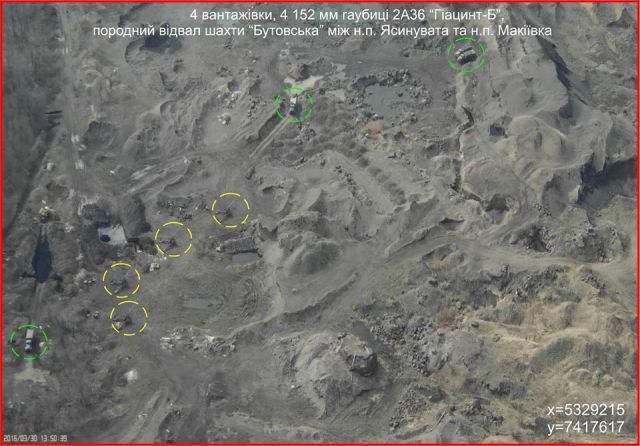
March 31, 2016 photo of Russian firing positions near Avdiivka, at Butovka mine. "Four trucks, four 152 mm howitzer 2A36 Giatsint-B. Butovska mine slag heaps inbetween the settlements of Yasynuvata and Makiivka. Photo: ATO Press Center https://www.facebook.com/ato.news/photos/pcb.1176613312349473/1176612459016225/?type=3&theater

March 31, 2016: Photo of Russian firing positions near Avdiivka, at Butovka mine. “Four trucks, four 152 mm howitzer 2A36 Giatsint-B. Butovska mine slag heaps inbetween the settlements of Yasynuvata and Makiivka. Photo: ATO Press Center

Due to the activities of “LNR” militants, the “Zolote” entry-exit checkpoint in Luhansk Oblast was closed immediately after being opened. When attempts were made to enter/exit the occupied territory through this checkpoint, terrorists would stop vehicles on their side [of the checkpoint] and beat the people travelling in them (several cases were noted). Commanders of the armed gangs operating in the area asserted that the Ukrainian side “did not coordinate” the opening of the checkpoint with them. Predictably, the local “LNR” population blames Ukraine for the checkpoint closure.

In Horlivka, following the casualties in the “3rd separate motorized rifle brigade” (the “Horlivka Brigade” – up to 10 terrorists were destroyed on 30.03.2016), the militants began to spread rumors about the “arrival of snipers from the US Marine Corps at the front.” These rumors are universally believed in militant circles.

An inspection committee from the “[DNR Army] Corps HQ” is starting work in the “100th Brigade” of the “DNR Army,” checking for fraud involving payments and allowance issued to “ghost employees.” Before the commission arrived, the brigade commanders seized so-called “military service cards” from the militants under their command.

The “1st Army Corps” is considering constructing its own military medical treatment center, since civilian hospitals are unable to meet militants’ needs (mainly due to a lack of medicines and medical equipment). A preliminary decision has been made to set up another “field hospital” in Yenakijeve.
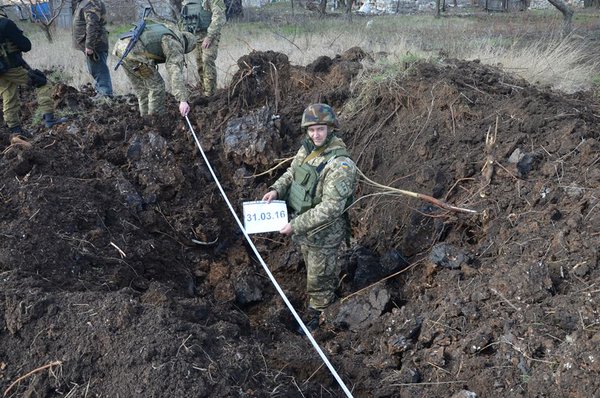
Russian forces used D-30 and MSTA-B howitzers against Ukrainian positions yesterday, March 31, 2016. Photo: https://twitter.com/InfoResist/status/715845505788559364

Russian forces used D-30 and MSTA-B howitzers against Ukrainian positions yesterday, March 31, 2016. Photo source

In Sverdlovsk, the high command of the “2nd LNR Army Corps” is conducting an investigation into an incident where a militant from the “4th separate motorized rifle brigade” threw a grenade at civilians. As a result of the militant’s action, six persons were injured (two of them, gravely). The militant was under the influence of alcohol.

The “LNR Ministry of State Security” held a meeting to discuss combating the rumors currently being spread among the local population about an imminent “return of Ukraine.” According to these rumors, spreading particularly actively among officials of “LNR state structures,” severe punishment awaits all those who have collaborated with the terrorists, after the arrival of Ukrainian troops expected in the near future. The “Ministry of State Security” suggests that, in addition to identifying and “neutralizing” the disseminators of such rumors, “counter-rumors” should be spread: stating that in the case of Ukrainian forces’ arrival, all inhabitants, without exception, will pass through filtration camps and be forced to relocate to other regions.

Video: Ukrainian troops repel attack near Avdiivka. Posted on April 1, 2016 by Military TV of Ukraine:

Source: Dmitry Tymchuk FB 


Glossary:

AC – Army Corps
ACV – armored combat vehicle
AGS-17 – automatic grenade launcher
ATO – Anti-Terrorist Operation
BMP – infantry fighting vehicle
BTG – battalion tactical group
BTR, APC – armored personnel carrier
BRDM – armored reconnaissance and surveillance vehicle
BRM – armored reconnaissance vehicle
DAP – Donetsk International Airport
DNR – “Donetsk People’s Republic”
DRG – sabotage and reconnaissance group
ELINT – Electronic Intelligence
GUR – Defense Intelligence
KSM – command and staff vehicle
LNR – “Luhansk People’s Republic”
MGB – Ministry of State Security
MOD – Ministry of Defense
MT-LB – light multipurpose tracked vehicle
MLRS – multiple-launch rocket systems
OMSBR – Independent Motorized Rifle Brigade
SBU – Ukrainian Secret Service
SPG-9 – stand-mounted grenade launcher
TZM, TLV – transporter-loading vehicle
UAV – Unmanned Aerial Vehicle (drones or other)
ZU-23-2 – anti-aircraft artillery system


Creative Commons License
This translation work is licensed under a Creative Commons Attribution-ShareAlike 4.0 International License. The rights pertaining to the original work remain unaffected.
Posted in Dmitry Tymchuk, English News, Pictures, South&Eastern Ukraine, War in Donbas | Tagged , , , , , , , , , , , , , , , , , | Leave a comment

Dmitry Tymchuk: Military update 03.30 #FreeSavchenko

information_resistance_logo_engDmitry Tymchuk, Head of the Center for Military and Political Research, Coordinator of the Information Resistance group, Member of Parliament (People’s Front)
03.30.2016
Translated and edited by Voices of Ukraine

(See end of post for acronym glossary)

Operational data from Information Resistance:

Without scaling down their activity, Russian-terrorist troops have slightly changed their tactics, focusing their shelling on individual sectors. They still resort to the “traditional” range of weaponry: grenade launchers, mortars, ZU-23-2’s, heavy machine guns, and occasionally armored vehicles (including tanks), as well as 122 mm and 152 mm artillery.

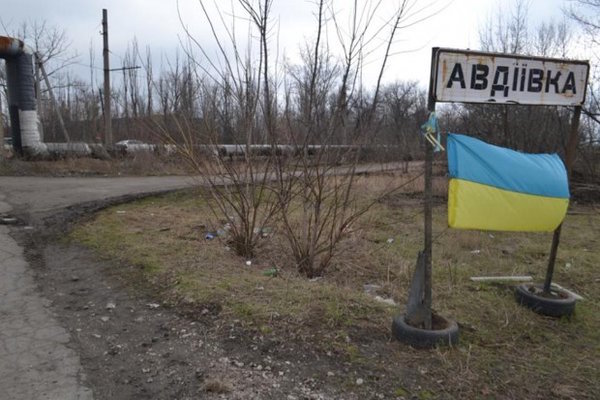
In the vicinity of Avdiivka, we note increased activity by enemy DRGs, which covertly approach Ukrainian troop positions and open fire from close range, using small arms and under-barrel grenade launchers. A new terrorist 152 mm self-propelled artillery unit (four “Akatsiyia” SAU 2S3’s) is located on a firing position south of Yakovlivka. From time to time, the unit advances to the firing line, then turns around and retreats without opening fire: as practice for firing on the Avdiivka “industrial zone.”

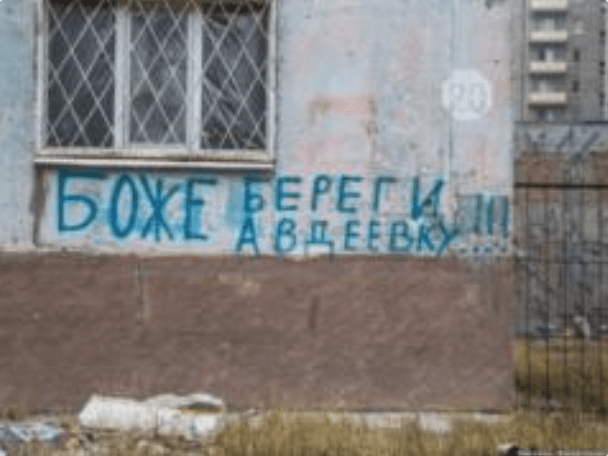
Avdiivka graffiti: "God protect Avdiivka"

Avdiivka graffiti: “God protect Avdiivka”

Increased militant activity has been observed in the Zhovanka–Zaitseve area. During the past 24 hours, terrorists in this area fired about 175 mortar rounds (82 mm and 120 mm) at Zaitseve and on positions west and north of it. The enemy also used tanks in this area, in two instances (from the forested area northeast of the Mayorsk automobile market, a pair of militant tanks operated in “carousel” fashion: alternately firing a series of three to five high explosive rounds). The ATO forces’ positions near Zaitseve also came under fire from militant 152 mm artillery.

Militant sniper groups became more active near Shchastya, firing at the ATO forces’ observation point and two strongholds in the area.

Near Dokuchajevsk (Tsentralnyy Karyer), terrorists further reinforced the troops concentrated here with bringing in a mortar unit (three 120 mm mortars) and two BMP-2’s. Militants are firing mortars from the back slopes of Tsentralnyy Karyer [Central Quarry], as well as from the residential districts of Dokuchajevsk.

On the stretch between Yasynuvata and Spartak, militants are building up their tactical groups. Apart from the “Pyatnashka” battalion, which consists mainly of units of Abkhazian mercenaries (currently the main enemy strike force in the “industrial zone” area), armed combat vehicles and militant personnel are accumulating near the engineering works in Yasynuvata (in total, up to 20 various armored combat vehicles, mainly BMP-1’s and -2’s, plus a reinforced company of up to 140-150 personnel). Given that similar-sized militant tactical groups are deployed directly in the area of Yasynuvata junction, Mineralne, and north of Yakovlivka, [it is obvious that] the high command of Russian-terrorist forces is not only preparing to continue active operations in this area, but is also afraid that Ukrainian troops might break through to the northern and western outskirts of Yasynuvata.


In Makiivka, the “Somali” battalion base, currently in the process of disbandment, is being transported by truck to the southern direction of operations. Simultaneously, the “DNR Ministry of State Security” has begun a major operation in Makiivka to find and neutralize (as quoted in the instruction sheets) “undercover subversive groups” of the Ukrainian troops (to date, up to ten local residents have been arrested on suspicion of involvement in these mythical DRGs). In addition, by order of the high command of the “1st DNR Army Corps (AC),” any transfer of personnel, equipment or weapons towards Horlivka and Yasynuvata through the area of Makiivka must circumvent the settlement.

A shootout was reported in the “DNR 5th separate motorized rifle brigade,” between a terrorist “company commander” and his subordinates. In the course of a conflict, the “commander” used a firearm, and his subordinates returned fire. As a result, two injured personnel were hospitalized, and two more militants deserted.

In the “DNR,” a large-scale campaign is being mounted to combat the “contraband of medical products” from Ukraine-controlled territory. Militant units that are currently inspecting and checking citizens and vehicles at the entry to occupied areas have received instructions to tighten their inspections, specifically looking for any medicines. A belief prevails in the “DNR law enforcement” circles that this campaign is connected to the “DNR” leadership’s current efforts to set up a system of organized smuggling of medicines from the Russian Federation.

Source: Dmitry Tymchuk FB 


Glossary:

AC – Army Corps
ACV – armored combat vehicle
AGS-17 – automatic grenade launcher
ATO – Anti-Terrorist Operation
BMP – infantry fighting vehicle
BTG – battalion tactical group
BTR, APC – armored personnel carrier
BRDM – armored reconnaissance and surveillance vehicle
BRM – armored reconnaissance vehicle
DAP – Donetsk International Airport
DNR – “Donetsk People’s Republic”
DRG – sabotage and reconnaissance group
ELINT – Electronic Intelligence
GUR – Defense Intelligence
KSM – command and staff vehicle
LNR – “Luhansk People’s Republic”
MGB – Ministry of State Security
MOD – Ministry of Defense
MT-LB – light multipurpose tracked vehicle
MLRS – multiple-launch rocket systems
OMSBR – Independent Motorized Rifle Brigade
SBU – Ukrainian Secret Service
SPG-9 – stand-mounted grenade launcher
TZM, TLV – transporter-loading vehicle
UAV – Unmanned Aerial Vehicle (drones or other)
ZU-23-2 – anti-aircraft artillery system


Creative Commons License
This translation work is licensed under a Creative Commons Attribution-ShareAlike 4.0 International License. The rights pertaining to the original work remain unaffected.
Posted in Dmitry Tymchuk, English News, Pictures, South&Eastern Ukraine, War in Donbas | Tagged , , , , , , , , , , , , , , , , , | Leave a comment

Dmitry Tymchuk: Military update 03.25 #FreeSavchenko

information_resistance_logo_engDmitry Tymchuk, Head of the Center for Military and Political Research, Coordinator of the Information Resistance group, Member of Parliament (People’s Front)
03.25.2016
Translated and edited by Voices of Ukraine

(See end of post for acronym glossary)

Operational data from Information Resistance:

In the past 24 hours in the ATO zone, the situation was at its most tense in the Avdiivka, Zaitseve and Mayorsk area, with increased militant activity in the coastal region. In addition to shelling actively, the Russian-terrorist forces continue to actively employ “minor warfare” tactics – laying mines to disrupt communications in the Ukrainian troops’ tactical rear and using sniper and DRG teams at the front line. Operating in the immediate rear, militant sabotage groups seek to destroy Ukrainian troop vehicles, engineering equipment and light armor, for which purpose DRG personnel are equipped with hand-operated and stand-mounted anti-tank grenade launchers.

The enemy is also actively conducting reconnaissance via ground, radio-electronics and air (using UAVs).

During attacks and provocations, the terrorists make use of a wide spectrum of weapons for their shelling and provocations: heavy machine guns, stand-mounted grenade launchers (anti-personnel and anti-tank), 82 mm and 120 mm mortars, in some cases armored vehicles and 122 mm cannon artillery. Along with the intensified shelling, militants simultaneously “closed down” several sections along the demarcation line to movement by both local residents and OSCE inspectors.

Near Zaitseve, ATO forces’ positions came under fire from 122 mm cannon artillery (eight rounds fired). The artillery fire was of a range-finding nature. Prior to this, as part of the rotation of Russian-terrorist troop units, new militant artillery units who arrived in Horlivka are conducting this shelling.

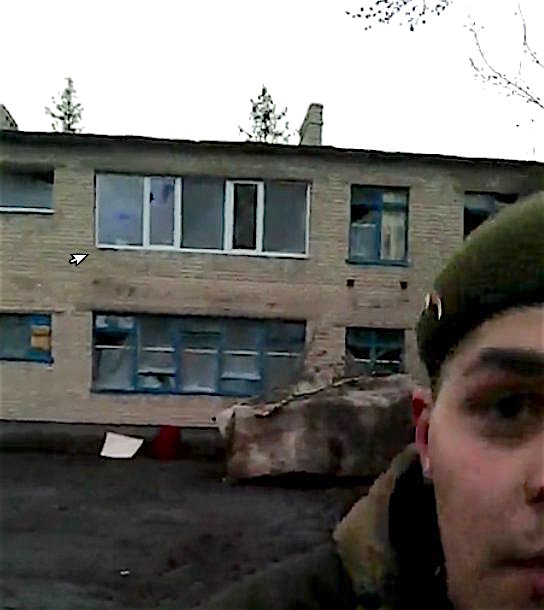
Putin's orcs hide a BMP beneath the wall of a school turned into a stronghold base in Zaitseve, March 17, 2016. (1/2) Photo.

Putin’s orcs hide a BMP beneath the wall of a school turned into a stronghold base in Zaitseve, March 17, 2016. (1/2) Photo.

Near Dokuchajevsk, militants continue to use 120mm mortars and light armored vehicles (BMP-1’s and 2’s). Terrorists subjected this sector twice to intensive shelling, including with the use of these weapon systems. Intensified enemy activity is also evident in the area of Pisky, Opytne and the air collector shaft of the Butovka mine. Along the broad stretch from Avdiivka to the north and north western sections of Horlivka (Mayorsk, Zaitseve), militants are actively using 82-mm and 120-mm mortars.

Putin's orcs hide a BMP beneath the wall of a school turned into a stronghold base in Zaitseve, March 17, 2016. (2/2) Photo.

Putin’s orcs hide a BMP beneath the wall of a school turned into a stronghold base in Zaitseve, March 17, 2016. (2/2) Photo.

Armed gangs on different sections of the front have been supplied with mobile firing groups. These include several weapons (sometimes 82 mm and 120-mm mortars, or more often, ZU-23-2 anti-aircraft guns) installed on vehicles (usually an army truck). Typically, a firing group consists of 2-3 items of weaponry (sometimes 1-2 items). These groups mount a short but intensive fire attack on a previously reconnoitred target (a settlement, stronghold, flank position) and promptly leave their firing position (most of the time, they remain deep in the tactical military orders of the armed gangs).

The militants’ high command is accelerating the process of fully manning units of the 5th and 7th separate motorised rifle brigades operating on the front line. Resupply is conducted in a forced order – military equipment and personnel are being transferred urgently, including from the armed gangs deep in the rear (e.g. from the current personnel of the so-called “training centers” and “Ministry of State Security (MGB)” units).

In Donetsk, militants continue preparing for the mythical “Ukrainian troop offensive.” In the western part of the city (Petrovskyi district), as well as in the (north western part of the) Kyivskyi district, the terrorists have additionally equipped two battalions of the defence district.

A militant communication center has been set up on Sosyury Street in Debaltseve near the residences building belonging to the railway technical school. Three special-purpose automobiles equipped with radio antennas and manned by personnel displaying Russian Armed Forces insignias are constantly in position there.

A structural unit for propaganda of up to 10 persons has been created in the command of the “1st Army Corps of the DNR,” which coordinates the activities of propagandists among the troop units (in the Corps brigades and separate battalions). The number of propagandists per unit ranges from 2 to 4 persons. Their responsibilities include distributing the “DNR” press and propaganda literature to militants, controlling the psychological morale of personnel, and gathering unit combat data for further transmission to the Corps’ propaganda section leaders for processing and publication by the “DNR Ministry of Defense” press service. “Service personnel” with a higher education are being engaged to perform the propagandist duties.

In Luhansk and Donetsk, militants are spreading official information in the “command structures of the Army Corps” that in both cities there are several well-trained foreign specialists of “Ukrainian DRG units” and “SBU liquidators of the GUR MOD” [Main Intelligence Service of the Ministry of Defense of Ukraine], whose methods are to eliminate the representatives of the terrorist military command. In this connection, the heavily guarded commands of the “1st AC of the DNR” and “2nd AC of the LNR” have been reinforced, while MGB [Ministry of State Security] forces have conducted a special information gathering operation to search for the mythical DRG units. At the same time, the “Horlivka garrison” militants are spreading information about the preparation of the Special Operations Forces of the Armed Forces of Ukraine for terrorist acts and sabotage in “the Horlivka chemical plants.” Militants have sharply increased security at the “Stirol” company, causing panic among the local population.

The “DNR” leadership is continuing to carry out activities to create a “naval fleet.” In Sjedove, Novoazovskyi district, the IR group network has recorded six motor launches “requisitioned” from the local population to the “DNR fleet.” The boats have been stationed near the former canning factory. Mortars have been installed on two motor launches, and heavy machine guns installed on the other four.

Source: Dmitry Tymchuk FB 


Glossary:

AC – Army Corps
ACV – armored combat vehicle
AGS-17 – automatic grenade launcher
ATO – Anti-Terrorist Operation
BMP – infantry fighting vehicle
BTG – battalion tactical group
BTR, APC – armored personnel carrier
BRDM – armored reconnaissance and surveillance vehicle
BRM – armored reconnaissance vehicle
DAP – Donetsk International Airport
DNR – “Donetsk People’s Republic”
DRG – sabotage and reconnaissance group
GUR – Defense Intelligence
KSM – command and staff vehicle
LNR – “Luhansk People’s Republic”
MGB – Ministry of State Security
MOD – Ministry of Defense
MT-LB – light multipurpose tracked vehicle
MLRS – multiple-launch rocket systems
SBU – Ukrainian Secret Service
SPG-9 – stand-mounted grenade launcher
TZM, TLV – transporter-loading vehicle
ZU-23-2 – anti-aircraft artillery system


Creative Commons License
This translation work is licensed under a Creative Commons Attribution-ShareAlike 4.0 International License. The rights pertaining to the original work remain unaffected.
Posted in Dmitry Tymchuk, English News, Pictures, South&Eastern Ukraine, War in Donbas | Tagged , , , , , , , , , , , , , , , , , | 1 Comment

Mustafa Dzhemiliev: UN Security Council Speech – March 18, 2016

By Mustafa Dzhemilev
03.18.2016
Translated and edited by Voices of Ukraine

Speech by the leader of the Crimean Tatars, MP of Ukraine, representative of the President of Ukraine for the Crimean Tatar people Mustafa Dzhemiliev UN SECURITY COUNCIL MEETING on March 18, 2016

Mustafa Dzhemilev

Mustafa Dzhemilev

“Dear members of the UN Security Council, ladies and gentlemen!

A month ago, it was 2 years since the beginning of the occupation of the Crimean Peninsula by Russia’s armed forces. The day before yesterday, March 16th, marked the 2-year anniversary of the so-called “referendum,” which was organized by the Russian authorities to give some “legality” to the Russian Federation’s annexation of this occupied territory.

As of the time of this “referendum,” Russian armed commandos without insignia had already captured almost all of the public institutions in Crimea. All the TV and radio channels were also captured, and their frequencies used to broadcast Russian propaganda. So called “self-defense” gangs roamed the streets, made up of underclass elements [of society] and armed mostly “with sticks.” Those who tried to publicly express a negative view of these events faced unpleasant, even lethal, surprises. For example, Reshat Ahmetov, a 39-year-old father of three, who came out onto the central square of Simferopol carrying a Ukrainian flag and [a banner with] the slogan “Down with the occupation!” He was seized by a detachment of the so-called “Crimean self-defense,” which was headed by the current “prime minister” of Crimea [Sergey] Aksyonov and taken to an undisclosed location. The day before the “referendum,” his dead body, blinded and bearing signs of horrible torture, was found on the outskirts of the city on the other side of Crimea.

We were pleased to see that this time, the international community was not so indulgent with the aggressor’s actions, unlike the Russian attack on and partial occupation of Georgia in August 2008. Few were impressed by the ludicrous and absurd arguments of the aggressor country, claiming that [the annexation] was the will of the inhabitants of Crimea, and that [Russia’s actions] protected them from the savage Ukrainian nationalists. Thus, as we know, on March 27, 2014, the UN General Assembly adopted a resolution condemning the illegal “referendum” and the annexation of Crimea, by an overwhelming majority, with only ten small countries voting in favor of the aggressor. But this resolution was ignored by Russia and did nothing to reduce its aggression against Ukraine.

Less than one month later, on April 7, 2014, regular Russian troops, together with militants trained and armed by Russia, began military operations in eastern Ukraine, resulting in the occupation of parts of the Donetsk and Luhansk oblasts, of a combined area approximately equal to the territory of Crimea.

According to some sources, by May 2015, the number of dead Ukrainian soldiers and civilians, including young children, approached 10 thousand, with thousands more people left disabled for life. About 2 million people have become refugees. The financial damages from the shelling of Ukrainian territory by Russia and their mercenaries in the Luhansk and Donetsk oblasts, is countable in the hundreds of billions of dollars.

I believe that my colleagues from Ukraine will elaborate further on the human rights situation in occupied Crimea. Myself, I would just like to list the most important [human rights issues], mainly checking them against the requirements of the Geneva Conventions of August 12, 1949 on the protection of civilians in occupied territory.

A terrorist regime has been established in occupied Crimea, which in many ways resembles the worst years of the Soviet communist regime.

Democratic freedoms that existed on the territory of Crimea since the proclamation of Ukraine’s independence, have been completely eliminated starting from the first days of the Russian occupation.

At all international conferences, Russian authorities are boasting that almost all the inhabitants of Crimea voluntarily received Russian passports and became Russian citizens. In fact, there has never been and still isn’t anything voluntary about it. Those who do not have Russian passports simply cannot exist on the peninsula – they can neither study nor work, nor establish property ownership, nor get medical care. The indigenous peoples of Crimea, who wish to remain in their homeland, in their homes, which they had worked incredibly hard to rebuild after returning from the places of Stalin’s deportation – if they do not wish to receive Russian passports, they are forced to ask their occupiers for the right to reside as nationals of a foreign state. And the occupier’s quota for issuing residence permits is no more than 5 thousand a year.

Article 49 of the Geneva Convention of August 12, 1949 on the protection of civilians clearly prohibits the deportation of the inhabitants of an occupied territory. Even in the first weeks of their occupation, the occupation authorities had already deported the leaders of the indigenous people of Crimea, the Crimean Tatars. The occupiers’ subsequent strategy concerning the indigenous inhabitants of Crimea, is to resort to persecution, iniquity, and humiliations of their dignity and religious feelings, so as to make them leave Crimea of their own accord.

The same article of the Geneva Convention prohibits the occupying power from relocating parts of its own population to the occupied territory. But according to the official data of the occupation authorities in Crimea, no less than 15 thousand people have been brought from Russia. Most of them are officials at various levels. If we add to this no less than 70 thousand Russian troops in Crimea, as well as thousands of ordinary immigrants from Russia, who are receiving land plots for free or on preferential terms, the number of Russian citizens in occupied Crimea is at least one hundred thousand.

Article 51 of the Geneva Convention of 1949 prohibits enlisting citizens of the occupied territory into the occupier’s armed forces or even auxiliary forces. In my hands right now, I have dozens of military summons, demanding [that the addressees] report to the military commissariat for enlistment in the Russian Federation’s armed forces, or suffer the penalties under the relevant article of the criminal law. Several dozen young men have already returned to Crimea in zinc coffins, after being sent to war in Syria to support the dictatorial regime of Bashar al-Assad.

In accordance with Article 64 of the 1949 Geneva Convention, the occupied territory shall retain its criminal laws, and the criminal law of the occupier country shall not be applied. In Crimea, Russian law applies exclusively. Mass searches are conducted, on the basis of an article of the law imposing criminal liability for the possession of “banned literature.” In the criminal law of Ukraine, the term “banned literature” does not exist.

The overwhelming majority of searches are carried out in the homes of Crimean Tatars. It is estimated that, of the more than 200 searches carried out recently, some 95% were done in Crimean Tatar homes, schools and mosques. As a rule, these searches are carried out with gross violations of procedural law, are accompanied by material damage and humiliation of human dignity, and have an explicit aim of maximizing the intimidation of those being searched.

Intimidation is also carried out by means of arrests and lawsuits on perfectly unjust accusations, made against the people who don’t recognize the legitimacy of the Crimean occupation.

Article 70 of the Geneva Convention of 1949 stipulates that an occupying power cannot subject citizens of the occupied territory to harassment, arrest and trial for actions or opinions expressed by them before the occupation. But several people have been imprisoned for over a year now, including Ahtem Chiygoz, the deputy chairman of the supreme representative body of the Crimean Tatars – the Mejlis of the Crimean Tatar people. They are accused of organizing and actively participating in the meeting against separatism that took place in Simferopol on February 26, 2014 – that is, a full three weeks prior to the so-called “referendum” on the annexation of Crimea to Russia.

According to Article 76 of the Geneva Convention of 1949, citizens who are sentenced in the occupied territory shall not be moved to the territory of the occupying country, but must serve their sentences in their territory. But Ukrainian citizens Oleg Sentsov, Gennady Afanasyev, Alexander Kolchenko, Alexei Chirniy and others, who, after inhuman torture, were sentenced to long prison terms for public demonstrations against the occupation of Crimea, were sent to serve their sentences in the Siberian camps of the Russian Federation.

During interrogations, almost all of the arrested and detained opponents of the occupation regime are beaten and subjected to inhuman torture, including electric shocks. The occupiers have used torture even on persons who are not suspected of anything, but whom the occupiers want to coerce into cooperation. Thus, on December 16th of last year, the 24 year-old resident of Dzhankoy, Yenver Krosh, was subjected to several hours of electric shocks, as a means to force him into writing a statement about his willingness to cooperate with the FSB as an informant.

But the most fearsome and repulsive means of intimidation that the occupiers resort to are abduction and murder. To date, 22 such cases have been registered. The dead bodies of some of these people were found, bearing signs of torture. About the rest, there is no information and presumably, all of them have long been dead. For obvious reasons, the occupation authorities take no action on missing persons, or simply pretend to be searching for them. Moreover, the FSB effectively uses the facts of peoples’ disappearance to intimidate and suppress the will of the people. Frequently, in order to obtain the necessary evidence during the interrogation of Crimean Tatars, FSB investigators will say: “Are you not afraid to disappear without a trace?” or “Are you not afraid that your kids might disappear?”

At present, the occupation authorities are considering declaring the Mejlis of the Crimean Tatar people an extremist or terrorist association, and banning it. The main reason for such accusations is that the Mejlis, which is elected directly by the Crimean Tatar people through democratic elections and therefore, represents all the indigenous people of Crimea, does not recognize the legitimacy of the occupation, and remains loyal to its country – Ukraine. Therefore, from the standpoint of the occupation authorities, it is a structure that represents a “threat to the security and territorial integrity of the Russian Federation.” This matter was up for review in the so-called “Supreme Court of the Republic of Crimea” in Simferopol, but the results are not yet known.

If the court makes such a decision, it could mean the beginning of mass reprisals not only against members of the Mejlis of the Crimean Tatar people, which consists of 33 persons, but also of the entire system of the national government of the Crimean Tatars, which also includes 248 permanent delegates to the National Congress (Qurultay), and about 2300 members of local and regional Mejlis’ throughout Crimea. From the occupier’s point of view, they will be guilty of being chosen by the Crimean Tatars as their representatives. In essence, this means war and repression against the entire Crimean Tatar people.

I believe that such actions by the occupiers against all indigenous people of Crimea, and their expanding repressions against all who do not accept the occupation of Crimea, are sufficient reasons to introduce new and harsher economic and individual sanctions against the Russian Federation.

I have absolute certainty that no effort of the international community can ensure full respect for human rights in Crimea, until that land is liberated from occupation. Therefore, all measures should aim to force the aggressor to leave all the occupied territories of Ukraine, and to hold the occupier-country’s leaders accountable for all crimes committed on the territory of Ukraine.

Thank you for your attention.

Source: Representative of the President of Ukraine for the Crimean Tatar people, Mustafa Dzhemiliev FB page 


Creative Commons License
This translation work is licensed under a Creative Commons Attribution-ShareAlike 4.0 International License. 

Posted in #Free Savchenko, English News, Pictures | Tagged , , , , , , , , , , , , , , , , , , , , , , | 1 Comment

Nadiya Savchenko – Letters from prison March 23, 2016 #FreeSavchenko

By Nadiya Savchenko, tweeted by her lawyer Mark Feygin and posted by her sister Vira Savchenko
Posted on 03.23.2016
Translated and edited by Voices of Ukraine

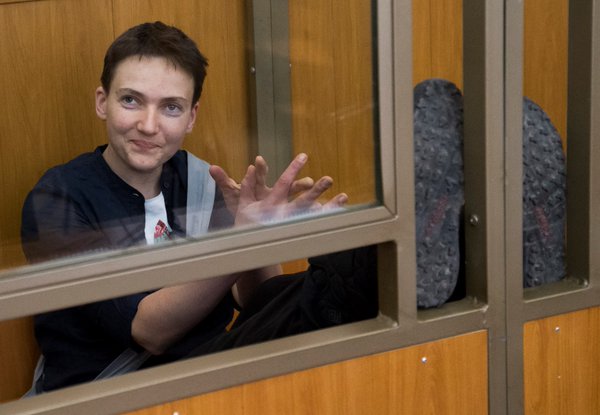
AP Photo/Ivan Sekretarev

AP Photo/Ivan Sekretarev

Nadiya Savchenko’s lawyer Mark Feygin writes on the first letter he tweets:
“Just came out from meeting with Nadiya Savchenko in prison. She has no regrets and thanks everyone.”

Savchenko writes:
“Thank you – to the deputies of Ukraine, and all the people from Ukraine and Russia who came to support me on the day of the verdict. That was great! We showed everyone an obvious revelation that the Russian court is not the law, but a Big Top Circus!

The judges and prosecutors looked totally miserable, and after the trial went to drown their troubles in vodka! Their torment is finally over! Or so they think. In truth, by passing my verdict, they signed a death sentence for themselves!

Ukrainians – thank you for the Anthem and Flag of Ukraine in the Russian courtroom! :)))

With Ukraine in my heart,
and with sincere gratitude to you.
[signed] Nadiya Savchenko.

Thank you to my three lawyers, Feygin, Polozov and Novikov, for standing in the courtroom like a powerful wall, protecting me from evil eyes, evil tongues and evil people even on the day of the verdict, even though they had no obligation to do so.

Thank you for going through this battle with me to the end!

[signed] Nadiya Savchenko.

Ukrainians,

I sincerely thank you for not leaving me. Together, we will not abandon other Ukrainians held captive in Russia, and we will save Ukraine! I eagerly await our meeting, FREE and in Ukraine!

With Ukraine in my heart,
and with gratitude to you
[signed] Nadiya Savchenko.

[to her sister, Vira Savchenko]

Little Hamster, if I didn’t have a sister like you, I would have perished a long time ago. Kisses on your nose. 🙂 ”

Source: Mark Feygin Twitter 1

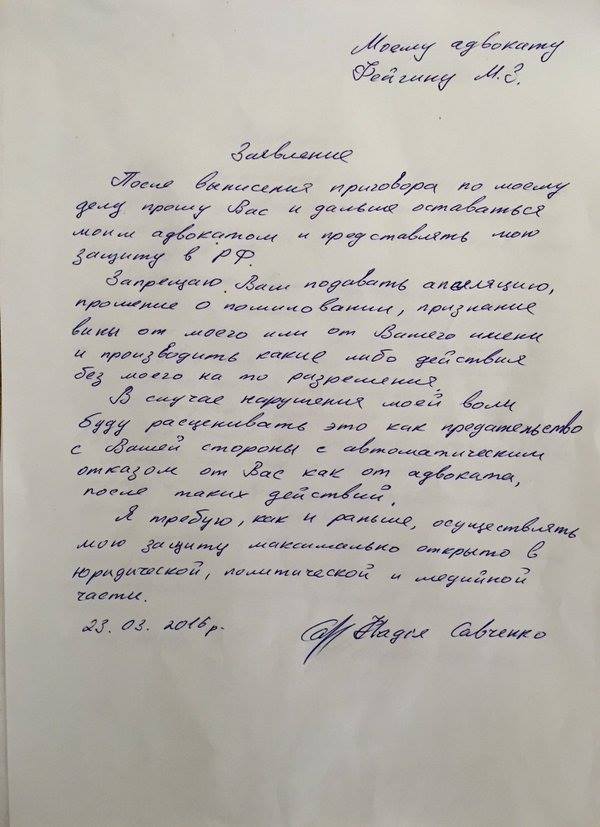
Feygin writes on the second letter he tweets:
“Nadiya renewed her agreement with me.”

Savchenko writes: 

“To my lawyer Mark Feygin

Declaration

After the verdict in my case is announced, please remain my lawyer and continue representing my defense in the Russian Federation.

I forbid for you to file any appeal, petition for a pardon, or admission of guilt in my case in your name, or to carry out any action without my consent.

Should you act against my will as described above, I will consider your actions a betrayal, immediately renouncing you as my lawyer.

I demand that my defense is conducted with maximum transparency in the legal, political and medical aspects, as it has been until now.

23.03.2016                                                                                [signed] Nadiya Savchenko

Source: Mark Feygin Twitter 2

This one appeared on the Savchenkos’ official correspondence page:

“Thank you to the good people of the world for making my final day of trial so brilliant and unforgettable! 🙂 

I sincerely thank you, that for all this time of my captivity in the Prison of the Peoples–Russia, you did not give me reason to lose heart, and showed me that there is a lot of good in the world. 

I am alive thanks to you.

With sincere appreciation
[signed] Nadiya Savchenko.

Source: Nadiia Savchenko FB 


Creative Commons License
This translation work is licensed under a Creative Commons Attribution-ShareAlike 4.0 International License. 


Posted in #Free Savchenko, English News, Pictures | Tagged , , , , , , , , , , , , , , , , , , , , , , , , | Leave a comment