By Digests & Analytics UkraineNews Agency, Kyiv
10.14.2014 Re-posted by Voices of Ukraine, with permissions.
14/10/2014 Ukraine: Daily Highlights – Verkhovna Rada adopted a package of anti-corruption laws
Riots near the Parliament. Anti-corruption legislation package has been adopted. National Guards Commander Poltorak is the new Defense Minister. Marches dedicated to the anniversary of the Ukrainian Insurgent Army went on without excesses.
Ukraine
Verkhovna Rada adopted a law on increasing of the criminal liability for violation of election law and for voter bribery.
Also a package of anti-corruption legislation, introduced by the Government, has been adopted as well as an anti-corruption bureau has been created, introduced by the Government. According to the adopted legislation, 1) officials must fully disclose all sources of their income, 2) public access to the property ownership register will be provided and 3) companies will have to declare all their final beneficiaries. Structure and functions of the prosecutors office were changed by the new legislation. President Poroshenko declared readiness to sign the new legislative initiatives immediately.
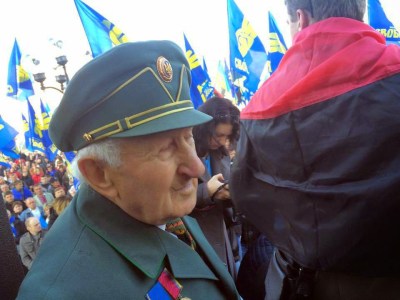
Thousands of people joned “Marches of Heroes”, which took place in Kyiv, Kharkiv and Odessa. The marches were organized by volunteer battalions “Azov”, “The Right Sector”, and “Svoboda” party and dedicated to the anniversary of the Ukrainian Insurgent Army (UIA).
Protesters engaged in a fight with police near Verkhovna Rada under the pretext of recognition of UIA fighters as a belligerent party. Police detained up to 50 persons accused of mass riots.
National Council of Anti-corruption Policy, established by the President, will be a consultations and analytics body.
National Guards Commander Poltorak has been approved by Verkhovna Rada as the new Defense Minister.
Central Election Commission has asked Verkhovna Rada to legally regulate issues of the election in the Donbass combat zone.
The process of revising of party lists with respect to inclusion and cancellation of registration of candidates for early elections to the Verkhovna Rada has been completed. Democratic forces have agreed on a single candidate in many districts.
Vice Prime Minister Groysman said that the heating season in the Country will start on the 1st of November. However, the Government is ready to change the date if the weather conditions become unfavorable.
SSU declared that the National Guards protest near the Presidential Administration was organized by the Russian security services with the use of the social network “VKontakte”, but mass riots have been prevented.
NBU Head Gontareva believes that adoption of the anti-corruption legislation will make Ukraine more attractive for foreign investors. The IMF praised the actions of the National Bank to resolve the the currency crisis and believes that Ukraine is able to pay its foreign debts. According to the statement of the Minister of Finance Shlapak, the program of cooperation with the IMF does not require adjustments. Cash foreign currency reappeared at cash desks of major banks. The official exchange rate is established at the level of 12.95 UAH/USD, 16.42 UAH/EUR (+ 6 cop) and 3.21 UAH/10 RUR (-1 cop).
Naftogas has filed a lawsuit against Gazprom with the Stockholm Arbitrage, aiming to ensure the current contract is in line with international and Ukrainian legislation, retrieve compensation of losses from the decline of supply volume and establish economically justified tariffs for the gas transit.
Kyiv
Mayor Klichko approved a former top manager of companies, belonging to oligarch Yurushev, as the Head of Construction Department of the Kyiv Administration.
War in Ukraine
Seven civillians were killed and seventeen wounded during artillery shelling by militants of the funeral procession in the suburbs of Mariupol. A day mourning has been announced in the city.
Militants attacked Ukrainian Army checkpoint near Bakhmutka in Luhans’k region. Ukrainian military repelled another powerful assault of Donetsk International Airport and an attack of positions in Debaltseve.
Dmitry Tymchuk, Head of the Center for Military and Political Research, Coordinator of the Information Resistance group
10.15.2014 Translated and edited by Voices of Ukraine
According to Information Resistance operational data, yesterday, October 14, local residents in Sverdlovsk, Rovenki and Antratsyt and representatives of Russian “Cossack” groups reported on the establishment of a “Cossack People’s Republic.” At the entrances to Sverdlovsk, they have installed Cossack checkpoints.
In occupied Crimea the accumulation of Russian occupation troops continues from formations of new units.
In particular, in Simferopol, in the composition of coastal forces, the BSF [Black Sea Fleet of the Russian Navy] 8th separate Artillery Regiment was formed, with operational command of the Southern Military District. Their weapons – about 60 pieces of artillery and rocket artillery systems (self-propelled howitzers and MLRS “Tornado”), as well as the ATGM.
In the area of the isthmus (Armyansk), the formation of a mixed artillery unit of the occupation troops from subsequent units of the Russian Federation Armed Forces (from the Black Sea Fleet, as well as earlier those who had been transferred to Crimea). Formed are:
• The 8th SAR (BSF) [Separate Artillery Regiment of the Black Sea Fleet, Russian Navy],
• The 810th marine brigade (BSF) artillery unit,
• The 943rd reactive artillery regiment,
• The 291st Artillery Brigade,
• The 205th Motorized Rifle Brigade.
Dmitry Tymchuk, Head of the Center for Military and Political Research, Coordinator of the Information Resistance group
10.15.2014 Translated and edited by Voices of Ukraine
According to Information Resistance operational data:
Over the past day Russian-terrorist troops violated the ceasefire silence more than 40 times.
About 2:30 am this morning, after lengthy artillery and mortar fire, insurgents attempted to storm the Donetsk airport. The terrorist attack was repelled.
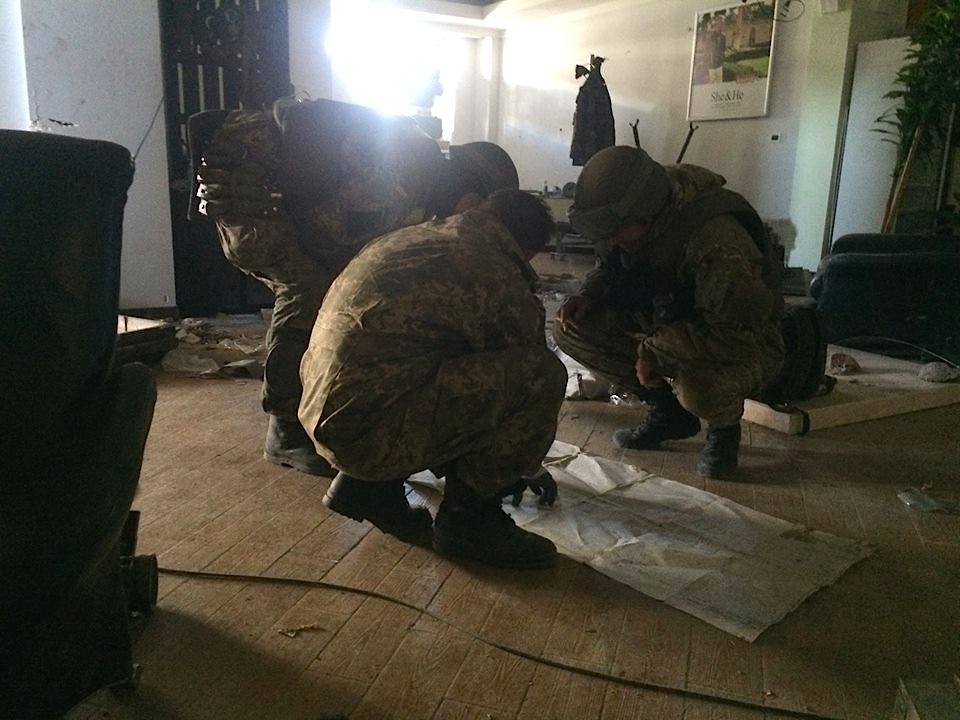
Planning strategy at Donetsk airport. Photo: Iurii Biryukov
Insurgent actions were recorded in the directions of Debaltseve, Donetsk and Mariupol – respectively 20, 9 and 4 fire attacks from all types of weapons.
Clashes between the ATO forces and Russian-terrorist forces were held at Donetsk airport (twice), near the settlements of Debaltseve and Taramchuk.
In Horlivka, the local militants introduced “compulsory labor” to the locals for administrative offenses. In particular, offenders are forced to participate in the construction of fortifications (trenches, bunkers) in a suburban area.
In the territory controlled by the “DNR” [“Donetsk People’s Republic”], an increase has been observed in pro-Ukrainian sentiment among local businessmen. It is estimated that 50-70% of the entrepreneurs will work to end the Russian adventure in the Donbas and towards a return of these areas under the full jurisdiction of Ukraine.
The leadership of the “DNR” obligated all ISP’s [internet service providers] operating on the territory controlled by the insurgents, to register as media and to pay “taxes” to terrorists. Registration is under threat of physical punishment. This is creating a “single register” of Ukrainian sites subject to being blocked.
In the city of Stakhanov, Mayor S.V. Zhevlakov, at a meeting of the heads of educational institutions, demanded – in the form of an ultimatum – that all of the teaching staff provide statements for employment “in education system of the LNR.” According to Zhevlakov, everyone who does not sign such a statement will be dismissed.
By Andrey Palych, “AndrewRostov”
10.11.2014 Translated and edited by Voices of Ukraine
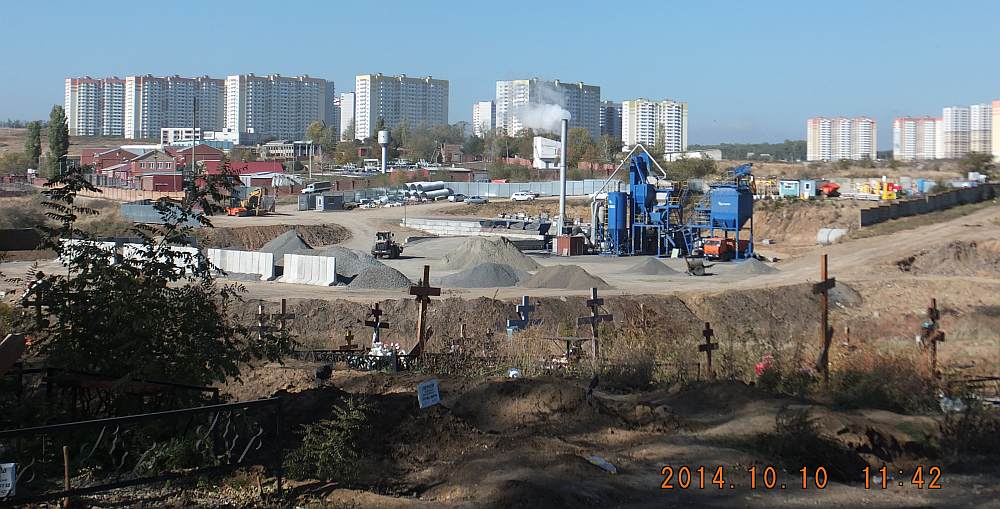
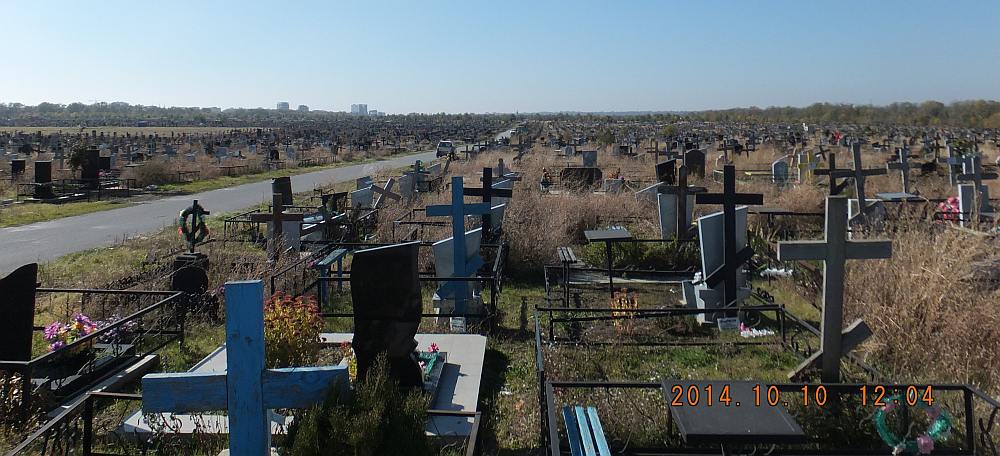
Yesterday I visited one of the largest cemeteries in Europe [Editor: Total area of the cemetery is 900 acres. According to reports from 2009, 335,000 people were buried there].
I came over to check on my father. I discovered bizarre burials there, to say the least.
“Northern City Cemetery. Opened in 1972.”
“From eternity to eternity, we go:”
So, now closer to the subject. Last year, in May, when I buried my father, [the cemetery] gave us a spot right in front of the recently completed residential complex “Suvorov,” that the Russian Defense Ministry built for the troops.
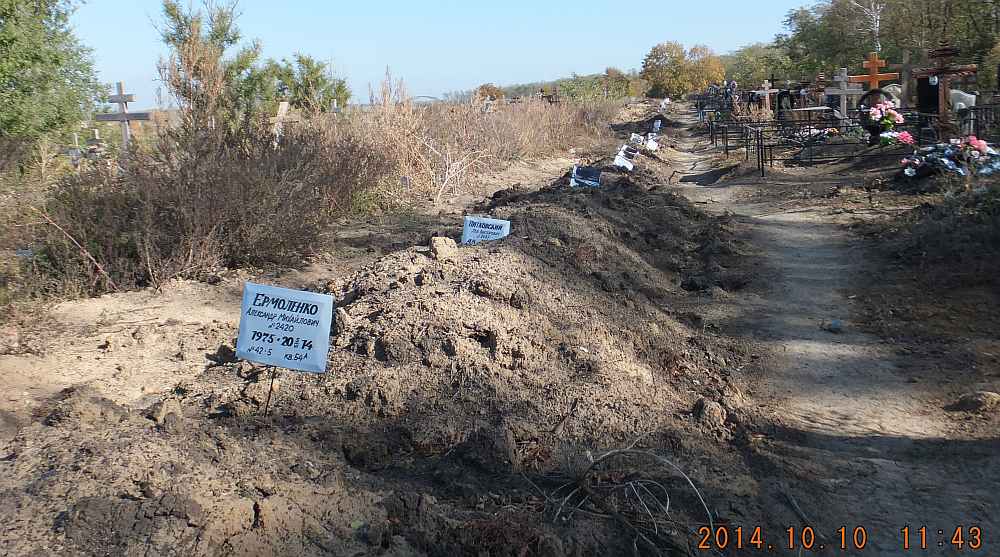
And here in the outskirts across from “Suvorov,” the burial sites were located on both sides of the dirt road, which could [previously] fit two passing cars. And this time, we were unable to drive up [to the grave]… [We] had to leave the car and walk. Instead of the road, there are three rows of these graves.
Most of the graves [are marked with] UM or UF. I understand this means “an unidentified male” and “unidentified female.” The date of death for the majority of them is the summer and autumn of 2014, most [of them are] listed to be 20-30 years of age, 40-45 y.o… Almost every one [of them] is under 60 years of age. But there are also many graves marked with last and first names. All of the people buried there are young. And their dates of death fall to 2014 and 2013, and even 2012. It is clear that all the burials took place at the same time, because I visited the cemetery myself and saw that the [dirt] road was utilized for the burials recently. They are all very fresh. Also the fact that these burials took place away from the central alleys and the new developments, where people are currently buried, is also suspicious. [These burials] are located far away and on the outskirts [of the cemetery], where only the relatives of those who have graves there can get to them. The signs bearing a date of death, marked with 2012 or 2013, also seemed very strange. I don’t think that unidentified bodies can be kept in the morgue for so long. Does anyone have any other thoughts on this?
These are new blocks, where the burials take place now.
Update: I found Dmitry I. Tikhonov here. His address is Rostov-on-Don, 72 Oborony Ave. Anyway … everything is really unclear… How come the 33 y.o. man had no one to bury him like a human being…
[Editor: One of the versions currently in speculation is that as a result of the overflow at the cemetery storage facilities (due to new bodies of Russian soldiers arriving from Ukraine), the cemetery buried the old bodies to free up the space.]
Portraits and stories of people who have experienced
the inferno of war
By Taras Polataiko, Ukrainian Canadian artist, Assistant Professor, University of Lethbridge, Canada 10.13.2014 Transcribed and translated by Maria Stanislav for Voices of Ukraine
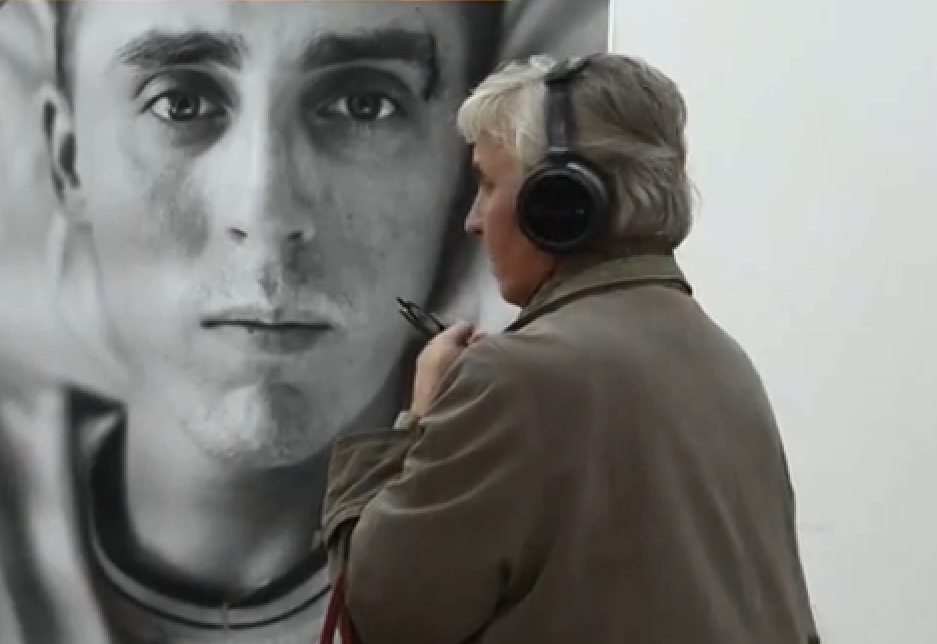
Taras Polataiko’s project War. 11 Portraits showed in August and September at the National Art Museum of Ukraine’s [NAMU] charity fundraising initiative to help wounded soldiers and museums who have suffered or been damaged within the Ukrainian ATO (Anti-Terrorism Operation) zone. And it continues to show internationally into the new year.
Over several days in early August, the artist spoke with patients in the surgical department of the Central Military Clinical Hospital in Kyiv who came there from the front with serious injuries. Polataiko had 11 photo-portraits made of these men – who had been in the inferno of war – and recorded their stories. They are diverse: volunteers, mobilized and contract soldiers, veterans of the Afghanistan War. They belong to different generations and went to the war zone from different regions of Ukraine. They have different attitudes to war and their own experiences.
Voices of Ukraine transcribed and translated each of the 11 audio stories that are part of this exhibition from Ukrainian and Russian, so that they may be read in English. This exhibition, and the stories, will travel to other parts of Ukraine, the USA and Canada. See it if you’re nearby and support our troops!:
Serhiy: There were supplies, but they weren’t for us, they were for officers.
What do we need? Well, we don’t have anything – no bulletproof vests, no helmets. The vests we had could be poked through with a knife. We’ve got nothing. The guys sleep on the floor all the time. We slept under the rain, too. If you’re waiting for the command to action, you sit neck-deep in the trench.
We don’t have any medicines, or anything. I got really bad food poisoning once, and there was nothing I could take. I went on duty some time around 2 am, then I got really dizzy, took a few steps, fell over and passed out. Woke up in the morning, still barely able to walk, threw up a lot, and that was the only way to recover. Like I said, no medicines at all. We need at least some basic stuff.
Sometimes, we spent whole weeks without food supplies. The deliveries wouldn’t come. Guys would go looking through green patches for anything to eat. Once, we found a bunch of grass snakes, skinned them and roasted them on the fire. They didn’t taste too bad.
Water was a problem, too. Sometimes, there would be no water for a few days. No way to wash ourselves, either. They need portable showers, or at least barrels of some sort, to fill with water and wash. We’ve got enough weapons, but we still need tents, because the guys are literally sleeping in the rain.
In short, they need any help they can get.
There were supplies, but they weren’t for us, they were for officers. They got food brought to them on trays, ate sweets, condensed milk, and stuff. (chuckles) And we just watched them. What more can I say?
============================================================
This is Roman’s story:
Roman, land forces: We were sent to a checkpoint, and given one ten-person tent for thirty men
Roman: Ever since we got to the Desna [military training center], we heard promises that we would all be fully equipped. Then we left for our base, a town in Luhansk oblast, and they said they’d equip us when we got there. When we got there, naturally, no one equipped us.
A moment that got stuck in my head, from when we were arriving. As we approached the base, we saw an air drone get shot down by a tracer fired from an APC. Two drones were flying around, and one of them was shot down. This was my first memory of getting to the base.
When we got to the base, one company was shipping out, right away. None of them had bulletproof vests. The rest of the guys in our battalion took off everything they had, vests and all, and gave it to that company. It was shipping out to help the 13th battalion.
Then we were sent to a checkpoint and given one ten-person tent, for thirty men. It’s been raining for four days. Everyone who arrived there was exhausted, and slept where they could. Some, under a tree, huddled in a raincoat. Some got a place in a tent. Some would sleep in a sleeping bag lying in an ankle-deep puddle of water. We were wet all the time, and there was no way to dry ourselves.
Taras Polataiko: Are there still not enough bulletproof vests?
Roman: At first, we weren’t issued any. Then, volunteers sent us vests, Kevlar helmets, and assault vests, too. These volunteers basically dressed and shoed our whole army, head to toe. We got some diesel generators, too. But at first, when we got to our checkpoint, we had nothing. We were waiting for night vision devices, and never got them. We were told that a car with supplies was sent for us, but the delivery never arrived. Any useful things sent to us tend to get misplaced at the base – sold off on the side, I guess. I don’t know who’s responsible for that, let our [military] prosecutor’s office find that out.
Then we moved to another checkpoint, guarding Grad [missile systems]. That was a strategic point, a high ground, and a large area to hold. We soon got reinforcements for that one. Spent maybe five days there, then went on to another checkpoint. That one was a transfer point, where a lot of military equipment was being brought. I haven’t seen so much hardware in my life. There were as many tanks as you’d see cars in Khreschatyk [central street in Kyiv].
What forces were you in? Have you served before?
I was in conscription service, back in 2003. Now I got mobilized, and served in land forces.
What are the biggest needs right now?
Over there? There isn’t enough water, or decent food. Now and again, volunteers would bring some food, grains and stuff. At other times, there’s tinned meat and fish in tomato sauce. You can easily get food poisoning from those. I did that once, and was bed-bound for a whole day. Couldn’t do anything except lie there and swallow pills till I got better.
What is the situation like with medical supplies?
There aren’t any at all. Most of us packed our medical kits ourselves, back in Kyiv, at the Desna [training base]. Medicines are very, very scarce.
Oleksandr, ‘Joker’: We lack specialists, and young officers lack courage. They’ve taught them all the wrong stuff in their schools.
Oleksandr: What we lack lacking is specialists, and our young officers lack courage. I can tell you what I’ve seen with my own eyes. When the 28th brigade arrived to support [my unit], the guys in it didn’t know what to do with a 242 cannon [Bushmaster M242, carried on board of APC]. They didn’t even know how to service it.
When young officers arrive, you can see they’ve taught them all the wrong stuff in their schools. There’s a war around, and he sits there saying, “No, I won’t shoot, because I don’t know the proper procedure for writing off ammo.” That, there is a disaster.
Our military manual is back from 1942-1943, and fighting according to it means – draw your swords, rush into the field, and crush the enemy by sheer force of number. But that doesn’t work in our case. We can’t fight by those rules anymore, and we don’t have the strength of numbers for that.
Taras Polataiko: Have you fought before?
Oleksandr: I was a contract soldier. Then, in 2001, when [Yuliya] Tymoshenko came to power, our salaries dropped down to zero, allowances were gone, and you were no longer on the list to get an apartment for your service. Had there been better conditions, I might’ve stayed on.
Were you an officer?
If I’d stayed, I might’ve gone for promotion. I have a higher education degree, so I had some prospects. But the state didn’t encourage that.
Were you mobilized this time?
Yes, mobilized on March 11th.
What kind of supplies does the army need right now?
The army needs everything. The uniforms they issue last a month, at most. They were kept in reserve warehouses, so they practically rotted, and they disintegrate after a month. All the guys had to buy their own uniforms. As for bulletproof vests, Korsar [M3] isn’t too bad. But consider this. To restart a human heart during CPR, the chest cavity must be bent 22 mm inwards. To stop a heart, you need 38 mm. Korsar, when struck with a 7.62 caliber round, bends 64 mm inwards. What can one say.
As far as everything else goes… We’ve got weapons, but our equipment has seen better days.
What are the most pressing needs?
Like I said – we need everything. But coordination between forces is a huge problem right now. Today, the 2nd battalion and the 72nd brigade de facto don’t exist, because they’ve been disbanded and thrown around. Some guys are sitting, surrounded, near Zelenopoillya, another part of the battalion, sits in the Donetsk airport…







 Voices of Ukraine