 By Yuriy Butusov, Ukrainian journalist
10.15.2014 – 21:55
Translated and edited by Voices of Ukraine
“I have never focused attention on some strategies of the struggle that is ongoing in Donetsk and Luhansk. In any case, nobody will take any rash [action] right before the holiday. Everything is being done according to a plan approved by the President, the same plan which is being carried out.” – (Col. Gen. Valeriy Heletey, former Minister of Defense, Ukraine)
Valeriy Heletey,
21 August, 2014
The feat and the tragedy on the South Front and the breakthrough at Ilovaisk occupy a special place in the history of the Russian-Ukrainian war. A large-scale invasion of Russian troops showed up our strength and our weaknesses. The strength of spirit, the devotion to duty of the soldiers, officers and generals, who remained on the front line until the end, and the disadvantages of battle management, irresponsibility and incompetence of certain officials. Unfortunately, they are trying to turn the heroism and tragedy of Ilovaisk into a pre-election political drama, to play it up and to talk it down.
To separate the facts from the artificial political husk, our own independent investigation has been conducted. The fighting in sector “D” and sector “B” should become a lesson which will help draw the right conclusions for the strengthening of the defense capability of Ukraine. Here, first of all, the society and the army must clearly define the successes and mistakes in the algorithm of actions. Here it is necessary to establish all the characters by name and mark all the worthy. Because Russian tanks and artillery were not stopped in this war by all of the world’s diplomacy. The invasion was stopped by Ukrainian warriors – and at the highest price. Ukraine must know about this price.
The Price of Ilovaisk
It remains inexplicable for what reason the Ukrainian leadership has made the decision to classify the exact list of names of the fallen warriors. Apart from political games, no other explanation comes to mind. I believe this to be an extreme form of cynicism and disrespect to the memory of the dead. Just as disrespectful on the side of the government is the lack of attention to living heroes – most of the participants of the battle were not presented with awards. At the same time, if not for their heroism and self-sacrifice, there would be no Minsk negotiations at all – Putin would never have negotiated with the losers, he would have simply dictated his terms. Ukraine became an influential subject of international diplomacy thanks to the stunning resilience and courage of its defenders.
Together with representatives of the Ukrainian command, with commanders of various units, we conducted our own analysis and assessment of losses during the breakthrough of Ukrainian forces from the encirclement under Ilovaisk on August 29th.
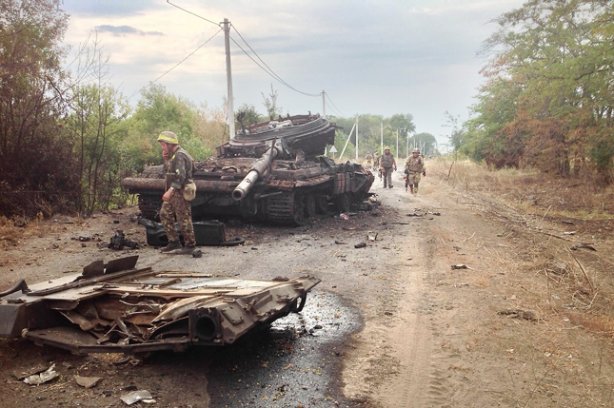
During the fierce fighting in the course of the capture of Ilovaisk – from August 10 until the moment of the Russian invasion on August 24 – the casualties of our troops from the Ministry of Defense, National Guard, the Ministry of the Interior and the Right Sector [battalion] detachment, amounted to 40 soldiers killed, with one serviceman captured. The composition of the group varied and did not remain constant. In the period from August 24 to 28, the Ilovaisk group was joined by the retreating forces from the border area of sector “D,” who were withdrawing in disorder. Two columns took part in the breakthrough from the “cauldron” [Editor: Soviet military doctrine distinguishes several sizes of encirclement: Cauldron (Rus. котёл, kotyol or kotel) is a very large, strategic-level concentration of trapped enemy forces] on August 29, the total number of which was, at minimum 970, and at maximum – up to 1,100 men. An accurate count was impossible because right up to the moment of the breakthrough separate groups from sector “B” kept arriving and joining with the two columns. The exact composition of the military equipment concentrated in the vanguard and rearguard of the groups is known. In the service of these troops were 7 tanks (including a captured Russian T-72B3), 22 IFVs, 6 MT-LB trucks, 3 APCs, 7 “Rapier” anti-tank cannons, 6 mortars, as well as not less than 120 vehicles. In the course of the breakthrough nearly all of this equipment was lost in battle. Also lost was a significant amount of equipment which was damaged in the fighting and which could not be evacuated because of the encirclement.
At this moment it is found that as a result of the breakthrough, as well as after release from captivity, 647 Ukrainian soldiers returned home from the forces withdrawing from Ilovaisk. Individual servicemen are independently entering Ukrainian-controlled territory to this day.
A significant amount of our fighters were captured and are still being held in custody. It is known that from the Donbas Battalion, 97 men are in captivity. The total number of prisoners is estimated by the Centre for Prisoner Exchange under the Dnipropetrovsk Regional State Administration as being over 600 men. But this is the total number of prisoners captured at all sectors of the front. How many of them were captured specifically at Ilovaisk? It is now impossible to ascertain, but clearly – from 150, according to conservative estimates, up to a maximum of 300 people.
Officially, the Defence Minister Valeriy Heletey named the death toll at Ilovaisk at 108 fighters. But unofficially, credible figures have been received of the numbers of the dead in the course of the withdrawal from the encirclement, those dying of their wounds in hospitals, and also as a result of the murder of the captured Ukrainian servicemen. This number is not less than 200 people, and by maximum estimates – the death toll could reach up to 250 men.
104 bodies remain unidentified at the present time. Some of them have been identified as Ukrainian soldiers and are buried as temporarily unidentified by name. Others remain in the morgues of Zaporizhia and Dnipropetrovsk. But not all the unidentified bodies in the morgues could be Ukrainian soldiers, and a significant number of them are definitely not victims of Ilovaisk, but of other parts of the Southern Front.
Therefore it is not possible to create a one-hundred percent clear picture of the losses right now. At the headquarters of the Operational Command “South” – sector “B,” under the leadership of Lieutenant General R. Homchak, a group of officers are working to gather and analyse all the data about the dead and of the participants in the battles in sectors “D” and “B.”
Who is at fault for the appearance of the Ilovaisk “cauldron”?
The Supreme Commander Petro Poroshenko has announced the dissolution of the 51st Mechanized Brigade, which fought mainly in sectors “D” and “B.” The reason – for disobeying orders. The Chief Military Prosecutor Anatoliy Mathios has stated that the reason for the defeat at the front and for the encirclement under Ilovaisk was the desertion of the 5th (“Carpathian”) Battalion of Territorial Defense which allegedly caused other units to abandon their positions. But, before giving an assessment of the 51st Brigade and the 5th Battalion, let us evaluate the situation from a military standpoint.
Was it possible for the forces in sector “D” to stop an attack of four full-strength Russian battalion tactical groups? Was the 5th Battalion of Territorial Defense, “Carpathian,” which consisted of about 300 servicemen, mobilized and equipped with only light infantry weapons, capable of repelling an attack of the completely equipped armoured units of the Russian Federation? Obviously not. Being stretched out at checkpoints, our weak army units could not form a fighting group capable of providing even a minimal density and stability of defense; they could not allocate strike groups from their ranks capable of conducting maneuver warfare.
But were the troops of sector “D” able, in the case of a competent assessment of the situation, to conduct effective military action against the aggressor and inflict losses? Absolutely, yes. For this it was necessary to withdraw them in a timely manner so that they could take up new positions, maintain their rear communications, re-group and wage maneuver warfare.
Was it possible to avoid the encirclement at Ilovaisk and to save the surrounded troops? Absolutely, yes. For this purpose it was necessary to give timely orders to retreat from the encirclement and to take up advantageous lines of defense.
Therefore, there are four key questions for which the investigation must provide answers:
- When did the command of sector “D” receive reliable information about the mass Russian invasion? When did the command of sector “D” relay this information to the Ukrainian government, to the commander of the Anti-Terrorist Operation [ATO] and to the Minister of Defense?
- What measures were taken by the command of the ATO after receiving this information? In other words – were reserves deployed towards the dangerous area? Was planning underway for a retreat of our forces to avoid encirclement? Were the rear lines of defense being prepared?
- Did the commanders of sectors “B” and “D” have the capacity to make independent tactical decisions according to the situation, which orders did they receive?
- What was the level of combat effectiveness of the forces in sector “D,” what were the reasons for the unauthorised retreats? Was operational planning of military operations by the ATO command carried out with actual combat capabilities of the troops in mind?
The key source of information regarding the situation here are the statements by the commander of the troops in sector “D,” Lieutenant-General Petr Litvin, and the members of his staff, because it is specifically the retreat of the units covering the state border which allowed the Russian troops to surround the fighting group in Ilovaisk. The author met with Litvin on the day on which he was handed command of sector “D,” at the command post of the 72nd Mechanized Brigade near the village of Sonyachne [Zaporizhia district] – this was on July 23. Litvin as commander of the 8th Army Corps arrived there with his staff, as up to that point the sector was under the command of the 72nd Brigade Commander, Colonel Andrei Gryshchenko.
ZN.UA managed to obtain some exclusive comments by Petr Litvin on the event, and to hear answers regarding the four key questions:
“Information about the alarming massing of Russian armoured and mechanized units on the border with Ukraine was received by us and relayed to the ATO command regularly. Also, the daily constant artillery shelling was reported of our positions from Russian territory. This was happening from the first day, when I took on the command of the sector. The dossiers regarding the threatening situation in the border region, about the state of our troops, went out daily, which you could ascertain for yourself, during our communication at the command post.
On July 23 you wrote an article “Crisis in Sector ‘D’” where you reasonably accurately presented the difficult situation, and continued to objectively cover this situation later on. To be honest, I figured that our reports and the publicity will attract attention to the problem and that decisions will be made taking the real situation into account.
Russian units, starting from mid-August, were transferred to the territory of Ukraine and took an active part in the hostilities against Ukrainian forces. Information regarding the large-scale Russian invasion in the region of Amvrosiivka, which resulted in the encirclement of our forces at Ilovaisk, was received from the State Border Service and from our sources on August 23, on the eve of Independence Day. Around 14:30 [2pm EEST] we reported on the crossing of the state border by Russian forces and their movement in the direction of Amvrosiivka. Later in the course of the day these reports were transmitted repeatedly. These data were fully confirmed by information from the State Border Service. Also information was received from individual groups of the special forces, which were also close to our borders.
To our next report to the ATO headquarters regarding the movement of Russian equipment, ATO Chief of Staff Major General Nazarov curtly responded: “This is all bullshit. We’ve been through this. Hang in there.” And hung up.
On the evening of August 23, I was summoned to communicate (through the Central Command Centre of the General Staff) with the Head of the General Staff. Because at that moment he was in the cabinet of the Defense Minister of Ukraine, I was connected to the Minister.
The minister listened to my information and gave the phone to the commander of the ATO, the Chief of General Staff Viktor Muzhenko. After hearing my report on the Russian offensive and about the situation in the sector, he replied: “If the situation changes, please report by the established order.” And that’s all.
I deployed my only reserves in the way of the Russian invasion for surveillance and fire correction – several surveillance groups of the 3rd Regiment of the Special Forces. In the morning of August 24, for personal validation and verification of information, the head of staff of sector “D” Colonel Romigaylo drove out onto the road in the region of Amvrosiivka – Kuteinykove. The colonel was camouflaged by the side of the road when, about ten metres away, one of the battalion tactical groups of the Russian Federation rode past him deeper into our territory. Straight from there Romigaylo called the head of the General Staff and reported that he is observing with his own eyes an offensive of large armoured units of Russian Federation forces into the rear of our positions. In response, Muzhenko said:
“…these are just demonstrative actions.”
Being positioned around Kuteinykove, we were constantly under fire from the enemy artillery, and on August 21 our command post was hit by a massive attack from “Uragan” [“Hurricane”] reactive artillery systems. As a result, 5 servicemen died, 12 were injured, and a number of equipment was rendered inoperable.
At the moment of the invasion, August 23, performing the task of covering over 150 km of the state border, on paper I had at my disposal the following forces… if we judge by numbers, and not by names, they were small consolidated companies of the 28th, 93rd and 51st mechanized brigades, 3 consolidated artillery batteries, the 5th (“Carpathian”) Battalion of Territorial Defense, an auxiliary consolidated company of the 2nd Battalion of the Territorial Defense of Rivne Oblast, six incomplete reconnaissance groups of the 3rd Special Forces regiment and a command group numbering 60 men. A group of scouts operated on the Savur-Mohyla hill, under the command of the ATO. The total number of all these units did not exceed 650 servicemen. In accordance with the military objectives and directives of the ATO Command Staff, these units were spread out on a wide front, and could not give each other fire support or interaction.
As commander of the sector, I did not have tactical autonomy in my actions. The orders of the ATO command determined not only the coordinates of the locations of various checkpoints, but even the numbers of the groups which were supposed to man them.
After the beginning of the invasion and with the threat of the envelopment of our forces from the flanks, a withdrawal of our units began – it proceeded without orders. As far back as August 23 the units of the 28th Mechanized Brigade and the “Carpathian” Battalion began withdrawing. The company of the 93rd Brigade never arrived in the prescribed area and began withdrawal on August 24. At the same time the units of the 51st Brigade began an unsanctioned retreat.
On the afternoon of August 24, full control in the sector was retained only by the artillery batteries of the 26th Artillery Brigade and my staff, who went out only by orders, being left without any cover of ground forces. And at 20:30 [8:30pm EEST] we received a directive from the ATO staff about the liquidation of sector “D” before 24:00 and the transfer of all remaining forces to sector “B.” All this was done in accordance with the directive.
The main problem in repelling the Russian offensive became the fact that long before the Russian advance the enemy used the scarcity of our troops in the border region and sent into our rear a large number of diversion and sabotage groups, who waged active hostilities, supplied the enemy with accurate information about our location, attacked our supply columns and checkpoints and engaged in battle with our detachments. The most intense enemy activity was observed in the border regions of sector “D” and the location of the base of our command post in Kuteinykove. At the same time our forces for long periods of time carried out operations under conditions of constant attack from two sides: from the territory of Russia and from the side of population centres controlled by separatists.
We had neither the strength nor the means to ensure the protection of even large nodes of communications, not to mention the creation of defensive lines and strike groups. Our covering detachments were exhausted by constant battles and artillery shelling of the superior enemy forces.
I do not think that the main reason for the tragic events that occurred was only the retreat of the “Carpathian” Battalion and the detachments of the 51st Mechanized Brigade. However, the actions of each commander and officer in the sector must receive legal assessment. The real reasons will become clear after the investigation by the Military Prosecutor’s Office.
I and my officers have testified before the Military Prosecutor’s Office where we have set out the facts in the framework of a criminal investigation regarding sector “D.”
All the information that I have relayed to you is recorded in the war diary of sector “D” which is also attached to the materials of the criminal case. Sooner or later, the whole truth about the Ilovaisk tragedy will become known.”
From the testimony of General Litvin it is possible to draw clear conclusions – hostilities at the Southern Front in the zone of sectors “B,” “D” and “M,” and specifically the offensive operation in the region of Ilovaisk, occurred without sufficient forces, without the presence of combat-ready operational reserves. Despite the presence of intelligence units of the Russian offensive, the command of the ATO took no reactive measures. Obviously, this exposed a complete lack of a unified analytical apparatus of intelligence services of Ukraine and a lack of a coordinating centre – an intelligence committee. There have been gross miscalculations by the military control, a blatant ignorance by the ATO command of field manuals and basic tactics. The initiative of commanders was completely shackled, which did not allow for responding to changes in operational environment. As a result, for a long time Ukrainian forces in sectors “B” and “D” were operating in an extremely unfavourable tactical situation, which led to instability and, in places, a complete inability to conduct defensive operations.
On August 22 I was at Ilovaisk at a command post of sector “B” and personally saw that the communications of the forces were extremely vulnerable, because the settlements and roads were not controlled by Ukrainian troops, and the movement of every column, in the face of constant attacks by subversive groups, turned into a dangerous combat operation. Undefended roads could have easily been cut. Under Ilovaisk our forces could not advance – they were forced to constantly repel enemy attacks using armoured vehicles and significant artillery forces – every 10 minutes there was shelling of our positions by rocket launch systems.
These errors are wrong to attribute only to a lack of resources, well-known problems in the destruction of the army under Yanukovych, the crisis, the low levels of training and supply. These problems should have been taken into account by those who gave the order to advance.
Considering the critical situation it was hardly advisable to keep several fresh detachments for the parade in Kyiv for Independence Day. The parade was an absolutely correct and necessary decision in wartime, but could probably have been organized using units that were on rotation or in the process of being formed.
And it looked completely ridiculous for the whole military leadership to be in attendance on the parade. When Viktor Muzhenko was receiving the parade and the state of the Colonel-General, and Valeriy Heletey was receiving an Order, they knew about the multiple reports concerning the invasion of Russian forces. People who can behave so calmly are either those for whom everything was going according to plan, or those who were completely unaware of just how serious the situation was.
Who gave the order?
Details of the strategic decision were learned by us from the participants of meetings with the President of Ukraine on military planning, which took place in the middle of August before the attack on Ilovaisk, and which was attended by a wide range of public figures.
The Supreme Commander Petro Poroshenko set out ambitious goals of offensive operations, which were to take place simultaneously on four strategic directions. The Ministry of Defense and General Staff supported them. However other participants of the meeting questioned the feasibility of these operations. As a result, a compromise decision was reached – the Supreme Commander ordered to limit operations to the defense of the whole line of contact. But the attack on Ilovaisk was mandatory.
At the meeting, the Chairman of the Verhovna Rada Alexander Turchinov drew the attention of the military leadership to the fact that the conduct of an offensive on Ilovaisk requires the presence of substantial reserves, which could reliably hold the areas of Amvrosiivka and Savur-Mohyla. The military leaders assured him that they understand the importance and value of the defense of the sector “D” bordering Russia.
The offensive was launched on August 10 according to the order of the ATO command, and simultaneously attacks began in the region of Yasynuvata, for the completion of the encirclement around Donetsk. The initial objective was to outflank Ilovaisk from the east, and exit into the area of Zuhres-Khartsyzk. It was made at a meeting of the command of sector “B” and the commanders of MOI [Ministy of the Interior] battalions and the National Guard on August 8. Fears of a lack of forces for the conduct of the operation were voiced at once, but all commanders understood the importance of the operation to liberate Donetsk, and counted on the arrival of reserves to strengthen them after the start of the operation.
As early as August 12 it became clear that the strike force, which never exceeded 700 men, cannot on its own clear a path to Zuhres. The enemy began to deploy reserves, armour, artillery, and the resistance took on a fierce character. Ukrainian forces did not have numerical superiority over the enemy. Strong artillery fire and counter-attacks made further advance impossible. Because of this the ATO command made the decision to adjust the plan – the army swept Ilovaisk from the western and eastern directions and attempted to storm the city together with forces from the MOI and the National Guard. The threat of encirclement was obvious to the majority of officers and to the command of sector “B,” the ATO command was informed about the situation and the threats. The forces performed their tasks with an understanding of the complexity of the situation and hoping for a timely approach of reserves in case of danger.
Russian troops were forced to undertake an offensive operation against the Ilovaisk group precisely because the forces of sector “B” were inflicting heavy losses on the units of Russian mercenaries. The mercenaries could not deal with this problem on their own, and the threat of Ukrainian forces entering onto the enemy’s communications was real. The Russian offensive is an admission of the effectiveness of the combat operations in the region of Ilovaisk during the course of the offensive. Despite heavy positional battles, the enemy could not hold back the onslaught of our detachments on their own, and the Russian command was forced to employ a massed invasion of the superior forces of the regular army.
Russian attacks on the Ilovaisk battle group on August 24-25 were successfully repulsed in battles in the region of the village of Ahronomichne. The Russian invasion was stopped.
The fact of the Russian invasion and the numbers of the forces taking part in the operation to destroy the surrounded Ukrainian forces was obvious after the capture of prisoners from the consolidated battalion tactical groups of the 98th, 106th airborne divisions, 31st Air Assault and 8th Motorized Rifle brigades of the Russian Federation.
However the Ukrainian command somehow continued to underestimate the threat, despite possessing all the information. The reserves deployed to break the blockade were completely inadequate. The operation for breaking the blockade was essentially not planned. Had the scale of the threat been assessed in a timely manner, the pullback of forces and equipment from under Ilovaisk could have been performed without serious losses. On August 24 and 25 a number of side roads was still open and the Ilovaisk battle group had received some critical supplies. Because the enemy waged effective counter-battery fire, on August 24 and 25 the main parts of Ukraine’s artillery were successfully withdrawn from the “cauldron.” But the decision to pull back the main fighting group was not taken. The ATO command issued the order to “Hold on!”
On August 27 the ring of encirclement closed. Without supplies of water and ammunition, resistance could not last for a long time. The enemy attacked constantly, and Russian heavy artillery undertook methodical shelling, gradually disabling military equipment and vehicles.
The enemy took Starobesheve, and it was 30 kilometres to the nearest Ukrainian positions at Rozdolne. In the case of a total annihilation of transport and military equipment, and the depletion of water and ammunition supplies, escape from the “cauldron” would have been impossible.
Holding the ‘cauldron’ under fire from the far superior forces of the fresh Russian regular army was impossible.
At a meeting of members of the public with the Supreme Commander on August 27, I suggested that in view of the concentration of large forces of Russian troops and the presence of convenient defensive positions, held and fortified by them for three days now, to use suitable reserves for assisting strikes towards the surrounded forces. Ukrainian forces were pinned down by enemy attacks on other areas of an overstretched front, and reserves could not arrive to help the surrounded forces. It seemed incredible that we could put together a strike group in several days, crush the Russian forces and re-establish communications. The terrain there is favourable for defense. I asked Petro Poroshenko to give the order for the immediate withdrawal of the battle group. However, the Supreme Commander said that the military command had reached another decision – the forces for the de-blockade have been gathered, in the coming hours they will clear a corridor. When I came home after the meeting with Poroshenko, I received a call from the front, and was told that while I was at the meeting, the only reserve in that area – the consolidated company tactical group of the 92nd Mechanized Brigade, was defeated in battle by the superior forces of Russian troops in the region of Starobesheve.
There were no forces for the de-blockading, but the order for a breakthrough never came.
The ATO command never dared to issue this order. Probably out of fear of taking any responsibility for the fate of the surrounded units. There was only one order: “Hold on!”
Today the minister of defense, Valeriy Heletey and the Chief of Staff Viktor Muzhenko explain their decisions with what has already been voiced by President Poroshenko: “the reserves were late by three days.”
This seems like a strange and naive statement. It is true that three days later the battalion tactical group of the 95th Airmobile Brigade arrived at the Southern front. But could one battalion tactical group, even reinforced by inexperienced units from the 1st operational brigade of the National Guard (equal in terms of personnel to one strengthened battalion, but without heavy armour and self-propelled artillery), pierce the defense of a large group of Russian forces, which possessed at least twice the numbers in personnel and equipment? And in addition, enhanced by numerous support units of mercenaries. Was it possible to break a corridor in one day, or would this have turned into a hard, multi-day operation? And was there a possibility to maintain the combat ability of the surrounded Ilovaisk group for three more days and, possibly, indefinitely further in the course of further battles for de-blockading? The fate of the regiment of the 92nd Brigade shows that defeat of Russian forces demanded not simply concentration of sufficient forces and means, but also thorough reconnaissance and operational planning. Moreover, the Russian artillery inflicted massed strikes on the regions of concentrations of Ukrainian forces – both inside the encirclement and outside of it.
So to state that, say, reserves would arrive in three days, and a miracle will happen, and the prepared Russian defenses will fall – that is a mockery of common sense, and an ignorance of the facts and of the real situation. In modern full-scale war an arrogant attitude towards the enemy, as the tragic lessons show, is very expensive. And the military leadership must answer for such profound errors in assessing the situation.
Negotiations between the Ukrainian and Russian presidents, promises of a “green” corridor for the exit of troops became in fact a smokescreen – under the guise of peacemaking efforts the Russian forces were simply cynically preparing for the destruction of our forces and did not cease shelling. The negotiations had only one negative effect: Russian forces deployed three defensive lines on the likely directions of the breakout.
Roughly the same analysis was delivered to the General Staff by the command of sector “B.” After information of the defeat of the 92nd Brigade, the commander of the forces in sector “B,” General Homchak, took an independent decision – to go for a breakout. Homchak stated that he better sees the situation on the ground, and that the breakout is necessary. Russian command offered Homchak to give up the weapons of the battle group and to surrender himself, guaranteeing safe evacuation onto Russian territory with later release to Ukraine. This would have meant a full capitulation of the whole Ilovaisk battle group. But on the war council with commanders of the units, a unanimous decision was made – the Ukrainian army will not give up weapons, and everyone will break out together in full armour. The decision to break out was brought on August 29 to the ATO command. Contrary to the order from the ATO command, Homchak took all responsibility for his actions on himself.
The breakout was not supported by synchronous attacks of Ukrainian forces. The operation was supported by the air strikes of Ukrainian warplanes, which conducted a daring assault against Russian positions, and by fire from several artillery batteries from outside the encirclement.
Nobody wavered. The commanders hoped for the best, but everyone knew that ahead, death could be waiting for them.
Deserters, victims
or heroes
Analyzing the operative and tactical issues, we must not forget: an investigation of the battles at Ilovaisk is necessary to give an objective assessment of all the participants of these events. To separate the scoundrels and criminals from those who became a victim of circumstances and tried to behave with dignity, and to celebrate the real heroes, to promote the talented and brave commanders. To pay homage to the memory of the fallen heroes – both ordinary soldiers and senior officers. Until this work is done, until the investigation of the military prosecutor’s office is complete, no-one, neither the Supreme Commander, nor public deputies, nor the chief military prosecutor – must give out public assessments of the actions of military units as a whole.
The basic principle of justice and the basic principle of military subordination is PERSONAL RESPONSIBILITY. Everyone must answer for his actions. The aim of the investigation is to establish the degree of responsibility for the abandoning of positions of all commanders and soldiers on all levels of the military hierarchy. From the Private to the General to whom he was subordinate. That is why there is a rigid chain of command in the army – it allows not only to act quickly, but to rapidly and accurately assess the responsibility of every serviceman.
The “Carpathian” battalion cannot be judged as a whole. Specific officers must be judged, who gave out specific orders. Out of respect to those fighters who for a month and a half remained continuously under fire and fought with the enemy, without possessing sufficient military training. I will remind, if anyone has forgotten: battalions of territorial defense are simply part of the rear guard in their areas. This is not a foreign legion.
On Tuesday I officially, as a witness, was present in the military prosecutor’s office at the investigation of the tragedy at Ilovaisk. I stated that the attempt to explain the tragedy with some particular cases – the failure to follow orders by the 51st Mechanised Brigade and the abandonment of positions by the 5th Battalion of Territorial Defense – is an attempt to remove responsibility from the real culprits for the encirclement of our forces and the subsequent defeat. If we must look for the guilty, we must begin from Kyiv, not from the brigades. That the 51st fought not better and not worse than other such brigades.
The brigade suffered heavy losses, and how could the decision have been made to disband it? Why make the soldiers and commanders into ‘scapegoats’? Forces, where several thousand conscripted soldiers and officers without elementary preparation were added into a small backbone, fought differently. Everything always depended on the quality of the recruitment and personal qualities of the commanders of the units. Any soldier knows what was happening in sector “D” in the 28th, 30th, 72nd mechanized brigades. Litvin plainly talks about the unauthorised retreat of many detachments. And what if we look at the lists of non-combat losses in various brigades? It is not the 51st that is the leader there. The president said that under Krasnopartizansk, a part of the 51st Brigade was forced to leave an encirclement through the territory of Russia, after destroying their weapons. Yes, 40 people left. But later from a part of another brigade, 300 men left – and it was not disbanded.
In the 51st Brigade there were probably exactly the same number of cowards and heroes as in any other such army brigade. Why it happened this way is a topic for another article. But it is specifically the actions of the fighters of the 51st Brigade which allowed the military-strategic situation to radically change.
It is the 51st that captured the majority of the Russian servicemen [the paratroopers], which were then shown in all the news channels, and who clearly confirmed to the whole world the fact of Russian aggression. For this, the brigade and those who committed these deeds should be, on the other hand, rewarded and celebrated. How it is possible to humiliate those who have made an invaluable contribution to our struggle?
Let us remember that the Commander of the 51st Mechanized Brigade, Pavel Pivovarenko, went missing in action in battle during the breakout from Ilovaisk. His body has still not been found, he does not feature in the lists of captured or killed. This is the only commander of a Ukrainian military unit, whose fate is unknown.
Many other servicemen of the 51st Brigade died and went missing in action, which by a strange will of the ATO command were scattered in different detachments across the whole front and acted in different sectors of the ATO.
The disbandment of the 51st Brigade and the attempt to ‘scapegoat’ the “Carpathian” Battalion is simply an unworthy manipulation of facts.
Until an assessment is made of everyone who took part and planned the operations in sector “D” and sector “B,” until we get evaluations of all decisions, all actions and inactions of everyone, we cannot defame the memory of heroes who gave their lives. This is sacred, you cannot lie here. Only the truth and eternal memory can appease the souls of those who paid the highest price in a terrible battle…
Source: GazetaZN.ua







 Voices of Ukraine