Wie mache ich einen ukrainischen Atomunfall? Teil 2: Fakten, Fakten, Fakten

Wie mache ich einen ukrainischen Atomunfall?
Teil 2: Fakten, Fakten, Fakten

von Dr. Anna Veronika Wendland

Dr. Anna Veronika Wendland

Dr. Anna Veronika Wendland

Zum angeblichen „Atomunfall“ im KKW Zaporizhzhja, Block 3, sagte mir ein befreundeter Ingenieur, ein studierter Physiker mit 30 Jahren Berufserfahrung in einem der ukrainischen Kernkraftwerke, ein paar interessante Sätze. Sie möchte ich, als Ergänzung zu meinem blog von gestern, meinen LeserInnen nicht vorenthalten.

„Was da kaputtgegangen ist im KKW Zaporizhzhja“, meint er, „war ein 6 kV/0,4 kV-Eigenbedarfstransformator. So etwas kommt vor und ist kein Anlass zur Beunruhigung; die defekte Komponente wird ausgetauscht. Ich möchte aber darauf aufmerksam machen, dass zum selben Zeitpunkt, wo wir uns hier mit der ungeplanten Abschaltung von Zaporizhzhja-3 beschäftigen, 29 ukrainische Kohlekraftwerksblöcke außer Betrieb sind“ – weil ihnen kriegsbedingt, möchte ich hinzufügen, der Brennstoff fehlt. Alle anderen, sehr ernsten Implikationen für die ukrainische Energieversorgung habe ich gestern in o.a. blog geschildert.

Für alle Liebhaber von Details sei an dieser Stelle nochmal erklärt, was für einen Stellenwert solch ein „Ereignis Stufe Null“ (so ist die offizielle Einstufung in der IAEA-Skala INES) in einem Kernkraftwerk hat. Jedes Kraftwerk produziert seinen Eigenbedarfsstrom – also das, was Pumpenmotoren und sonstige Antriebe und elektrische Maschinen in der Anlage brauchen – in der Regel selbst. Um ihn nutzen zu können, muss er von der Spannungsebene des Generators auf jene Spannungsebenen heruntertransformiert werden, die von den Verbrauchern im Kraftwerk benötigt werden. In den ukrainischen und russischen Kernkraftwerken ist das die 6 kV- Eigenbedarfsschiene, von der dann wiederum auf 0,4 kV (also 400 Volt) transformiert wird. Der besagte Trafo steht im Schaltanlagengebäude, es gibt auch weitere für die Umwandlung auf die 220 V-Niederspannung der üblichen Kleinverbraucher   Beleuchtung zum Beispiel, oder die fürs Schichtpersonal überlebenswichtigen Kaffeemaschinen und Teewasserkocher für das Heißgetränk auf Arbeit.

Gibt es einen Defekt in so einer elektrischen „Sektion“ 6/0,4 kV, sprechen die Sicherheitssysteme an – „Zashchita“ heißt das im Original des Schadensberichts –, und der Block wird automatisch abgefahren. Die genannten elektrischen Systeme sind redundant, das heißt, die Stromversorgung für die Verbraucher im Block ist gesichert, aber bis zur Reparatur des Defekts muss die Anlage vom Netz. Mit dem nuklearen Teil der Anlage hat so etwas technisch nichts zu tun – diese Komponenten gibt es in jedem Kraftwerk. Natürlich aber gibt es eine Interdependenz von „konventionellem“ und „nuklearem“ Teil insofern, als auch die Antriebe im nuklearen Teil natürlich von einer funktionierenden Stromversorgung abhängen. Deswegen ist diese Versorgung redundant und räumlich getrennt organisiert, und für eine sichere Unterkritikalität des Reaktors sorgende Abschaltsysteme sind so ausgelegt, dass sie bei Stromausfall in die „sichere“ Richtung reagieren. So fallen die Absorberstäbe der Gravitation folgend in den Reaktorkern, wenn ihre Stromversorgung gekappt wird.

Das Problem ist aber nun in der öffentlichen Diskussion, und auch in einem Großteil der Berichterstattung, dass die Berichterstatter in der Regel über wenig technische Grundkenntnisse verfügen – und wenn sie sich dessen bewusst werden, dann auch noch häufig einzig und allein Greenpeace als „Experten“ zur Rate ziehen. Häufig werden die Funktionsbereiche in einem Kernkraftwerk durcheinandergebracht und daher ein elektrischer Defekt zu einem „Atomunfall“ gemacht, d.h. es wird durch die Wortwahl suggeriert, es handele sich um einen Störfall im Reaktor oder Primärkreislauf der Anlage. Zweitens wird häufig das Ansprechen der Sicherheitssysteme, das zu einer Reaktorschnellabschaltung führt, bereits als Beweis für die Unzuverlässigkeit der Anlagen wahrgenommen – d.h. der Beweis, dass die Sicherheitsvorkehrungen reibungslos funktionieren, wird dem Gesamtsystem zu Ungunsten ausgelegt, weil man der irrigen Vorstellung folgt, in der Kerntechnik sei nur dann etwas sicher, wenn Defekte zu 100 % ausschließbar seien.

Kommt dann auch noch das Catchword „Ukraine“ hinzu, dann ist als Ergebnis der Schnittmenge sofort „Tschernobyl“ im Kopf, und auch deswegen landen wir ganz schnell wieder beim „Atomunfall“. Folglich ist die Meldung vom ukrainischen „Atomunfall“ in Zaporizhzhja eigentlich keine Meldung, sondern ein Symptom für eine spezifische Wahrnehmungsstruktur und -kultur hierzulande. Diese Meldung sagt mehr über uns Deutsche aus als über die Ukraine oder die ukrainische Kerntechnik, die übrigens, wie die russische, wesentlich besser ist als ihr Ruf beim deutschen Laien. Sie hat nichts mehr gemeinsam hat mit der Technologie von Tschernobyl Stand 1986 – die aber ohnehin eine ganz andere ist als jene der in Zaporizhzhja und anderswo eingesetzten Druckwasserreaktoren. Gemeinsame europäisch-ukrainische Projekte auf dem Gebiet der Reaktorsicherheit sind in ukrainischen Kernkraftwerken seit Jahren Routine, auch ohne EU-Assoziation.

Das Land Ukraine trägt jedoch bei uns an einer doppelten Hypothek – als Ukraine, und als Land, in dem 50 Prozent – momentan wesentlich mehr – des Stroms aus Kernkraftwerken kommen. Für die meisten Deutschen ist es immer noch eine Black Box mit bedrohlichem Inhalt. Es gibt dort Tschernobyl und folglich denkt das Volk an gefährliche Atomkraftwerke. Das Land steht in den Augen vieler einfach im Weg herum – zum Beispiel im Weg sicherer und günstiger Gaslieferungen aus Russland nach Deutschland, oder im Weg lukrativer Geschäfte unserer Wirtschaft mit den russischen Partnern. Die Ukraine und ihre BürgerInnen werden in weiten Kreisen der deutschen Bevölkerung mit Schwarzarbeit, Prostitution und nun auch noch mit Revolte und Instabilität assoziiert. Und jetzt sollen wir auch noch viel Geld für diese Leute und dieses schwarze Loch und diese vermeintlich maroden Atomkraftwerke zahlen? Soll doch Russland besser Ordnung schaffen – oder, wie Matthias Platzeck und das Deutsch-Russische Forum sagen würden, Stabilität.

Meldungen wie die vom „Atomunfall“ treffen auf einen wohlbereiteten deutschen Nährboden des Misstrauens und des Vorurteils, der, nebenbei gesagt, auch von der Moskauer „Informations“politik nach Kräften beackert wird. Dagegen helfen nur: Fakten, Fakten, Fakten. Physik. Ratio. Und auch wenn’s schwerfällt im Energiewendeland, das vermeint, alles besser zu wissen: dies gilt auch für ukrainische Kernkraftwerke.

Dr. Anna Veronika Wendland ist Osteuropa-Historikerin mit Schwerpunkt Stadt- und Technikgeschichte, zur Zeit Vertretung der wissenschaftlichen Leitung des Herder-Instituts für historische Ostmitteleuropaforschung in Marburg.

Quelle: Anno Veronika Wendland auf Facebook

Lesen Sie auch:
Wie mache ich einen ukrainischen Atomumfall? Teil 1: Die Deutschen, die Kernenergie und die Situation in der Ukraine

Posted in Analytik – Deutsch, Deutsch, Ost und Süd Ukraine, Posts - Deutsch | Tagged , , , , , , , , , , , , , | 1 Comment

Wings Phoenix: Don’t mess with Ukrops! Volunteers are coming up with non-traditional methods of solving problems

By Wings Phoenix, (Iurii Biriukov), army volunteer and Assistant Minister to the Minister of Defense
12.04.2014
Translated by Wings Phoenix Eng and edited by Voices of Ukraine, used with permission

A while ago some dickhead was talking about the possibility of buying weapons and military fatigues in any gun shop. The volunteers have answered the challenge, but because we don’t have any gun shops, we are buying stuff in electronics shops. Because you should not mess with Ukrops!

As they say, necessity is the mother of invention: a camera with 36x zoom, two accumulators, wifi bridge and a laptop. There are dozens of such devices in and around Donetsk airport, and together, they produce a panoramic picture. They are able to identify motion up to 1500m away, and the range of stable marking of a target is up to 800m. Oh yes, and there are infrared lights on the cameras (the cameras themselves are not lit up), and there is….. I can’t tell you more yet

As a result, yes, it is a high precision weapon. 🙂 Now adjusting artillery fire is not done by a “looking out method,” you can now sit in a safe bunker and control the perimeter. And receive many positive emotions.  🙂  And there are so many “organisms” destroyed, separatists’ bomb shelters, mortars, automatic grenade launchers, snipers.

Why am I writing all this now? It has become a tradition that the volunteers are coming up with non-traditional methods of solving problems. Such devices will be extremely useful in our army. Observation posts, checkpoints, ambushes. Relatively cheap and extremely effective solution to these problems. We do not need a gun spotter to be positioned under fire now, to risk his life. So colleagues, get connected!

P.S.: and don’t ask me to post a video, don’t ask  🙂
PPS: For exemplary stupidity 3 volunteers, a Ukraine army officer and a Ukraine security service officer have received medals  🙂
P.P.P.S. Special thanks to the Speaker of the National Security Council for the exact name of this operation  🙂
P.P.P.P.S: Vladimir Velikiy has solved the puzzle first and will receive a souvenir  🙂

Source, translation: Wings Pheonix Eng
Original source: Iurii Biryukov (Wings Phoenix) FB

Posted in English, English News, Others, Pictures, South&Eastern Ukraine, War in Donbas | Tagged , , , , , | 2 Comments

Dmitry Tymchuk: Military updates, 12/04

information_resistance_logo_engDmitry Tymchuk, Head of the Center for Military and Political Research, Coordinator of the Information Resistance group, Member of Parliament (People’s Front)
12.04.2014
Translated and edited by Voices of Ukraine

Operational data from Information Resistance:

In Donetsk, insurgents started remodeling minibuses to turn them into transport vehicles for mortar details, in order to increase the mobility level of mortar details and ensure their covert movement. Each remodeled minibus can carry a 120-mm mortar gun, ammunition, and the detail. At this time, at least 4 vehicles were re-purposed in this way.

Around Dokuchajevsk, the conflict is growing between local insurgents (mainly from the Kalmius gang and reorganized gangs) and Russian military servicemen “camouflaged” as insurgents. The main reasons behind the conflict are:
– the attempts of Russian military servicemen to assume control of all vehicle movement in the area (including coal transporting vehicles, and vehicles belonging to insurgents);
– establishment of a de facto Russian occupation regime (Russian command and control headquarters, patrols, attempts to restore a semblance of “law and order”), without regard to the position of the leaders of the local terrorist groups;
– arrival of significant numbers of insurgents from “reorganized units” from the northern and western parts of the terrorist-controlled territory; the new arrivals are ignoring the Russians’ attempts to assume control over them.

Formations of Russian-terrorist troops are continuing to reinforce themselves, both around the Debaltseve foothold and in the Pervomaisk–Stakhanov–Alchevsk area. Arrival of additional armored vehicles and artillery systems (up to 20 cannon artillery units in total) was reported.

The Russian composite task group concentrated in the area of Verhulivka (along the Luhansk–Donetsk motorway) is being reinforced after the losses it incurred near Chernukhino. At this time, local terrorist formations are filling in for this task group at the front positions – a total of 3 formations, which are acting in several smaller groups. These groups are employing a total of up to 5 armored vehicles. The apparel and gear of insurgents in these formations is in very poor condition.

The “Group from the Caucasus” and the company task group of the Russian paratrooper forces, which are operating to the north of Stakhanov, received supplies of fuel and ammunition during the last 24 hours. The supplies were delivered in a convoy (up to 15 vehicles) that passed towards Luhansk through Krasnodon several days ago.

Near Perevalsk, a collective medical center has been created for Russian mercenaries who were founded fighting for the LNR [Luhansk People’s Republic] and wish to receive treatment in the Rostov Oblast of Russia. The command of the Russian-terrorist troops is attempting to involve local medical personnel to assist in organizing the operation of this center.

Russian-terrorist troops continue using aerial drones for reconnaissance flights. The enemy often uses them in combination with ground electronic surveillance and radioelectronic warfare equipment. We received reports of increased enemy reconnaissance activity in the area of Mariupol, between Trokhizbenka and Schastya, near Stanytsia Luhanska, to the north of Avdiivka, and in the Petrovsky district of Donetsk.

Source: Dmitry Tymchuk FB


Posted in Dmitry Tymchuk, English, English News, South&Eastern Ukraine, War in Donbas | Tagged , , , , | 1 Comment

Semyon Semyonchenko: Creating a special parliamentary committee on the implementation of civilian control over the military organization of the state

By Semyon Semyonchenko, Commander of the volunteer Donbas Battalion, representative of the “Samopomich Association Party” [“Self-Reliance” Party]
12.04.2014
Translated and edited by Voices of Ukraine

Today the Verkhovna Rada [Ukrainian Parliament] voted for the creation of a special parliamentary committee on the implementation of civilian control over the military organization of the state. This is a permanent control commission with the rights of a Verkhovna Rada Committee. At the Rada, the coalition reached an agreement signed by the leaders of the factions, by Alexander Turchinov, Yuriy Lutsenko, Oleh Lyashko, Oleh Berezyuk and Yulia Tymoshenko, on the fact that the commission will be headed by MP (Samopomіch) Semyon Semyonchenko.

Glory to Ukraine!

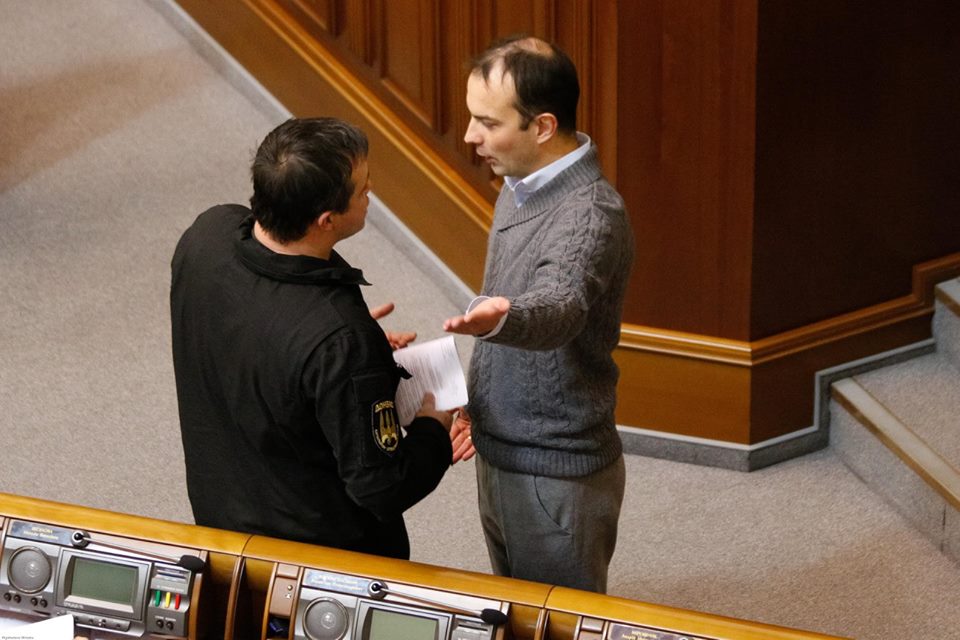
Semyonchuk (on left) in Parliament

Semyonchuk (on left) in Parliament

Source: Semyon Semyonchenko FB

Posted in English, English News, Others, War in Donbas | Tagged , , , , | Leave a comment

Wings Phoenix: It’s not good to destroy trust towards every living thing in the state administration and MoD

By Wings Phoenix, (Iurii Biriukov), army volunteer and Assistant Minister to the Minister of Defense
11.29.2014
Translated by Wings Phoenix Eng and edited by Voices of Ukraine, used with permission

I am really sick of fakes! No – I am EXTREMELY sick of fakes! What can be done about them? How do you fight this?

Let’s take the topic of uniforms from Canada. Someone read somewhere [there were] about 30,000 sets, then yesterday I read a report [that it was] about 3,000 – and all hell broke loose! Here are the items that were transferred:

• pants – 3,449 units

• coats – 2,400 units

• winter gloves – 2,131 units

• demi-season gloves – 3,283 units

• boots – 2,928 units

The documents from the Canadian Embassy are lying right here. And yes, there is another cargo – 10 times bigger than the one that arrived. For the moment it is in Ottawa. Then there was another fake – that there were 70 soldiers that were brought to the airport but that the uniform was not given to them and that they were sent away with nothing. And no-one thought to check, no-one had a thought – maybe they were sent to unload the cargo? And maybe no-one was sent at all? No, we are now yelling to the entire world.

And now some creature named Dmitry Mendeleev came out with this… Apparently, Ukroboronprom buys useless junk for the MoD [Ministry of Defense], earns millions on it, and the MoD and the National Guard don’t even ask for this equipment and try to get rid of it by any means. My oh my! And the armour is bad there, only holds against 7.62 [mm bullets] (and how else is it supposed to be in an APC?). And the agreement was signed two weeks before receiving a reply from the supplier (even though the agreement was signed only in the middle of November). I won’t even mention about the millions. Now this happy creature is sitting there warm and cozy, and the whole of Facebook is hysterical – help, we are being betrayed! And no-one is thinking about the fact that in our country the profitability of the deals of state enterprises is strictly regulated (do you know how much is allowed? No?)

Journalists! I am also like mass media a bit. I am not asking you to cheat and to present everything in rosy colors. I am not saying that everything is good in the MoD, no, it’s just the opposite. But let’s not twist the truth at least! It’s not good to destroy trust towards every living thing on Bankova St./Hrushevskyi St./Vozdukhoflotsky Ave. [the locations of the state administration and MoD] – it won’t lead to anywhere good. It’s hard there even without all this.

In the [Donetsk] airport today it is also… very hard…

Source, translation: Wings Pheonix Eng
Original source: Iurii Biryukov (Wings Phoenix) FB


Posted in Analytics, English, English News, Eyewitness stories, Others, War in Donbas | Tagged , , , , | Leave a comment