Dmitry Tymchuk: Military update 4.9 #FreeSavchenko

information_resistance_logo_engDmitry Tymchuk, Head of the Center for Military and Political Research, Coordinator of the Information Resistance group, Member of Parliament (People’s Front)
04.09.2015
Translated and edited by Voices of Ukraine

Operational data from Information Resistance:

During the last 24 hours, increased activity by Russian-terrorist forces has been observed in the ATO zone.

In addition to multiple attacks in different parts of the demarcation line, insurgents have carried out limited tactical offensives on one stretch (in the Luhansk region) in the vicinity of the Bakhmut highway, attacking the advanced positions of Ukrainian troops. For half an hour, Ukrainian soldiers engaged in a close firefight with an attacking enemy infantry team (up to a company in size), which was supported by several armored vehicles (4 vehicles operated near the positions of the ATO forces, one of which was a tank; 5 more armored vehicles supported insurgent infantry with heavy fire from the inside of their military formations). As a result of combat, insurgents were pushed back to the starting line.

In the vicinity of ​​Bolotene [Luhansk region], insurgents attacked positions of Ukrainian troops with mortar fire. In Donetsk region, positions of Ukrainian troops near the settlements of Novosilka, Opytne, Avdiivka, Berdyanske came under the mortar fire of terrorists. During all of the attacks, Russian-terrorist forces mainly used 120-mm mortars that have been allegedly “moved away” [from the area. Ed. note: as per Minsk II agreement]. The enemy combined mortar fire with other heavy infantry weapons – heavy machine guns, heavy grenade launchers, and small arms.

Also, insurgents inflicted an artillery attack using 122-mm D-30 systems (also supposedly “moved away”). In addition, “wandering” [mobile] terrorist tanks opened fire at the positions of our troops in this area three times. On the OpytneAvdiivka stretch, firing enemy infantry groups attempted to butt through inbetween Ukrainian units. Insurgents actively used Zu-23-2 systems and mortars during these attempts.

In the vicinity of Hranytne (south of Donetsk) a mobile firing group of terrorists, armed with anti-tank systems, ambushed and tried to destroy several armored units of the ATO forces. However, launches of anti-tank guided missiles from an earlier established firing position were unsuccessful for the insurgents – none of the anti-tank missiles hit the target.

Russian-terrorist forces continue to carry out the regrouping of their troops. In particular, a tank tactical group previously recorded by the IR group to be on the march (moving through Luhansk) came out at the Pervomaisk–Stakhanov direction, some tanks (7 vehicles) left towards Horlivka. Following the tank convoy on the same day, 11 liquid bulk tank truck tankers and 4 specialized vehicles (mobile machine army shops) proceeded along the same route.

A company tactical group of insurgents concentrated near Starobesheve, previously reported by the IR group, began to advance towards the front (west and north-west of Telmanove, possibly advancing towards Dokuchajevsk).

Reinforcements continue to arrive in the vicinity of Novoazovsk – Oktyabr Bezimenne for gangs that are waging heavy fighting with Ukrainian troops on the ShyrokyneChermalyk stretch. A sharp decline in the number of reinforcements for Russian mercenaries has been observed, the majority of them – are local “DNR” insurgents (Russian mercenaries are observed mainly as part of the crews for the military equipment transferred from Russia). At the moment, 550-600 people have been transferred as reinforcements into the area.

Besides combat activity, Russian-terrorist forces continue to actively increase combat readiness of their formations and carry out mobilization activities.

The system of repair and maintenance of military equipment and means of insurgent transportation have been practically finalized on the occupied territory. If last year the share of returned military equipment that was previously out of order was estimated by the IR group at not more than 5-7%, today, the share has reached a rate of 25-30%.

Also, works to increase the capacity of major railroad and automobile communications controlled by the occupiers have been observed, to transfer weapons and  material and technical resources from Russia.

During the past 24 hours, a sharp increase in the number of supply convoys has been observed – overall, movement of 44 vehicles (mostly through the “northern” route, a significant number of vehicles was recorded on the Krasnyi LuchDebaltseve stretch (21 vehicles in two convoys), and between Alchevsk and Stakhanov (13 army trucks, also in two convoys).
Source: Dmitry Tymchuk FB

Posted in Dmitry Tymchuk, English, English News, Pictures, South&Eastern Ukraine, War in Donbas | Tagged , , , , , , , , , | Leave a comment

Dmitry Tymchuk: Military update 4.8 #FreeSavchenko

information_resistance_logo_engDmitry Tymchuk, Head of the Center for Military and Political Research, Coordinator of the Information Resistance group, Member of Parliament (People’s Front)
04.08.2015
Translated and edited by Voices of Ukraine

Operational data from Information Resistance:

In the course of the last 24 hours, the situation in the ATO zone remained complex, with signs that point to further exacerbation. Russian-terrorist troops fired on Ukrainian positions and civilian settlements approximately 40 times. Also, during the last 24 hours, the enemy made six attempts to attack the positions of the Ukrainian army; in some of the attacks, they used combat equipment (up to 3-4 units per attack).

For active offensives, Russian-terrorist troops mostly use small arms. We also observed that the terrorists are using mortars (including 120-mm mortars that, in accordance with the Minsk Agreements, should have been withdrawn behind the contact line), armored vehicles, as well as artillery (in particular, D-30 howitzers and SAU 2S1 “Gvozdika” [“Carnation”] self-propelled artillery unit). Based on this, we can state that the blatant violations of the “truce” terms by the Russian-terrorist troops are not isolated incidents caused by “lack of discipline” in the insurgents ranks, but a conscious and intentional military approach of the “DNR” [Donetsk People’s Republic] and the “LNR” [Luhansk People’s Republic].

The gravest situation was observed in the Donetsk and Luhansk sectors, where shelling by terrorists was the most active and used a wide range of weapons, including those prohibited by the Minsk Agreements terms.

On the morning of 04.07.2015, the advance positions of the Ukrainian army in the vicinity of Opytne (Donetsk sector) were fired at from 120-mm mortars, followed by an attack (a diversionary group in a frontal attack, combined with the main forces attacking from the flanks). During the attack, the insurgents actively used small arms and heavy infantry weapons (mounted and hand-held grenade launchers). At first, the enemy was stopped by the retaliatory fire of one of Ukrainian strongholds, then an advanced party of the ATO forces, working with a cover of armored equipment, forced the enemy back to their starting positions.

Fighters of the Azov Battalion prepare to fire an anti-tank weapon in the town of Shyrokyne, eastern Ukraine on Sunday, March 23. Photographer: Mstyslav Chernov/AP Photo

Fighters of the Azov Battalion prepare to fire an anti-tank weapon in the town of Shyrokyne, eastern Ukraine on Sunday, March 23. Photographer: Mstyslav Chernov/AP Photo

The terrorists also attacked the positions of the Ukrainian forces near the settlement of Novotoshkivske, as well as several Ukrainian ATO positions in the Seaside [Mariupol] sector and near Avdiivka (Artemivsk sector). These attacks were carried out by small infantry groups with the active support of armored vehicles. Also, in order to provide fire support to the “infantry” during the attacks, the terrorists employed mobile artillery and mortar squads (usually up to 4 units), which fired from camouflaged, pre-equipped firing positions.

In the vicinity of Krymske, an insurgent fired upon the Ukrainian troops using two combat groups: an infantry group and an armored group. A group of 3 infantry combat machines (BMP-2), acting under cover of mortar fire, occupied a pre-equipped firing position and fired heavily on the positions of ATO forces, using small arms, BMP weapons, 120-mm mortars, and ZU-23-2 anti-aircraft guns. Every attempt of the insurgents to force the Ukrainian forces back from their positions was unsuccessful. The Ukrainian troops returned fire.

We have observed a mixed battalion-tactical group of the enemy transferring to Bezimenne and Novoazovsk. The group consists of two reinforced companies (200-220 people), 7 tanks, and 22 armored combat vehicles.

Reinforcements of Russian-terrorist troops continue arriving in the Artemivsk sector (we have spotted 3 armored combat vehicles and 6 tanks transferring via Chornykhyne).

In the Kuibyshivskyi and Kyivskyi districts of Donetsk, advance mobile insurgent groups are forming to operate on the Krasnohorivka – Avdiivka stretch. For these purposes, a total of 23 armored vehicles (mainly ones that underwent repair), including 10 tanks, were transferred here over the last 2 days, from the vicinity of Snizhne and Amvrosiivka.

Russian-terrorist troops in Donbas continue restoring their combat capacity and building up stocks of supplies and technical resources. Over the last 24 hours, 38 vehicles arrived as part of convoys from Russia (including 16 fuel tankers and 5-6 specialized vehicles). They were mainly moving along the “northern” route (from Lutuhyne and Luhansk to Alchevsk and Perevalsk, then directly to the areas of gang concentration in the vicinity of Stakhanov, Bryanka and Pervomaisk). Supply vehicles were also spotted moving through Chornukhyne – Debaltseve – Vuhlehirsk, to Yasynuvata and the terrorists’ “Horlivka garrison.”

Source: Dmitry Tymchuk FB

Posted in Dmitry Tymchuk, English, English News, Pictures, South&Eastern Ukraine, War in Donbas | Tagged , , , , , , , , , | Leave a comment

Adopt A Soldier initiative adopts more veterans for April

By Voices of Ukraine Senior Staff with posts from Ukraine War Amps
04.07.2015

Ukraine War Amps’ ADOPT A SOLDIER project commits to delivering to more veterans in April!

Between April 12 – 30th Adopt A Soldier is committed to delivering donations to: Leonid Moroshan, Ihor Petsyk, Ruslan Karpetz, Vadym Dovgoruk, Vadym Svyrydenko, Vasyl PelyshMaxim Vakulenko, Oleksiy ZamirkoVyacheslav Buynovsky.

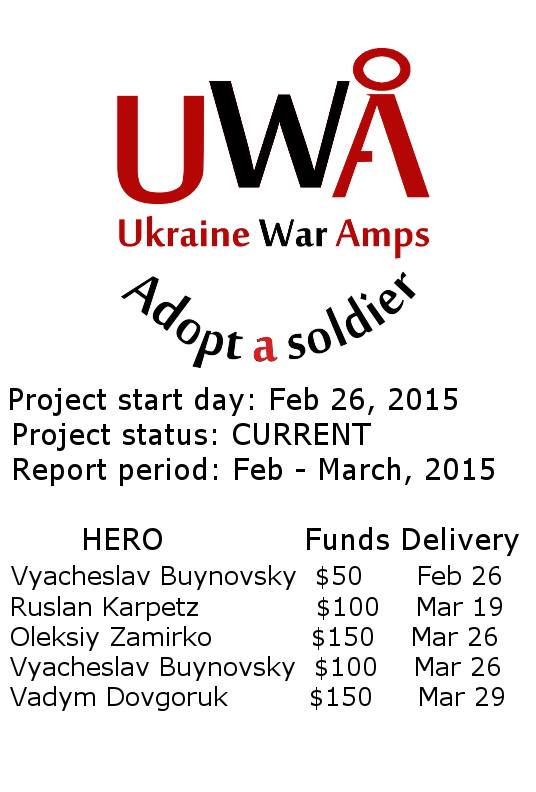
In March, the Ukraine War Amps Community through the Adopt a Soldier project helped four Heroes, delivering $500 in total. The project started with one veteran in February, and will increase to nine in April! Following is the March report:

In addition, the updates on the individual war amps are as follows:

On March 27, 2015, Vyacheslav Buynovsky left the hospital and finally got home to Sumy Region. He also agreed to coordinate UWA logistics and some of the activities in Ukraine: to call some hospitals and ask for seriously wounded amputees who could be helped by Adopt A Soldier. He feels good and is in a good mood, looking forward to contributing to the cause. Buynovsky was “Adopted” by a family in Toronto, Canada.

Vasyl Pelysh‘s family is now in constant contact with Isabel – Vasyl’s supporter through the UWA – their first established bridge. Vasyl should be in Chicago soon for further treatment. Vasyl comes from the Lviv region.

Maxim Vakulenko was “Adopted” by a school in Mississauga, Ontario, Canada! He is busy volunteering for the Aidar Battalion. His wife just turned 22, and they have a 3 year old son. Vakulenko  comes from near Kyiv, Ukraine. 

Oleksiy Zamirko was also “Adopted” and found common ground with the UWA rep in Kyiv (Dmytro Gribinik – look for him in the Facebook group) and they committed to becoming airborne as soon as Zamirko gets better, as Zamirko is eager to parachute together with Dmytro! Dmytro originates from Alchevsk and Zamirko from the Vinnytsia region of Ukraine. 

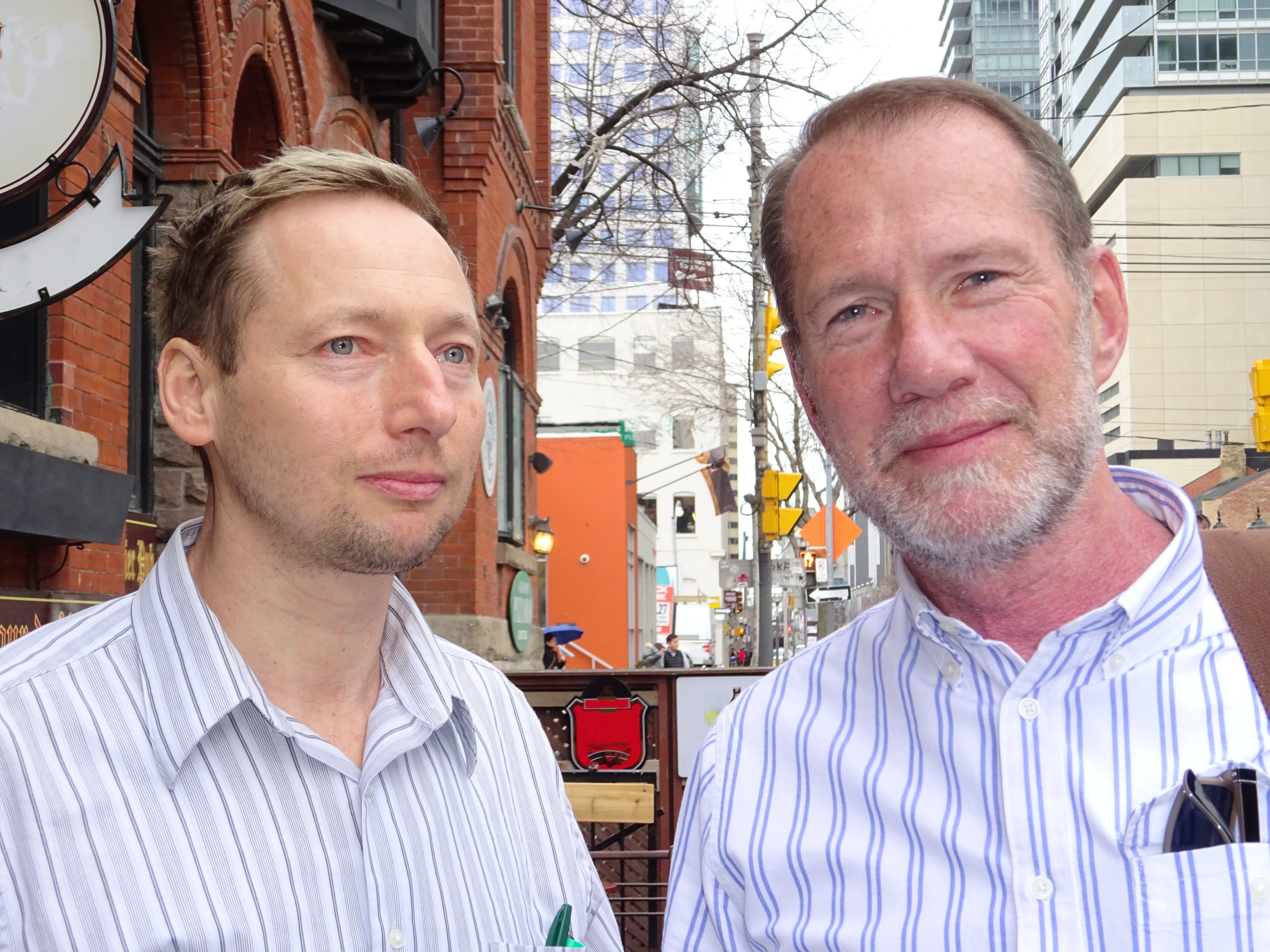
Gene Berezovski and John Broadhead

Gene Berezovski and John Broadhead

The Adopt a Soldier project was founded by John Broadhead and Gene Berezovski, who have also co-founded Ukraine War Amps. It aims to “adopt” soldiers by providing monthly stipends of approximately $50 USD to as many veterans of the Russian invasion and war on Ukraine as they can, on an ongoing basis. 100 percent of the proceeds go directly to those being helped. Ukraine War Amps provides photographic evidence of payments. In addition, they put you directly in touch with the war amp you’re helping! Proofs of payment and the stories of the war amps can be found on the Ukraine War Amps Facebook page.  Your assistance can make the difference between their living with some dignity or living in hopelessness. Adopt A Soldier’s goal is to ensure that amputees have everything they need to live as normal a life as possible, while also providing a unique bridge between the donor (wherever they are in the world) and the amputees in Ukraine, by putting them directly in touch with each other.

Donors can choose an amputee from the list on the website and choose to donate to their “adopted” amputee on a monthly basis. Just leave a message in the comments for your chosen amputee, or for the Ukraine War Amps (UWA) team, and UWA will deliver it or help to provide a direct connection between both sides. Here is what all the donation options look like:

Option 1 : an ongoing monthly payment in any amount for a chosen amputee
Option 2: a one-time donation in any amount for a chosen amputee
Option 3: an occasional donation in any amount for a chosen amputee
Option 4: an ongoing monthly payment in any amount for the general cause
Option 5: a one-time donation in any amount for the general cause
Option 6: an occasional donation in any amount for the general cause

UWA will send out reminders to make a donation on a monthly basis through the website. UWA collects funds during the first 2 weeks of the month, then delivers them during the second half of the month. In addition, anyone can send them an email with suggestions, recommendations, or ideas through their website.

Please visit the Facebook page and the website for more information and photographs on each of these Ukrainian heroes!

Please help Ukraine War Amps help these Veterans and heroes who stood up for their homeland, for its freedom and democracy.

Adopt A Soldier website for donations 
Ukraine War Amps Facebook

More about the founders of the Adopt A Soldier project and the Ukraine War Amps (and Voices of Ukraine’s first story on this initiative) can be found here:
https://maidantranslations.com/2015/03/14/you-asked-how-to-help-adopt-a-soldier/

Posted in English, Help for ukrainian wounded, Pictures, War in Donbas | Tagged , , , , , , , , , , | 3 Comments

Leonid Moroshan, fighter with the 128th Separate Mountain Infantry Guards Brigade, severely wounded near Debaltseve, needs help (Photo Report)

By Tsenzor.net
04.02.2015
Translated and edited by Voices of Ukraine

On February 16, 2015, a soldier of the 128th Separate Mountain Infantry Guards Brigade, Leonid Moroshan, callsign “Kozak Shaman,” was seriously wounded in the battle for Debaltseve.

Leonid was taken to hospital with shell fragments in his lung, shrapnel in his shoulder, and an open fracture of the leg above the knee (the bone was fractured – thank God, the doctors were able to save it from amputation).

Volunteer Andrew Merezhko wrote about this on his Facebook page, reports Tsenzor.NET.

On February 18th, Leonid had surgery in Artemivsk, and then was transported to Kharkiv. On Tuesday, March 24th, the doctors operated on Leonid’s leg for the fourth time, but they did not pull the fragment out, because they cannot locate it.

Today, the soldier is being treated in a hospital in Vinnytsia. On Thursday, I went to check up on him. On March 11th, they did another operation. It went well, but his body is already exhausted by the antibiotics and other medicines, his stomach was empty until lunch and he did not want to eat. His leg is in pain and requires painkillers, it’s now being stretched with weights. He has 31 stitches in just one leg… Today, the pain decreased a little, his mood improved… his condition is stable, we’re waiting for the next operation!

After lunch, Leo was feeling a little better. The children’s drawings and crafts that I’d brought with me put a smile on his face.

For Leonid, a very long-term rehabilitation is still ahead. I, Andrew Merezhko, am addressing friends and strangers! Please help! I did not ask [for help] during the events of Maidan, I did not ask when the war began, but I am asking now, not for myself, but for our Ukrainian guy – Leonid Moroshan, a true patriot, who went through Maidan from start to end, who fought in eastern Ukraine for over six months, with whom we stood shoulder to shoulder on Maidan during the hottest days [of fighting], and [he’s] a first-class master of woodcarving in civilian life. He is a real fighter, he has always been on the forefront; as [he was] on Maidan so [he is] in the war. During his whole time on Maidan, he received 16 stitches as a result of various injuries (hand, knee, face, neck). Every drop makes the ocean. It is YOUR help that will make a difference for him. Thank you! “- says the volunteer.

Would you like to help Leonid?

Source: Tsenzor.NET.ua

To help Leonid Moroshan, please go to:

Adopt A Soldier website for donations 

Ukraine War Amps Facebook

Posted in English, English News, Pictures, South&Eastern Ukraine | Tagged , , , , , , | Leave a comment

Dmitry Tymchuk: A few words about the current situation in the ATO zone

information_resistance_logo_engDmitry Tymchuk, Head of the Center for Military and Political Research, Coordinator of the Information Resistance group, Member of Parliament (People’s Front)
04.06.2015
Translated and edited by Voices of Ukraine

A few words about the current situation in the ATO zone:

The current lack of large-scale offensive action on the part of Russian-terrorist troops in Donbas, as well as the lack of activity on the part of Ukrainian troops under the Minsk Agreements, have resulted in the lowered attention of the Ukrainian society towards the events in the ATO zone. That is only to be expected. However, based on the events at the start of this year [2015], we are well aware what lies at the end of such [quieter] periods.

Therefore, here are some comments on the current situation:

1. Concerning the future advance of the terrorists.

We don’t know when Russian-terrorist troops will become a full-scale offensive. The leaders of the “DNR” [Donetsk People’s Republic] and the “LNR” [Luhansk People’s Republic] are also unaware of that. As seen from the events around the time of the Ilovaisk tragedy and the Debaltseve springboard battles, the decisions made in Moscow are communicated to the terrorists as last-minute orders.

However, even as of this time, three main strike groups of Russian-terrorist troops have ALREADY been formed; the enemy is actively scouting out the positions of Ukrainian troops (using any means from sabotage and reconnaissance groups to radio intelligence); and on the tactical level, the terrorists are trying to create a ‘configuration’ of the front line that would be convenient for them, by attempting to squeeze out our troops from their positions in several sectors at once (Avdiivka, Shyrokyne). We observed a similar situation late last year – and early this year, it resulted in the loss of the Debaltseve springboard. Therefore, the facts are that Ukraine must be ready for a full-scale offensive even today.

2. Concerning the current processes in the “DNR” and the “LNR.”

At this time, the insurgents (or rather, representatives of the Russian [military] command, the FSB [Federal Security Service], and the GRU [Main Intelligence Directorate] of the Russian Armed Forces, currently supervising insurgents in Donbas) have the following tasks:

– complete the roundout of “DNR” and “LNR” formations, making the “final touches” to the strike groups formed in the following sectors: Donetsk and Artemivsk (the most powerful terrorist group was concentrated in this area, on the base of the “Horlivka garrison,” able to act in two operative sectors: southwest and north), north of Luhansk oblast (sectors of Shchastya and Stanytsia Luhanska); and the Seaside (Mariupol) sector.

– create a single structure of terrorist formations, with a single command system (the “administrative” separation of the “DNR” and “LNR” does not matter in this instance; nominally, each “terrorist republic” has its “army corps,” but both of them are subordinated to a single command). The main task here is to join all gangs in Donbas under a single command. The mechanism for a single command of the troops has already been tested during the Debaltseve springboard battles (January – February 2015), where an offensive with a singular purpose was carried out using the “DNR” forces (advancing from the northwest and south) as well as the “LNR” forces (advancing from the southeast and east).

– create a single system for logistics support of both “army corps” using resources delivered from Russia. The intermediate “hubs” used to distribute these resources are already functioning as part of this system; the resources are delivered via two main routes (we nominally call them “northern” and “southern” routes). The insurgents’ current efforts to increase the capacity of the railway points in Ilovaisk and Debaltseve are aimed at creating this single supply system.

– create a single system for personnel training. Nominally, this system consists of two components: training camps in Russia and in the occupied Crimea (the main centers are in Rostov-on-Don (Russia) and Perevalne (Crimea); in the latter case, trained personnel is transferred to Donbas through [Russia’s] Rostov oblast); and training centers created by Russian [military] specialists in the “DNR” and “LNR” territories.

The first component is aimed at training traitors in Crimea and mercenaries from Russia. In this aspect, the trend is rather bleak for Putin. While last year, the majority of mercenaries deployed to Donbas had served in special force units and had armed combat experience, this year, training centers are grabbing everyone they can find. More and more mercenaries are “cannon fodder” who have not done even compulsory military service, let alone setting foot in active war zones. Russia may be vast, but the human resource is not endless, and there are less fools every day.

The second component’s effectiveness is also dubious. Experience shows that most of the local insurgents in Donbas are gentlemen not burdened by intellect, and even the efforts of the best Russian instructors may not be enough to turn them into competent soldiers. Combined with the shortage of [qualified] Russian mercenaries, this renders the Kremlin’s task of enabling the “DNR” and “LNR” to conduct serious military operations without the help of the regular Russian army impossible. A rather unpleasant turn of events for Putin.

3. Concerning the presence of Russian troops in Donbas.

After the Debaltseve operation in February of this year [2015], we are observing a rapid decrease in the strength of regular Russian forces in Donbas (in the form of battalion and company technical groups, formed on the basis of different units and divisions of the Russian Armed Forces). Most of the Russian military servicemen active [in the region] right now are members of the GRU’s sabotage and reconnaissance groups, or acting as military instructors in training centers and officers in command bodies. The same picture was observed in September, after the Russian-terrorist Ilovaisk operation.

The algorithm is obvious: during large-scale offensive action that the insurgents cannot conduct on their own, Russia quickly brings in their units to Donbas to bear the brunt of the combat missions. After the end of the operation, the troops are withdrawn, and only the necessary minimum remains in Donbas.

Therefore, when we evaluate the potential of Russian-terrorist troops, in particular in the north of Luhansk oblast and in the Seaside [Mariupol] sector (theaters of war in proximity to the Russian border), we must firstly take note of the Russian troops stationed in the borderland regions of Russia opposite these sectors. At this time, the majority of Russian battalion tactical groups is indeed concentrated in these borderland regions. Let us draw the conclusions.

Source: Dmitry Tymchuk FB

Posted in Dmitry Tymchuk, English, English News, Pictures, South&Eastern Ukraine, War in Donbas | Tagged , , , , , , , , | 2 Comments