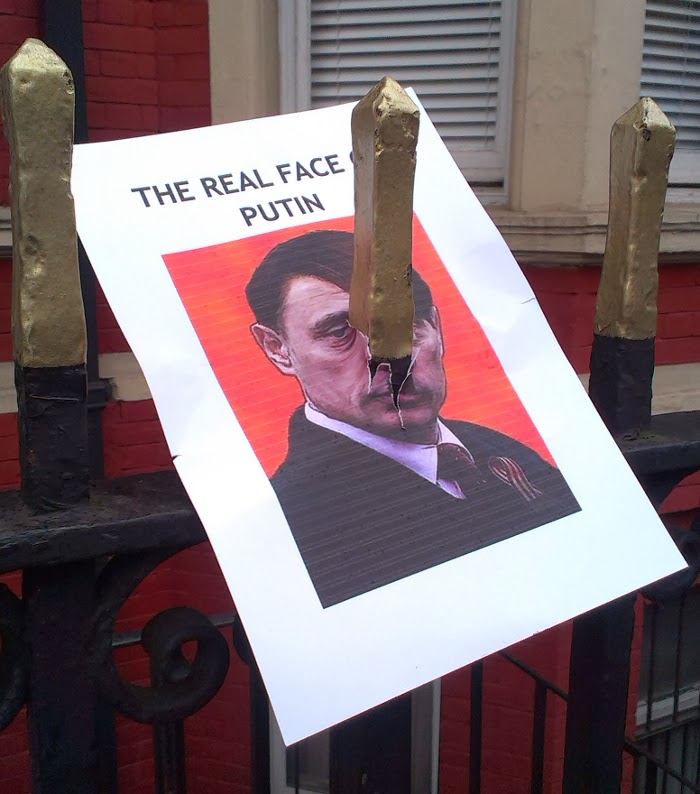
Anton Shekhovtsov: Is Putin a new Hitler (in the making)?
Source: http://anton-shekhovtsov.blogspot.it/2014/03/is-putin-new-hitler-in-making.html
His country pompously hosted the Olympic Games and then he decided to annex a part of a neighbouring sovereign country to his own empire on the ground of protecting his compatriots from suffering abroad.
Is his name Adolf Hitler? In October 1939, following the start of the invasion of Czechoslovakia, Hitler declared:
For months the Germans in Sudetenland have been suffering under the torture of the Czechoslovak government. […] The Sudeten German population was and is a German. This German minority living there has been ill-treated in the most distressing manner.
Or is his name Vladimir Putin? In March 2014, 75 years later Hitler’s speech in Reichstag on Sudetenland and shortly after the Ukrainian revolution ousted the criminal authoritarian regime of Viktor Yanukovych, Russian forces invaded the Ukrainian republic of Crimea, while Putin appealed to the Council of Federation of the Federal Assembly of the Russian Federation:
In connection with the extraordinary situation that has developed in Ukraine and the threat to citizens of the Russian Federation, our compatriots, […] I hereby appeal to the Council of Federation of the Federal Assembly of the Russian Federation to use the Armed Forces of the Russian Federation on the territory of Ukraine.
Apart from these quotes, and the striking similarities between the anthem of the Russian parliament and that of Nazi Germany, there are other reasons to believe that convergences between Hitler’s and Putin’s doctrines are not a coincidence. And here is why.
Fascist Eurasianist ideology behind Putin’s Eurasian Union
Putin’s military invasion of Ukraine is driven by revanchist ambitions to restore the Russia-led empire at the expense of sovereign states. Already in 2005, when addressing the Federal Assembly of the Russian Federation, Putin declared:
Above all, we should acknowledge that the collapse of the Soviet Union was a major geopolitical disaster of the century. As for the Russian nation, it became a genuine drama. Tens of millions of our co-citizens and compatriots found themselves outside Russian territory.
However, the new empire, the Eurasian Union which Putin is seeking to establish in 2015 on the basis of the existing Customs Union of Belarus, Kazakhstan and Russia is not going to simply duplicate the Soviet Union. Putin will go further; the Eurasian Union has to be interpreted literally in the geographic terms. Ukraine is just the first step. Putin never considered Ukraine “a real state” anyway. In 2008, talking to George Bush at a NATO meeting in Bucharest, Putin said: “You don’t understand, George, that Ukraine is not even a state. What is Ukraine? Part of its territories is Eastern Europe, but the greater part is a gift from us”.
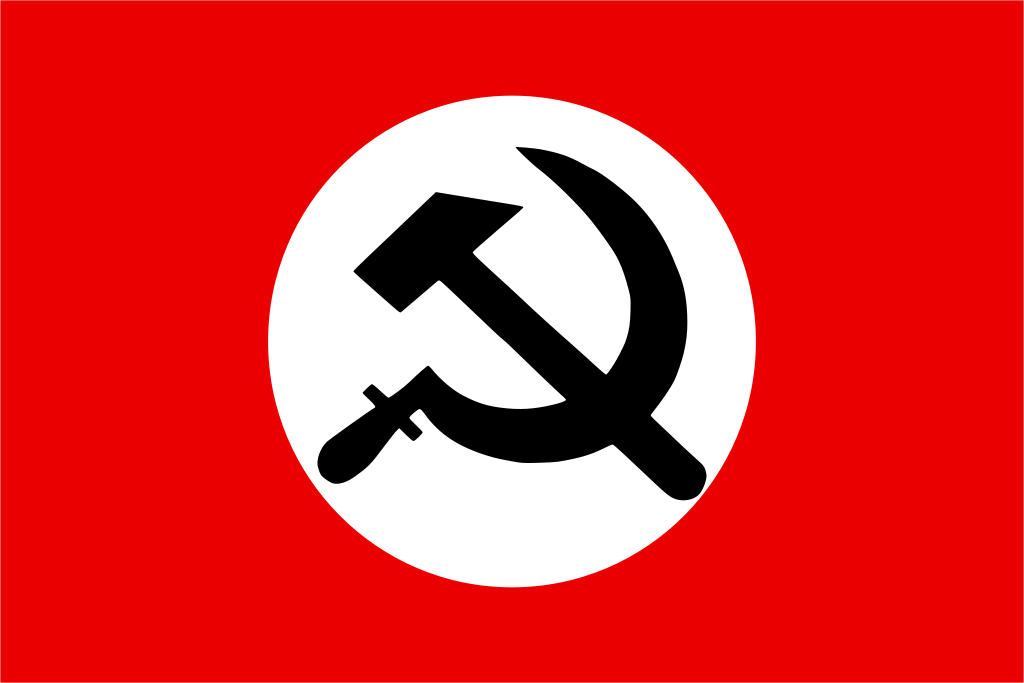
In its modern interpretation, the ideology of Eurasianism is a form of fascism with a distinct Russian colouring. The main advocate of Eurasianism is Aleksandr Dugin, a notorious Russian extremist and leader of the International Eurasian Movement with strong links to fascists in Western Europe and Britain in particular. Dugin’s rise began in 1998 when Putin became Head of Russia’s Federal Security Service: Dugin left the fringe fascist National-Bolshevik Party (NBP) and was appointed as a special advisor to the contemporary Russian Parliament speaker Gennadiy Seleznev.
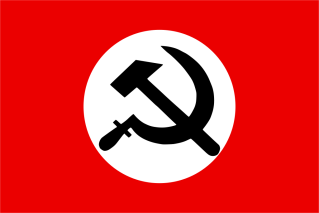 |
| The flag of Dugin’s National Bolshevik Party |
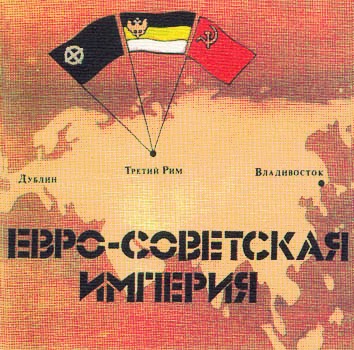
Among the Western fascist ideologues, who have exerted the formative influence on Dugin, one author is of particular interest. This is Belgian extreme right politician Jean-François Thiriart (1922-1992), a convicted collaborationist during the Second World War and a dedicated post-war pan-European fascist. By the beginning of 1980s, Thiriart put forward an idea of the fascist Euro-Soviet Alliance and argued: “If Moscow wants to make Europe European, I preach total collaboration with the Soviet enterprise. I will then be the first to put a red star on my cap. Soviet Europe, yes, without reservations”.
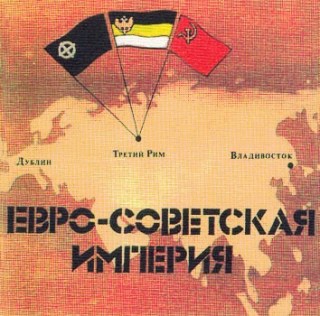 |
| The Euro-Soviet Empire from Dublin to Vladivostok with a capital in Third Rome (Moscow) |
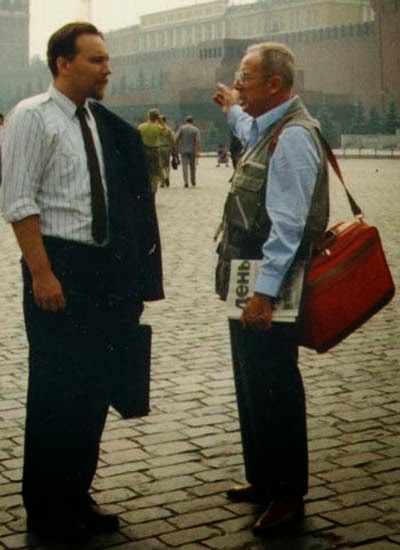
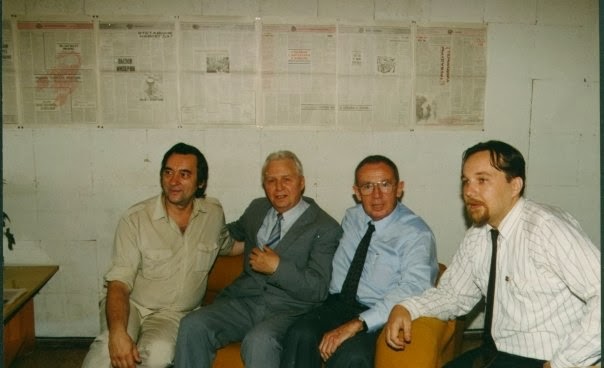
In August 1992, Thiriart went to Moscow as a member of the revived European Liberation Front to meet Dugin and other Russian fascists and anti-Semites: Aleksandr Prokhanov, Sergey Baburin and others, among them the leaders of the misleadingly named Communist Party of the Russian Federation, Gennadiy Zyuganov and Yegor Ligatchev.
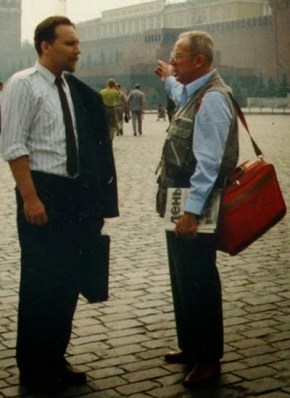 |
| Aleksandr Dugin and Jean-François Thiriart on the Red Square in Moscow, 1992 |
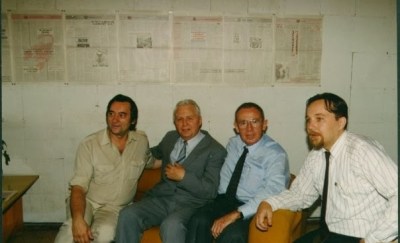 |
| Aleksandr Prokhanov, Yegor Ligatchev, Jean-François Thiriart and Aleksandr Dugin in Moscow, 1992 |
In 1997, while still being a co-leader of the NBP, Dugin published his most important work, The Foundations of Geopolitics. Dugin’s military adviser for this book was General-Lieutenant Nikolay Klokotov who taught at the General Staff Academy of the Armed Forces of Russia. In The Foundation of Geopolitics, grounded the Eurasianist aversion to the US and the Anglo-Saxon world in general. According to him, the planet is roughly divided into three large spaces: the World Island (the US and the whole Anglo-Saxon world), Eurasia (predominantly Central Europe, Russia, and Asia), and the Rimland (the states between the World Island and Eurasia). In Dugin’s view, there is a perennial irresolvable confrontation between the World Island associated with the US dominated “homogenizing New World Order” and the “Land power” of the Russia-oriented “New Eurasian Order”. In classic Manichean tradition, Dugin demonises the US and the whole “World Island” as a “reign of Antichrist”. To fight this “World Island”, Russia has to secure the Eurasian continent first, to build a 21st century version of Thiriart’s Euro-Soviet Empire.
In the same book, Dugin, with the help of General-Lieutenant Klokotov, provided a plan of building the Eurasian Empire. Some regions and countries would be taken by military force (hard power), some – by the power of persuasion (soft power). With regard to Ukraine, Dugin wrote:
The sovereignty of Ukraine represents such a negative phenomenon for the Russian geopolitics that it can, in principle, easily provoke a military conflict. […] Ukraine as an independent state with some territorial ambitions constitutes an enormous threat to the whole Eurasia, and without the solution of the Ukrainian problem, it is meaningless to talk about the continental geopolitics. […] Considering the fact that a simple integration of Moscow with Kiev is impossible and will not result in a stable geopolitical structure […], Moscow should get actively involved in the re-organisation of the Ukrainian space in accordance to the only logical and natural geopolitical model.
This “logical and natural geopolitical model” implies the division of Ukraine into several “zones”, the majority of which will be directly controlled by Moscow. This is something that the Kremlin is already trying to do.
The Kremlin’s current strategy towards Ukraine was tested in Georgia in 2008. For several years before Russia invaded Georgian regions of South Ossetia and Abkhazia, Russian authorities encouraged Georgian citizens of these regions to apply for Russian citizenship. When the time came, the Russian forces successfully provoked the Georgians to respond with fire, and then Russia occupied South Ossetia and Abkhazia on the pretext of protecting Russian citizens and Russian “blue-helmets” in these regions. During the attack on Georgian territories, Dugin urged the Russian military to send tanks on Tbilisi:
“Tanks to Tbilisi!” – this is a voice of our national history! […] Those, who do not second the “Tanks to Tbilisi!”, are not Russians. […] “Tanks to Tbilisi!” – that’s what should be written on every Russian’s forehead.
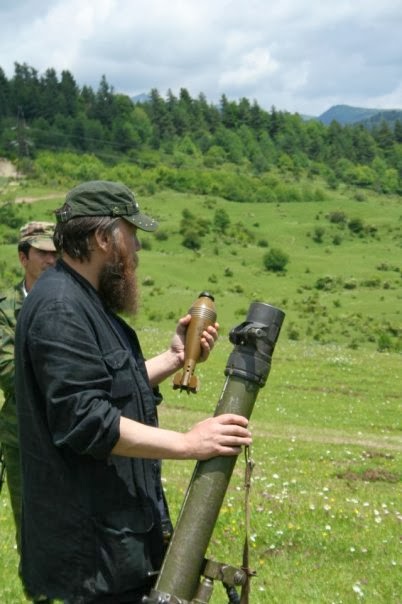
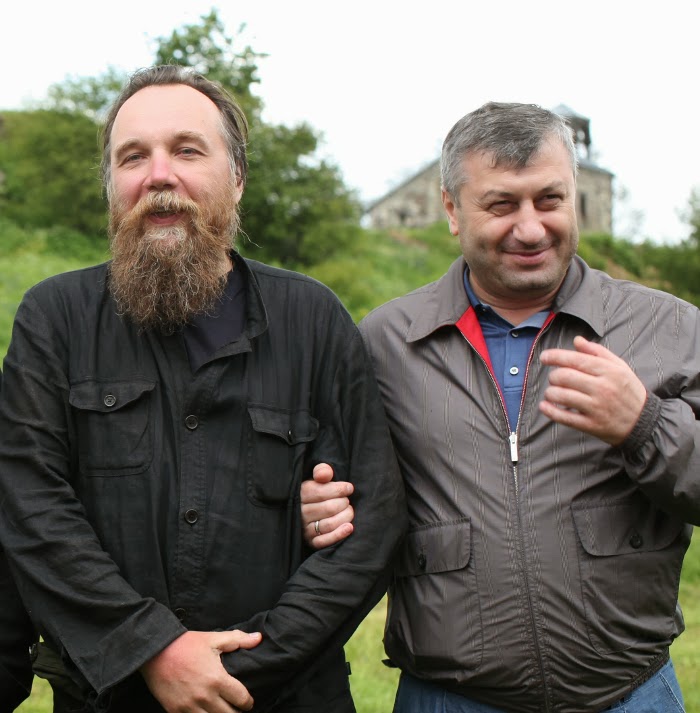
Dugin himself went to South Ossetia with his followers from the Eurasian Youth Movement, and conducted the talks with the self-appointed leader of pro-Russian South-Ossetian separatists Eduard Kokoyty.
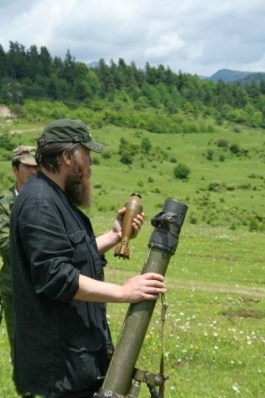 |
| Aleksandr Dugin in South Ossetia ready to kill Georgians, August 2008 |
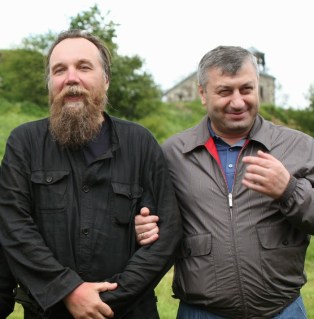 |
| Aleksandr Dugin and Eduard Kokoyty, South Ossetia, 2008 |
The Kremlin’s Eurasianist plan for Ukraine was similar: many years before the Russian invasion of the Crimea, Russian authorities introduced a simple procedure of obtaining Russian citizenship. Moreover, the Russian Black Sea Fleet is also based in the Crimea, in the city of Sevastopol. However, the Kremlin’s Plan A did not work: Ukrainian forces did not fall for provocations and did not open fire even despite the outright military invasion. Plan B for the Kremlin is obviously to carry out a terrorist attack against Russians or its own military forces in the Crimea and then accuse the Ukrainian side of terrorism. Then begin the full-blown invasion. The Goebbels-style propaganda machine is already working.
The Kremlin has already “elected” the Prime Minister of the Crimea, Sergey Aksenov. His ultranationalist party, “The Russian Unity”, obtained 4.02% of the vote in the local Crimean elections in 2010, but this notwithstanding the Kremlin decided he was an appropriate leader of the occupied territories. One historical comparison suggests itself: when Nazi Germany invaded Norway in 1940, the Nazis backed the leadership of Vidkun Quisling, head of the National Unity party which was never able to obtain more that 2.5% of the vote in the parliamentary elections before the invasion. After the Second World War, Quisling was executed and his name became a synonym for “traitor”.
The Kremlin’s Eurasianist plan for the EU is different: while the Baltic States and Poland may indeed be invaded (Putin has accused Poland and Lithuania of training “Ukrainian militants” and large-scale Russian tactical exercises have already started on the borders of these countries), the Kremlin probably relies on soft power in most of the EU countries. The Kremlin’s main allies in the EU are extreme right parties. Putin believes that the European extreme right are on the rise, and when they eventually take power, their countries will leave – and ultimately destroy – the EU to pave a way for the “Euro-Soviet Empire”.
Putin is already a cult person for many European far right activists. The Italian National Front applauded Putin for his anti-gay laws and the disruption of the US/European plans to crack down on Bashar al-Assad’s regime, Andreas Mölzer of the Freedom Party of Austria hailed Putin as a hero who “had managed to steer the post-communist, crisis-ridden Russia into calmer waters”, Nick Griffin of the British National Party praised Putin’s Russia for “a robust, transparent and properly democratic system”, Norwegian extreme right terrorist Anders Breivik wrote of him as “a fair and resolute leader worthy of respect”…
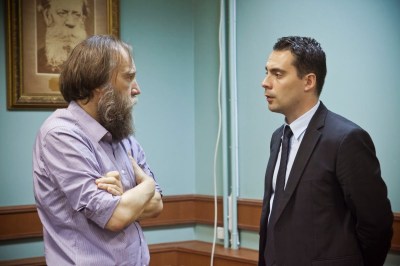 |
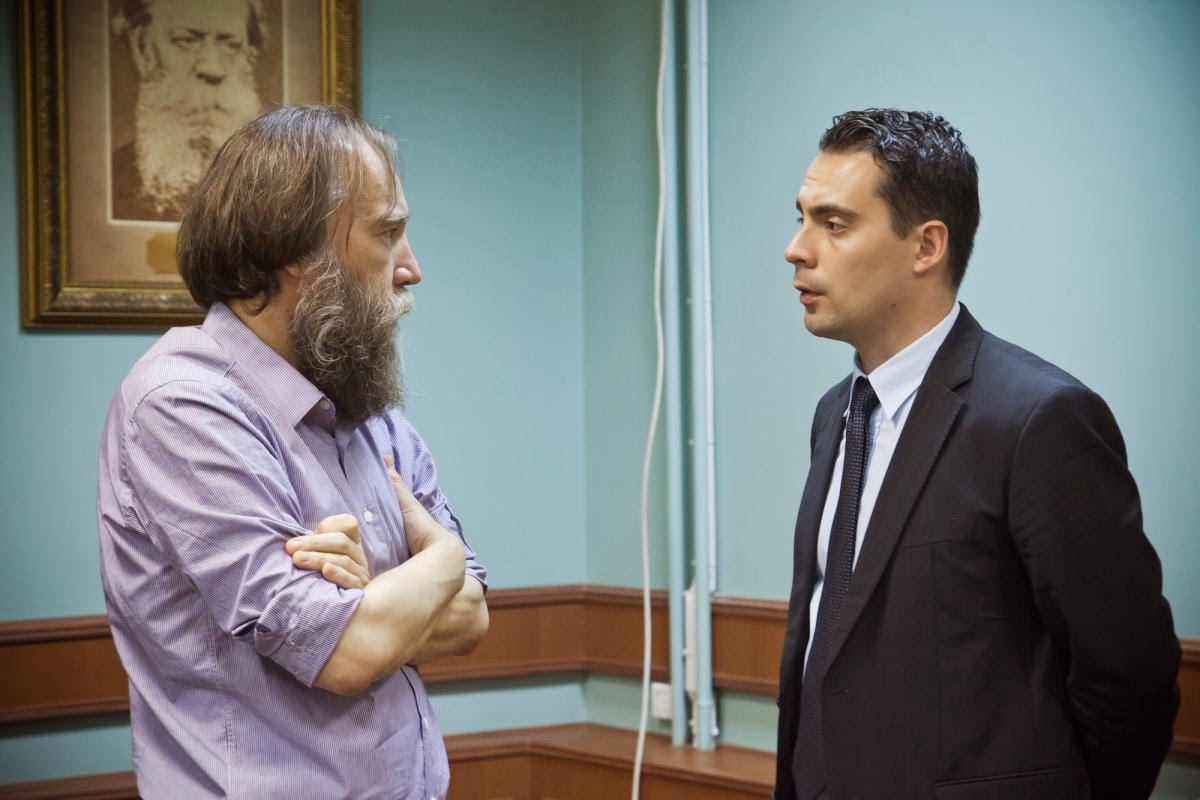
| Aleksandr Dugin and Gábor Vona, Moscow, 2013 |
In May 2013, Jobbik’s leader Gábor Vona visited Moscow to meet with Dugin at the Moscow State University. At the meeting, Vona called the European Union “a treacherous organisation” that “took away our markets, our factories, and filled the shelves of our shops with Western garbage”. Russia, at the same time, managed to “preserve its traditions” and, unlike the EU or the US, “did not worship money and mass culture”. According to Vona, “the role of Russia today is to offset the Americanisation of Europe”. Jobbik’s leader even went so far as to declare that it would be better for Hungary to join the Eurasian Union should occasion arise.
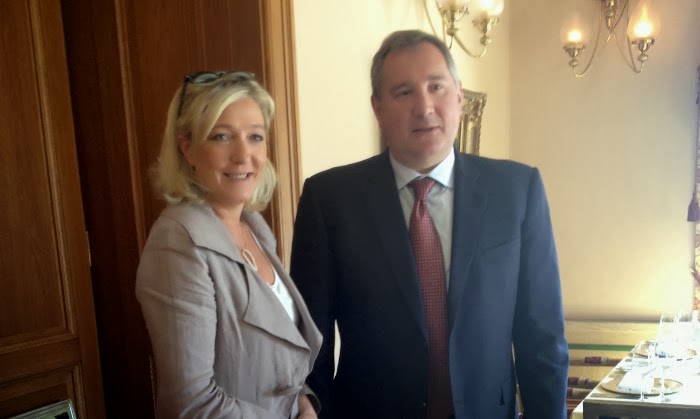
In June 2013, Marine Le Pen, the French National Front’s leader, also visited Moscow. She met with the Speaker of the Russian parliament Sergey Naryshkin and Deputy Prime Minister Dmitriy Rogozin. The latter is one of the most ardent hawks in the Russian government. The same month, Le Pen visited the Ukrainian city of Sevastopol. The details of her visit to the Ukrainian port that hosts the Russian Black Sea Fleet are unknown.
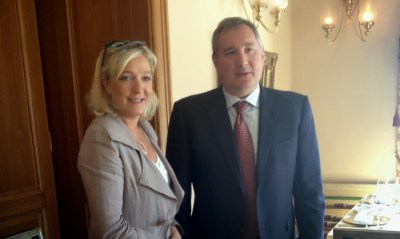 |
| Marine Le Pen and Dmitriy Rogozin, Moscow, 2013 |
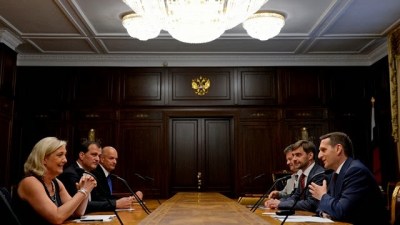 |
| The meeting of Marine Le Pen and Sergey Naryshkin, Moscow, 2013 |
It now looks increasingly clear that Putin’s Eurasianist plans go far beyond Ukraine which indeed seems to be a contemporary Sudetenland case. In his recent essay, Dugin has outlined the future of Russian Eurasianist expansion:
In its liberationist battle march, Russia will stop neither on the territory of the Crimea, nor of the Dnieper region, nor even on the Western borders of former Ukraine. Our aim is the liberation of Europe from Atlanticist invaders – those who caused the catastrophe in Kyiv and delegated power to the criminal junta. Our aim is the great continental liberation struggle. The battle for Europe lies ahead. Even if we – for our egoistic purposes – secure acceptable borders, we will need to liberate Europe, and not only Central, but also Western Europe. […]
It is just the beginning. That is why the cells of active resistance to American hegemony will be formed not only in the Crimea, Eastern Ukraine, Western Ukraine, but in Europe too.
You called us the “gendarme of Europe”. Yes, very much so. We are gendarmes. We ensure order, law, rights and security. We punish criminals and shackle insurgents. We guard a healthy family and justice. We defend culture and spirit. Faith and morality. Identity and tradition.
We are saint gendarmes.
And we are going to you. To the West.
To defend our borders.
Will there be another “Western betrayal” – a phenomenon that refers to the late 1930s when the West failed to meet the legal and political obligations to protect Central and Eastern Europe from Nazi Germany? Before the West decides how it should act, let us consider the following points.
Why protecting Ukraine is crucial…
…for Ukraine herself
The Ukrainian revolution has toppled the corrupt authoritarian regime of Viktor Yanukovych, which, during its last days, resorted to state-inspired terrorism against the protesters. The early presidential elections are planned for May 2013, and it is evident that a new president will be pro-democratic and pro-European. The early parliamentary elections – although they are not planned at the moment – should take place shortly following the presidential elections. Again, the pro-democratic political forces are most likely to win the elections.
Even if certain members of the far right Svoboda party are represented in the current government, one should understand that this government is transitional and has to deal with only two major problems: (1) the Russian invasion and (2) the economic crisis. Furthermore, popular support for Svoboda has dramatically dwindled throughout 2013. In the 2012 parliamentary elections Svoboda won 10.44% of the vote; by the end of January – beginning of February 2014, according to the opinion polls, only 5.6% of the voters would have cast their ballot for Svoboda in a parliamentary election – enough to pass the electoral threshold but obviously too poor to exert significant influence on Ukraine’s politics. Even worse for the party, its leader Oleh Tyahnybok’s presidential rating fell from 10.4% in March 2013 to 3.8% at the end of January – beginning of February 2014, making him a no-go presidential candidate. It is even entirely possible that support for Svoboda as a party may decline further. Despite the sensationalist, Kremlin-inspired “analyses” claiming that Ukraine was facing “a neo-fascist coup”, Svoboda has been discredited during the revolution and – if Ukraine survives the ongoing Russian invasion – is unlikely to regain the support it enjoyed in 2012.
Furthermore, Ukraine is a multicultural country, and the Crimea in particular is a home to several ethnic communities. It is the only home to the Crimean Tatars, who have taken part in the Ukrainian revolution and fought against Yanukovych’s criminal authoritarian regime. According to the reports from the Crimea, Crimean Tatars are going to fight the Russian occupation forces in case of the full-blown invasion, but if the Crimean Tatars are defeated, it will amount to genocide of the Crimean Tatar population.
…for the region
If Ukraine survives the Russian invasion, it will become a normal European democracy and a source of stability in the region. Moreover, the successful democratic transformation of Ukraine may inspire the pro-democratic processes in Russia.
If Russian invades and partitions Ukraine, it will become a permanent battlefield of different powers and a source of instability right on the border of the EU.
…for Europe
Putin is not going to stop with invading Ukraine. His plans are not only revanchist but ardently imperialistic too. Dugin’s fascist Eurasianist ideology, which seems to lie at the heart of Putin’s projected Eurasian Union, is underpinned by a vision of the contemporary version of the Thiriart’s Euro-Soviet Empire which includes the whole Eurasian continent.
Around a million of ethnic Russians live in the three Baltic States which once were Soviet republics. What if Putin decides that they are “suffering under the torture” of “Lithuanian, Latvian and Estonian nationalists”? The invasion of South Ossetia and Abkhazia gave Putin an idea that the Sudetenland scenario works. If it works for Ukraine too, then the Baltic States will be next. And then Putin may change the scenario, like Hitler did after the invasion of Czechoslovakia, Poland and annexation of Austria.
Does this sound mad? It definitely does. A few days ago, German chancellor Angela Merkel told US President Barack Obama that after talking to Vladimir Putin she was unsure whether he was “in touch with reality”. According to Merkel, Putin is living “in another world”.
…for the world
In 1994-1996, Ukraine voluntarily gave up the world’s third largest nuclear weapons stockpile. In exchange for this unprecedented act, the US, UK and Russia signed with Ukraine the Budapest Memorandum which included security assurances against “the threat or use of force against the territorial integrity or political independence of Ukraine”. Russia has already violated the Budapest Memorandum. If the US and UK ignore its legal commitments and do not protect Ukraine, then all the efforts for world nuclear disarmament will be in vain. Ukraine would be a precedent: Why give up nuclear weapons if they are the only guaranty of political independence and territorial integrity? Moreover, those countries that do not have the nuclear weapons yet, will start building them, and a new nuclear arms race will be set in motion in an increasingly unstable world.
Is Putin a new Hitler? Not yet, but he may be a Hitler in the making with a fascist Eurasianist ideology underpinning his aggressive actions. If the world does not stop him, he will become a Hitler with a nuke.

 Representatives of Russian culture centers in Ukraine held a press conference on March 5 to express their opposition to the aggressive policy of the Kremlin to “defend” the Russian population, reports Espreso.TV.