 By Pavel Kanygin, journalist.
05.14.2014 Novaya Gazeta
Translated and edited by Voices of Ukraine.
The story of the abduction of our special correspondent Pavel Kanygin, as he himself tells it without emotion or judgement.
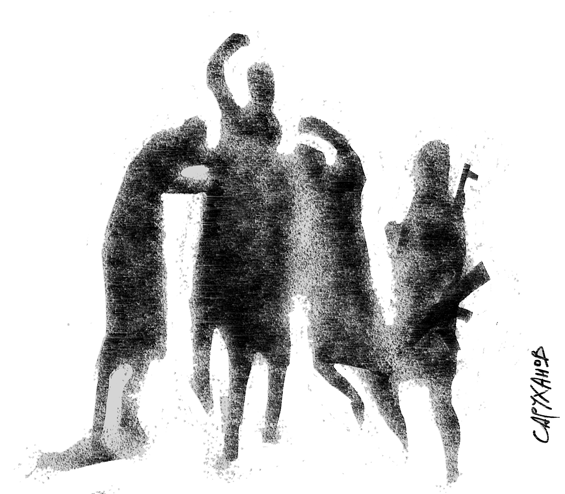
With my colleague Stefan Scholl, from the [German] Sudwest Presse, we were detained together at night in a pizzeria where we dined and were writing reports about the referendum for our papers. Four men came and sat at our table, and one of them said that they had no issues with Stefan’s material, but from me, they want explanations.
“We have read your materials. What do you mean by, ‘These ballot papers look as if they have been printed on a printer?’” one of them asked me.
“This phrase, ‘There were hardly any young people,’ is a lie,” said another. “Everyone voted!”
“But I saw very few young people,” I said.
“That means you weren’t looking in the right direction,” they explained. “Why did you do that?”
“No, he wrote right things too. That bitch mayor really did throw us off the premises, and we nonetheless settled everything ourselves.”
“It’s true. Okay bro, you just have to realize that all of you, the press, this is our weapon. What are we without you? The fact is, your writing is murky, bro. You need to write more simply, so that they can all understand that the Banderites are putting pressure on us here, and we are just normal people, not terrorists; we stand for the truth, in short.”
“You just write it the way it is, but why mention all that about the young people?”
“Ok, we just wanted to talk. Now, come with us to the square.”
It was noisy at the main square of Artemivsk. One of the activists found a reprint of my notes in the Ukrainian publication lb.ua about the disappearance of the mayor of Artemivsk. My Ukrainian colleagues had put ‘Separatists Kidnapped Mayor’ in the headline.
“So, he’s writing for the Banderites!”
“We’re separatists to you, you bitch?”
“You sent-in beast [i.e.: spy]!”
People surrounded me but didn’t touch Stefan Scholl. Before they threw me in a car and took me off for questioning (more about this later), Stefan tried to make peace with them. They did not listen to him. But at one point they threatened him: if he continued any further, they would shoot him right there and then.
Although there were few armed militia there, ordinary people were coming to the “lynching.” But to explain anything to them, turned out to be useless; people did not want to listen.
As if I were a spy, they wanted confessions that I was working for Right Sector. Someone said that they should get a repentance from me and that it should be recorded on video. Someone else said that I had to publicly announce a retraction [of what I wrote] right there on the spot.
My crimes were becoming more fantastic by the minute, and the intentions of the people in the crowd were getting more and more serious.
They would not let me explain. About fifty people had gathered around. Finally, the people on the square started saying that I worked for the SBU [Security Service of Ukraine], the CIA, the USA, and the person who took my press card said that I was an American who has mastered the Russian language and had forged my Novaya Gazeta identity card. Someone grabbed me by my backpack.
I covered my head with my hands, and they rained blows on me from different directions, wherever it was possible to reach, and I sank to the ground. I was being beaten by women and men. Someone said that it was “revenge for their sons who were dying for freedom in Sloviansk and Kramatorsk.” People shouted that no one listens to them and that “no one has heard them all these years.” One of them hit me and said, “What kind of terrorists are we, you bitch!”
The crowd was calmed by the voice of an undersized, robust fellow of 45 years. On each side of him, as I saw then, hung a short-barreled Kalashnikov. He told them: “Quiet everyone!” He pulled away the guy who was still kicking me and threw him onto the ground. He was on the ground next to me for a few seconds. I just caught sight as he fell down in his old, winter boots.
The robust fellow spoke calmly and quietly.
“Let’s take the schmuck to Sloviansk,” he said. “We’ll figure things out in the SBU basement.”
At that time there were, and still are, 14 captives in the SBU basement. That included five Ukrainian journalists, and now it turned out that I was going to be the first Russian. The headquarters of the armed militia had been in the actual SBU building for a month already, where Strelok and his helper, the “People’s Mayor” and commander of Sloviansk, Ponomariov were ruling.
“Strelok will figure things out,” the robust one said.
Everyone in the crowd called the robust man Tower, or Leonid[ov]ych. Calmly and without emotion, he twisted my arms and pushed me into a black Chevrolet Epica. He told me to sit down, not move, and press my head to my knees. He sat next to me. I raised my head for a second and said, “What do you want?” He did not answer but only elbowed me in the jaw, chipping a tooth.
“I told you not to move, schmuck.”
A minute later, another person sat in the driver’s seat and let me lift my head. He introduced himself as Sergiy Valeriyovych. He was about 50, had glasses on, sparse combed back hair, and was wearing a black jacket with a white shirt and tie.
“Pavel, you must understand everything. Tell me, why do you write this stuff?” he said. “You’re a Russian.”
“This schmuck is strange,” the brawny one said. “They roughed him up now.”
“Pavel, the Russians are our only hope,” again interjected the man in the driver’s seat.
“Valerych, that’s enough. Let’s get going to Sloviansk,” the brawny one said.
“Don’t interrupt, Leonid[ov]ych. Pavel, I think you understand what is happening to you now, and why.”
“Let’s go, Valerych.”
“I suggest that first we go to Volodarka, keep [him] until morning, and then, if he survives, we’ll go to Sloviansk,” Valeriyovych said to the brawny one. “Let them decide things there: it would be good to get [exchange] some of our boys for him.”
“Yes, *** him in the woods.”
For a few seconds, there was a pause in the car. But the car did not stop. Serhiy Valeriyovych said, “It’s not necessary to talk like that, Leonid[ov]ych. We’re civilized people. Aren’t we, Pavel?” Valerych said for some reason. “We won’t be doing that.”
There was some sort of headquarters at Volodarka (a small village between Sloviansk and Artemivsk). There were bonfires burning in barrels, and a large tent was lit with an electric light. There were a few women around the tent and about twenty young men with machine guns and rifles, some of them [were] in masks. They took me out of the car and led me into the tent. Tower told me to undress. I asked what he meant exactly.
“Take everything off. Put everything on the table,” Tower repeated. “Take out your laces and belt too.”
Other militiamen also took my bag and backpack. They sat me on a bench, and people surrounded me. One insurgent in a mask asked me for the password to my cellphone and laptop. I refused. Tower hit me in the face again with his elbow.
“You still don’t get it? Password!”
“Let him write it down,” someone said.
“He won’t give it.”
“What a bitch.”
I got up off the ground. One militiaman without a mask took me by the wrist and said he’d break my finger if I didn’t give him the password. I dictated it.
Having accessed the computer, the first thing they did, as far as I could understand, was to look at the photographs in the album.
“Where have you been, abroad? Some kind of towers, pictures,” one gunman said. “How much does gas cost there?”
“In Italy, about 1.6 euro.”
“Fuck! And people don’t make a fuss?”
“What are you talking to him for, he’s a CIA worm.”
“How much are they paying you? Who are you working for?”
“He works for Ukrainian publications, this animal wrote that we were separatists, that our referendum was a sham.”
“He wrote that the ballot papers were screwed up, that we printed them on a printer.”
“And they’re murdering us! They’re crushing us with tanks! You think we can print them normally? You are Russian, aren’t you? You should be on our side!”
“And what are these photographs? Were you at Maidan?”
The insurgents started up the video that I had taken in the centre of Kyiv back in December. Everyone crowded in front of the screen.
“Guys, now it’s clear! He’s been sent here!”
“That means tomorrow we take him alive to Sloviansk. Tie him up and put him in the trunk [of the car]. Don’t hit him,” Tower said. “I’m tired, and it’s time to go home.”
“Maybe we should pack him a little lighter?”
“I said it once, and I’ll say it again–keep his things safe and don’t take anything.”
Then they interrogated me for about an hour. Someone read my old notes, “Why the hell did you interview Poroshenko? Should have interviewed Dobkin.” “Here’s something about Crimea. Have you been in Crimea? How were the people there, happy?” “He writes that everyone is rejoicing, hello Russia!”

In the SBU building in Sloviansk, captured by militia, to which our correspondent, fortunately was not delivered.
After Tower left, the interrogation was not so severe. The insurgents’ telephones were going off all the time. They called someone as well and said that they had “caught a good target for exchange.” But after another call, the people in the tent urgently decided to move me to another place. They didn’t even try to tie me up, there was no time to put me in the trunk. They just threw me on the floor of the car between the seats. The car rushed along a bad road and stopped somewhere in the middle of the route. Here there were also fires in barrels, tires were piled up, people with machine guns were crowding around, and a masked man stood at the side of the road with a traffic control baton.
My computer, documents, and wallet were passed round from hand to hand. There was no one here who had questioned me at the other tent. The car in which they had brought me also rushed off.
My new keepers know very little about me and are not particularly interested in me. They only knew that they had to transfer the client to the SBU in Sloviansk in the morning. They did not want to do that at all. Someone suggested that they hide me there and demand a ransom. They named an amount of US $30,000.
“But they will be expecting him in Sloviansk,” said one of the insurgents.
“We’ll say we killed him during an escape attempt. He tried to get away.”
“So when do you get your money, cheapskate?”
“Guys, what are you talking about?”
I said that they might be able to get money in Moscow, but I would have to call my colleagues at least. I asked for a phone. But after talking it over, the guys decided it was not worth it to let me handle a phone. “He’s a dangerous guy, what if he calls somewhere else.” A minute later, there was a new plan: the kidnappers said that they would take everything I had from me–my things and my money–and let me go. But when they emptied my wallet, they were infuriated. I had 39,000 rubles [US $1,130 approx.] in cash. They didn’t pay any attention to the cards.
“What else is there? What about the watch? Is the ring platinum?”
They thought my watch was cheap, and in fact it was. But the “platinum” wedding ring caught their eye. “You don’t wear regular gold, fat cat?” I decided not to say that the ring was silver. The gunmen also asked if I had any friends or colleagues in Artemivsk who might cough up more dough.
“They talked about some German [meaning Stefan]. Let him get some dough together if he wants to live.”
We put my phone on speaker and I called Stefan. He said he had 600 euros and 2,000 hryvnias, which he could get from an ATM. Nearly a thousand dollars. We agreed to meet at four o’clock in the morning at the hotel.
“Although this isn’t a ransom, it’s your contribution to our war,” said the masked man, the one they all called Sever [North].
“If everything goes smoothly, you’ll go to Donetsk in the morning,” said the insurgent in the mask, the one they called Khan. “You should thank us for not handing you over to Sloviansk.”
I asked what would have happened [to me] in Sloviansk.
“Your FSB and Chechens are there. They wouldn’t be talking. At best you’d be sitting in the basement, at worst… well you understand.”
The insurgents were happy that they could get more money in Artemivsk, and they even relaxed a bit. “[At this rate, we’ll make 30,000 and get out!]” They put me in a new car, and I was left there for a couple of minutes by myself with my telephone, which they had forgotten to take from me after my call to Stefan. I managed to send a few texts to my colleagues.
Three of us went to meet Stefan in Artemivsk. Khan was the driver and rode with a rifle on the front seat. North kept his Makarov pistol ready and pulled his mask on. It was already 4:30 am, but Stefan had not come out. North racked the slide, said we should go after him in the hotel, and ordered me to go first. A guard was lying on a sofa in the hall, and when he saw me, he asked who I was. “Ok, I understand, “he said when he saw North with a weapon, and went back to the sofa.
We went to the room, but there was no one there. So, we went back to the street. North was convinced that Stefan had run away.
“The German has abandoned you,” the gunman said, “your time is up.”
I suggested that Stefan was going around to all the ATMs in town and trying to get the necessary sum of money. In the volatile cities around Sloviansk, the banks were limiting cash withdrawals to no more than 200 hryvnias per day. But just in case, I suggested calling someone else in Donetsk, where I had colleagues and friends. However, North refused and informed me that if there was not going to be any money, then I would stay there or go to Sloviansk.
“German bitch. I knew it,” North said. “Just give them a chance to desert a Russian.”
“He’s been living in Russia for sixteen years already,” I told him.
“And you’ve been left to rot in any case. He jumped [ship].”
Another fifteen minutes later, we saw Stefan in the distance, who was rushing toward us. Having run around Artemivsk that night, the German had managed to get the money without running into any trouble.
“Are you going to let him go now?” Stefan asked.
“He is coming with me to Horlivka, and then we’ll hand him over to whomever we have to. They’ll check him out, and then it’s on to Donetsk.”
“Will he be safe?”
“The important thing is that he behaves himself.”
We got back in the car. It flew into two large potholes on the way. As we drove up to Horlivka, North said that for each pothole, I would have to pay another 10,000. I said that I didn’t have any more cash.
“You’ve got your cards, let’s look and see what you’ve got. Hey, it only cost 10,000 Russian Rubles altogether–wheel rims cost more.”
North looked in the wallet again: “Fuck it, how many of these cards do you have! You bitch, we’re here fighting, shedding blood, and you’re all getting fat at home!” North also found my receipts for the hotel in Odesa at 500 Hryvnias a night. “You fucker, you slept for three days with this moola, and we manage three weeks on that!”
Khan’s phone went off for the first time since they had been driving me. Khan said that everything was alright with me and that they were taking me to a hotel in Donetsk.
There was a small line of cars at the militia checkpoint before Horlivka. Armed men were inspecting each car with a flashlight. They did not look at our car. North showed his pass, and we went into town.
Khan offered me some mineral water. I refused, and then Khan ordered me, adding, “Go on, drink. You’ll live. It’s not poison,” and started laughing.
We stopped at the ATM, and North saw me up to it. But here too was the same problem with the cash limit. On the card, around 100,000 rubles was left in overdraft, but to withdraw it all was impossible.
“I wanted to leave you a little money to get back on, but right now it’s a shame it’s not working,” North said.
I asked if they were going to let me go as they promised.
“We should hand you over to our people here,” North answered. “But you look so pale, are you on drugs?”
“I’m tired.”
“Now you can rest. Relax, you’ve got no money left anymore.”
North laughed. At first, they took me to Khan’s car, while North stayed in the street. Very soon, another car came and North said that we’d take it and he helped me out.
“Nah, he’s a junkie, for real,” Khan laughed, “he can barely stand up.”
I remember them putting me into the car, and North lighting a cigarette, and I’m closing my eyes, and a young woman wakes me and she’s saying I have to extend my stay or check out of the room. The clock says 11:45 in the morning, Hotel Liverpool, Donetsk. I am lying clothed on the bed. The manager tells me that people had brought me in a car, I was not drunk but looked like a sleepwalker, walking on my own.
Shoes without laces, jeans without a belt, my sim card was on the table and my rummaged bag was lying on the floor.
___________________
*Uncensored equivalent of the verb “bang.”
P.S. Having paid the ransom, Stefan Scholl also left Donetsk Oblast and is now in Russia.
From the NG Editor:
“Novaya Gazeta” is grateful for the assistance of officials in Russia and Ukraine, to facilitate the release of Pavel Kanygina, our colleagues who have shown solidarity and restraint. And a special thanks to Vladimir Lukin, Maxim Shevchenko, Hope Kevorkova, Sergey Ponomarev (The New York Times), Ilya Azar (“Echo of Moscow”), Svetlana Reiter, Peter Shelomovskij (“to Fontanka.ru”) and, of course, Stefan Scholl.
Source: novayagazeta.ru
READ MORE:
http://rt.com/news/158300-kidnapped-journalist-novaya-gazeta/




 Voices of Ukraine