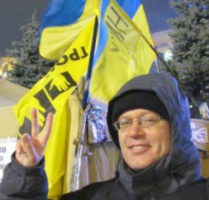
 By William Risch, Associate Professor of History at Georgia College
12.02.2014
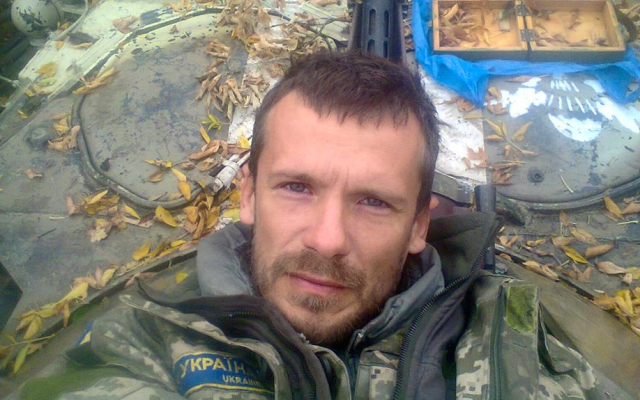
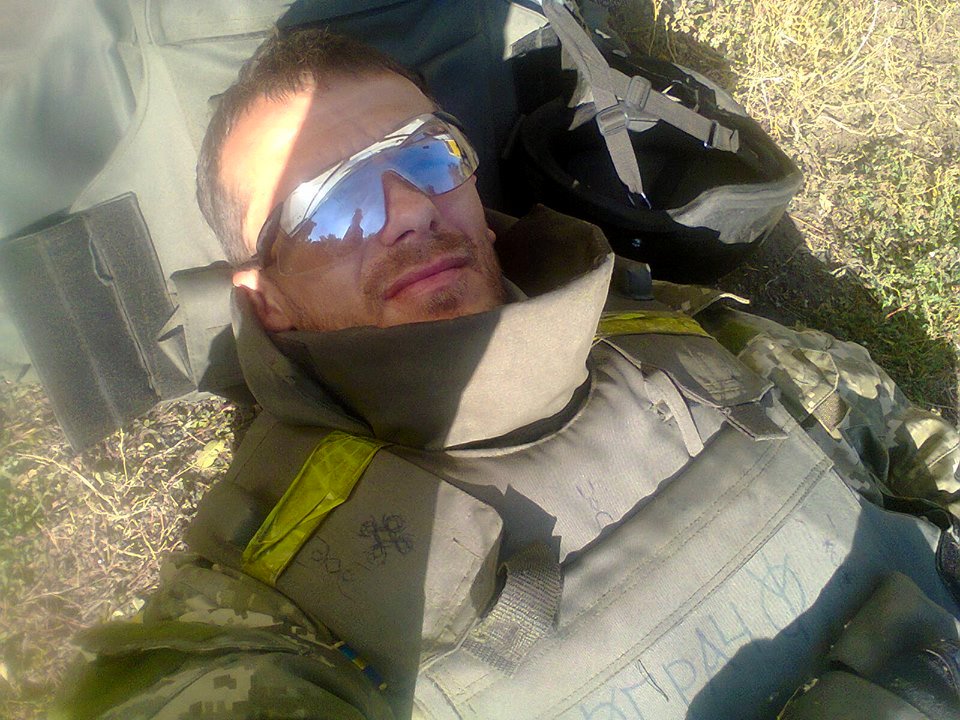
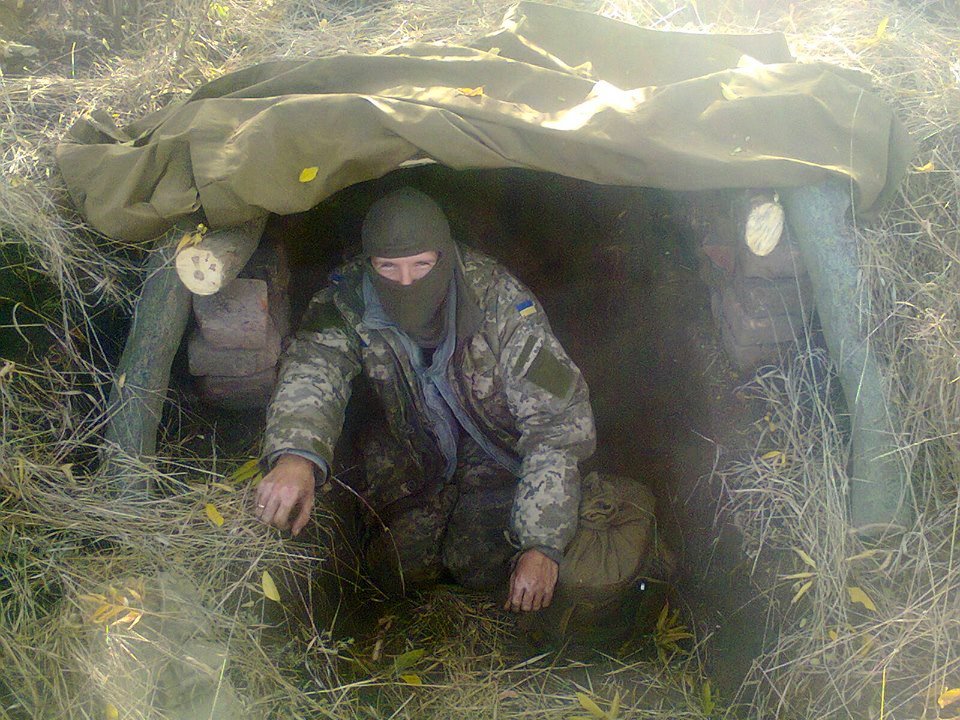
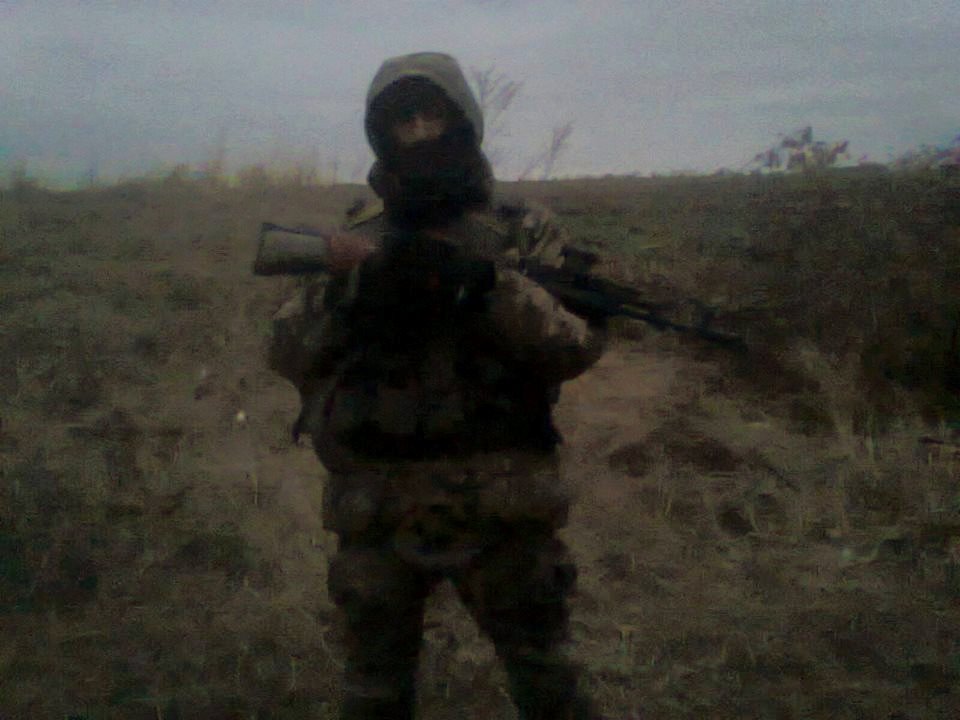
Transcribed and translated by Maria Stanislav and edited by Voices of Ukraine. All photographs by Mykola Voronin.
An interview with Ukrainian Cyborg and paratrooper Mykola Voronin – currently with the 79th Airmobile Brigade, previously in the Donbas Battalion – conducted by William Risch, Associate Professor of History at Georgia College for his oral history project on the Euromaidan protests and their aftermath in Ukraine. William Risch is currently living in Ukraine. The interview was conducted on November 10, 2014 in Kyiv.

William Risch [WR]: Today is 10th of November, 2014, this is William Risch, with Mykola.
Mykola Voronin [MV]: My name is Mykola Voronin, Kyiv Mohyla Academy. I’m a mathematics instructor currently fighting for Ukraine as part of a paratrooper battalion. I’ve been a paratrooper for months now.

WR: A few words about yourself. Where and when were you born, what can you tell us about yourself, your family, your education?
MV: I was born in the village of Darivka, Kherson oblast. When I was fourteen, I enrolled in a college in the oblast city [Kherson], in the department of economics and business. At age 17, I entered the Kyiv Mohyla Academy, where I studied for seven years. After that, I left education and went to work in the field of environmental science. Mainly, I was involved in creating environmentally-friendly settlements. I became a fairly known environmental scientist at the time and was on TV a number of times. I was a pacifist, a real hippy – anti-war, anti-weapons… Right up to the beginning of this military conflict.

WR: For my next question – how and when did you decide to serve in the ATO [Anti-terrorist operation] zone? Why was serving there particularly important for you?
MV: I decided to serve in the ATO zone during Remembrance Week. That is the week that follows Easter, and the time to remember everyone who died. This year, it was some time in April, I think. That was when I decided to go to the Donbas volunteer battalion.

The reason I went there was because I saw, with my own eyes, how separatists conduct themselves and what they bring to the world – and what they bring is death, destruction, murder, and grief for everyone. By comparison, I also went to see how pro-Ukrainian rallies went. Having visited both sides, I could feel a tremendous difference.
At pro-Ukrainian rallies, people were kneeling in prayer, without any weapons. There were people of all religious denominations there, they even brought children. In the separatist camp, however, there were weapons, brawls, in-fighting… It was a republic of bandits.
After seeing that, I decided I don’t want to be on the side of death and destruction. So I went to fight for Ukraine – for happiness, peace, and harmony in my country.
Another important factor for my decision was the fact that my friend was taken prisoner by separatists, and tortured.
WR: What is his name?
MV: Stalker Semitsvetik [Septicolor]. That’s his call sign. I’d rather not name any names.
WR: Were you in Donbas when the whole thing started?
MV: Yes. I’m a teacher of mathematics in Horlivka. That is a town 30 km from Donetsk, currently captured by separatists. For the last four years, I’ve lived and taught there. You can say that I’m a Donbas resident.
WR: So you remember what Donbas was like before the war?
MV: Yes, I witnessed it all. I saw what things were like before the war, and what happened during it. I have a hope that I will also get to see what happens after the war, and that I will witness a restoration of that land. I’m ready to contribute my efforts to the restoration of Donbas.
WR: What can you recall about separatists in Horlivka? What was your impression of them?
MV: Mainly, plenty of negative emotion. Some of my good friends are among the separatists, and they, by and large, acted reasonably and in a civilized manner. But people like that are a minority. I’m still in touch with those friends. We talk over the internet, but these days it’s mostly arguments.
WR: What would you like to tell about your time at the front lines?
MV: I would like to share what I learned at the front lines. And what I learned was to love my country. Truly love it. I learned to work in tandem with my country, together, where it helps me and I stand for it. People who backstab and steal – they are not my country. My Country is people who help us, the military. These are volunteers, people who express their support, people who pray, donate, visit us… Those are the people who are my Country, and people for whose sake we, the military, stand our ground.
WR: What attitude did the locals have towards Ukrainian armed forces in the ATO area?
MV: We saw different attitudes. At first, they were very negative. They would throw themselves in front of tanks, shout: “Down with Ukraine, give us Russia!”
Personally, after the first three days I spent standing with separatists, I saw and understood what awaits separatist lands in the future. I saw that they have no goal to construct anything, they just want to tear things down. I saw this from the very beginning, and I saw what that would lead to.
Now many people have felt the negative consequences of separatism on their own skin – like lack of wages, murders without trial or investigation, violence and brutality, deaths, blood, destruction, hunger, cold, lack of water and heating… Now that they have felt that, they are changing their stance.
In liberated towns, many people wave at us and shout ‘Glory to Ukraine!’ when we are passing through on board APCs. Even children. They make me especially happy. Once, we were moving past a town that was previously held by separatists, and children waved at us, shouting ‘Glory to Ukraine.’ Then I saw an old man sitting outside, looking like a textbook separatist, and his young grandchild standing behind him. The boy was waving at us and smiling so much. I thought to myself – I hope the old man doesn’t see him and smack him upside the head for that. (laughs)
Children are more sensitive than adults, they pick up the energy vibe, and they can tell whose side the truth is on. In some ways, children are the hardest to fool. But, sadly, they can also be the easiest to fool, too. Many kids, among them my students – I know at least three of them – are fighting for separatists right now. My own students. 15-year-old boys, practically children, were given submachine guns and brainwashed. I don’t know what’s been done to them to make them fight for separatists.
WR: Among the separatists you saw in Horlivka, were there any outside people taking part in protest rallies?
MV: Yes. Many, in fact. At the time, Donetsk was the core of separatism. I was there, myself, and I can speak from what I saw. There were plenty of Cossacks from Russia, and folks I called ‘men in black,’ were not ashamed to introduce themselves as members of Russian special services.
WR: Was that as early as April?
MV: Yes, from the very beginning. I can’t give you exact dates, everything has been jumbled in my head, I don’t even know what day it is today.
Woman: It’s the 10th of November.
MV: Thank you. (laughs)
WR: How did serving in the ATO zone change your life? Your attitude towards people, you view on different things?
MV: My attitudes changed drastically. As I said before, I found my country. I found a country that is worth loving, worth living for, worth doing good for. That country is Ukraine. I didn’t use to be much of a patriot. I just lived my life, like many people do. Today, I feel everyone who is supporting Ukrainian troops. I feel their support, their prayers, and I’m proud to be Ukrainian. I didn’t use to feel like that before this.
WR: Thank you. In your opinion, what must change in Ukraine?
MV: Everything. Everything must change in Ukraine. The first thing has already begun changing – that’s the people. People are spontaneously uniting, self-organizing to save our country. People are fighting against corruption, evil, banditry, lies and falsehoods. People are uniting for love, peace, and harmony. And I’m ready to unite with people for the sake of such great and important goals.
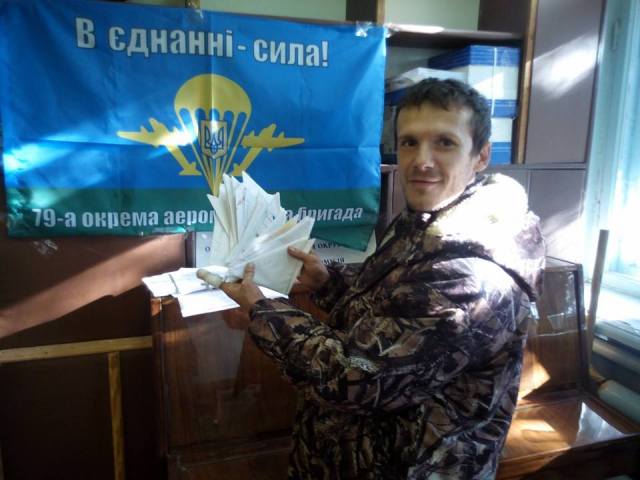
WR: I also have a question about people you served with. What are your memories of people who helped you, supported you, over there, at the front?
MV: People who fought with me? There are heroes among them. People whom I can openly and honestly call heroes, people who stood with me, who went to battle without taking a step back. There are also people whom I can’t call heroes. Those are people who betrayed, stole, and lied. Yes, there are people like that too.
Naturally, my attitude to every one of them is different. People who haven’t let me down – I’m ready to help them, ready to carry out reconnaissance with them, to trust them and work together. As for people who lied and stole, or otherwise behaved badly – those I’m not ready to cooperate with.
WR: As you know, Kyiv is quite peaceful. What should we, those who are away from the front line, know or remember about what is happening in the east?
MV: You must know and feel in your hearts, that we stand our ground, that we will not give up and will stand to the end. You must know that we feel each and every kind thought sent in our direction. Even if it’s just a thought, not backed with any financial, physical or moral support. Just a kind thought about us – we can feel it. Maybe not every soldier can. But for those who can, these thoughts inspire us, give us wings, and help us hold on.
WR: My last question – what do you think the West must do to help Ukraine in this state of war?
MV: Put more pressure on Russia. Restore the Iron Curtain and put maximum restrictions on everyone leaving Russia. Break away from Russian gas and oil and entirely refuse contact with Russia. For the good of the global community, Russia must be isolated, because it is a plague-ridden dog, and its current state must not be allowed to spread to the rest of the world. The whole world should do that.
And also, help Ukraine with whatever they can – with thought and deed. We will be grateful for any help. We are in dire need of weapons, seeing as our weapons and ammo are old, we have AK’s dating back to the 1940’s and 1980’s. But we don’t let that stop us. Separatists have newer weapons, supplied to them from Russia – so we take their weapons whenever we can. Then we use their own weapons to fight against them. But if the global community, including the United States, supported us with weapons, they would help Ukraine win this war.

We will be grateful for any financial and economic support that the world can give us. The world must remember the Boeing [MH-17] that was shot down by Russians. The world must remember every person who died in this war. The world must give every bit of support to Ukraine, because the effort of the entire world is required to stop a plague dog that has started biting everyone indiscriminately – and we can see that is true, from Russia’s recent moves, including their launches of nuclear missiles.
Ukraine alone can handle Russia, but that will be more difficult, both for Ukraine and for the world. It will take longer, and involve many more casualties. The entire world must help and support Ukraine with whatever it can. We appreciate the existing help, but we are hoping for more intense support in the nearest future.
WR: Is there anything you would like to add?
MV: I wish us victory. A victory of good, peace and harmony over the war, destruction, misery and grief that separatists bring us.
WR: Thank you for your time, and for your service.
MV: Thank you for having me. I hope we’ll meet again.
RELATED READING:
Voices of Ukraine, Cyborg Nick on Donetsk Airport
BBC Ukraine/VoU, War for Peace: The story of a pacifist with an automatic gun [who became a cyborg]
Information Opir/VoU, From the lips of a “Cyborg”: The war changes you
Voices of Ukraine, Cyborg Nick: I sleep in a trench for you






 Dmitry Tymchuk, Head of the Center for Military and Political Research, Coordinator of the

 Voices of Ukraine