January 30, 2014 14:15 INSIDER
By Tetyana Nikolayenko, Maxim Kamenyev
Translated by Maria Stanislav
Source: http://www.theinsider.com.ua/politics/52e9ee27a355c/
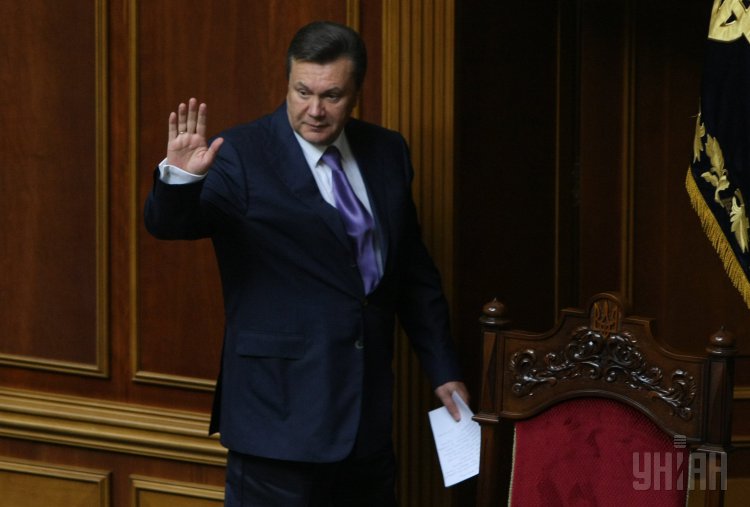
The President resorted to threats to break the resistance of the “regionals” who were going to reformat the majority, while Akhmetov and Firtash backed down.
This Wednesday, the parliament could’ve changed the fate of the country.
By 6 pm on Wednesday, the majority of people’s deputies were prepared to vote not only for the law granting amnesty to all detained activists without any counter-demands to Maidan, but even for the return to the Constitution of 2004. Over 60 deputies from the Party of Regions were ready to defect to the opposition.
However, the opposition leaders showed their hand to the President’s representatives too early. [The President] Yanukovych arrived at the parliament immediately and resorted to threats of parliament dissolution to squash the rebellion in the faction of the Party of Regions.
After that, people’s deputies passed the bill under which amnesty is only possible for the Maidan activists if they vacate all occupied buildings and streets within 15 days. This was the scenario the President insisted upon.
The Kremlin helped Yanukovych to “break” the “regionals.” Yesterday, Russia suspended customs clearance of Ukrainian goods. The looming recurrence of the trade war with Ukraine’s northern neighbor forced the SCM Corporation owner Rinat Akhmetov, and Dmytro Firtash, the owner of Group DF, to convince the “regionals” under their control to support the President’s position.
INSIDER found out how the opposition deputies, the majority of non-affiliated deputies, and some of the “regionals” were planning to restrict Yanukovych’s power, and how the latter squashed the mutiny in the Rada [the parliament].
The Constitution Conspiracy
The only issue to be addressed by the deputies yesterday was the law on amnesty for the Maidan activists. The government and the opposition had already admitted that settling the political crisis was impossible without the document in question.
As many as four bills to that effect were registered in the parliament. Two of them – authored by the Batkivschyna [Fatherland] party deputy Leonid Yemets, and by the unaffiliated Yuriy Derevyanko – provided for unconditional release of protest participants.
The “regionals” Dmytro Shpenov and Vitaliy Zhuravsky co-authored a bill, proposing to only grant amnesty to those protesters that committed no felonies, and only after activists remove themselves from the occupied streets and buildings, take down the tents, and stop protests altogether.
Finally, the President’s representative Yuriy Myroshnychenko proposed to grant amnesty to protesters if they vacate administrative buildings and streets within 15 days. There was no demand to leave the Maidan [the Independence Square]. The bill did not present any demands concerning tents or protests, either. According to INSIDER’s information, the bill was drafted by a team of lawyers led by Andriy Portnov, First Deputy Head of the Presidential Administration.
The opposition refused to vote for the government’s bills. “The Maidan is electrified and demands a decision. We are being forced into a trap, where we have to either deny the government’s concessions and face bullets, or turn into traitors and leave politics,” an UDAR [Vitali Klytschko’s party] deputy Victor Chumak said yesterday.
Starting from early morning, the leaders of parliamentary factions have been negotiating in the office of the parliamentary speaker Vladymyr Rybak.
Meanwhile, in the parliament’s lobbies, Inna Bohoslovska and David Zhvaniya, acting with approval of the opposition deputies, worked to reformat the parliamentary majority to vote for the return to the 2004 version of the Constitution.
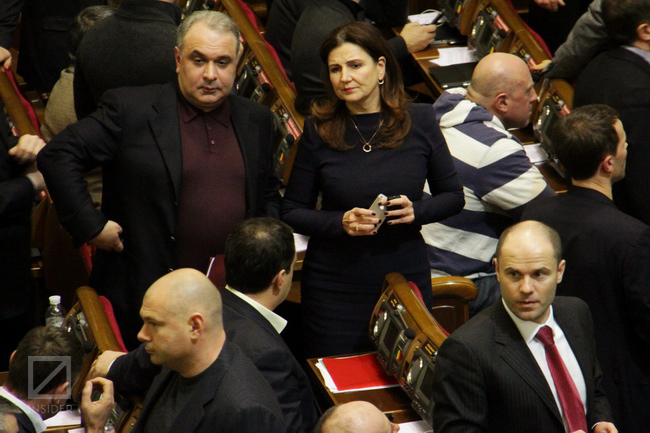
That version entails restricting the President’s scope of authority in favor of the government and the parliament. Several deputies of opposition factions informed INSIDER that this was the only condition on which Arseniy Yatsenyuk was prepared to accept the President’s offer to take charge of the Cabinet of Ministers.
This was the step demanded from the leader of the Batkivschyna faction by the EU and the US ambassadors, as well as the option offered by the SCM owner Rinat Akhmetov.
The opposition deputies wanted to bring back the old version of the Constitution by voting for a so-called “Constitutional Act.”
“This document was prepared by Sergey Holovaty, and even though the constitutionalists recoiled from it at first, they came to agree that it was the only possible option,” one of the unaffiliated deputies told INSIDER.
“We have over 226 votes. 68 deputies from the Party of Regions are prepared to support it. If Rybak refuses to put it up for voting, we will depose him as the speaker,” the same deputy noted.
At the same, Petro Poroshenko was negotiating with Volodymyr Lytvyn, regarding whether the latter would support the former’s candidacy for the post of the head of the parliament. As noted by a source within Lytvyn’s circle, Poroshenko added that 20 “regionals” are also willing to support him.
Closer to 5 pm, Volodymyr Rybak announced that two bills were agreed on – one on amnesty, and one on the group that would draft amendments to the Constitution.
UDAR deputies claim that members of the Batkivschyna and the Svoboda [Freedom] parties were prepared to make concessions and vote for the bill that entailed vacating administrative buildings.
“We can provide for an organized exit of protesters from regional state administrations. It is a controlled process. We also found leverage to influence the Pravy Sector [Right Sector], by sending Andriy Ivanchuk [Editor’s note: a close associate of Arseniy Yatsenyuk] in there,” one of the Batkivschyna deputies shared.
Basically, the only thing left for Yatsenyuk to do was convince the faction.
“We must understand that, on our part, concessions must be made, too. But some people on the Maidan, like Yuriy Lutsenko, will never agree to that,” one of the deputies complained.
However, this offer sparked a scandal within the Batkivschyna faction.
“The faction has already met twice, and Yatsenyuk didn’t come to those meetings. We don’t know or understand the particulars right now. Maybe Yatsenyuk is ready to become prime minister, but doesn’t know how to explain it to us, let alone to the Maidan,” one of the Batkivschyna deputies suggested.
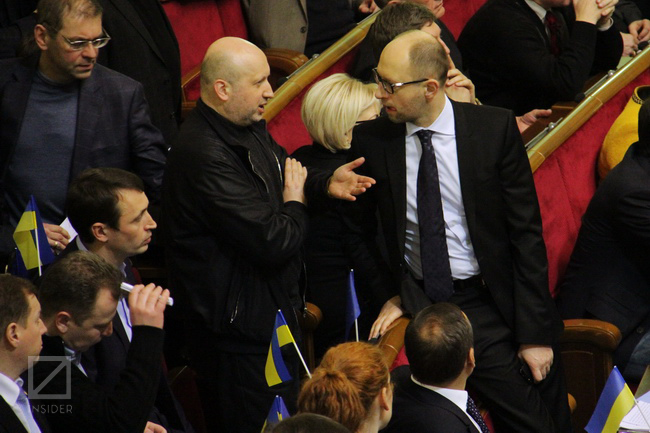
There was heated argument within the faction, and most spoke out in support of the bill penned by the unaffiliated Derevyanko, or the faction’s own bill.
The faction took this conclusion to the session hall. It would seem that the speaker Volodymyr Rybak had no choice but to move the bill discussion to Thursday, but all faction leaders decided to vote today.
“There are enough votes in the session hall to vote for the Derevyanko bill, but one man is against it – Andriy Portnov, Deputy Head of the Presidential Administration,” Victor Chumak said.
False Start
Portnov and Lukash spent their whole day in the Rada, negotiating with faction leaders. Also present were the deputy Yuriy Voropayev, representative of Rinat Akhmetov, and a billionaire deputy Vadym Novinsky. The head of the Rada’s budget committee Yevgeniy Geller and other influential “regionals” visited the speaker’s office from time to time.
The deputies of the UDAR and Batkivschyna told INSIDER that during one of their visits to Rybak’s office, Yatsenyuk, Klytschko and Tyahnybok stated that their people refuse to vote for Myroshnychenko’s bill. After that, Andriy Portnov showed them the draft of the President’s order to dismiss the parliament.
In response to that, the opposition leader said that they had enough votes to not only pass Derevyanko’s bill, but also adopt the Constitutional Act, and even vote for the release of Yulia Tymoshenko.
The leader of the Party of Regions faction Olexander Yefremov immediately declared that he must hold a faction meeting. He gathered the “regionals” in the parliament’s cinema hall, which the deputies have dubbed “Katrusya’s Cinema” (it is located one floor below the session hall).
The journalists that followed them downstairs could hear a very heated discussion, even through the doors.
“We will not be intimidated,” Serhiy Tihipko shouted.
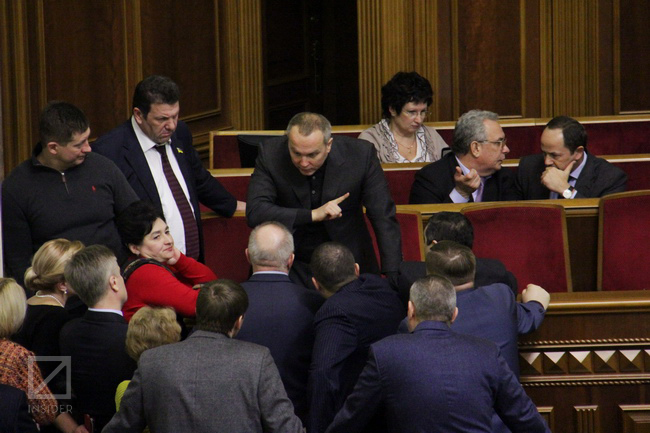
Hanna Herman said that unaffiliated deputies were not ready to support the Party of Region’s bill.
“I address my deputy friends, let us avoid ending up in another embarrassing situation,” she implored.
“Let’s find out which bills we have the votes for, and how many,” Olexander Yefremov suggested in response.
After that, sources assure, the head of the faction held a show of hands – and 52 “regionals” raised theirs in support Derevyanko’s bill.
A flushed Yefremov ran out of the room and informed that the President asks to stop the faction meeting.
The President Strikes Back
Five minutes later, a marble-pale Yanukovych arrived at the parliament.
He told the deputies that he came to them straight from the hospital.
“I had a hemorrhage, I was on an IV drip. But when I saw what was happening here, I had to come,” were Yanukovych’s words, according to the deputies.
However, the malaise didn’t stop the President from squashing the mutiny in the faction’s ranks.
“I haven’t heard such strong language in a long time. We were threatened that we’d be crushed into the pavement, and thrown into the —ing jail, told that there’s a file on each and every one of us,” one of the “regionals” said.
Yanukovych demanded that the “regionals” vote for the Myroshnychenko bill. He said he’d discussed the bill in question with the German Chancellor Angela Merkel and the US Vice-President Joseph Biden, who approved of the text of this document. He proceeded to say that he’d met one of the opposition’s demands by dismissing Mykola Azarov from the prime minister’s post, but he “can’t keep giving,” and now it’s the other side’s turn to make concessions.”
Serhiy Tihipko said that many deputies from his group refuse to vote for Myroshnychenko’s bill out of simple fear for their life. According to him, nine of them saw funeral wreathes delivered to their houses in the last few days. To that, the President ordered Andriy Klyuyev to ensure security of these “regionals,” and would not continue debating with Tihipko.
Next, the President said that he would not sign the law that cancelled the outrageous Kolesnychenko-Oliynyk law [one of the “dictatorship laws” of January, 16].
Finally, Yanukovych bluntly told the deputies that if they fail to vote for the Myroshnychenko bill, he will address the people on television that very evening, announcing dissolution of the parliament, and sign the appropriate paperwork in the morning. After that, he said, he’d call early parliamentary elections, and following them, maybe even early presidential elections.
Meanwhile, three leaders of the opposition factions approached the entrance to the “Katrusya’s Cinema.” They spent some time hovering by the doors uncertainly.
“Why should we go in there? It’s his meeting with the fraction,” Yatsenyuk answered to the journalists’ questions as to whether the three were going to go inside.
However, some time later, Vitaliy Klytschko approached Oleh Tyahnybok with a piece of paper that said, “Mr. President, we demand a meeting.” Curiously enough, on the other side of the same paper was the text of the mentioned Constitutional Act.
The head of Svoboda handed the message to one of the President’s security members, and the opposition leaders left to Rybak’s office, soon to be followed by Yanukovych. We don’t have any reliable information as to what the President discussed with the opposition this time. But when the meeting ended, Klytschko said that the President is ready to dissolve the parliament.
The “regionals” were waiting for Yanukovych’s return, many smoking nervously right on the premises, some others filling up in the cafeteria.
Serhiy Kivalov asked his compatriot Vitaliy Barvynenko, an Odessa region deputy with the majority, whether the latter was ready for early elections. He responded that he wouldn’t run for the Rada anymore. “Well, the mayor’s office is vacant in Bilhorod-Dnistrovsky, so you can run for city head, instead,” Kivalov joked.
But most “regionals” weren’t feeling up to banter. They swore blind that the President had no legitimate means of dissolving the Rada. “Portnov said that Victor Yushchenko had no legitimate means to do that either, back in 2007, but he dissolved the parliament nevertheless. So there is precedent,” one of the “regionals” told us in an informal conversation.
The “regionals” did not dare call Yanukovych’s possible bluff. After long hard thought, they agreed to support the Myroshnychenko bill. “Don’t be too swift to judge me. You try spending some time alone with the President. Then you’d understand,” said one of the deputies close to Tihipko.
At the meeting with the opposition leaders, Yanukovych once again claimed that he is ready to dissolve the parliament. Then he returned to the “regionals.” After hearing that the faction is prepared to support the Myroshnychenko bill, the President left the parliament.
Meanwhile, Rybak called all people’s deputies into the session hall and put the Myroshnychenko bill to a vote. The people’s deputies cast 232 votes in its favor. There were eight “regionals” who still abstained from the voting. Among them Yuriy Blagodyr (close associate of the former parliament speaker Volorymyr Lytvyn), Hanna Herman (advisor to the President), Artem Pshonka (son of the General Prosecutor), singer Taisiya Povaliy, and others.
Seven more of their colleagues simply didn’t show up at the Rada yesterday. The opposition deputies didn’t cast a single vote in support of the bill. Of the 43 unaffiliated ones, only 11 voted in favor, mainly those who were previously with the opposition. Yefremov’s group didn’t give a single vote. But the Communist Party faction supported the bill unanimously.
Rybak closed the special session of the Rada immediately after the vote.
“It was a tragic day. Today, we could’ve changed the fate of our country and reformatted the majority, but we didn’t succeed,” one of the unaffiliated deputies lamented.
So why did the “regionals” failed to rebel against the President, and why did Rinat Akhmetov and Dmytro Firtash back down?
Hand in Hand with Moscow
The previous day, which saw Azarov’s resignation and a rebellion within the ranks of the “regionals”, triggered a sharp reaction on behalf of Russia. Let us not forget that Mykola Azarov and the Russian government were very close-knit.
Just the day before, the Russian Prime Minister Dmitriy Medvedev stated that Moscow was suspending talks with Kyiv on the subjects of financial aid and gas supplies, until such time as the new prime minister is appointed, because the details of cooperation were agreed personally between Medvedev and Azarov.
The Kremlin didn’t stop at official statements. Yesterday, the Employer Federation of Ukraine, headed by Firtash, announced that the Russian customs assigned so-called “risk profiles” to Ukrainian goods, making them subject to thorough scrutiny at the customs. The goods are to be unloaded from train cars and containers, weighed, and inspected against conformance certificates. Plus, their owners will have to pay additional customs duties, ranging from 5 to 40 percent of the goods value.
This information sparked plenty of worries among the deputies. They called the managers of their companies asking how things were at the customs.
“I have an eighteen-wheeler full of kitchen ovens stuck at the Rostov customs. My people took a flight there to see what’s going on. Maybe it’s only because of the snow,” fretted Valentyn Landyk, people’s deputy from the Party of Regions, honorary president of the Nord corporation.
SmartHolding owner Vadym Novinsky actively assures that there are no politics involved in this recent development.
“It is true that before, the Russian customs officer would select one car in each train for inspection. Now all cars are inspected. This is a precaution in view of the upcoming Sochi Olympics,” the billionaire told INSIDER.
It’s high chance that Moscow decided to show Yanukovych what consequences Ukraine can face if it follows the conflict resolution scenario proposed by the West.
Novinsky did not stop at comments that day, either.
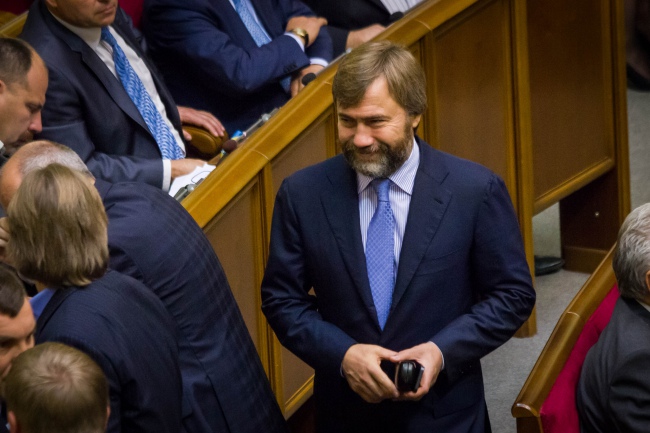
Yesterday, the owner of SmartHolding actively helped the President to hold “preventive talks” with the deputies. First of all, with the unaffiliated Igor Yeremeyev, co-owner of the Continuum group of companies. Novinsky has been hard at work all day. As the UDAR reputy Serhiy Kaplyn was giving a blitz-interview to the Rada TV channel, saying that the opposition does not support the Myroshnychenko bill, Novinsky tried to check him – but left once he saw that Kaplyn was already broadcasting live.
“F—tard, God forgive [common Slavic interjection],” spat the billionaire known for his fear of God. Later, one of the seasoned “regionals” shared his impressions of Novinsky’s actons in the Rada, saying, “Watching my Orthodox brother was a particular delight. There’ll be Tomahawks [missiles] in Kyiv tomorrow, and he doesn’t give a hoot.”
In informal talks, some deputies assured that Novinsky is all but “Putin’s warden” in the Rada, and earnestly claimed that he has a 24-hour phone line to the [Russian] Patriarch Kirill.
Today’s events should bring quite some joy to Russia. If the protesters fail to vacate streets and buildings within 15 days, the President can resort to force again. The EU and the US made it clear to the President that this scenario is not acceptable to them. But the heads of the Customs Union states will definitely be more understanding of such methods. Rumor has it that one of the last orders given by Azarov in his post as the head of the government was to prepare the document package required for Ukraine’s membership in the Customs Union. This is to be done by March, 10, 2014.

 Voices of Ukraine