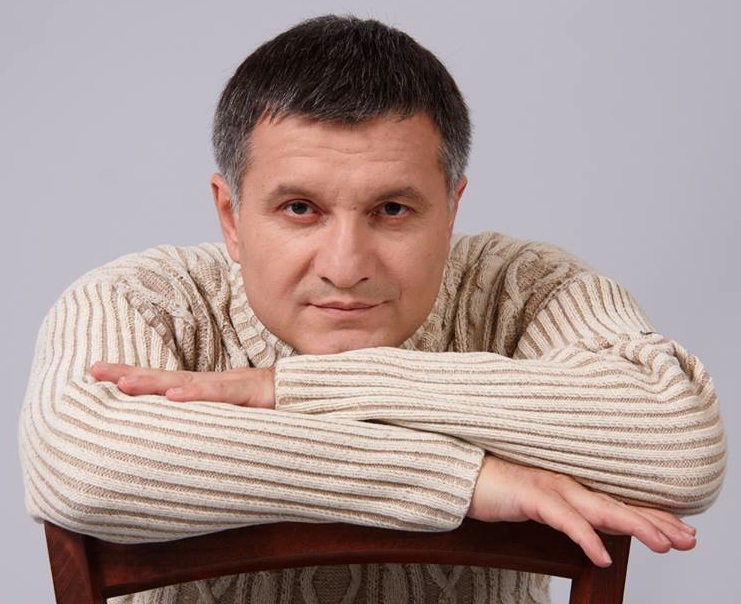
Military expert Dmitry Tymchuk has worked in Iraq, Kosovo, and Lebanon
Currently, thousands of Ukrainians wind down their day with a visit to the Facebook page of Dmitry Tymchuk, Ukrainian officer, coordinator of the Information Resistance group and the Director of the NGO Center for Military and Political Studies. Every evening, the author publishes his summary report that contains operational information about the situation in the Armed Forces of Ukraine, the situation in Crimea and on the Ukrainian borders. Day after day, Dmitry uses his unfailing greeting at the beginning [of the summary] (“Brothers and sisters!”) and the hope that the next day will bring Ukraine only good news, expressed at the end. Information Resistance group was created by Dmitry Tymchuk with his colleagues at the initial stage of the [Crimean] conflict; it actually took over the functions of government agencies that were supposed to inform the people and the international community about events in Ukraine. Over the past two weeks this very Facebook page probably became the most valuable source of information for most Ukrainian and international media. During this time, Information Resistance received 23,000 new subscribers! [Since this article was published 5 days ago, they have gained another 10,000+ subscribers –VOU editor].
– Dmitry, does the Ukrainian government pay enough attention to information security?
– If Yanukovych was absolutely uninterested in information security (only to the extent that it related to his own person), then during the presidency of Viktor Yushchenko many useful initiatives were declared in this direction, but they still have not been implemented.
First of all, I mean that they adopted the Information Security Doctrine. Unfortunately, the existence of this doctrine is remembered only by specialists, even though from a legal standpoint, it would have worked. Therefore, at the present moment, we have stepped on a mine that was hidden a long time ago – since no one worked on the direction of information security in Ukraine. I can say this with great confidence. There are specialized structures within our domestic intelligence services that work on information and psychological resistance, but there are a lot of problems here [in these structures]. Their powers remain not quite clear – there are no documents that could define the functions of each of these structures within a framework of a certain complex mechanism. We fully realized the consequences of this situation on March 1-2, 2014. Let’s remember how everything happened. When the invasion began, the Russian media spread outright “disinformation” and propaganda. All the media outlets worked on this, starting from the RIA “News” and “Interfax.” Their mission was as follows: firstly, to demoralize the personnel of the Ukrainian army and the population; secondly, to justify the actions of the Russian government in the eyes of Russian society; and thirdly, to mislead the international community. And we saw how well this plan worked! All domestic media, taking the lead from Russian media agencies, reported that Ukrainian military units in Crimea were going en masse over to the side of the occupiers, and that the Russian flag was raised over the Ukrainian Navy frigate “Hetman Sahaydachniy.”
Even the UN Security Council, instead of ascertaining the fact of aggression against Ukraine, advises us to pay attention to the internal political situation. We were being attacked, and the UN was saying it’s important that “UDAR” [Ukrainian Democratic Alliance for Reform, Vitali Klitschko’s party] make friends with the “Party of Regions!” It is just schizophrenic. All of these events are the results of Russian propaganda. Besides, those events happened during the weekend, and the entire government vertical was merely paralyzed. There was no structure that could work at least at the informational level and report to the world that an act of aggression had been carried out against Ukraine.
– And this is when you decided to take on this mission?
– When I heard about the Russian aggression against Ukraine, I immediately got in touch with my schoolmate, also a reservist, Lieutenant Colonel Yury Karin, who once served in the press service of the Defense Ministry. At the level of personal relationships we’ve got a lot of personal contacts in the military structures and intelligence services. These people received a lot of information but did not know how to implement it. We understood that the situation was a stalemate and waiting for the official state machine to “stretch out” and start acting [on it] was unacceptable. We decided to take matters into our own hands. To avoid becoming a “flush tank [for disinformation]” and to prevent us from being used blindly, we have implemented a system whereby the information is immediately verified by multiple sources. In case of considerably resonant communications, we’re trying to appeal directly to the participants of the events. Our system worked – at the moment, I think we completed our task. After four days of the invasion, the state machine and its press service have finally started working. We would like to acknowledge the work of journalists – their “airborne troops” practically immediately landed in Crimea and started covering the situation from the scene. Thus, we fought off the first blow in the initial stage of the conflict.
– Do you think that the Ukrainian media space was ready for such a development in Crimea?
– March 1 through 3rd – were the days of complete failure. In terms of the information situation in Ukraine, this stage can be compared to June 22,1941… Over time, the situation is gradually leveled off. After March 4, 2014 our forces were divided approximately 50/50. After March 6 approximately, we started to gradually extricate Russian disinformation from our media. It was not easy, because the opponent operated under very favorable circumstances – and did not even need to create special infrastructures in Ukraine, because we already broadcast almost all of the Russian TV channels and the majority of our media report in Russian – there is no need to translate. In the initial stage, our media was used practically blindly. Because government agencies did not make any announcements, an information vacuum was formed. At the same time, it was necessary to cover the events somehow, and so journalists started borrowing information from the Russian media.
– How do you evaluate the work of Ukrainian and foreign media today?
– According to my observations, the German media were the most loyal to Putin’s propaganda. But when the situation started to become more even at the level of international structures, when Europe acknowledged Russia’s actions to be aggressive and condemned them, then even German media, which was apparently generally funded by Russia, started to change its tone. It became obvious that we have persuaded everybody. And it’s very important, since now Ukraine can only count on the support of the international community.
Ukrainian media, to my mind, are working on the highest level now. Of course, there is still a lot of “disinformation,” but it can be explained not by broadcasting the position of the Russian media, but by a more obvious inclination to disseminate information as fast as possible. Journalists must remember that it may lead to panic among the population. For example, when Russians moved their checkpoint in Chonhar village of Kherson oblast, which is at the border with Crimea, several hundred meters forward, some media wrote that the checkpoints were practically near Kherson. Of course, the fact that these situations are possible in the first place can be explained by the shortcomings in the government machine — we have a pressing need in a single organization that will be responsible for information security. When the Deputy Secretary of CNSD [Council of National Security and Defense] on the fifth day of the invasion says that they set the task to counteract Russian propaganda and there will be a draft document prepared in a week, this isn’t funny at all. Hitler seized half of Europe in two weeks!
– Do you support the prohibition of Russian channels broadcasting in Ukraine?
– This should have been done back on March 2nd! In conflict conditions any country must immediately close its information space! Panic among the population and army demoralization are terrible things. They can devalue any military potential. If a soldier is not morally ready for battle and is convinced that everything is over, then he is useless.
– What would you recommend to Ukrainian journalists, in particular to those who are working in Crimea now?
– First of all, I summon everybody to be very careful, because the real armed gangs, which journalists themselves often call “self-defense” for some reason, are rampant [in Crimea] now. But this is not self-defense, since they do not have a hint of organization and discipline. We constantly receive messages that drunken “Cossacks” and criminals, mobilized by [Sergey] Aksionov, threaten locals with guns. These are inadequate people who are not responsible for anything. I’m sure that they could have cared less about all of the statutes and guarantees provided to journalists by international law. By the way, let’s not forget that the Russian military also do not wear insignias on their uniforms, and therefore it’s very doubtful whether they can be considered [enemy] combatants. All these people are acting outside the limits of international legal frameworks, and journalists cannot count on their “press” badge to protect them. At the same time, I am asking all media people to remember that this is war. Sometimes a provocative title can raise a publication’s rating, but under present circumstances, it is unacceptable to act this way — any careless word can cause panic. We are constantly receiving calls from people who live in the oblasts [regions] that border on Russia — today any unverified message makes them want to immediately run somewhere, to save their families. Journalists must realize the degree of responsibility placed on them today.
– I know that your materials are translated into many languages. How often are they used by the foreign media?
– I would like to thank folks from Euromaidan — they help us a lot. Because there are only three of us coordinators of Information Resistance — we physically do not have enough time to arrange any kind of cooperation with the media. Our task is to search for information, to verify it and to disseminate it. The guys from Euromaidan PR approached us and offered their translation services. Besides, they had already worked out the channels of cooperation with Western media. I felt the effect of our work when I recently talked to my old acquaintance, who works at NATO headquarters. I started talking about our group and found out that everyone there knew about our group and constantly used it as a source of information. I am very pleased that the system proved to be successful and continued to develop on patriotism and pure enthusiasm without our direct participation. As far as I know, people in NATO and the OSCE are reading all our messages. Our work is akin to the continuation of the approach founded on Maidan, when people self-organized without any external coordination. Today Ukraine is in an information war waged to a large degree by the strength of public activists.
Information Resistance
logo designed by: Mikhail Golovachko