The Donetsk Oblast Council and its chairman Andriy Shyshatskiy appealed to the Verkhovna Rada (the Parliament) of Ukraine with the demand to take steps and “stabilize the situation in the country”, including the adoption of the bills on referendum and the national status of the Russian language.
The text of the letter is published on the Donetsk Oblast Council’s website.
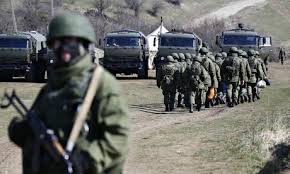
The Ministry of Defense says that the number of Russian troops and equipment along the borders of Ukraine in recent days has become smaller. Deputy Chief of the Armed Forces command center Alexander Rozmaznin stated this at a briefing, Ukrainski Novyny reports.
“The situation on the eastern borders with the neighboring country has stabilized … The number of troops has reduced … And it is calmer there,” he said. At the same time, the official emphasized that there are still over 10,000 Russian soldiers on the Ukrainian border.
An intercepted Skype videocall, in which Kremlin political strategist Aleksandr Dugin instructs separatists of the Southeast of Ukraine, appeared on the Internet, according to the Internet edition of BY24.ORG. The video recording of the conversation between Aleksandr Dugin, Sociology professor at the MSU, who is close to the Putin administration, with the wife of Pavlo Gubarev detained by the SBU appeared on the internet on March 29, 2014 and became a hit among Ukrainian web users in less than a day.
The Kremlin political analyst Dugin has reassured Kateryna Gubareva (she is temporarily acting on behalf of her husband among Donetsk separatists) about Moscow’s support. He later instructed her what further actions should be initiated by pro-Russian extremists in the Southeast of Ukraine.
According to Dugin, the primary directive of Moscow is to consider all local politicians who agreed to participate in the Presidential elections of May 25, 2014 traitors. This also applies to the leaders of the Party of Regions, formerly in power. Meanwhile, Moscow still recommends to support Viktor Yanukovych, already ousted by the Party of Regions.
The source reminds that even in Donetsk the recent separatist rallies demanding the return of the ousted ex-President drew rather small crowds.
Here is the scandalous video:
Meanwhile, according to Dugin, separatists should not try to find common ground with the new government in Kyiv, but to “act in a radical way.” Therefore, Aleksandr Dugin is in fact openly inciting civil war in Ukraine.
Moscow will later support civil war in Ukraine, Aleksandr Dugin reassured Kateryna Gubareva in the conversation:
“The Kremlin is determined to fight for the independence of South-east Ukraine.”
At the present moment, there are no official commentaries from either Kateryna Gubareva or Aleksandr Dugin regarding the videocall published on the Internet. The Kremlin press-service does not comment on the published material, either.
As a reminder, in recent years, the Kremlin has embraced the concept of a so-called “Eurasian Union,” developed by Aleksandr Dugin.
Biographical note
Aleksandr Gelyevich Dugin was born on January 7, 1962 in Moscow. A Russian public figure, philosopher, political scientist, sociologist. His political activities are aimed at the creation of a Eurasian superpower through the integration of Russia with former Soviet republics into a new Eurasian Union (EAU).
In 1979, he attended Moscow Aviation Institute (MAI), although he was expelled in his sophomore year for poor academic performance. This did not prevent him from later providing the Academic Council at Rostov State University at his thesis defense with a diploma from the correspondence department of Novocherkassk Engineering Institute (it is unknown when he graduated). In 1980, together with Geydar Dzhemal, Dugin joined the circle of the “Black Order SS,” founded and headed by Yevgeny Golovin (the so-called “Reichsführer”), one of the first Russian “new right.” Since then, Dugin considered himself a disciple of Golovin.
Then in 1988, Dugin and Geydar Dzhemal joined the National Patriotic Front “Memory” of Dmitry Vasilyev, but Dugin was later expelled from the organization. According to the official statement, for “past and ongoing contacts with representatives of dissident immigrant circles of occultist and satanic beliefs, in particular, with a writer [Yuri] Mamleyev.” From 1990 to 1992, Dugin worked with the declassified KGB archives, and used those materials to publish a series of newspaper and magazine articles, books, as well as launch the “Secrets of the century” TV program that was broadcast on Channel One.
Perestroika and the destruction of the Soviet Union changed Dugin’s attitude towards the Soviet regime and communism. He treats the defeat of the USSR during the “Cold War” from a geopolitical standpoint – as a victory of “sea civilization” over the “land civilization.” Dugin turns to Marxism, National Bolshevism (Nikolai Ustryalov, Ernst Niekisch), metaphysics of Communism (Nikolai Klyuev, Andrei Platonov) , Eurasianism (Nikolai Trubetzkoy, Peter Savitskiy, Nikolai Alekseev, Lev Gumilev), as well as the New Left (Guy Debord, Jean Baudrillard). In October 1993, Aleksandr Dugin defended the Supreme Soviet of Russia during the storm, and took the defeat of the parliament as a personal tragedy. Shortly thereafter, Dugin created the National Bolshevik Party [the NBP] together with Eduard Limonov and Yegor Letov which was in irreconcilable opposition to then President Boris Yeltsin. At the time, their party was known by its radical Anti-liberalism and anti-Americanism.
Over the next few years, Dugin, as the ideological leader of the NBP, published a multitude of radical political and metaphysical texts distinguished by a strong poetic and metaphoric nature. His interest in the Russian Orthodoxy and the Old Believers led him to believe in the correctness of Edinoverie – the preservation and revitalization doraskolnyh [before the split of the Russian Orthodox Church]traditions of Russian Orthodoxy in the bosom of the Russian Orthodox Church. During this time, Dugin has become a parishioner at an Edinoverie parish within the Russian Orthodox Church. In spring of 1998, there was a break between Aleksandr Dugin with Limonov and the NBP. In 1998, Dugin became the advisor to Gennadiy Seleznyov, Chairman of the State Duma, and in 1999 he headed the Center for Geopolitical Expertise of the Advisory Council on National Security of the Chairman of the State Duma. Meanwhile, Aleksandr Dugin became a Geopolitics lecturer at the General Staff of Russia. With Vladimir Putin in power, a new period of Dugin’s political activity began – he moved from the radical opposition in the previous government to being a loyalist of the current government.
Dugin in Georgian South Ossetia occupied by Russian troops in 2008
04.01.2014 Translated and edited by Voices of Ukraine
“Information Resistance”
Brothers and sisters,
Here’s the summary for April 1, 2014. (for the summary from the previous day, seeSummary of March 31).
The bad news:
1. The Russians are “returning” the seized equipment in Crimea in a rather interesting manner.
Thus, today in Bakhchisaray, they were loading the equipment [belonging to] our transportation battalion – “to be returned.”At first, the Russians agreed to give back 74 units of military equipment (they kept 27 fuel trucks and 3 mobile car repair shops).
The equipment was en route to the mainland, when a dashing Russian colonel waltzed in and ordered them to unload 7 more fuel trucks). As in, “we need them.”
Russian soldiers disagreed and said that before loading [the equipment] to the railway platforms, they removed everything they could from the vehicles, and destroyed what they weren’t able to take. They said, why do we need this scrap metal? The colonel responded by stomping his little feet and yelling at his soldiers that they should have understood first what would be useful and then destroyed it and given it back to the Ukrainians.
In general, you get the idea in what condition the “returned” items were after spending some time in the arms of greedy and mean “Russian brothers.”
2. German Foreign Minister Frank-Walter Steinmeier said that he didn’t see any path leading towards NATO membership for Ukraine.
However, he was quick to reassure that the “German government has not taken any official position on the issue.” But the fact that Europeans have started to crap bricks at the thought of Kyiv’s appeal to join the MAP (Membership Action Plan) does not inspire optimism.
On the other hand, it might be a message directed at Russia, to keep it in the loop. In any case, Steinmeier’s reasoning is not a diagnosis yet.
The good news:
1. NATO leadership has announced that it will suspend all practical civil and military cooperation with Russia and promises to offer help to Ukraine.
Meanwhile, the Verkhovna Rada [Ukrainian Parliament] has given permission to admit the militaries of other countries to the territory of Ukraine for military exercises in 2014. Practically all exercises, which start in May, will have servicemen from our partners in Europe and NATO.
As for assistance – they’re not talking about direct military assistance. But military–technical assistance – is something (Kyiv has requested radar stations and funds for equipping the border).
But the most important thing: NATO responded to Russia’s provocation. If the Alliance is ready for a new “Cold War” – then we want this support. As long as there is no real war in Ukraine.
It’s even easier with the military exercises: they were planned a long time before the invasion. But holding them now acquires a completely different military and political importance.
Particular attention should be paid to the Ukrainian-American “Sea Breeze-2014” exercise (up to 1,800 servicemen, with weapons and equipment, up to 9 ships, up to 2 submarines, up to 12 airplanes and helicopers) that will last 25 days.
It is still unclear where the exercises will take place. If Americans agree to hold them near Odesa (no other options are available) – the Black Sea Fleet of the Russian Federation in Crimea will throw a fit.
2. Party of Regions MP, Nestor Shufrich, said that Russia, with its “hostile actions,” left pro-Russian politicians in Ukraine without support.
Well, if it slowly begins to dawn on our Regionals [members of Party of Regions] who the enemy is in Ukraine, this is an undoubted success. Although the leopard cannot change his spots: they condemn Russia not for invading Ukraine, but because of the fact that their ratings fell. Fucking patriots, God forgive me.
3. Verkhovna Rada ordered the Interior Ministry and SBU [Security Service of Ukraine] to disarm illegal armed groups.
I do not know how effectively it will be done. But that is a very necessary and timely solution – no doubt about it. If we wait any longer, these domestically draped events become comparable in danger to the invasion of Russia.
4. Privatbank claims that all Crimean customers whose cards have been blocked, can unlock them at any branch of mainland Ukraine.
It is very important for our servicemen who move to the mainland – we are often asked by the guys from Crimea (after the occupation, the Privatbank cards issued in Crimea were blocked).
The only question is how they now get to the mainland. However, with a squeak this problem is solved. Let’s hope for the best, and help our children, best we can. One does not ignore brothers in need.
Am gestrigen Montag veröffentlichte das Auswärtige Amt eine gemeinsame Erklärung der Außenminister des sogenannten Weimarer Dreiecks (Deutschland, Frankreich, Polen) zur Ukraine.
Detlev Preusse, ehem. Leiter der KAS-Abteilung Ausländerförderung, bringt treffend zum Ausdruck, was viele Ukrainer angesichts dieser Zeilen fühlen:
[…]
Meine Fassungslosigkeit bezieht sich auch auf den nachfolgend zitierten Satz der Erklärung.
„At the same time, we acknowledge that Russia and Ukraine have always had special and strong ties based on history, economy and culture. These ties must be developed in the spirit of good neighbourly relations, mutual interest, genuine partnership and on the basis of Ukraine’s territorial integrity and sovereignty.“
Von der Ukraine wird folglich erwartet, nunmehr im Geiste guter Nachbarschaft und echter Partnerschaft mit der Russischen Föderation – diese offenbar inklusive der Krim – zusammenzuarbeiten, auf der Basis der territorialen Integrität und Souveränität der Ukraine. An keiner Stelle der Erklärung wird eine Aussage darüber getroffen, dass zur territorialen Integtrität der Ukraine nach dem Internationalen Recht, d.h. auch nach allen Verträgen zwischen der Russischen Föderation und der Ukraine, die Krim gehört. Es muss gefolgert werden, dass die drei durch ihre Außenminister vertretenen Staaten keinerlei Anstrengungen unternehmen werden, die Ukraine in ihrem legitimen Anliegen zu unterstützen, die Beendigung der Okkupation und Annektion der Krim durch die Russische Föderation zu erreichen.
Ich kann nur noch in Sarkasmus verfallen:
Die Ukrainer werden begeistert sein, nach der fröhlichen und ja fast gewaltfreien Okkupation der Krim und den Versuchen zur Aufklärung der Bevölkerung der Ostukraine über ihr Recht, der Russischen Föderation beitreten zu können, durch humanitär gemeinten militärischen Druck an der Grenze selbstverständlich unterstützt, und nach der freundlichen Kennzeichnung der Maidanbewegung und der neuen Regierung in Kiew als faschistisch, nunmehr wieder vertrauensvoll mit der Russischen Föderation zusammenarbeiten zu können. Mit Verlaub: Ein geradezu unverschämt blödes Dokument. Ich nehme diese Aussage zurück und bezeichne es als Eingeständnis der Unfähigkeit, zu einer klaren Lageanalyse und Strategie zur Überwindung des Konflikts zu gelangen.

 Tuesday, April, 1, 2014, 14:28