By Thomas C. Theiner, https://twitter.com/noclador
Russian propaganda fools and tools claim daily that Sloviansk has been shelled by Grad multiple rocket launch systems. It is an urban legend born out of the Russian tradition to shell enemy cities indiscriminately and with a perverted glee with multiple rocket launch systems (MRLs) until nothing lives anymore.
06.11.2014 Translated and edited by Voices of Ukraine
Brothers and sisters!
Here’s the Summary for June 11, 2014 (for the previous summary, please see the Summary for June 10).
The bad news:
1. Russian Foreign Minister Sergei Lavrov announced that Russia is providing humanitarian assistance to Donbas through the “militias because of Kyiv’s refusal to work together on this issue.”
Sure, after the events in eastern Ukraine wind down, our country must take on support for and humanitarian assistance to the national militias of the Caucasus, who have long been leading the deadly battle against Putin’s genocide.
Although it’s impossible to compare Donbas and the Caucasus. Donbas terrorists are criminals and Russian mercenaries. Whereas in the Caucasus, a struggle for liberation and an opposition to Moscow’s genocide is underway.
Also, it’s abundantly clear that it’s possible to divert Putin’s attention from aggression against Ukraine only by diverting his attention to the hot spots in Russia itself. It sounds cynical but this is the instinct of Ukrainian self-preservation.
2. The leader of the terrorist organization “DPR” [Donetsk People’s Republic] Denis Pushilin freely crossed the Russian border. Another runaway rogue, Oleg Tsaryov, suddenly surfaced in Luhansk.
Whoever is not lazy can drag themselves across the border.
Our guards explain: but the closed checkpoints were captured by terrorists!
This, we somehow guessed without the State Border Control Service. The question is why, when the checkpoints were captured back God-knows-when, Ukrainian law enforcement didn’t care one bit about it.
3. The situation with the ‘provision of status of combat participant (CP)’ to the guys who are now fighting terrorists as part of the ATO forces, smacks of some phantasmagoria.
The situation is more or less clear with the National Guard. Here’s how the picture comes together. The National Guard command quickly reported that it created the First Battalion from volunteers. However, de jure [legally] it doesn’t exist–the servicemen in the Battalion are officially registered in positions at completely different units, which don’t participate in the ATO. Accordingly, they won’t be awarded the CP status.
This is one of the wildest instances of bureaucratic marasmus in this undeclared war. There is only one solution–to urgently register these battalions (it’s well known that there are two more National Guard battalions “on the way”) as full-fledged combat personnel units. Why this isn’t being done is totally unclear.
The CP status of the military units of the Armed Forces that participate in the ATO is more complicated. The Defense Ministry representatives give us the most conflicting information. I promise that as soon as we clarify this issue, we will immediately report on it.
However, the Defense Minister claims that the CP IDs will be handed out after the ATO, but here it is impossible to agree with him. The issues with the [CP] status must be addressed now–later, to prove anything to bureaucrats will be useless.
In any case, it wouldn’t hurt some military officials to spend a week or two at a checkpoint near Sloviansk. You’d see, [their] brains would work faster when they need to solve such problems [urgently].
The good news:
1. Petro Poroshenko doesn’t exclude the possibility of conducting a round table in Donetsk “with the participation of those parties to the conflict that support a peaceful plan for its resolution.”
A peace plan, as I said earlier, is always positive.
I honestly can’t understand what the round table can discuss with murderers and rapists. After all, the proclaimed format obviously doesn’t exclude the participation of terrorists–who suddenly decided to support peaceful dialogue. I would hope that Poroshenko has his own higher considerations, beyond my understanding, in mind. Because, for now, all this still doesn’t look all that clear.
2. The Ministry of Defense promises complete filtration of everyone leaving the ATO zone.
Quite a timely move. As soon as Poroshenko announced the creation of corridors for refugees, the question of filtering arose immediately. We don’t need the terrorists to spread out across the country under the guise of being refugees from Donbas.
However, we are very hopeful that said filtering is not organized akin to border control or [troop] mobilization, i.e. not through one unmentionable place.
3. The Governor of Luhansk Oblast [region] Iryna Verygina announced that the Party of Regions [PR] faction Leader Oleksandr Yefremov and other PR members, as well as members of the Communist Party, supported terrorism.
It would seem only the laziest haven’t yet talked about this. One wants to hope that at least this statement by the Governor of the Luhansk Oblast, about Luhansk”native” Yefremov, would make both the Verkhovna Rada [Ukrainian Parliament], and law enforcement act. It’s impossible to fight terrorism in the country when the main organizers and sponsors of terrorism sit in Parliament.
The word titushky is often translated into English as ‘rent-a-thug’ or similar. The main titushky camp in Kyiv was in Mariinsky Park, a five-minute walk from my flat. I spent a good many hours watching the titushky; trying at times to communicate with them–though, unfortunately, my Russian does not go far beyond the kind of slogans (‘Thanks for the dictatorship’ etc.) that I myself dislike.
Looked at from the outside, it might be tempting to write off the titushky as a monochrome bunch of brainless thugs. In reality, they were quite dispirate–and different types would come and go. Some were elderly–heavy and tired men and women bundled against the icy weather; trudging through the snow on the way to the shops. Others were little more than kids–out to see Kyiv, they bustled around in groups of friends, smoking and spitting, moving from the camp to the warmth of Arsenalna Metro station. Others were much tougher–heavy-set men with scarred faces and gold teeth.
I once discussed the titushky with a reporter for Al-Jazeera, whom I met on a bus. He mentioned that they must be the worst type of humans–willing to sell their rights and suppress others. I understand the argument; but I often felt sorry for them–especially the youngest and oldest. Regimented into frozen and dejected-looking lines in the park, through the night, to be ticked off as present and collect their daily 200 UAH; or trying to warm themselves in the metro station; or buying the cheapest food, booze and cigs; or worrying about whether they would actually get their money; or sprawled in their cheerless camp (which I once sneaked into–the guards were both unaware and naive); they often looked pitiable. Many times I walked among groups of them–they never questioned me. Once an old man slipped and fell heavily on the ice. I helped him up, along with a chirpy young girl–both thanked me. Around midnight on a freezing night I witnessed the bizarre sight of a dozen or so Falun Gong practioners meditating, cross-legged, in deep snow in Mariinsky Park–sending positive vibes at the Chinese Embassy building opposite. Groups of titushky, perplexed, quizzed them in animated voices as they shuffled past on treacherous icy paths.
Some of them could be far more menacing. I was once with some protestors in Mariinsky Park at night; behind surrounding trees and bushes dozens of dark shapes loitered, perhaps ready to strike.
All titushky shared some features. They were impoverished; not only in a material sense but also in terms of understanding and vision. They were anti-Maidan, but not really pro-anything. How could they be? I have travelled through smaller towns in the heart of Donbas, home of many titushky; these towns present a striking picture. Huge Soviet monuments–Socialist-Realism miners; Lenin; tanks and planes from the War, guns pointing west–dominate. The outlines of mid 20th century identity remain frozen in place but without a life force, surrounded by a changed world. There is little vision of how life could be different: the local population can’t adapt easily–after all, they were the Soviet elite, at least in name; lauded as a new type of human. Corrupt oligarchs and criminal structures control the police and the remaining industrial infrastructure. Akhmetov and others milk what remains, while buying extravagant assets abroad and building super-stadiums in Donetsk. This has all been ignored for decades, from the level of the individual to the highest ranks in the state.
Coming from this environment, the titushky responded to slogans, power and money–but they did not have ideals; just remnant Soviet instincts. They were rarely much danger in their own right. When instructed to burn some cars, or attack some people, or blockade an embassy they would. But they never took the initiative in this. I quite often wore my Maidan ribbon among them, at least during the day; and made comments like ‘Please go home.’ I rarely got any kind of response; occasionally a hostile look but never more.
By the February 20th, when the titushky evacuated Kyiv, the ones I saw were made up of young men aged from about 16 to 26; plus a sprinkling of their girlfriends. They were not the most thuggish-looking types; they fought the protestors but looked scared and would not act without close supervision and instruction by security services. It might seem like I acted rashly, in the story below. But a key part of any conflict or competition lies in understanding both yourself and your opponent. In my estimation they did not present a danger to me–only to obvious ‘protestors’ (who themselves moved around in large and obvious ‘protest’ groups, among a largely inactive public), who the titushky might be instructed to attack. By this time, I was not too concerned about getting injured–a broken arm, or similar. For them to kill a foreigner was extremely unlikely, especially one who could not be easily identified as a ‘protestor’ (in fact, I only twice saw examples of either titushky or security services attacking people who were not offering resistance; on both occasions quite lightly kicking injured protestors–though I know there were worse cases involving Berkut and Interior Ministry forces). If anything unexpected were thrown into events–a ‘foreign observer’; contradictory commands; even unpredictable behaviour; the titushky would be confused. Without a clear command-and-obey hierarchy they had little ability to act.
I think clearer understanding of the titushky element of society–who are, after all, part of Ukraine and even more so part of Russia–could allow the New Ukraine both to understand the challenges it faces and to understand current Russian instincts better (Putin strikes me as a kind of high-level titushok, with ideology–a far more potent characteristic–added in).
Specifically turning to eastern Ukraine, the titushky element of society there has allowed armed separatists to function. The danger rests not in titushky themselves, but that they allow a power vacuum and that their instincts are to (at least passively) support anything that looks and feels vaguely Soviet–hence all the slogans, symbols and 70-year-old pop songs. But divested of their leadership–the volatile mix of ideologues and corrupt officials and ‘businessmen’ who control them–they would be manageable.
So, with that in mind, on to events of the 20th February …
2. Memories from Thursday 20 February:
This may not be factually accurate; but my purpose is to recall events, as I remember them and without embellishment.
That Thursday, all work was cancelled. I was expecting a quiet day in Kyiv–the arrival of an EU Delegation should have meant a lull. At about 10 am I was still home; but then started to hear sounds of explosions, and sirens, and muffled shouting out in the street.
I thought there might be a demo, on the road near my apartment–on the approach to the Rada. Maybe some protestors, calling for EU help. I got a big sheet of A3 paper and marker–something I could scribble a message on.
The street outside the apartment was still–little traffic, few people. Getting to Slava Square, I had a shock–hundreds of titushky streaming up the street; in green steel helmets, with silver police riot shields and new wooden clubs. They were being shepherded along by Interior Ministry troops, who were both mixed among them and in slow-moving buses. Two guys stood on the corner, watching.
The pair looked a little like titushky themselves; so I asked where they were from. The reply: ‘Kyiv’ (so not titushki). I asked ‘What’s happening?’ –with some urgency. One replied, in a sarcastic tone: ‘This is war.’ Wanting information, I again asked ‘Where are they going?’ The reply: ‘Which planet are you from?’ My blood, already up, boiled: I grabbed the guy’s collar and pushed him against a wall–my most violent act. ‘Look. I just want information. If you don’t know, just say that. What’s happening here?’
The youngish man seemed to think the titushky were chasing protestors–as I’d already surmised from the earlier shouting and bits of protest stuff (ribbons, and orange helmets) laying here and there. (As it turned out, the titushky were actually heading towards buses which would take them out of Kyiv). I started running along the street, away from the Rada, among the titushky and cops. The cops were urging the titushky on; as we ran, the latter started tearing off their yellow armbands (identifying them as ‘anti-Maidan’), and dropping shields and helmets–these littered the pavement.
I picked up a helmet; I would later give it to my mum’s boyfriend, to wear on his 60s army motorbike. A late middle-aged guy in the Yorkshire Dales now has a good tale about the green helmet he wears.
We ran on; me remembering to get a bit of video–some kind of evidence:
The few people on the streets watched, or turned away and hurried off. As we ran, I said to an Interior Ministry commander ‘I can’t believe you are doing this–you should be ashamed of yourself!’ (I was angry–thinking they were chasing peaceful protestors; though I had a clear head). A group of people stood huddled together, a little back from the pavement, with odd expressions. I remember yelling in passing, in English: ‘You should be trying to stop this! You’re Ukrainians–it’s your country!’ They understood: some looked blank, some ill, some helpless; one man seemed torn between movement and stasis.
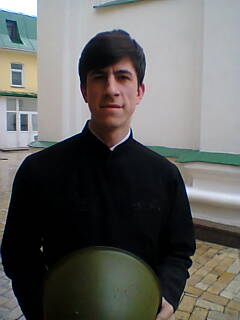
I ran on, overtaking titushky and cops, wanting to get ahead of the pack: maybe I could pretend to be some kind of international observer–maybe protect people. At [Kyiv Pechersk] Lavra, two priests stood watching–bewildered. I said (thinking they were Russian Orthodox) ‘I hope you don’t support this!’ ‘No, we are a Ukrainian Church–what’s happening?’ ‘Can you ring your (monastery) bell (in warning)?’ ‘We don’t have one.’ Then do this, I said, shouting ‘Stop titushky’ at the groups of young men moving along the other side of the road–who took no notice (but would not in my view have attacked priests). The two priests started calling out. Thanking them, I left the helmet with them for safe-keeping (and on Saturday went back to collect it, taking this photo):
Priest and titushka helmet
One group of about eight titushky paused, as they ran past the holy Lavra; using their clubs to almost rythmically smash to pieces an orange (protest) helmet laying on the ground. I’d seen police doing this earlier–such is the power of symbols, in Ukraine.
We ran on, to the war museum and soaring Motherland Monument; now just me and the titushky. Intent on looking for something, and as so often happens among strangers here, they asked no questions. I got a bit more film:
As I thought they were, I too was scanning around for protestors. Heading downhill, now in front of nearly all the scattered bands of titushky, I asked a guy with a boat on a flatbed trailer to block the road and pretend to break down; which he did. This threw the titushky into some confusion, slowing them down.
I passed the lead group as they turned right at Druzhby Narodiv Boulevard and starting heading uphill, towards Pechersk Metro station. I never did find the protestors–though there must have been some around–only two medics wearing Maidan ribbons (which on my warning they quickly stripped off). After running to the metro I got on a bus, and got down to the Maidan barricade near Bessarabka. Ambulances were whizzing out of Maidan–as I learned later, ferrying dead and injured away from Instytutska Street. I showed the barricade guards my titushky film, warning them that a 4 to 500-strong group may be on the way. I walked up to Maidan Square–by now the shooting had either stopped or there was a lull.
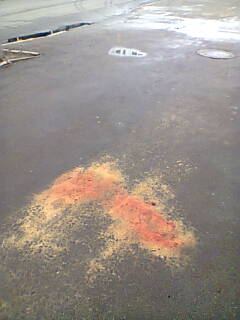
I later got a phone number from a competent-looking barricade guard, and went back to check for titushky movements–but couldn’t find them. Then walked to their camp in Mariinsky Park–for so long hostile territory but now abandoned. For a moment, I thought about using some of the petrol laying around to set it on fire. There were obvious signs of a recent battle–patches of paving ripped up, torn branches, a patch of blood:
Blood near Mariinsky Park
The few remaining guards at the Rada looked dispirited, and nearly let me slip past their checkpoint. I knew then that the government was near collapse:
Scouting around the top end of Instytutska St., above the National Bank (where at least one sniper had been operating) nervy-looking Berkut with Kalashnikovs were manning roadblocks, watched by plain-clothes or SBU men. I tried to get through but was turned back; oddly, they never asked many questions and, if they did, took my ‘lost tourist’ story at face value:
A deserted central street
I can’t remember much of what happened later–I think that in the afternoon I went to a client’s office to do some work. Everyone was quiet, they did not seem to want to talk about it–so I did not force it. Later I think I was back on Maidan.
Over the last few weeks of Maidan a lot of my days were like that–a strange admix of work; scouting around among police and titushky; sending off messages to a UK friend–and deleting the evidence; standing in the snow or tire-soot; watching or being watched by SBU men; checking Maidan defences and thinking about strategies; scattered bouts of stampede or violent protest.
PayPal, electronic transfers, and more–we work hard to help simplify the procedure.
Money collected by PayPal will be spent in Europe on commodities, which will then be sent to the front. Transfers will be spent on what can be bought officially. Cash—on everything remaining.






 Voices of Ukraine