By Olya Mikhailyuk
05.21.2014 Ukrayinska Pravda
Translated and edited by Voices of Ukraine
 Finding yourself in Lviv right after Luhansk is like a contrasting shower. That it’s very useful is what I have in mind. Having ridden across the country from East to West, you feel how diverse it is in mood and behaviour, how united it is in hope.
To “Well, how is it there in Donbas?” from my Lviv and Kyiv friends, I cannot respond briefly, so here again I’m writing a long textual observation.
A lot of weapons. A lot of aggression. A lot of quiet protests and “I’m Praying for a United Ukraine” billboards. Some are leaving. I understand why and call for all Ukrainians to understand and help this initiative.
Some stay. I understand them too. Their motivations are different.
Close to My Heart
I board a [train] compartment at the Komunarsk station. The last rays of sun fall on the passengers travelling from Luhansk–an attractive, elegant woman speaks Ukrainian, and a man, who is grey-haired, taut, wearing glasses, and “understands Ukrainian,” offers his companion Artek wafer cookies.
The evening light peers out simultaneously tender and solemn. Along the dozens of kilometers of railroad there’s lilac. Over the last month, I see it again and again outside the window and think about whomever got the idea into their head to plant this lengthy purple streak.
Suddenly I hear [in Russian], “The Russians did everything right with Crimea, they ought only to have done it sooner.” I quickly return to reality, despite the fact that the phrase is uttered with the same feeble intonation as all the previous ones–about wafer cookies.
I can’t bear it anymore, I join in, as a witness of the Crimean situation I let myself object, I speak about the unwarranted use of propaganda and violence, I try to argue, which, it seems, frankly infuriates my companion.
In about three minutes he is mashing an invisible hand flexor, and then–when asked whether he considers the beating of students right–already sputtering saliva, his nails digging into the seat cover–he yells, “Of course it was right. Only, they should have done it much sooner. She does not like violence, and I don’t like your upbringing. I would talk to your father. Strength and discipline should lead. You are talking to a military man.”
At this point I finally understand that I don’t want to talk anymore, and I go out into the corridor to read. In contrast to the monotonous scenery, the corridor of our car is multilayered. Beyond the window, as before, there’s the sky, the steppe, and already on the horizon–two triangles of pale lilac, pyramids in the last light of day.
In our neighboring compartments, there are apparently entrepreneurs–trendy clothes, smiles, canned beer, and talk about how Donetsk definitely has to remain a part of Ukraine, about the divisions in families on political grounds and ways to calm down their own wives.
At the next window, there’s a young woman with a little boy who is tugging at the handrail and pounding his small fists on the window. Further on, there’s a bare-chested fellow covered in tattoos and a belly that sways in rhythm with the car, he’s constantly on the phone with someone repeating, “So what, they f**ked up Donetsk, there’s not much left anymore.”
I don’t want to contemplate exactly what is meant. For some time he remains silent, looks at the boy, and slides into a sticky grin, “Come on, come on, little guy, keep pounding. Everything’s paid for.”
The military man comes out into the corridor, apologizes, says he is actually for peace and understanding in Ukraine, it’s just that now everyone is very nervous. I go back. In Horlivka a local farmer enters our compartment.
The discussion lasted the whole way. When it became particularly heated, someone would invariably intervene: either the conductor, who over the past few weeks clearly had the experience, the vendor-lady selling beer, ice-cream, and chicken chops, who walked through the cars addressing everyone only as “bunny” or “sunshine” (this especially suited the one with the belly at the far window), or a woman from Ivano-Frankivsk, who talked about working in Italy.
She was singing, not talking. The military man and the farmer enjoyed listening to her. As a farewell to me she said that she loves Ukraine too, but one has to control their nerves, because there won’t be anything left to love with, if you take everything so close to heart. That was not something that I wanted to hear at that moment.
The People’s Music, The People’s Lyrics
Leaflets have appeared in Alchevsk recently, “The Alchevsk People’s Self-Defense Headquarters informs the citizens that economic responsibility for assisting the Banderite neo-fascists and the [Ukrainian] National Guard is being introduced. At the yielding of quarters to fighters, supply of financial aid, transportation of fighters in personal vehicles, or posting of bail for them–all property of the perpetrators will be confiscated. The costs will go to provide compensation to the families of killed or tortured citizens of Donbas. Please, display civil consciousness.”
Signed, “The Chief of Staff of the Alchevsk People’s Self-Defense,” with no name or surname.
Again this vague nothing, which has recently been branded as “the people’s,” doped with calumny, instigation, and deception.
To the so-called people’s referendum on May 11 in Alchevsk, people came en masse and voted confidently. The first question is: can you tell us something about the flag–what do the three colored stripes signify? Next, they were starting to get more nervous: from whom and to what extent do you want to be independent? Who is your leader? What is the economic development program of the Luhansk People’s [Republic]? And the cultural?
Most of the people who came to the referendum couldn’t and can’t form their own opinion. They either run away from questions–say nothing or burst into yelling and insults–in other words, once again they have nothing to say.

“Luhansk Don’t Stay Silent!!!” Photo by Serhiy Zhadan.
And so, I was never able to figure what the Luhansk People’s Republic was for these people and why they voted for it. Presumably, because they associated it with something at that moment that was the safest. After all, they see only threats from the West–“Banderite neo-fascists,” and from the East–real armed people and equipment.
My friend and I went about the polling places. He is a local resident, he knows many who are now in the so-called Self-Defense. Upon our arrival, they reacted with somewhat ironic smiles, “So, Glory to Ukraine?”
“Glory to the heros!” replied my friend and asked for a ballot.
Then he decided to fill one out for his wife too.
“Do you know her opinion?” wondered the women in the commission. “Then take one, you’re allowed. We are having a people’s referendum.” All this with a musical accompaniment of “Do the Russians Want War?” Maybe they really don’t want it? By the way, this song in its time was banned in Russia as being, “one that weakens the morale of the Soviet troops.”
Those Who Speak
Yulia Krasylnykova, public sector activist (from Luhansk, now residing in Kyiv)
We had to leave, at least the activists did. In Luhansk–searches and intimidation; you cannot carry out events, so it is more effective to work at a distance. When the situation is more or less stabilized, it will be worth going back and continuing to do something.
I haven’t lived at home since the 30th of April. For the time being, I have moved to Kyiv. We are setting up a database of people from Central and Western Ukraine who are willing to board people from the East. We are developing a website and preparing material for Western Ukrainian publishing houses.
The first time I went to a meeting in Luhansk was on November 25. Afterwards, flash mobs were led from time to time as well as themed events. However, since December 11 people began gathering in small groups–those who didn’t have the means to go to Kyiv but could not stay at home in front of the television.
Every day, ten to fifteen people with a small recorder playing Ukrainian songs would unfurl their flag beneath the Shevchenko monument, and thus they would stand in the freezing cold, quietly listening, talking, singing the anthem and dispersing. This continued for about a week and a half.
We came to understand that they intended to continue, and we should do something. So, we found a more powerful amplifier, and started calling on people to come out and distribute information on the web. And by late December, there were from fifty to a hundred people at those meetings.
Then we realized that there was no sense in having the meetings every day, because they were repetetive.
Since January 2, a Street University has begun work, and even at a freezing minus 20 it was warm and felt good. At first, activists gathered from art and human rights get-togethers–they already knew each other–then new guys and girls began joining us. It was so fun to realize that there were so many people ready to do something for their country.
At the end of January, the propaganda started working: ”frightening” pictures from Hrushevskyi Street on regional television and tales about forty buses of Banderites which, “I saw myself, I made them turn back.” And on it went.
It [the meetings] ended when guns were distributed at the SBU [Security Service of Ukraine]. And now we have a very tense criminal situation in the city. Anarchy. It is scary to stay not only for an activist but also for an ordinary citizen. I do not see a peaceful resolution to this situation, but maybe this is my personal despair and fatigue.
It was possible [to resolve the situation] before the weapons were distributed. It all could have happened without the seizure of the SBU and other events, if those newly-appointed–for example, the governor–really would have kept order, instead of having endless press conferences.
We tried to speak with those on the other side. We were together in what we opposed–against the oligarchs, but we differed in what we were “for.”
In the captured SBU itself, there’s no unifying concept. Eight different groups are located on the different floors, in a weird way they share spheres of influence, but there is no dialogue between them. They imagine the future in different ways. There’s even a pro-Ukrainian group.
It is not clear how and with whom one is to speak, because while some speak, others do something different. This concerns hostages too. When our activists, a guy and a girl, disappeared, some said that they were not in the SBU building, but others saw the guy, but not the girl, and a third group saw the girl, but without the guy.
Now our actions have no results. We no longer have any influence on the situation. We can become an unrecognized territory, even two (she smiles)–the Luhansk People’s Republic is not uniting with the Donetsk People’s [Republic].
It was painful for me to leave, my friends nearly took me out by force, but we cannot entrust our fate to the people who seized power there. I’m in a destructive mood now, I don’t want to do anything.
For example, this year our favorite film festival “May 32,” documentary movies about youth, is unlikely to take place. In recent years we have been gathering up to a thousand people under the open sky in the square next to the SBU. Sometimes in the rain, but people watched the films through the night and talked about the upcoming year while dispersing. I hope it will all come back.
Now, I feel outrage, aggression, fatigue, but I know that I want to do something in Luhansk. Wherever I go, I will go back.
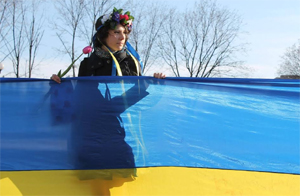
Julia Krasylnykova. Photo by Iryna Ryevunova.
Nameless, biker from Alchevsk (does not intend to leave)
Many are taking advantage of the situation that has arisen–some aim to be mayors, others–police chiefs. Observing the actions of the people who are now inside the SBU, one can consider their opinions divided. And not only their opinions, each has already started acting on their own scheme.
How did it all start for us? In January, the mayor let it be known that due to the events on Maidan, we had no police remaining at all, and we had to guard law and order [ourselves]. We have always remained beyond politics, and now we are not fighting for a chair but to take care of our homeland.
After this call, we united–bikers, mariners, Afghans, and formed squads. Our biker club is an organization with a tough format, we don’t just ride around on bikes, so it wasn’t much work for us to get organized.
We tried to guard order in the city.
For instance, we caught hooligans who were painting the city and monument to Lenin with black and red flags. Whatever it was, it’s our history. We watched the youth–who, where, why. It’s enough for us to control the city. We had to “work” but not rigidly. We gave some of them up to the police. What happened to them there I don’t know, I wasn’t curious. We defined our place ourselves, and in our city we have relative order in comparison to other cities in Donbas.
I won’t assert any one thing regarding the events in Kyiv or Odesa, because I only saw it on TV in two absolutely different interpretations. You defend your idea, your yellow-and-blue ribbons and talk about the terrible things done by one side. And I can talk from the other. And most of our citizens will support my point of view that red-and-black and yellow-and-blue flags are of no need here.
The week before the referendum, we received so much disinformation that it would have been enough for two civil wars in Ukraine. At first we tried to check it, but our efforts were insufficient.
Regarding weapons, I can say that there are many in the region. Among those to whom they were given are morons who can’t make use of them. It can be dangerous, especially in Donbas, and especially at holidays after a certain dose of alcohol. But a person who, as we say “gets botched up,” will no longer have his weapon. Certain people are watching this.
Now the arms are being used with a political subtext, later it is going to be warming up the criminal elements of the region. This is a lifestyle, a kind of constant internal aggression of the residents of Donbas–in any company and at any celebration it will reveal itself. Alcohol and drugs will help to reveal it, and the current events in the country are also drugs in their own way.
Here’s a case. A person came to the SBU, where people were standing up for their interests, and being drunk, decided to wave a knife around. He cut one of the SBU security guards, a good man, a veteran. He survived, but the one with the knife was just torn to pieces without an investigation or trial. People have accumulated so much hatred, and here was an object. They beat him with everything at hand and then kicked him brutally. The age categories were absolutely different. It was especially unpleasant to watch the teenagers who had decided, most likely, to play defenders of the homeland. They weren’t beating a human, but rather an already bloody piece of meat.
You speak of love for your land. Have you often met people here who love their city or town and wanted to make it better? I haven’t. The main concept here is indifference, to put it mildly. People think of how to survive and of nothing more.
Definitely, it would be great to find a compromise. But this needs smart and authoritative people. Who are they? Unfortunately, we don’t have our Moses. There is no one to choose from. It’s just six of one and a half dozen of the other.
I would like to see new faces and new propositions. We have to set the direction. That is why the first step was taken–the referendum. That was the hope that we would find our direction. Not yet confidence but hope.
People, in their view, chose the lesser of two evils. People do not believe the government in Kyiv. But as before much depends not on us, but the politicians.
In any state, there exist two states, antagonizing each other–the state of the poor and state of the rich. Only wisdom can reconcile them, and then justice will come.
Do you believe that we will have such a state? I don’t. It seems to me that we are degrading–we are unwilling to think, to feel, to analyze, to make decisions for ourselves and take responsibility for them. This concerns all of Ukraine.
I love my country and know it well. For example, not far from Perevalsk there was the Pansky Stavok–a picturesque spot in a gully amid a field, distant, quiet, incomparable sunrises. There was a spring up the way.
About six years ago, they started developing coal there, which has caused damage to the ecosystem. Water has partly filled the kopanky [small illegal coalmines]. Everything that was dug out was just abandoned as they moved on to new plots. The depth of the kopanka could have been the size of a multistoried building.
Such large scale destruction of our nature. We are outraged, but the government shuts its eyes to this. I wish to enjoy life and, moreover, share it with others. And it seems you don’t need a lot, but everyone should have their peace and joy.
Even the people with the guns. I wish it to be comfortable for me myself, but now with what is surrounding me, I’m forced to live in a different way. Spring is wonderful, even the May dust wasn’t as bad as usual. Nature is merciful, but people are doing something wrong.
Oleksiy Kravchuk, director (originally from Lviv, working in Luhansk for a couple of years)
Most people here want Luhansk to remain Ukraine. And now politicians have to be very careful in what they say. The candidates for the Presidential Elections, instead of political slogans, should address the people directly and stop the aggression.
I’m constantly saying here that in no way should we go to war, because negotiations are always better than armed conflict. I have even cleaned up all words from my own vocabulary that might offend someone from one side or the other.
A person with an assault weapon always causes a certain tension, right? My mother-in-law lives in Kramatorsk. I constantly see people with weapons in Luhansk too. The bandits should be stopped, and the rest should be spoken to.
We have to understand that even people with Russian flags are those who are unsatisfied, who have a desire to change something. Thousands of people. Don’t just call all of them bandits and separatists–in fact they want a good future for their children as well.
So, you should apply knowledge and will to the latter, and you should draw the sword only in case of a direct attack. I know for sure that I should not pity them or bear them ill will, because it increases the distance between us. The media is working to this effect–from one and the other side. Families are falling apart, because half of the bed is yellow-blue while the other is a tricolour. But this is all wrong.
It is not important whether the slogans are pro-Russian or pro-Ukrainian. Unless they have live people behind them, they are emptiness, a sort of pseudo-patriotism, and no more. People are being twisted around, they start insulting each other, get weapons, and shoot. And this will last until an idea capable of uniting people ripens.
Let’s be honest, in terms of a humanitarian direction, nothing has changed in Ukraine during the years of independence, neither in Luhansk, nor in Lviv. I had worked as a theatre director in Lviv for seven years, and every time the head of the Department of Culture was changed, I should have adjusted and asked for [an increase in] wages, maintenance, about any ideas; however, innovations were never discussed.
Individual people simply did their jobs sincerely and in parallel with the prevailing Ukrainian situation. Thus, we unfortunately didn’t move away from the Soviet mechanism of theater management.
So, right now, the Ministry should take not the “patriotic” position, which is very reminiscent of Soviet times, but rather unite the intellectuals and take the necessary practical steps.
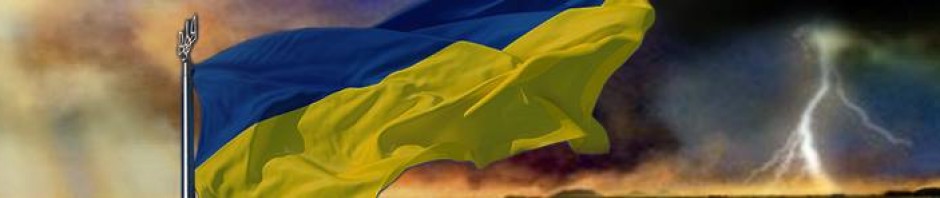
![From the Facebook page “Straikplakat” [Strike Placard]. Text reads: "Luhansk–Wake Up! #Ukraine is United".](https://maidantranslations.com/wp-content/uploads/2014/06/a4892c9-84e3825-10152006-461552037312002-6941008885682421591-n.jpg?w=640)
From the Facebook page “Straikplakat” [Strike Placard]. Text reads: “Luhansk–Wake Up! #Ukraine is United”.
I believe that Serhiy Zhadan’s performance in our theater in late April was much more important than the slogans heard in Kyiv.
There is need in these territories for literature, theatre, and music festivals and communications. Art unites. And now, how much do they pay for an assault weapon–a thousand dollars? Three assault weapons is one stage performance.
It is necessary that intellectuals and creative personalities from all over Ukraine, Europe, and Russia unite. Political actions are not needed now, but rather artistic actions. Aggression doesn’t last long. There will come a next stage. And meanwhile…
Do you know this joke: a man comes to a cemetery, he looks–there are crosses and crosses all around “Yesss,” he says, “So far I see only the pluses [advantages].”
Source: Ukrainska Pravda–Life


![From the Facebook page “Straikplakat” [Strike Placard]. Text reads: "Luhansk–Wake Up! #Ukraine is United".](https://maidantranslations.com/wp-content/uploads/2014/06/a4892c9-84e3825-10152006-461552037312002-6941008885682421591-n.jpg)


 Voices of Ukraine