Countering Russia’s False Narratives on Ukraine (VIDEO)

U.S. State Government Blog
06.24.2014
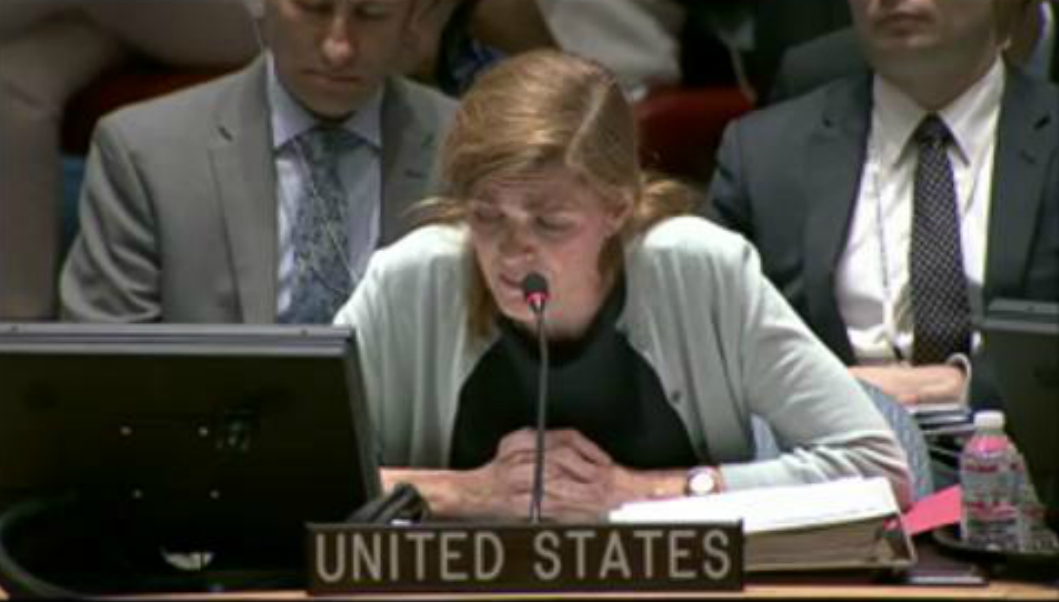
U.S. Ambassador to the UN Samantha Power

U.S. Ambassador to the UN Samantha Power

WATCH VIDEO: http://blogs.state.gov/stories/2014/06/24/countering-russias-false-narratives-ukraine

On June 24, 2014, the United Nations Security Council convened to address the situation in Ukraine.  U.S. Ambassador to the UN Samantha Power addressed the Security Council, and said:

“…Time and again — at least 17 times since February — we have gathered here to discuss the situation in Ukraine. And time and again, we’ve had to dedicate significant amounts of time to reviewing the efforts of Russia to destabilize its neighbor and to refuting the bald misinformation and outright fiction about what is happening on the ground in Ukraine.

“Russian rhetoric has been inaccurate, inflammatory and self-justifying. On June 17, just last week, Foreign Minister Lavrov accused Ukrainian military authorities of carrying out ‘ethnic cleansing.’ Days earlier, a leader in the Duma accused Ukraine of committing ‘mass genocide.’

“My government, this Council, and the United Nations take extremely seriously any reports of ethnic cleansing or genocide. But baseless claims like this have the effect of radicalizing Russian separatists, escalating this horrible crisis and further eviscerating the credibility of Russian reports from the region.

“We should consider such claims alongside the facts on the ground, such as the situation of the ethnic Tatar community in Crimea following Russia’s purported annexation, which the international community will never recognize. The homes of Tatar leaders have been arbitrarily searched, and editors of its main newspaper threatened with prosecution. Tatars who have participated in peaceful protests have been locked up by the dozens, and many more insulted and harassed for speaking their language in public. And its members have been told that they — and all Crimeans — must give up their Ukrainian citizenship, or else be treated like foreigners in their own land.  Meanwhile, in areas controlled by illegal separatist groups in southeast Ukraine, we continue to see Russia’s extensive support for the campaign of violence and separatist terror.

“The crimes committed by these groups are methodically documented in the UN Monitoring Mission’s reports, and follow a pattern set by Russia’s unlawful intervention in Crimea. They include the violent seizure and occupation of public and government buildings; unprovoked, lethal attacks against Ukrainian security forces; and arbitrary arrests, torture, beatings, death threats, disappearances, killings, and other serious abuses carried out by Russian fighters and the pro-Russian separatists.”

Ambassador Power continued, “…Russia has attempted, erroneously, to characterize the events unfolding in eastern Ukraine as a humanitarian crisis. They falsely have cast themselves as the defender of rights and vindicator of the vulnerable; and the Russian army and its operatives as a humanitarian aid agency. But this Russian ‘aid’ operation sends soldiers, not doctors; it mans armored personnel carriers, not relief tents; it provides surface-to-air missiles, not meals-ready-to-eat.  Russia claims that 100,000 people have fled Ukraine for Russia. Yet, Under-Secretary-General Amos informed this Council in a briefing last week, that the real number is around 4,600.

“I do not for one moment intend to minimize the very real humanitarian consequences of the crises in Eastern Ukraine and Crimea, including the tens of thousands of internally displaced people within Ukraine’s borders. But we have to be objective and fact-based in our claims and candid about what has brought about these dire humanitarian consequences: namely, the political and military support that Russia continues to provide to armed, violent separatists.”

Ambassador Power concluded, “…As we sit here, eight OSCE monitors are being held captive for the crime of bearing witness and gathering facts – actions that are dangerous only to those who would distort those facts. These monitors have been held captive for nearly a month — a month! — by separatists in Donetsk and Luhansk, with no justification. For these crimes, there must be consequences.

“There also must be continued consequences for Russia’s consistent violations of the fundamental principles of the UN Charter and for its ongoing failure to meet the commitments it has made. And there must be consequences for the widespread crimes and abuses committed by the armed separatists Russia supports. Both because the victims of these crimes merit justice; and because, as we have seen, unless Russia feels effective pressure to de-escalate, it will continue to choose to escalate this crisis.

“We have urged Russia to be part of the political solution to the crisis in Ukraine. But if it persists with the same escalatory tactics — it must face additional costs.”

For more information:

Source: http://blogs.state.gov/stories/2014/06/24/countering-russias-false-narratives-ukraine

Posted in "Voices" in English, Crimea, English, English News, South&Eastern Ukraine, Video | Tagged , , , , , , | 2 Comments

【情報レジスト・ティムチュック】 6月25日(水)のまとめ

10173325_481968728598454_1124228004_n

原文はこちら:フェイスブック情報レジストHP
6月24日の分はこちら

和文: S.J.

※ 3月10日からウクライナで活動しているボランティア情報局、「情報レジスト」(”情報で抗議する”)リーダが発信しているその日の記録を和訳したものである。※ ======================================

■ 悪かったこと ■

(1) 一方的な「停戦」が継続している。テロリストは、反テロ作戦軍の陣地を砲撃し、鉄道を爆破し、行政府庁舎を新たに占拠している。

民間人の死者が発生しており、その中には子供も含まれている。本日、医師の話によれば、6月24日にアントラツィトで殺された10か月の赤ちゃんは、 Continue reading

Posted in Tymchuk日本語, 日本語 | Tagged , , , , , , , , , , , | 2 Comments

Latest from the Special Monitoring Mission (SMM) in Ukraine based on information received until 24 June 2014, 18:00 (Kyiv time)

Organization for Security and Cooperation in Europe
Special Monitoring Mission in Ukraine
06.25.2014 Kyiv

The situation across the country was calm. Four SMM monitors from the Donetsk team have been missing for 30 days and four SMM monitors from the Luhansk team for 27 days.

The situation in Kherson was calm. Internally displaced persons (IDPs), recently arrived from Luhansk, informed the SMM that they had received free accommodation, meals and healthcare at a sanatorium in Skadovs’k. The manager of the sanatorium as well as a member of the Skadovs’k Regional Council added that 50 IDPs were staying in the sanatorium, which had a capacity of 150. They both, however, warned that employment opportunities were poor, saying that only two IDPs had so far managed to find temporary employment. They also said that neither the City Council nor the Regional Council had an assigned budget to cater for IDPs. Also in the Kherson region, the SMM spoke to the director of the City Centre for Social Services and the deputy mayor of Kherson. They said that the IDP Co-ordination Centre had already processed 120 displaced persons from Crimea and approximately 800 from Donetsk and Luhansk. Twenty IDPs from Luhansk and Donetsk are arriving in the city every day, they said. They warned that the city’s capacity to accommodate more IDPs would be exhausted in 10 days.

The situation in Odessa was calm. The SMM met a representative of the Good Samaritan Charity Foundation who commented about what he described as a lack of state support. The foundation, is currently refurbishing a housing facility in Mayarkee with a capacity to host 150 IDPs.

The situation in Kharkiv was calm. The head of the Labour and Social Protection Department of the Zmiiv district administration in the Kharkiv region informed the SMM that in the previous nine days, the number of IDPs had increased from 19 to 87 in Zmiiv. Although the district, city and village councils, supported by local people and businesses, are providing food and medicine, he warned that conditions would worsen with the onset of winter, and IDP needs would increase once the school year commenced.

Also in the Kharkiv region, the head of the Izyum district administration told the SMM that there had been “a sharp increase” in the number of IDPs in the district, currently numbering 762.

The situation in Ivano-Frankivsk was calm. The SMM met the head of the Regional IDP Co-ordination Council on 23 June.  He claimed that since mid-June, based on a decision of the Department of Social Affairs of the regional administration, male IDPs – deemed by the administration capable of fighting – were being denied the resettlement lump sum of UAH 500, ordinarily given to IDPs on arrival at their end destination.

[The SMM head office, in co-operation with the UNHCR Office in Ukraine, has organized and has begun to implement a joint training programme of monitors from each of the ten teams on the topic of IDPs. The purpose of this UNHCR-facilitated training, being carried out over the next three weeks,is to strengthen the capacity of the SMM to monitor and report on the situation as regards IDPs.]

The SMM met the mayor of Luhansk City. The mayor stressed that a roundtable meeting – incorporating the so-called ‘Luhansk People’s Republic’, the government of Ukraine, the leader of the armed Cossack faction in the Luhansk region, and the OSCE – should be held in Luhansk city, in order to bring hostilities to an end.

The situation in Lviv was calm. The SMM monitored a gathering outside a military base in Lviv, in which 20-25 parents and relatives of Ukrainian Army conscripts demonstrated against the extension of military service from three to four months, the lack of rotation for their sons/relatives and their inability to get copies of their sons’/relatives’ contracts.

The situation in Kyiv was calm. The SMM monitored a gathering of approximately 150 females who constitute a group called “The Mothers of Sons” in front of the presidential administrative building in Kyiv. The demonstrators were protesting against the conscription of their sons into the Ukrainian Army.

The situation in DonetskChernivtsi and Dnipropetrovsk was calm.

Source: OSCE Special Monitoring Mission in Ukraine

Posted in English, English News, News summary, Other, South&Eastern Ukraine | Tagged , , , , , , , , , , , , , | Leave a comment

Customs blocked first aid kits from Canada that provide rescue for the wounded

By Olena Mityasova, Oleksiy Pshemyskyi, Pavlo Lysenko, Vitaliy Kovalenko, TV channel “Inter.”
06.24.2014
Translated and edited by Voices of Ukraine

Ukrainian Canadians brought first aid kits for Ukrainian servicemen who are fighting against terrorists in eastern Ukraine.

However, the much-needed humanitarian aid for the soldiers is still sitting at [Ukrainian] customs. Our correspondents found out why.

This is Celox that can stop the bleeding. Sticky pads like this that if your lungs get shot through, one goes to the front, and one to the back [of the wound].

They transported assistance to soldiers, but they got into a war with bureaucracy. Ukrainian Canadians, Marko and Ulyana have collected money abroad for 10 thousand kits for our soldiers. They have already bought 1.5 thousand [kits]. Each costs $100.

If the military had these supplies, dozens of lives could have been saved. They bought the first aid kits, even found an airline that could deliver them free of charge to Ukraine. But Customs wouldn’t let them through.

Ulyana Suprun, a representative of the Ukrainian World Congress:

–No one does anything, we turned to the Health Ministry and nobody is able to get the cargo cleared at Customs, we can’t send [it] into Ukraine for two weeks already.

We are confident that the officials just want a bribe. After all, to let first aid supplies vital for the soldiers into the country, you only need a piece of paper from the Ministry of Health. But no one issues it.

–We will not pay because my husband and I did not stand on Maidan for three months to start paying bribes again.

Even diplomats are unable to overcome the bureaucratic machine. 1.5 thousand of the same kits from the U.S. Embassy waited for a week to get cleared by Customs. They arrived in the country only yesterday. But where the aid is, neither the Defense Ministry, nor the RNBO [National Security and Defense Council] know.

Volodymyr Chepovyi, the speaker of the RNBO information center:

–Since there is no information [as to the cargo’s whereabouts], we will take control over [the issue] for it to become effective and public.

To control where and how the humanitarian aid is now distributed, is practically impossible now.

Ihor Koziy, a military expert of the Institute of Euro-Atlantic Cooperation:

–Today, those officials who used to be corrupt still remain corrupt. In fact, this whole thing seems to be under the signature of combat units, any factor might be in play here. They could sign for more than they actually received, and therefore something is missing as a result, and so on.

It turns out that [soldiers] are fighting at the frontlines, and those bureaucrats in their offices are making profits. It is quite possible that these medical supplies may turn up in pharmacies, or, like the MREs, be sold over the Internet.

Source: Podrobnosti.ua 

Here’s the video of “Inter” report [in Ukrainian]:


Posted in Diaspora, English, Languages, Media, News, Pictures | Tagged , , , , , , , | 7 Comments

Ukraine-Analysen: Die Ukraine-Krise in den deutschen Talkshows

Von Fabian Burkhardt, München

Ausgehend von Vorwürfen einer möglichen »Kriegstreiberei« und Russlandfeindlichkeit in den deutschen Medien untersucht der vorliegende Beitrag anhand von dreißig deutschen Talkshowsendeterminen, die die Ukraine-Krise im Blickfeld hatten, zwei Fragen: Sind Berichterstattung und Kommentierung in den Medien anti-russisch? Und: Hat die Ukraine eine »Stimme« in den Talkshows? Anhand der geladenen Gäste kommt die Untersuchung zu dem Ergebnis, dass der Vorwurf der Russophobie nicht haltbar und die Ukraine kom-parativ eindeutig im Nachteil ist.

Zum vollständigen Text

Posted in Analytics, Analytik – Deutsch, Deutsch, Languages | Tagged , , , , | 1 Comment