Klimkin named the conditions for a bilateral ceasefire

By Obozrevatel.com
08.18.2014
Translated and edited by Voices of Ukraine

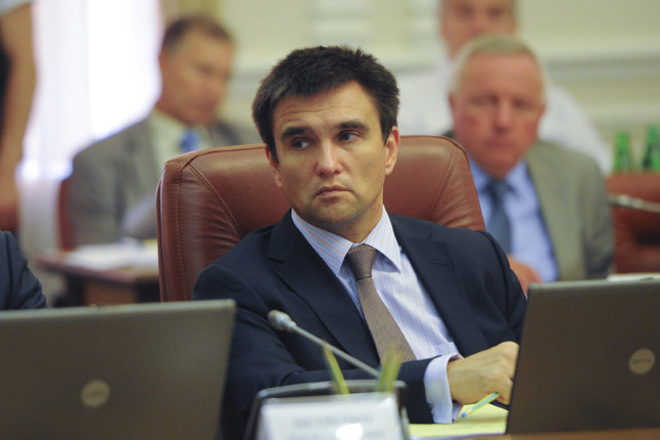
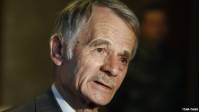
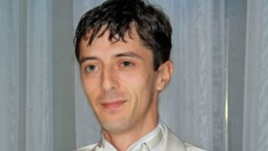
Pavlo Klimkin, Minister of Foreign Affairs of Ukraine

Pavlo Klimkin, Minister of Foreign Affairs of Ukraine

The Ukrainian side insists on a bilateral ceasefire, but Moscow has refused to give any guarantee on its part, Interfax-Ukraine reports with reference to the Minister for Foreign Affairs of Ukraine, Pavel Klimkin.

According to him, a ceasefire is possible only under three conditions – that the border is completely safe; that OSCE monitors are everywhere, including along the border, to monitor the ceasefire; and that all the hostages are released and no one even tries to take new hostages.

“In Berlin, yesterday we talked about the fact that everyone must do everything in his power to block the border to stop the attacks on our territory, so that no armed men, weapons or heavy artillery can cross the border with Russia,” –said Klimkin.

The minister also said that this applies as well to the release of Ukrainian pilot Nadezhda Savchenko, “who was just stolen from Ukrainian territory in an absolutely inhuman way.”

According to him, the Ukrainian side is committed to the idea of a bilateral ceasefire.

“We want a cease-fire that is really two-way and effective. And this is possible only if Russia will take decisive and effective steps towards de-escalation,” –he said.

Source: Obozrevatel.com

Posted in "Voices" in English, English, English News, Pictures, South&Eastern Ukraine, War in Donbas | Tagged , , , , , , , | 1 Comment

In war, money is easily converted into lives…

By Ievgen Shevchenko, Donbas Battalion
08.09.2014
Translated and edited by Voices of Ukraine

In war, money is very easily converted into lives. Easier than anywhere else …

Today, my brothers were ambushed … and everything would have be fine, we could have escaped with only a few lightly wounded… we only needed one APC, one, only one working APC to cover our guys, to provide a retreat, to hide our [guys] from the hail of bullets…

A couple of weeks ago, someone at the [Defense] Ministry proudly reported, some [fucking] General announced that you [could] see [for yourself], the Donbas Battalion was now provided with APCs, as many as three of them! ‘Here’s to you, our dear [volunteers], you are welcome, from my heart I tear them [the equipment]–fight [with it]!’ Only the equipment turned out to be from the post-war years [after 1945]–it was going to be written off, but instead it came to us. Two of the three [APCs] didn’t even reach the frontline–they broke down in Artemivsk, and the third one did some fighting for a week, reached Lysychansk and then broke down there. Thank you, Comrade General! Thank you so very much!

And now I only regret one thing: that I didn’t become a billionaire in my 31 years of age, and I have nothing with which to repair our armor… And even more, I have nothing with which to buy new armor… I’m sorry, guys… Rest in peace…

Source: Ievgen Shevchenko FB 


Posted in "Voices" in English, English, Eyewitness stories, Pictures, Social Media, War in Donbas | Tagged , , , , , , , | 4 Comments

Thank you, Maidan…

1915054_138625382824043_5784643_nBy Evgeni Yakunov
08.14.2014
Translated and edited by Voices of Ukraine

Thank you, Maidan…

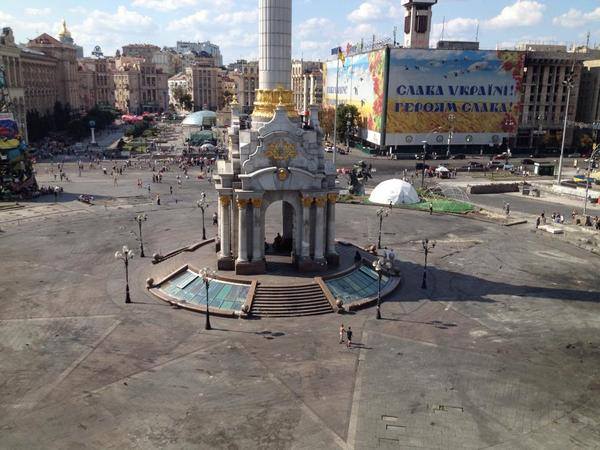
…a group of people on the stage, not yet dismantled by the communal workers, was still holding strong. A tall broad-shouldered beauty, Bozhena, played the guitar and sang songs and – a cappella – the anthem. It was beautiful and sad. Her colleague called the people onto the stage, to remain there all night and thus to preserve the small rebellious flap of territory that was left of Maidan. Not paying attention to them, the students (girls from the Sunday “clean-up” clearing Maidan) dismantled and dragged heavy fence sections from under the stage towards waiting trucks. Maybe they were the same students who first came to the Independence monument at the end of November of last year…

Opposite the conservatory the two remaining tents were living out their last hours and minutes – their inhabitants were voluntarily carrying out and loading double-decker bunks from unplaned boards, refrigerators, fans, acid batteries, spring mattresses and other Maidan belongings onto orange KrAZ trucks. On Institutskaya [Street] a puny little man in camouflage was rooting in the depths of the barricades, loading copper wire and other metal into a linen bag to hand in to the scrap merchant. Cool jeeps of Kyiv celebrities hurried along the newly-swept Kreschatyk

That is how they were clearing up Maidan for good. Or – cleaning it. Depending on whom you ask. It was sad. Not that I believed it was all a betrayal, that the current government continues the work of Yanukovich (as the last defenders of Maidan were shouting from the stage). But in some sense I understood them, too. Sure, only the marginal elements remained here. But many of them stood shoulder to shoulder with us this winter. Perhaps, then, this was their hour, when the homeless, the unemployed, the neglected street urchins, for the first time felt as citizens, and realised their necessity to society and to their country? How hard they will find it to get back again to whom they were before…

With each dismantled barricade and folded tent, the square loses its familiar landmarks. And now you cannot immediately figure out where you stood with an umbrella under pouring rain in the first evenings of the protest, where you saw the traces of bullets and bloodstains on the pavement, when one sniper bullet cut short the lives of two people at once, where in the smoke of the burning Trade Unions building they were loading a dying Self-Defense volunteer onto a pick-up truck…

It is probably as difficult for a fighter to leave his trench, which he got used to living in, which he dug out himself with a trench shovel under a rain of bullets and missiles, which more than once saved his life and on the parapet of which remained the traces of the blood of his slain comrades.

But it is impossible to spend your whole life in one trench, sooner or later you have to go over the top. Especially as the front has moved far to the East.

You have noticed that today in Kyiv there are few yellow and blue ribbons on lapels and not that many balconies have flags flying from them. That is not because Kyiv became less patriotic.  Ribbons, flags, cars decorated with the national symbols – they are like flags on the operational map of the general staff – they mark the front line. Today is runs through Odessa, Kharkiv, Mariupol… and already – through Sloviansk, where 150 patriots yesterday gathered a town council, their own little Maidan.

Yes, the lustration has not been carried out yet, the government still contains mostly the same people and many things have not been done yet. Maybe even, nothing, of what the Maidan sotnias demanded. But Maidan will never be able to achieve it, because it was never a self-sufficient phenomenon. It was just a weapon. And a weapon, as the hero of a famous novel, Louis Boujold, said – “is just an instrument forcing the enemy to change their point of view. The battleground is the mind. The rest is just a sham.” Maidan changed us inside, and that is all it was capable of.

I could have said the standard: “Maidan is dead, long live Maidan!” or “Maidan will never die, because it is inside our soul.” But I will say it differently. I will say: “Farewell, Maidan!”

That is how we say farewell to our youth. To the youth of our great struggle. A time when, it seemed, we would be able to conquer freedom and independence only if a million of us took to the streets! Because we deeply believed that our strength lay in walking unarmed against the truncheons of “Berkut,” and with plywood shields against the assault rifles of snipers – could they really shoot at their own people?

“Lord, how naive we were!..”

Now we have our own machine guns and even tanks. But to defend freedom and independence, we have to be ready not to fear “Grad” rockets, ballistic missiles and, maybe, tactical nuclear weapons…

Only now have we stepped into adulthood. Only now we are beginning to understand the price of the issue.

On the wall of the Heavenly Hundred, near the Ukrainian House, the last name on the list is that of Vladimir Rybak, an MP from Horlivka, brutally tortured to death by Russian mercenaries. He did not die on Maidan, but his act is the continuation of sacrifice that was born on Maidan. And the Heavenly Hundred has somehow imperceptibly transformed into the Heavenly Battalion and a pain in my heart aches for the realisation that this is far from over.

Those who grew up went to the war. Those who were left on the former Maidan, remained stuck in childhood. Operetta Cossacks, Sotniaks of non-existent Sotnias, surrounding themselves with aluminium shields of their deceased or front-bound comrades. You feel sorry for them, as you feel sorry for all men who do not grow up in time. Maidan ended, now they have to find themselves all over again – for some, while shedding blood, some – sweat, earning for the family and for the defense of the Fatherland.

And yet – thank you, Maidan! It was good with you…

…the KrAZ with the belongings of the last Maidan tent rolls down the Vladimirsky descent. In the back are three tanned torsos. The wind waves the yellow-blue flag and the carefully cropped forelocks. The boys smile and cry out, raising their arms to the sky: “Glory to Ukraine!”

Kyiv citizens, walking down Vladimirsky, accompany them with applause.

Source: Dmitry Chekalkin, FB
 

Posted in "Voices" in English, English, Eyewitness stories, Maidan Diary, Pictures | Tagged , , , , , , | Leave a comment

Mustafa Dschemiljew: Damals Kolyma, jetzt eine Verbannung aus meiner Heimat

Mustafa Dschemiljew: Damals Kolyma, jetzt eine Verbannung aus meiner Heimat (Aktualisierung des Artikels Mustafa Dschemiljew: Putin will ein Treffen während mein Sohn als Geisel gehalten wird)

Mustafa Dschemiljew

Mustafa Dschemiljew

Der erfahrene Anführer der Krimtataren Mustafa Dschemiljew beharrt nachdrücklich darauf, dass die Anerkennung der russischen Annexion der Krim auf keinen Fall Teil einer Vereinbarung sein darf, mit der die russische Aggression im Osten der Ukraine beendet werden soll. Er äußert sich ebenso klar angesichts der Versuche, die fortdauernde Inhaftierung seines Sohnes in Simferopol von seinem Wohlverhalten abhängig zu machen.

Bei einem Besuch auf der Krim am 14. Juni wurde der russische Präsident Wladimir Putin gefragt, warum Dschemiljew und Refat Tschubarow, der Vorsitzende der Medschlis (Vertretung) des krimtatarischen Volkes, für fünf Jahre aus ihrer Heimat verbannt wurden. Putin antwortete: “Wir werden mit absolut jedem zusammenarbeiten, der das Wohl der Völker Russlands, einschließlich des Volkes der Krimtataren, die jetzt auf der Krim leben, jedoch nicht mit denen, die mit Problemen der Vergangenheit spekulieren und aus der PR mit den Problemen der Vergangenheit ihren Beruf und ein Mittel gemacht haben, Geld zu verdienen”.

Ob dies eine Antwort ist, sollte jeder Leser selbst entscheiden. Mustafa Dschemiljew hat schon viele vermeintliche Gründe gehört, seitdem der 71-Jährigen kurz vor dem siebzigsten Jahrestag der Deportation der Krimtataren aus ihrer Heimat vom Mai 1944 verbannt wurde. Der österreichische Präsident Heinz Fischer teilte ihm zum Beispiel mit, Putin habe behauptet, er könne nicht zulassen, dass Dschemiljew auf die Krim zurückkehre, weil er ukrainischer Staatsbürger und Mitglied des ukrainischen Parlaments sei.

Putins Worte in Jalta [vom Juni 2014] waren von besonderem Zynismus geprägt. Von welchem Geld redet er da? fragt sich Dschemiljew. “Seit vielen Jahren haben wir uns für unser Recht, in unsere Heimat zurückzukehren, eingesetzt. Es hat uns Gefängnis, Arbeitslager – in Kolyma und anderswo – eingebracht. Und jetzt haben wir eine Verbannung aus unserer Heimat dafür erhalten.”

Dschemiljew, der im Jahr 1944 erst sechs Monate alt war, verbrachte für die Verteidigung der Rechte des krimtatarischen Volkes zehn Jahre in Kolyma. Seit der Unabhängigkeit der Ukraine spielt er eine wichtige Rolle bei der Verteidigung der Demokratie und der Freiheit für alle Menschen in der Ukraine.

Der prominente Krimtatare Mustafa Dschemiljew wurde von Vertretern des russischen Präsidenten Wladimir Putin angesprochen, dass ein Treffen mit Putin erwünscht sei. Sie weisen darauf hin, dass es vom Ergebnis eines solchen Gesprächs abhänge, ob Dschemiljews Sohn, Chaiser aus der Haft entlassen wird, und ob ihm selbst die Rückkehr auf die Krim erlaubt würde, was ihm am 22. April für fünf Jahre untersagt worden war.

Für Dschemiljew ist es klar: sein Sohn wurde als Geisel genommen, um von seinem Vater die Antwort zu bekommen, die sie haben wollen.

“Zugegeben, niemand kann derzeit sagen, wie viele Monate oder Jahre es dauert, aber die Besetzung wird auf jeden Fall zu Ende gehen, und die Krim wird wieder ein Teil der Ukraine sein. Dann wird alles anders sein, und wir werden in der Lage sein, absolut legal in unsere Heimat zurückkehren können, und alle werden zur Rechenschaft gezogen werden, für das, was sie ukrainischen Staatsangehörige in ihrem eigenen Land angetan haben,” sagte Mustafa Dschemiljew gegenüber Radio Swoboda.

Im Mai 2013 erschoss Chaiser Dschemiljew und Fewsi Edemow, der als Leibwächter bei der Familie angestellt war. Obwohl alle Beweise darauf hindeuten, dass der junge Mann wegen Totschlags angeklagt werden müsste, und auch die Witwe des Toten bestätigt, dass ihr Mann und Chaiser ausgezeichnete Beziehungen zueinander hatten, erhoben die Behörden Anklage wegen Mordes.

Sein Vater sagt, dass von Anfang an der Fokus auf ihm selbst lag und nicht seinem Sohn. Wie berichtet bekam er im November 2013 ein Angebot von Menschen in der Umgebung des damaligen Präsidenten wiktor Janukowytsch, sein Sohn könne am nächsten Tag freigelassen werden, wenn er die (oppositionelle) Batkiwschtschyna-Partei verlassen und der regierenden Partei der Regionen beitreten würde. Er konnte diese Bedingungen nicht akzeptieren, und innerhalb von ein paar Tagen wurden die Anklagepunkte gegen Chaiser noch verschärft.

Chaiser Dschemiljew

Im Fall gegen Chaiser ermitteln jetzt sowohl die Ermittlungsbehörde der Krim und der Kyiwer Staatsanwalt. Der Fall wurde letzterer auf der Grundlage des ukrainischen Gesetzes über das besetzte Gebiet übertragen. Einem Antrag auf Anerkennung des Tatbestands als Totschlag durch Unachtsamkeit wurde zugestimmt. Zwei Kyiwer Gerichte haben nun entschieden, dass Chaiser sollten aus der Haft entlassen werden sollte.

Nachdem diese Gerichtsentscheidungen ignoriert wurden, wandte sich Dschemiljew an den Europäische Gerichtshof für Menschenrechte, der am 10. Juli in Anwendung des Artikels 39 die Freilassung von Chaiser aus der Haft anordnete.

Urteile des Europäischen Gerichtshofs für Menschenrechte sowie Anweisungen gemäß Artikel 39 sind für alle Unterzeichnerstaaten der Europäischen Konvention verbindlich, darunter auch Russland. Chaiser Dschemiljew ist immer noch nicht freigelassen worden.

Das Einreiseverbot gegen Mustafa Dschemiljew wurde kurz vor dem siebzigsten Jahrestag der Deportation der Krimtataren aus ihrer Heimat im Mai 1994 verhängt – Dschemiljew war damals sechs Monate alt. Er hat sein ganzes Leben mit der Verteidigung der Rechte der Krimtataren, der Unterstützung der Demokratie und der Freiheit für alle Menschen in der Ukraine verbracht. Sein unerschütterliches Bekenntnis zur Gewaltlosigkeit spielte eine wichtige Rolle bei der Emöglichung der Rückkehr der Krimtataren nach der Unabhängigkeit der Ukraine und bei der Bekämpfung derjenigen Kräfte auf der Krim, die Konflikte zu schüren versuchen.

Der Kreml restauriert viele bösartige Überreste der Sowjet-Ära, so auch in diesem Fall einer Verbannung von Menschen, die nicht einfach erneut aus ihrer Heimat in die Vernichtung schicken kann. Zwei Monate später wurde gegen Refat Tschubarow, dem Vorsitzendenden der Medschlis, ein ähnliches Verbot verhängt.

Quelle: http://khpg.org.ua/en/index.php?id=1408196605 16.8.2014 – Charkiwer Menschenrechtsgruppe – Halya Coynash

Posted in "Voice" auf Deutsch, Deutsch, Deutsch news, Krim, News DE, News deutsch | Tagged , , , , | Leave a comment

Der russische Sicherheitsdienst FSB verstärkt die Hexenjagd gegen ‘Extremisten’ auf der Krim

1408227437-krim

Foto: Radio Swoboda

Dem Leiter einer Koranschule auf der Krim steht wegen des Besitzes von muslimischer Literatur, die auf einer Liste verbotener “extremistische Literatur” in Russland steht, ein verwaltungsgerichtliches Verfahren bevor. Es gibt keine solche Liste in der Ukraine, und die beanstandete Literatur war auf der Krim immer weit verbreitet. Continue reading

Posted in "Voice" auf Deutsch, Deutsch, Deutsch news, Krim, News DE, News deutsch | Tagged , , , , , , | 1 Comment