 By Dmitry Volchek, Russian author, poet, translator, samizdat published, editor of Radio Svoboda’s Culture program and leads Results of the Week program on Saturdays, VoltchekD@rferl.org
07.26.2014 19:35
Translated and edited by Voices of Ukraine
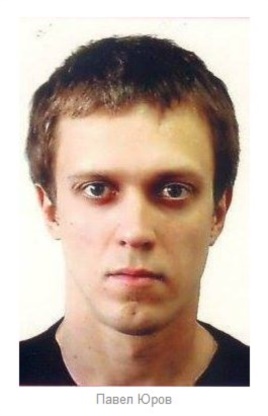
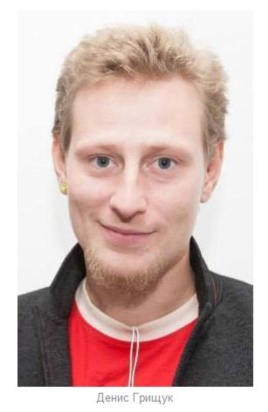
The Kyiv theatre director Pavel Yurov and artist Denis Hryschuk spent 70 days in Sloviansk as hostages of the separatists commanded by Igor Strelkov.

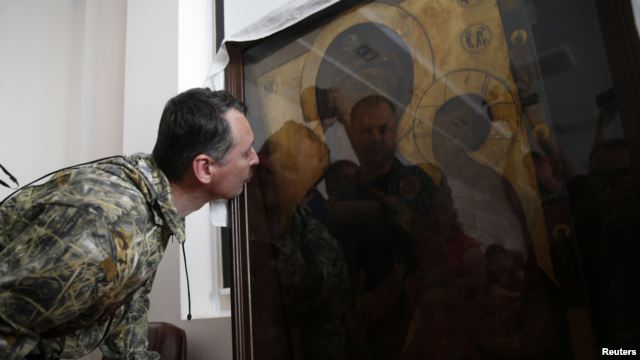
Igor Strelkov kissing icon, July 10, 2014
Pavel is a native of Antratsyt in Luhansk oblast, Denis was born in Donetsk. On 25 April en route from Donetsk to Kyiv they decided to have a look at Sloviansk and see what was going on in the town which the separatists had captured. After a careless word they captured by Ponomerev’s henchmen, who was the “people’s mayor” at that time (Strelkov was to arrest him later), they were dragged off to the captured SBU (Ukraine Security Service) and beaten. Pavel and Denis stayed in the SBU basement, and then the City Police detention center, until Ukrainian troops liberated Sloviansk. Nothing was known of their fate for all this time. Various Russian theatre personalities, Evgenij Mironov, Ksenija Rappoport, Aleksandr Kaljagin, Valerij Fokin, Mihail Porechenkov and Kirill Serebrennikov wrote a letter asking for their release, but like many other letters it received no answer. Pavel and Denis are now in Kyiv undergoing a course of psychological rehabilitation and are recovering their health. Pavel will have an operation, they broke his nose in the SBU basement.
Pavel Yurov and Denis Hryschuk told Radio Svoboda how a short trip to Sloviansk turned into a two month nightmare.
Denis Hryschuk: It all started in a café where we stopped to eat. There were journalists and local people there. We were looking at the news on our tablet and a woman asked us what news there was. We answered her. We might have said something, but our support for a united Ukraine came out, I do not remember. They started to call us Banderites. We showed them our passports and said that we were residents of the region. They said we had bought them, they shouted at us. We left. After three hundred metres we were stopped by armed people who said that we are arrested on the orders of the mayor and they took us to the SBU. The kept us at the SBU, in the basement, and then took us to the remand centre.
Did they suspect that you, like everyone, were Right Sector members, or some sort of spies from Kyiv? Did they interrogate you often?
Denis Hryschuk: They used different names: “Right Sector,” Maidan coordinator. They found that I had a video with the Maidan when it was just starting, in November and December. They found one contact in my telephone from the Kharkiv Euromaidan, that really worried them. They were seeing spies in everyone. They even suspected their own. There are enemies everywhere, pravoseki [Right Sector supporters], Maidanites and now Banderites are coming, they are going for everyone. They interrogated me once on 26 April and I told them everything that I knew. They went to check their information, obviously they did not find anything. They did not ask me anything more.
Did they not let you contact your relatives? Why not? Was it just cruelty or did they have their reasons?
Denis Hryschuk: No, they did not yield on this issue. We asked them several times if we could call someone and they said we could not: some people can, but you cannot.
Pavel Yurov: On the third or fourth days we wanted to send a letter to our friends: we gave one of them a telephone number so that our friends could tell our relatives that we are all right and that we are at the SBU. The guards thought about it then beat us up for 12 hours. They thought up lots of espionage horrors and games. Someone was worried that we really were in touch with someone and that we could give them some information.
Was that when they broke your nose?
Pavel Yurov: They broke my nose when they hit me the first time, when they took us into the SBU, they started to make a list of my things, and I got one on the nose. I started bleeding, I went into shock. They then took us into a garage, they hit and kicked us in the head, on the body. They cut Denis’ arm, I don’t know if it was an accident or not. They called some sort of male nurse, he treated the arm with some peroxide but also hit him in the ribs. They put gauze in my nose to stop it bleeding and continued kicking me in the back. They intimidated us in all sorts of ways: they joked about cutting my ears off. They said that some Gogi would come and rape us, they pretended they wanted to take our trousers off. That was the same evening when they captured us and then took us into the basement. Then, when we wanted to pass a note: this was the change [of guard] for one comrade-sadist who came every 15 minutes and beat us with a truncheon around the shoulders, the sides, the ribs and the knees. And the rest of the time I got one or two beatings a week around the body as a precaution. One the men that arrested us came down in the basement and noticing our familiar face he seemed to think are you still here? You’re going to get it. When there was fighting around Sloviansk on 4 May, one of them dropped in and started shouting that his commander had been killed today, he started to beat us up, there was someone from the Dnepr Battalion, they beat him up very badly. They beat him so much that he even soiled himself, he did not ask to go to the toilet. They beat up another person, from Svoboda [party]. I just lay and shivered and he hit me in the ribs. Twice, just to make sure.
Were you allowed to speak to the jailers, did they speak with you?
Denis Hryschuk: Yes, we did talk to the people who were guarding us. They used us for all the daily work. Pasha and I brought them food, cleared up the SBU area, then in the detention centre we painted the windows, cleaned the floors or the cell. Some of them even said to us: we know that you are not here for any reason, but you have to stay here.
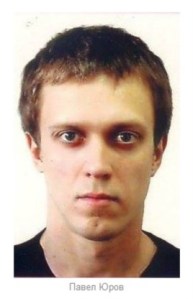
Pavel Yurov
Pavel Yurov: This whole story reminds me very much of a theatre. That’s the same Strelkov who arranged reconstructions of previous wars. The guys who came to us in the assault battalion [who were used] as “cannon fodder” said that they were digging trenches, fortifications or something to give the impression of military activity. Trenches and fortifications as such cannot give defense and help in a war. Being on the inside we saw the other side of this terrible theatre which was shown to hostages. We called it the “not freely convertible Donbas currency,” that is, people who could be exchanged for something, who could be used as a shield, and be of use to you in a difficult situation. The usual people participating in this movement are scum, trash, hoods, ex cops, soldiers and drug addicts. I suspect that some Russians are leading them officially or unofficially. Although we had no direct contact and I did not hear any Russian spoken: usually they were local people. Many women were sympathetic to them at that time. Their main asset in this movement is the ignorance of the region and the ignorant people there and their inability to critically analyze information.
You said they use heavy drugs. Did they inject themselves right in front of you?
Pavel Yurov: I saw people who were obviously out of it. We saw syringes with methamphetamine, all the ingredients for preparing a fix. I think that the rear guard used it because they had nothing to do, and those who went out on all sorts of sorties, played a kind of counter strike when one moves and thinks one has several lives and then runs with it. They looted as much as they could, they kept their power and when they were encircled, they ran away.
Who else was there with you?
Pavel Yurov: They detained people who just went by in a car, people who had come to support the militia, but they were missing some documents, some were drunk and they detained them as suspicious. On our right there was some sort of criminal authority from Artemovsk and on the left a local Sloviansk business oligarch. A drunken priest was there who they took at the barricade with what looked like two thousand in stolen money. An American Hari Krishna was there who chanted mantras every day. There were militiamen there. When they took us to the SBU after two weeks they detained the person who had escorted us from the SBU, that is one of the guards, and he was detained until we were released. Ordinary citizens were detained there as well. They captured one woman who was in a car and had been photographing something. This is what they did not like more than anything else, they detained this woman who had two passports, Russian and Ukraine, she was hysterical for a whole week, screaming and hitting the door and walls with a plate. It seems that they finally took her to Donetsk to some sort of mental hospital. Soldiers from the Ukrainian army were there whom they had captured in the conflict zone. Journalists were detained: Journalists from RIA Novosti [News], Russia Today and Ukrainian journalists were there. The journalist Sergey Lefter was also in the SBU basement.
Denis Hryschuk: With us [there also] was even Igor Oprya, a student from Krasnyi Liman, who was on his way to his parents for a holiday, he went past the SBU and they arrested him on May 2nd and he was released with us. They also held Vyachslav Malanchuk from Svoboda. The previous mayor of Sloviansk, the one before Nellie Shtepa, Valentin Rybachuk, he was also opposite us, they demanded a ransom for him.
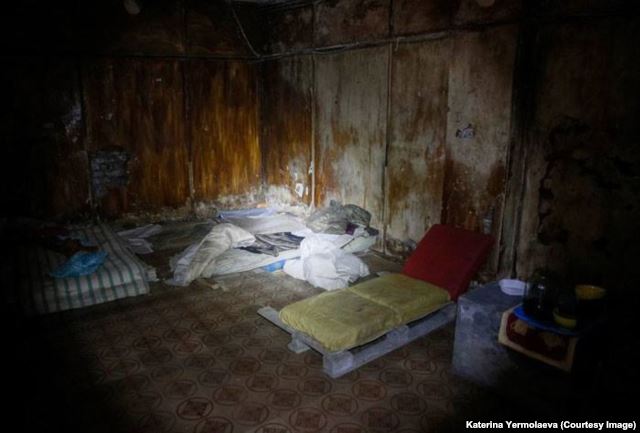
The SBU basement in Sloviansk where separatists held prisoners
Did they put the People’s Mayor Ponomarev with you when they arrested him?
Denis Hryschuk: No, they kept him at the police station across the road.
And where was Nellie Shtepa kept?
Denis Hryschuk: At the city council, that is what they told us. The result was a mayoral triangle, an ex mayor in every building.
That is like in Stalin’s times: the executioner could become a victim at any minute…
Pavel Yurov: Yes. Everyone is pursuing his personal ends: some people steal, someone play Robin Hood and settle accounts with some people.
Did you notice the power change when the separatists got rid of Ponomarev?
Denis Hryschuk: We were not informed of what was happening outside our cell, at the government center; very little information came to use so we did not know about the change. We only knew who they had chosen as president and they told us when there was a truce.
Pavel Yurov: I noticed their change of mood when the pro Russian referendum was messed up, when Russia got angry with them, then they lost confidence in their strength and started to make up even more fantastic stories. A guard came up to us and said that Ukraine did not exist any more and that their tanks had reached Kyiv and Lviv. One spetz (this is what they called their officers) said that he gave Kyiv three days. But they were more on edge than before. Although in theory this was the contingent that operated on the principle of losing nothing. They kept stealing until the last moment but ran away on July 4. The generator worked until the end, the oil ran out, the light went off, all was silent and dark. Then I understood that Yanukovich’s escape was also not a precedent because they were doing exactly the same thing. They looted as much as they could, they kept their power and when they were encircled, they ran away. Yanukovich did the same thing: he kept stealing until the last, and he ran away when they closed in on him. Although they were also against Yanukovich. Strangely enough they confirmed that they wanted him to be replaced democratically. Obviously that is their mentality, he is the king pin, even if we don’t like it, he is still the king pin. He had to be killed and you yourself become the top dog, I don’t know what sort of plans they had in mind. There were also sorts of convict mentality ideas about how to conduct their internal policy.
And Putin is perceived as the godfather?
Pavel Yurov: After that failure our guard who was in charge of the detainees first in the SBU, then in the government offices also came out against Putin. At one point he started saying that there are no Russians, Ukrainians, Belorussians, there is one people, the Slavs and there should be a Slav world. There is a nationalist junta in Kyiv, bastards, and traitors in Russia and Moscow. But we will build Novorossiya from here, from pole to pole. I tried a long time to understand how he saw this politically and economically. But you do not discuss things in detail with a man who is carrying a pistol under his armpit and who locks your cell.
When Russia abandoned them they stopped believing in their strength.
There were people who had been coerced, who had to work there. Cooks, for example, who made our food, they kept them there as well. Or the lads who peeled potatoes or carried the pots and pans, they also detained them there as hostages like us. Again there was the “cannon fodder” [the assault battalion] where they sent some people to dig fortifications around Sloviansk and the fortifications for the mortars. Three days before they left I washed this one lad’s blood off his feet and cleaned the blood off the floors. The 25 year old from Sloviansk was sitting at home when the militants came to him and said: join the militia. He said: I’m not coming. They shot him in the leg and took him off to prison. When people refused to volunteer to die under the bombs this is what they did.
On what basis did they separate the detainees and the disciplinary battalion?

Dennis Hryschuk
Denis Hryschuk: At first they detained everyone, put them in cells, they took them out because they decided on the level of their guilt, as they said. They sent them to the assault battalion for 10, 20, 30 days or indefinitely. They could go out into the courtyard, they were not prohibited from going into the closed space. But they were still detained, they did not have much freedom.
Many were let go after a couple of days, but you were in prison almost the longest, for 70 days. Why were you the ones they did not want to let go?
Pavel Yurov: The point is that everyone was supporting us. Ukrainians, the SBU had made some agreements and the local Donetsk powers had also tried to reach an agreement through the Russians, there was a letter from Russian cultural figures, my actor friends were talking with colleagues from Moscow and were also trying to come to some sort of agreement. And these guys who were holding us just did not understand our value. These guys don’t represent anything themselves and everyone signs signatures for them and they don’t know how much they are worth. So they kept us till last. In June they wanted to exchange us for some sort of humanitarian aid, but this did not come about. These paramilitary groups work autonomously and each one decides what it will do. This makes the situation more complicated, there is not a united army, or a single movement but the babble of chaotic conflagration.
What was the most frightening thing during these 70 days?
Denis Hryschuk: The worst thing was to realize how much trouble I have caused and worry for my friends and your relatives.
Pavel Yurov: The worst moment for me was in the basement when I came out of the initial shock and started to watch what was happening. I understood that this was a unique experience, as a human being and as a producer. I tried to remember and follow some dialogues, situations, scenarios, collisions of wills, conflicts. And the most frightening moment was when the thought came to me: suppose you never get to tell anyone about this. Logically I felt no one was going to shoot me for any reason, although many shouted that they would, but these were unsupervised people and each one had a firearm. It was completely unclear what might happen. But when they beat us up for a long time I thought that they might actually kill us. But the last ten days – two weeks when we were in the government office before our release a nurse came every morning to check our health.

Picket in support of Paul and Dennis Yurova Hryschuk in front of the SBU in Kyiv, May 28, 2014
How were the last days of captivity and how did they free you?
Denis Hryschuk: They told Pasha and I that we were not going into the assault battalion, that we were only for exchange and were not going to be running around under fire. They took Igor and Yaroslav out of our cell, they were bombed as they dug fortifications. On July 4 they said that the ATO had already entered the city and that troops would soon be in Sloviansk. After exactly six hours the warders got together very quickly. They closed all the cells, windows for ventilation, it was very stuffy in the cells. After 20 minutes we heard the cars leaving the government offices. And then at one o’clock in the morning a local Sloviansk oligarch opened the cell. They called him an oligarch, he had his own business and had been detained with us for two months. He opened the door and said: they had run away, we had to get out of the building because there might be an attack. We had the keys because we gave out food and it was possible to hang onto the keys to the cells. We let all the detainees out, we let out 40 odd battalion members and left the building. We contacted Kyiv, they put us in touch with the ATO leadership and they told us where to go and where they would collect us. The Ukrainian troops came in the morning and sent us to the checkpoint, then to Izium, then Kharkiv, and then to Kyiv.

In the City Council of Sloviansk, the former headquarters of the separatists, after it was liberated by Ukrainian troops.
Is an investigation ongoing now, did they interrogate you in the SBU?
Denish Hryschuk: We testified immediately after our release while still at Izium. They have not called us to the SBU yet. We are working with human rights advocates who are bringing a case against Russia in the European court of human rights. We are still coming round, we are getting better and trying to get used to our surrounding world because it is more difficult to adapt here than there.
Pavel Yurov: I am not yet familiar with the action but I am happy that there will be international proceedings. Then this will have a positive effect on European integration. The more legal procedures we carry out together with Europe, the further we will be from Russia.
Do you think that Russia is the main culprit?
Denish Hryschuk: I think everyone is to blame. It is not possible to apportion blame categorically, Russia, oligarchs, Banderites or eastern Ukraine, everyone is to blame. I think we are to blame for letting it get to the point that our society had such a division that there was a reason for people to take up arms.
What would you wish for these people who kept you in captivity?
Denis Hryschuk: Let them leave us alone in peace, let them go home and not be involved this sort of thing again.
Did the “Stockholm syndrome” not arise, when a captives starts to sympathize with the terrorists?
Denis Hryschuk: No. Absolutely not. We also thought about that several times when we were there and after we came back. No, we did not get that syndrome, I don’t know if that is good or bad, but we didn’t get it.
Are you prepared to forgive them?
Denis Hryschuk: I forgave them long ago. We thought a lot, we talked about God, we prayed a lot, did a lot of psychoanalysis, we tried to understand why we were here and what it was for. It helped us cope or adjust to that reality, to work on ourselves.
Take away their “Donbass feeds the whole country” or the Russian flag, national anthem and all that pathos, and they will have to face up to the fact that they are living in poverty.
Pavel Yurov: The first month I wanted to drop napalm on them all. I was so furious, angry and helpless. Then I changed my opinions and in the end read the New Testament from beginning to end and took it seriously. It works out like this, and I have been thinking about this in recent days, that under the influence of narcotic substances and the rush of the struggle for fairness, these people created an irrational unconscious field for victims to fall, us, who were afraid of death and thought that it would all soon be over. In this irrational field there was some contact and the guards and militants developed their individual approaches to each person. And we all got it in the neck not just for being pravosek (Right Sector) or whatever, but for our relation to life and our own transgressions. I understood this personally and saw the possibility of finding something higher so as not to go crazy, not to despair and give into panic but stay sane and healthy. So I don’t think you can punish one person for it all, it has to be case by case at least. Obviously, imprisonment is needed for the most serious supporters. But many of them need psychiatric help, rehabilitation centres for drug users and such things.
How do you think the war will end?
Denis Hryschuk: I think Ukraine will win this confrontation, we will remain one integral state and somehow we will understand it all. It will not last long if there is no open opposition from Russia.
What do you think the future of Eastern Ukraine will be like?
Pavel Yurov: The problem is that it is a pro-Russian region, at the expense of its industry which was focused mainly on the Russian market due to the fear of the people who live there. I have not lived there for 17 years, it is easier for me, although I feel that a lot of what is happening there is happening to me personally. Fear of freedom of choice, there is no top dog to tell me what to say or do. This is a difficult time for this area. Hence their pride and narcissism, take from them their “Donbas feeds the whole country,” or their Russian flag, anthem and all this pathos and they would have to admit that they live in poverty, and that mentally, it’s not they haven’t developed but they do not use their full potential. They think very inflexibly: either stability for ever, or instability for ever. That is why they do not think that they could learn something or change their lives. There is very scant interest in what happens elsewhere, outside their region. In March I was at a round table for miners’ issues, there one of the union representatives said that this was a technocentric region. Production was the most important, that they needed a five year plan, manufacturing standards, this was the most important for a proper life. People were resigned to this. It turns out that a ton of coal was more important than a human life, but this is not right and it cannot be this way. Again this is the Wild West, or in our case the Wild East, the region where many convicts were sent and if they died in the mines no one was going to be particularly sorry about it. That is why I would like to see a competent and effective social and cultural policy in Ukraine, and in particular in this region. I would like to remove all monuments of Lenin, all these signs and street names like “50th anniversary of the USSR” and make a local and common Ukrainian Cultural Foundation, a cultural base. I have wanted to make a show or film about the mines for a long time. People are still working there and dying, but they feel that they are nonentities, though they should feel like heroes. And their heroism ultimately rests on the fact that they have just a bit more money for living than other people. But it seems to me that there is an opportunity to change something.
You said that as a film producer you were watching the guards. Could you use your experience of imprisonment for a theatrical piece?
Pavel Yurov: Of course, there are different thoughts. I am not in a hurry, I am adapting to normal life, I am getting used to being able to move around freely, talk freely and that for this nothing will happen to me. But I have enough material for the theatre, a film, writing and for contemporary art. I will try to do something with this. God-willing, something will come of it.
[AUDIO] Pavel Yurov talks about Sloviansk prison in the “Results of the week”
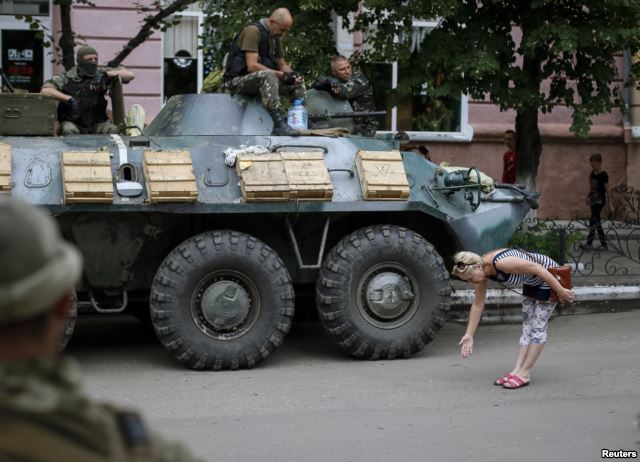
A resident of Sloviansk welcomes Ukrainian soldiers, 15 July 2014
Source: Svoboda
 By Borys Humenyuk, OUN Battalion





 Voices of Ukraine