Dmitry Tymchuk, Head of the Center for Military and Political Research, Coordinator of the Information Resistancegroup, Member of Parliament (People’s Front) 05.24.2016 Translated and edited by Voices of Ukraine
(See end of post for acronym glossary)
Operational data from Information Resistance:
Russian-terrorist troops in Donbas continue shelling Ukrainian troop positions and settlements. During the past 24 hours, terrorists used 82- and 120 mm mortars, as well as BMP-2 and BTR-80 armored vehicles in addition to small arms. The enemy continues to actively use UAVs for the reconnaissance of the tactical zone, and of parts of the operational-tactical zone.
Avdiivka, May 22, 2016. Photo: Hromadske Radio
Militant tactical groups operated in the vicinity of Avdiivka; sniper fire, heavy grenade launchers, and 82 mm mortars were used from positions near the bridge at the Yasynuvata Junction and south of the traffic police station. In the area of Mar’inka, militants used sniper groups and 82 mm mortars from their positions in the Petrovskyi district of Donetsk. Militants deployed 120 mm mortars from positions north and west of the Oktyabr village, firing on the ATO forces’ strongholds and observation points in the vicinity of Pyshchevyk and Pavlopil. Terrorist strike groups (SPG-9M and ZU-23-2) fired heavily on the ATO forces’ positions near Berezove from positions north of Dokuchajevsk and near the settlement of Yasne. Active militant shellings from small arms and AGS-17’s were detected in the areas of Schastia, Sokilnyky, Trokhizbenka, Talakivka, and Shyrokyne.
Russian-terrorist forces are [currently] deploying an additional command center in the Svitlodarsk direction of operations (in the area of Kalynivka – Vuhlehirsk). The command center is advanced directly to the front line.
In the area of Slovyanoserbsk, we spotted a “roaming” militant mortar unit, using 2B9 automatic 82 mm mortars and at least two 120 mm mortars. This unit’s mortar detachments are highly trained.
Two 2S1 “Gvozdika” 122 mm self-propelled guns and four cargo trucks were observed moving through Yenakijeve to the southern direction of operations; four more self-propelled guns were transferred in the same direction, northwest of Makiivka. These self-propelled guns were a part of the artillery group that had previously shelled Avdiivka and its industrial zone.
Eight railway cars with ammunition and equipment arrived in Debaltseve from Russia, as well as six platforms with wheeled armored vehicles (APCs). The armored vehicles were unloaded with the help of ramps outside the station.
The “DNR” uses militant-controlled media and social networks to carry out another information campaign to discredit Ukrainian troops, alleging that confrontations between the Ukrainian Armed Forces and “right-wing, nationalist armed groups” representing “volunteer battalions” are observed in the ATO area. According to the disseminated information, at least 80 servicemen of the Ukrainian Armed Forces died at the hands of “nationalists.” Moreover, undisclosed operational reports of the “DNR military intelligence” also contain this information, stating that “particularly violent confrontations are observed between Ukrainian airborne forces and nationalists.” Militant “military intelligence” and propagandists are not perturbed by the fact that the “volunteer battalions” which appear in their messages have long joined the Armed Forces and other Ukrainian armed groups.
Food products from Ukraine-controlled territories started appearing in stores and shopping centers of the “DNR” on a large scale (mainly dairy products, canned fish and meat, dressings like mayonnaise and ketchup, as well as beer) – all without Ukrainian excise stamps. According to IR data, the main smuggling route was organized in the Volnovakha area, with assistance from Ukrainian officials.
In Horlivka, so-called “medicine runs” are gaining popularity with local residents who travel to Bakhmut (formerly Artemivsk) and other settlements in the Ukraine-controlled territories to purchase medications. Given the scarcity of medications in the “DNR,” “DNR” officials from the entourage of Alexander Zakharchenko are attempting to establish contraband channels to supply Ukrainian-made medications to the occupied areas.
Dmitry Tymchuk, Head of the Center for Military and Political Research, Coordinator of the Information Resistancegroup, Member of Parliament (People’s Front) 05.20.2016 Translated and edited by Voices of Ukraine
(See end of post for acronym glossary)
Operational data from Information Resistance:
Russian-terrorist forces remain active in Donbas, firing along almost all sections of the demarcation line, most of all in the area of Avdiivka and its suburbs (including Opytne); near the Butovka Mine ventilation shaft; south of Luhanske; in the vicinity of Novotroitske and Berezove; along the Zaitseve–Mayorsk strip; and in the coastal direction of operations.
In the Avdiivka area, terrorists shelled the ATO forces’ advanced units from a position east of the Yasynuvata Junction using 120 mm mortars, following an earlier shelling of the “industrial zone” with 122 mm artillery from the direction of the Mineralne–Yakovlivka line. During daytime, militants fired 82 mm mortars from several positions, while two sniper groups operated in the same area (with large-caliber sniper rifles).
Near Novotroitske, the enemy used automatic 82 mm mortars and sniper fire from the southern waste mound (outskirts of Dokuchajevsk).
From the southern part of Staromykhailivka, a pair of militant BMP-2’s targeted the ATO forces’ positions east of Krasnohorivka station (near Geologicheskaya Street), firing mainly from their on-board 30 mm automatic cannons.
Near Stanytsia Luhanska, a militant grenade launcher group was observed; heavy machine gun fire was also recorded.
Recently, the enemy’s actions have observed the following specifics:
• sharply increased sniper activity;
• repeated attempts by small militant groups to covertly approach the ATO forces’ positions in order to suddenly open fire (detecting their approach is made more difficult by the “vegetation”); in all cases, shooting comes with the aid of covering fire (mainly from AGS-17’s, heavy machine guns and mortars);
• enhanced coordination between terrorist units (the obvious benefits of extensive training and exercises in combat coordination organised in the militant “training centers” in Donbas during February and April of this year);
• active reconnaissance (by DRGs, UAVs, and radio intelligence) of the ATO forces’ front edge and tactical rear, as well as multiple attempts to scout the Ukrainian troops’ operational and tactical rear using DRGs and UAVs (in the latter case, militants are primarily interested in the locations of combat equipment, command points, and fuel and ammunition storage sites);
• DRGs staffed by the Russian Special Forces appeared simultaneously in several sections. These are professionally trained groups arriving from Russia in the course of rotation of the regular Russian Federation Armed Forces units in Donbas. Their task at this stage is to “learn the lay of the land”;
• militants are gradually moving heavy weaponry closer to the front again. Terrorist tanks have been spotted on several sections of the front simultaneously (for the moment, in small groups of 2-3), while the presence of 122 mm and 152 mm towed artillery systems and self-propelled guns has been noted in several directions of operation (for now, in “scattered” battery formations of 4-6 systems and guns). There is no doubt that militant use of cannon artillery at this stage mainly serves two purposes – preparatory artillery fire and “running-in” the new reinforcements in artillery details;
Increased discontent has been noted in several units of the “1st DNR AC,” specifically among local militant “personnel” used in clashes and armed provocations against Ukrainian troops. Local militants are unhappy with the “multi-layered cake” configuration for Russian-terrorist forces’ combat formations used by the Russian command on a number of sections of the front. Units manned by local militants with poor combat training, as well as by mercenaries under disciplinary sanctions (essentially, “cannon fodder”) are brought directly up to the front line and engaged in combat. The second line consists of local militants who received a relatively high level of training from Russian instructors, led by the latter; as well as Russian mercenaries trained in Russia. The third line consists of Russian Federation armed forces units.
Displaying little concern for camouflage now, militants are moving heavy armor, forbidden under the Minsk agreements, in close proximity to the front line. South of the Putylivka neighborhood (Donetsk) a battery of 152 mm “Msta-B” howitzers was transferred on trailers hauled by Kamaz trucks (6 guns); near the Donetsk International Airport (DAP), four terrorist “Gvozdika” 2S1 122-mm self-propelled guns were spotted travelling to the southern direction of operations.
In the Proletarskyi district of Donetsk, we observed the transfer of up to 5 “Kamaz” trucks with military personnel, bearing insignia of a red star in a circle. Until now, no such insignia has been seen on representatives of Russian-terrorist forces units.
A large group of militants (about 300 persons) from the local Donbas population, previously members of armed gangs of the “1st DNR AC” (mainly riflemen and sappers), have been sent from Khartsyzk (Donetsk oblast) to the training base of the GRU of the General Staff of the Russian Federation Armed Forces near Saint Petersburg (Russian Federation). The militants wore Russian-issue fatigues with an insignia depicting a dark-green flag with two ribbons (light green and light red in color), and an inscription in Armenian across the width of the flag. According to information from militant circles, the group will be trained in the GRU base on Russian Federation territory “under the patronage” of a private-sector military company, and afterwards participate in the hostilities in Nagorno-Karabakh. This group was transported on board of “Ural” automobiles with tactical markings “55” and “23.”
Following the “LNR’s” example, the “DNR” launched a large-scale hunt for “Ukrainian spies and saboteurs of the Special Operations Forces and SBU.” According to the information possessed by the “DNR MGB,” a formidable Ukrainian sabotage and intelligence network is at work in Donetsk and Horlivka. The directors of the militant “state security” administration have tasked units under their control to urgently develop and implement “a plan of action to identify and neutralize” Ukrainian saboteurs. Particular attention should be paid to the governing bodies of local housing and utilities services, allegedly rife with “spies.” Mass searches have also been ordered in residential and business premises, looking for secret caches of weapons and explosives. Rumors are circulating among rank and file “DNR MGB” employees from the local population that the “DNR” leadership and Russian “supervisors” are using these searches to identify targets for subsequent “expropriation.”
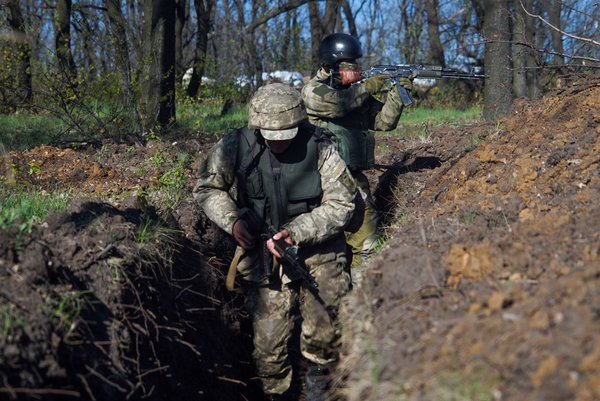
Ukrainian military servicemen control their position outside Avdiivka, eastern Ukraine, Saturday, April 16, 2016. Photo: AP
Dmitry Tymchuk, Head of the Center for Military and Political Research, Coordinator of the Information Resistancegroup, Member of Parliament (People’s Front) 05.17.2016 Translated and edited by Voices of Ukraine
(See end of post for acronym glossary)
Operational data from Information Resistance:
During the past two days the Russian-terrorists forces in Donbas sharply increased their activity, deploying cannon artillery (122 mm) as well as heavy armor (tanks) for shelling. The situation was aggravated along almost the entire demarcation line. In addition to this, militants continue their active reconnaissance of ATO forces’ combat positions both at the front and in tactical depths, actively using DRGs and “small” infantry groups.
Terrorists deployed six 122 mm D-30A guns and 4 tanks in the heavy shelling from positions north of Yasynovskiy Lane [Avdiivka] and south of the Yasynuvata Junction, firing on the Ukrainian forces’ positions around Avdiivka‘s “industrial zone,” near Soborna Street, and near the parkland southwest of Avdiivka. During the course of the shelling, militants used a tank “carousel” (mainly using HE projectiles) to shell the ATO forces’ advanced positions; some sixty 122 mm shells were also fired.
Avdiivka’s “industrial zone”. Photo by Roman Drapak
Around the area of Opytne, in the vicinity of positions located near the lakes Khutor and Kooperatyvnyy, Ukrainian battlefield security discovered an enemy infantry group of to 12 personnel, which had secretly infiltrated the neutral zone from the direction of Spartak and tried to shell the ATO forces’ positions from small arms and grenade launchers. After the resulting clash, terrorists were forced to retreat to their original positions under covering fire from AGS-17’s and 82 mm mortars.
In the areas of Mariinka, Pisky, and Krasnohorivka, the enemy actively fired from small arms and heavy machine guns, and deployed sniper groups.
South of Donetsk (vicinity of Novotroitske, Berezove, Hranitne), militants used mortars and the use of a ZU-23-2 was also recorded.
In the vicinity of Schastia, Stanytsia Luhanska, and on the Trokhizbenka – Sokilnyki stretch, militants attempted using small infantry firing squads to shell the ATO forces’ advanced positions from small arms and anti-personnel grenade launchers (both underbarrel and stand-mounted). In the area of Luhanske, the enemy used SPG-9M’s twice, and mortar fire came from the direction of enemy positions northeast of Nyzhnje Lozove (mostly 82 mm, as well as several hits from 120 mm).
The “2nd LNR AC” continues receiving personnel reinforcements in the area from Zholobok to the salient near Schastia-Stanytsia Luhanska; militant rotation is also noted in the vicinity of Krymske (a new unit of up to 100 personnel has arrived here).
Militants are actively replenishing ammunition stocks in the 3rd independent motorized rifle brigade (OMSBR) in Horlivka, and in the units in the Petrovskiy district of Donetsk. Two tank companies are present here, on camouflaged positions southeast of Yakovlivka and near Putylivka (Donetsk).
Militant artillery is present in the area east and southeast of Yasynuvata: 122 mm and 152 mm caliber systems (mostly D-30A and “Msta-B”), for a total of a 3-battery mixed division (16 guns), as well as at least six 122-mm SAU 2C1 “Gvozdika” units in the area of Yakovlivka – Mineralne.
“Supervisors” from the General Staff of the Russian Armed Forces are continuing inspections in a number of units of the “1st DNR AC,” checking combat readiness and the state of arms and military equipment. The inspection of the 3rd and 7th OMSBR’s assessed their current state as “generally satisfactory,” while recommending supplementary armament and re-equipment of a number of these brigades’ units.
Russian sappers have arrived at a militant base located on the territory of a brickworks (western edge of Donetsk, the area of the Trudovskaya Mine). Their aim is to lay as many mines as possible on the approaches to their positions from the side of the Ukrainian forces (north and northeast of the factory). The mines are laid as follows: the first row consists of MON-50 directional anti-personnel claymores without remote detonation, laid as far away from terrorists’ own positions as possible; the second row, closer to terrorists’ positions, consists of MON-50 mines with remote controlled detonation, and anti-tank mines.
In the area of Donetsk, militant self-propelled artillery and armor (self-propelled artillery and APCs, some 20 units in total) were seen transferring to the facilities of the “Tochmash” factory (in the Kyivskyi district of Donetsk). The equipment was moved in small batches of 2-3 units at a time.
The “DNR police” has started a “purge of the ranks” (so far, in several district offices) that will entail a significant “staff reformatting.” The process was initiated by the command of the “DNR Ministry of State Security (MGB),” which stated that the terrorists’ “law enforcement” ranks are “polluted by pro-Ukrainian elements.” In reality, this change is meant to replace local “police officials” who had established drug trafficking and the supply of “live goods” (prostitutes) to the Russian Federation (mostly to the North Caucasus regions), with “specialists” arriving from Russia. Thus, the “DNR” is carrying out a redistribution of its criminal market disguised as a “clean-up.”
Information is circulating among the unit commanders of the “1st DNR AC” holding positions south of Donetsk about provocations “involving mass civilian casualties” allegedly being prepared “by the Special Services of Ukraine (SSO)” together with units of the 14th OMBR of the Ukrainian Armed Forces.” The relevant reports also feature an unknown “unmarked plane” which the Ukrainian Armed Forces are supposedly planning to use to deploy chemical weapons; the reports also mention intensified electronic intelligence on the part of the Ukrainian troops. It is possible that the leadership of the “1st DNR AC” are disseminating information to prepare for provocations with civilian casualties that will be subsequently blamed on the Ukrainian Armed Forces.
After the insane statement by the DNR leader Alexander Zakharchenko, who said that the OSCE police mission monitors would be shot on sight if such a mission were to start, the “DNR MGB” and the “LNR MGB” were tasked with “finding” a number of “Ukrainian spies and saboteurs” in the occupied territories who have been allegedly trained by US instructors. Such “saboteurs” must admit to intentions to “bomb coal mines” and to “destroy OSCE inspectors.”
In Luhansk, the “LNR MGB” staff are actively searching for “Ukrainian saboteurs’ secret warehouses.” According to the “MGB’s operational data,” a “Ukrainian subversive network” is being deployed in “LNR”-controlled areas, and numerous secret caches of weapons and explosives have already been established for its needs.
By Nadiya Savchenko, filmed by TSN, original video by TSN
05.25.2016 Transcript, translation and subtitles by Voices of Ukraine
Video with English subtitles (full transcript below)
Nadiya Savchenko:
First, you hear me out, journalists. First, get some respect for people’s personal space! I’m here straight from prison, so can you give me some room? Unless you want me to say something bad to you, clear a 3-meter circle around me!
Now please listen to me. I spent two years in jail. Back up! Have some respect for personal space! You won’t have any trouble hearing me!
I spent two years in solitary. I’ve become unaccustomed to people. So forgive me if I speak too harshly.
The first thing I want to say to you is: I’m free. I want to ask for forgiveness of every mother whose children did not come back, while I’m still alive. I want to ask for forgiveness of those mothers whose children are imprisoned, while I’m free.
I want to tell you: I can’t bring back the dead, but I’m ready to lay down my life once more, on the battlefield for Ukraine!
I will do everything possible to set free every child [of Ukraine] that is currently imprisoned.
All Ukrainian heroes must not die! Having dead heroes is very convenient! And when they’re alive, it’s bad for everyone! But we will live! And heroes will be in the Verkhovna Rada of Ukraine!
The Verkhovna Rada of Ukraine will be made up of heroes, unlike the Russian Duma, and they will earn glory for Ukraine, and the gratitude of the Ukrainian people. Our Verkhovna Rada will consist of people who are worthy of it!
Here in Ukraine, we will build a life of human worth and dignity! I will be honest with you – I don’t know how to accomplish this. I won’t promise you it will happen tomorrow.
But I will tell you that I am ready to die, every second, to make this happen! And this WILL happen!
Thank you, all the people. For fighting for me, and for everyone else, as well. I might be the first, but if you fought for me, you fought for every Ukrainian, who will be free!
Had people not talked about me, the politicians would’ve been silent forever!
So I thank all the people. Thank you all!
I want to thank those who wished me well – I survived because of you!
I want to thank those who wished me ill – because I survived to spite you!
And I want to thank those who didn’t care – thank you for not getting in my way!
“Then on what basis did they arrive at their decision?..”
By Anton Naumlyuk, journalist, especially for “Novaya Gazeta,” Grozny
05.19.2016 Translated and edited by Voices of Ukraine
Jury finds the Ukrainians Karpyuk and Klykh guilty of the murders of Russians in 1994
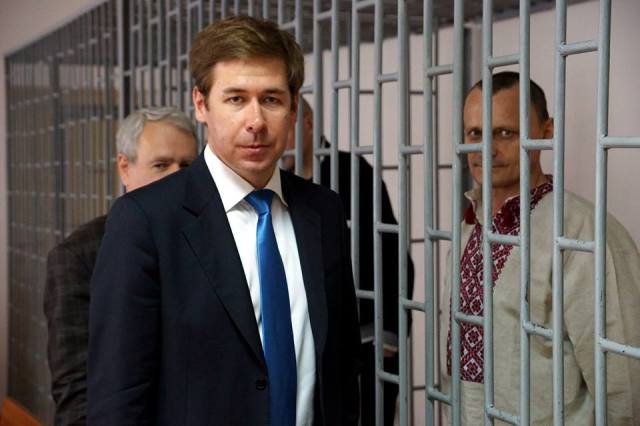
Karpyuk’s attorneys (from left) Dokka Itslaev and Ilya Novikov speaking to Mykola Karpyuk in court in Grozny. Photo: Anton Naumlyuk
Attorney Ilya Novikov calls Olena Karpyuk in Kyiv, turns on the speakerphone and holds the phone as if he is going to say something. Standing opposite from him, behind bars, is Nikolai Karpyuk, smiling shyly. You can hear a child’s voice [on the phone], his ten-year-old son Taras says: “Tato [daddy], I love you.” “I love you too” – replies Mykola, clutching the bars with his hands.
Mykola Karpyuk’s son and wife Olena (far left) celebrating Karpyuk’s birthday on Maidan in Kyiv, May 21, 2016 with Vira Savchenko, Oleg Mezentsev and other activists. Photo: social media
This phone call is for him. Mykola has not seen his family for almost two years, after being detained in Russia in the spring of 2014. The trial of Ukrainians Mykola Karpyuk and Stanislav Klykh is being held in the Supreme Court of the Chechen Republic, and has lasted for over eight months already. According to the investigators, in 1994, Karpyuk and Klykh, together with other members of the nationalist organization UNA-UNSO (now banned in Russia), flew into Tbilisi to enter Chechnya via “mountain passes and abandoned trails.”
The Ukrainians’ alleged purpose in Chechnya was to take part in the war against [Russian] federal forces on the side of Ichkeria. To this end, Karpyuk together with Oleksandr Muzychko, the brothers [Oleh and Andriy] Tyahnybok, and other members of the nationalist movement in Ukraine, allegedly created a paramilitary unit dubbed “Viking,” and fought as part of it, against federal troops.
According to the prosecution, during the storming of Grozny on December 31, 1994, they killed and wounded several dozen Russian soldiers.
“You will have to decide whether or not to believe the prosecution’s sole witness,” – Ilya Novikov, Karpyuk’s lawyer, told the jurors.
Indeed, due to a lack of other documentary evidence, the prosecution’s case was built on the testimony of Ukrainian Alexander Malofeyev, who has been sentenced for 24 years [in prison]. Before this, he was convicted of robbery, at least three times in Crimea and once in Russia. As of now, he is convicted of involvement in the Chechen war, including military operations in 1997.
According to Malofeyev, he was accepted into UNA-UNSO in 1991, which would have made him 15 years old at the time. In 1994, he came to Chechnya, where he fought with Karpyuk, Klykh, Muzychko and other nationalists. In 1997, he “fought in various parts of Chechnya.”
Mykola Karpyuk, dressed in a traditional vyshyvanka [embroidered shirt] for International Vyshyvanka Day on the day of his trial, May 19, 2016. Photo: Anton Naumlyuk
“When I asked Malofeyev where exactly he fought in Chechnya in January and February 1997, he said that fighting was all over Chechnya at the time. It is unclear where Malofeyev could have fought [in 1997], considering that the federal troops had been withdrawn from Chechnya in December 1996. If we go by Malofeyev’s testimony, then the so-called First Chechen War has not ended with the signing of the Khasavyurt Accord, but continued personally on Malofeyev’s account. Still, how did he find [federal] troops to fight in Chechnya [in 1997]?”- Karpyuk’s attorney Dokka Itslaev stated during the debate.
According to Malofeyev’s testimony, on December 31, 1994, Karpyuk and Klykh fought in Minutka Square [in Grozny], near the train station, and defended the Presidential Palace. They took captive Russian soldiers, tortured them, and raped them with a shovel handle.
Malofeev was not brought to [the trial in] Grozny, but appeared as the prosecution’s witness via video conference. He gave a very detailed account of the criminal world in Crimea, naming local criminal authorities, and willingly showing [prison and gang] tattoos all over his body. However, his testimony regarding the events in Chechnya was so vague that the lawyers declared, “We doubt that Malofeyev has ever been to Chechnya in the first place.”
Malofeyev’s stepfather and ex-wife confirmed this in court. Judge Vahit Ismailov, who presides over the case of Karpyuk and Klykh, requested Malofeev’s criminal case from Kerch. When the document arrived in the Supreme Court of the Chechen Republic, it became apparent that in 2000 Malofeyev was serving another sentence in Crimea, and not undergoing combat training in Salman Raduyev’s camps in the Vedeno district [as he had testified]. Prosecutor Sergei Blinnikov took an impressive leap of imagination to explain this apparent contradiction: he accused the SBU [Security Service of Ukraine] of falsifying the criminal case materials.
“He [Malofeev] did not serve a prison sentence. They had invented this legend in advance. That’s the bread and butter of all special services in the world,” – said Blinnikov. Some plainclothes men sitting in the courtroom exchanged understanding looks. Klykh’s lawyer Marina Dubrovin joked that now that the prosecutor declares Malofeyev’s conviction a legend, the latter may now appeal the Crimean court’s ruling.
Translator (far left) and lawyer Marina Dubrovnik (center). Photo: Anton Naumlyuk
In their final statement, the lawyers shared an analysis of the circumstances of the death and injuries of all 43 of the victims – soldiers of the Russian army who took part in the storming of Grozny on New Year’s.
“During the course of the trial, the death of ten soldiers has not been confirmed by evidence examined in the proceedings of this criminal case, and therefore, cannot be attributed to our clients,” concluded Marina Dubrovina. The deaths of the remaining [33] servicemen occurred on that day in different districts of Grozny – from the Presidential Palace to the village 13 km away from the center. Not a single person died that day on Minutka Square, because the fighting had not yet reached it.
“How could there have been war on Minutka Square on January 1st? There couldn’t have been any war there, because they [the troops] did not approach from that side. On January 1st, the war [fighting] was happening near the railway station, near the cannery, and in the Staropromyslovskiy district. They could not have fought their way through to Minutka Square. There could not have been any deceased soldiers on Minutka [Square]. They are likely to have died in the tanks and infantry fighting vehicles. It was only later that they began to press forward; fighting on Minutka Square began in late January,” I am told by a person who had participated in those events and was defending the Presidential Palace.
“The reality of the military operations in Abkhazia is that Ukrainians really did fight in Grozny, but there was no ‘Viking’ group,” says Ilya Novikov. “Still, these are two different statements: ‘Ukrainians fought there’ or ‘Karpyuk and Klyh fought there.’”
“Sashko Bilyi [Olexandr Muzychko],” tells journalist Aslanbek Dadaev, who was present in Grozny at the time. “But there were no combat units made up of Ukrainians. In fact, Bilyi and some Ukrainians together with him were unarmed. They went to repel the assault with knives and bayonets in hand. Only when he returned with the prisoner, did he take a weapon from him. There is also a video, where they interrogate this captive captain, shot by Belal Akhmadov who was later killed together with Maskhadov. The captain survived, and later, when there was a truce, he was inviting the militants to his wedding,” the journalist told me.
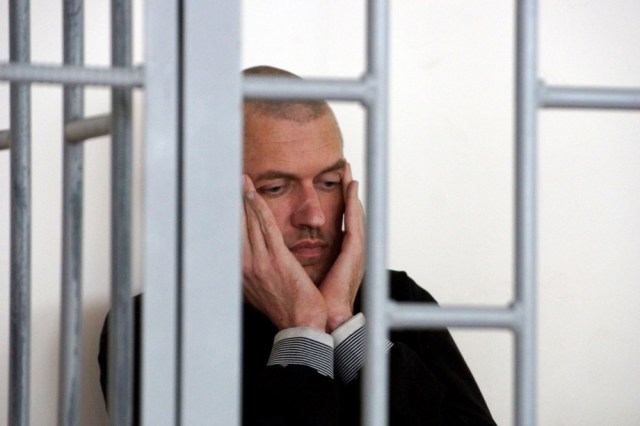
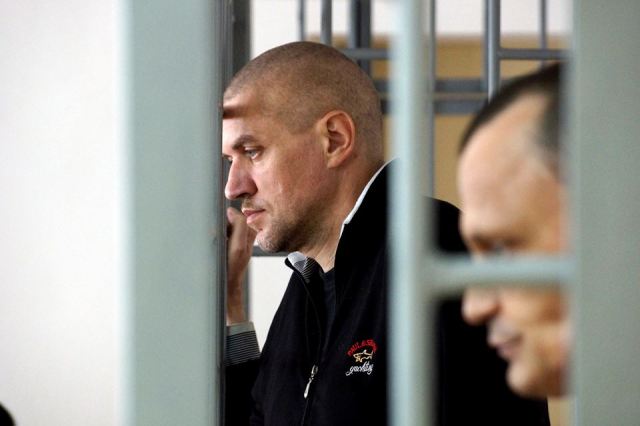
Stanislav Klykh. Photo: Anton Naumlyuk
After the arguments for each side were given, the judge spent almost the whole day giving the jury instructions before they proceeded to the jury room. The judge suggested that the jury review the questions pertaining to two episodes: participation in gangs, and the murder of Russian military personnel.
The lawyers tried to change these questions, insisting that episodes for which the Ukrainians have not been accused cannot be used with the jury. For example, illicit arms trafficking does not appear in the indictment, yet the questions for the jury describe in detail how Karpyuk supplied the “Viking” group with arms and ammunition. And not one word about the fact that both Ukrainians had recanted their original testimonies and declared that they had been tortured. During his final word, Klykh lifted his trouser leg, leaned on the crossbars of the cage, and began showing the burn marks on his legs.
“Everything put together in this criminal case was based on the slander I was forced to say about myself. Why bother with facts and evidence when you have an electric current? And when the electric current didn’t work on me, they told me: tomorrow, we’ll have your young son here, and will do to him the same that was done to you. Then I said to them, ‘Yes, I’ll sign all your vile lies.’ And I signed,” Karpyuk explained in his final statement.
Photo: Anton Naumlyuk
Photo: Anton Naumlyuk
When Klykh, instead of his final word, began reciting poetry, “Vladikavkaz. Here, in ’43, they stopped the Teutons. Here One was crucified, to become stronger. And people fought here, both for Christ, and for Allah,” – the judge ordered him to be removed from the courtroom.
“Why don’t you put a bag over my head? In Yessentuki, they led me to the cage with a sack over my head,” Klykh recalled in response. In the evening, the jury went into the deliberation room. There was clearly no unity amongst them; they failed to make a decision the first time around, and the chairman of the jury requested a recess until morning. In the morning, a decision was made, and formalized within half an hour. When the chairman – a burly man who often paused to drink water – read a long text of questions and answers, the jury tried not to look at the lawyers or at the [prisoners’] cage. The jury declared the Ukrainians guilty. But never specified whether the decision was unanimous, or what the balance of votes was. Klykh, according to the jury, deserves leniency.
Stanislav Klykh in court. Photo: Anton Naumlyuk
“Slaves could not have set a person free,” Karpyuk shrugged his shoulders and started persuading his lawyers, who had defended him for eight months, not to take the jury’s decision to heart. Klykh was reading a newspaper while the verdict was being announced, and paid no attention to anything else.
Surprising everyone in the courtroom, the Spokesman for the Head of the Republic arrived to be present at the announcement of the verdict.
Karpyuk’s final statement (video in Russian)
“Is there any documentary evidence of [these] Ukrainians being in Grozny?” – he asked me after the court session. “For instance, there are a lot of photos and videos of Bilyi.”
When he learned that such evidence did not exist, he was surprised: “Then on what basis did they arrive at their decision?…”
“My only transgression before Russia is that I am Ukrainian,” Karpyuk said in his final word. “The commander of the group that tortured me, said it right: ‘You crossed the border of the Russian Federation? Rights don’t exist here.’ The Chechens here joke: didn’t you know, Mykola, that being Ukrainian in the Russian Federation is a criminal offense? Now I know.”
The Chechens do treat the Ukrainians in the Grozny jail (SIZO) with some sympathy.
While everyone was waiting for the jury, the judge asked the bailiff to give Karpyuk some water.
“Not allowed,” – said the commander of the convoy. “What if it’s poisoned?”
“So buy him a sealed bottle of water, the man has been sitting here [for a long time],” said [Judge] Ismailov.
Klykh declined the offer of water.
On May 24th, the prosecutor will demand that the punishment is decided for the Ukrainians. Theoretically, he can even request a life sentence, but the defense will demand to withdraw the murder charges based on the expiration of the statute of limitations – it has been more than 15 years. The second accusation, one of participation in a gang, is unlikely to be lifted, even though this exact charge was dropped in Malofeyev’s case.
“We expect that both Karpyuk and Klykh, like other Ukrainian political prisoners – [Oleg] Sentsov, [Olexandr] Kolchenko [Gennadiy] Afanasyev, [Yury] Soloshenko, [Serhiy] Litvinov, [Valentyn] Vyhovskyi and others, will be included in the exchange processes and will return home by the end of the year,” Ilya Novikov said hopefully.
Attorney Ilya Novikov in court. Photo: Anton Naumlyuk
On the same day as the verdict was handed down by the jury, the court extended the detention period for Karpyuk and Klykh by a further three months.
“Within three days, we will appeal. We will keep fighting, what else is there to do,” responded attorney Marina Dubrovin.
The case of Karpyuk and Klykh, as all other political processes against Ukrainians in Russia, involves not only those who found themselves on the defendants’ bench, but also prominent political figures, who are not being accused directly, but who, de facto, were the reason for the respective cases. For example, the case of Serhiy Litvinov, whom the IC RF (Investigative Committee of the Russian Federation) initially tried to accuse of the massacre of civilians in the Luhansk region, involves Ihor Kolomoisky, who was allegedly supplying the “Dnipro-1” Battalion with bags of money as a reward for the shootings ordered by the Minister of Internal Affairs Arsen Avakov. When it became clear that proving the existence of Litvinov’s “victims” was impossible, the murder charge was dropped, but Kolomoisky’s and Avakov’s names remained in the case file. In the case of Karpyuk and Klykh, this figure, mentioned but not accused, was the former Prime Minister Arseniy Yatsenyuk. According to this same witness Malofeyev, he saw Yatsenyuk once in Grozny, armed with an AK and “firing no less than 10 shots towards the Russian soldiers” (in 1994, Yatsenyuk was twenty years old).
The only distinguishing feature of Karpyuk and Klykh’s case from the trials of other Ukrainians – Sentsov, Kolchenko, Savchenko and others – is that their cases have been isolated from the so-called “Big Ukrainian Case” about crimes of the Ukrainian military and activists during the events in Crimea and Donbas. The events for which the Ukrainians are being sentenced in Grozny, happened 20 years ago. But it is obvious that the case revolving around the deaths of Russian soldiers during the assault on the capital of Chechnya, initiated immediately after the Chechen war and then forgotten about until 2014, would not have emerged again, if it were not for the events in Crimea and the war in Eastern Ukraine. Malofeyev only included Karpyuk and Klykh in his testimony after they had already been detained. The case itself was brought up when the need arose to collect as many Ukrainian hostages as possible: firstly, to add to the propaganda of Russian TV, and secondly, to use them as bargaining chips during peace talks.
After the verdict, President Poroshenko wrote on Facebook: “We are doing and will do everything to return Karpyuk and Klykh home.” But so far, they [Karpyuk and Klykh] have not been mentioned in the [prisoner exchange] negotiations.
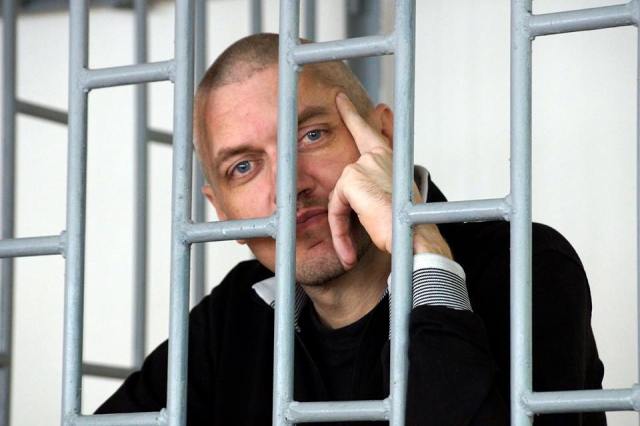
Klykh and Karpyuk in court. Photo: Anton Naumlyuk
Anton Naumlyuk, especially for “Novaya Gazeta,” Grozny Source: Novaya Gazeta
 Dmitry Tymchuk, Head of the Center for Military and Political Research, Coordinator of the Information Resistance group, Member of Parliament (People’s Front)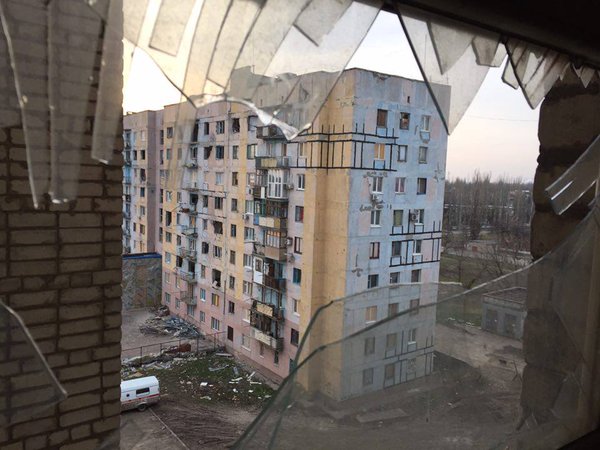





 By Anton Naumlyuk, journalist, especially for “Novaya Gazeta,” Grozny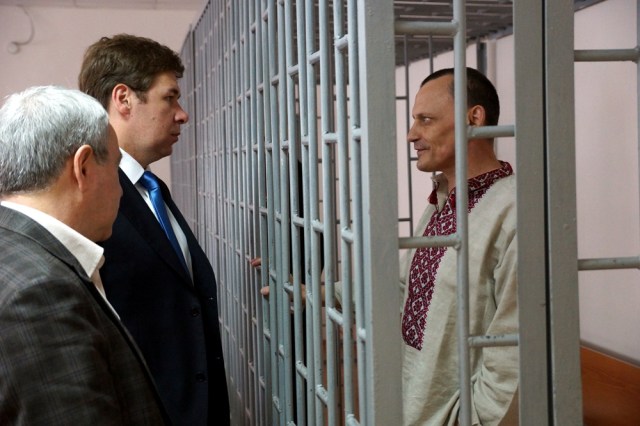

![Mykola Karpyuk, dressed in a traditional vyshyvanka [embroidered shirt] for International Vyshyvanka Day on the day of his trial, May 19, 2016. Photo: Anton Naumlyuk](https://maidantranslations.com/wp-content/uploads/2016/05/13249436_1200920686609536_486140443_n.jpg?w=640&h=427)



 Voices of Ukraine