
Der Koordinator der Widerstandsbewegung Kulikowo Pole im russischen Fernsehen: “Das Blut der russischen Babys” an ukrainischen Schulen
Der Koordinator der Widerstandsbewegung Kulikowo Pole im russischen Fernsehen: “Das Blut der russischen Babys” an ukrainischen Schulen
 By Johan Karlsen, Luhansk blogger
12.07.2014
Translated and edited by Voices of Ukraine
We have received information from inside sources that the local bandits and representatives of various illegal armed groups, who fight in eastern Ukraine, are very concerned by the not quite correct attitude from the Russian Federation and international Russian terrorists towards them and their loved ones. From the list of grievances towards Russian terrorists, we can highlight the following:
Attempts to influence this situation using mind games, by manipulating information, as in “it is all Ukrofascists,” does not adequately work anymore. The reason is that the creators of “vato”-news and “vato”-fakes are often very far from the realities of what is happening, and the fruits of their imaginations are radically different from the picture that is seen by the direct participants.
Due to the fact that in recent times these precedents of fights (one of the last ones is covered in the previous repost) are becoming more frequent and more violent, it highlights the prerequisites to not only an active confrontation between local terrorists and the Russians, but also the expansion of this conflict onto the territory of the Russian Federation.
It is known from trusted sources that in revenge, the embittered representatives of the illegal armed groups are planning to undertake a number of acts of sabotage and terrorism; for this purpose, through “refugees,” materials for explosives and weapons were smuggled into the territory of the Russian Federation. One of the first signs, is the explosion that was heard in the early morning of 11.27.2014 in Rostov-on-Don [Russia], when an unknown person fired into the window of one of the cafes from a hand-held anti-tank grenade launcher, presumably, an RPG-7. At the same time they detained a 25-year old “unknown ex-Spetsnaz.” And, by the looks of things, it is not the last such “show.”
Source: Johan Karlsen FB
 Dmitry Tymchuk, Head of the Center for Military and Political Research, Coordinator of the Information Resistance group, Member of Parliament (People’s Front)
12.08.2014
Translated and edited by Voices of Ukraine
Over the weekend (December 6-7, 2014) we received reports of the reinforcement of local insurgent formations, and formations of “camouflaged” Russian forces stationed on the occupied Donbas territory, which incurred losses over the last few days. The reinforcements are arriving mainly in the form of Russian mercenaries and contract soldiers of the Russian army, deployed from composite task groups stationed at the border.
The artillery component of these gang formations and Russian troop formations is being reinforced as well. Over the last two days, at least 2 cannon artillery batteries (152-mm MCTA-B howitzers, 122-mm D-30 howitzers) arrived in the occupied areas of Donbas. Ammunition and other supplies are being delivered from Russia and accumulated at increasing rates.
Due to the significant losses incurred by the special forces [Spetsnaz] units of the Russian Armed Forces, special forces units of the Internal Troops of the Russian MIA are being deployed to Donbas. We have identified fighters belonging to the following special forces units of the Russian MIA Internal Troops:
• “Rosich” 7th special forces squad (Novocherkassk);
• “Vyatich” 15th special forces squad (Armavir);
• “Edelweiss” 17th special forces squad (Mineralnye Vody);
• 107th brigade of the Internal Troops of the Russian MIA.
Due to the losses incurred by the composite battalion task group of the Central Military District of the Russian Federation which was formed of members of two motorized infantry brigades of that district, this battalion task group was moved from the front positions near Dokuchajevsk to the support echelon in the Starobesheve – Kuteinykove area, for reinforcement and replenishment. Total losses of this battalion task group (permanent and temporary casualties) have reached a quarter of its original staff.
In a number of Donbas towns (Torez, Rovenky, Snizhne, Krasnyi Luch), terrorists continue “enlistment” to the so-called “Army of Novorussia.” These “mobilization arrangements” are carried out by armed insurgents in a number of companies and mines in the region, on a compulsory basis. The total number of local residents “mobilized” in this manner over the last few days was up to 30 persons in total.
On Saturday, December 6, the enemy attempted to mount an offensive against the positions of Ukrainian troops to the south of Avdiivka. The attempted offensive was accompanied with cannon artillery fire. After two consecutive strikes by Ukrainian GRAD multiple rocket launcher systems, the enemy first stopped the attack, and then retreated to the area of Yasynuvata.
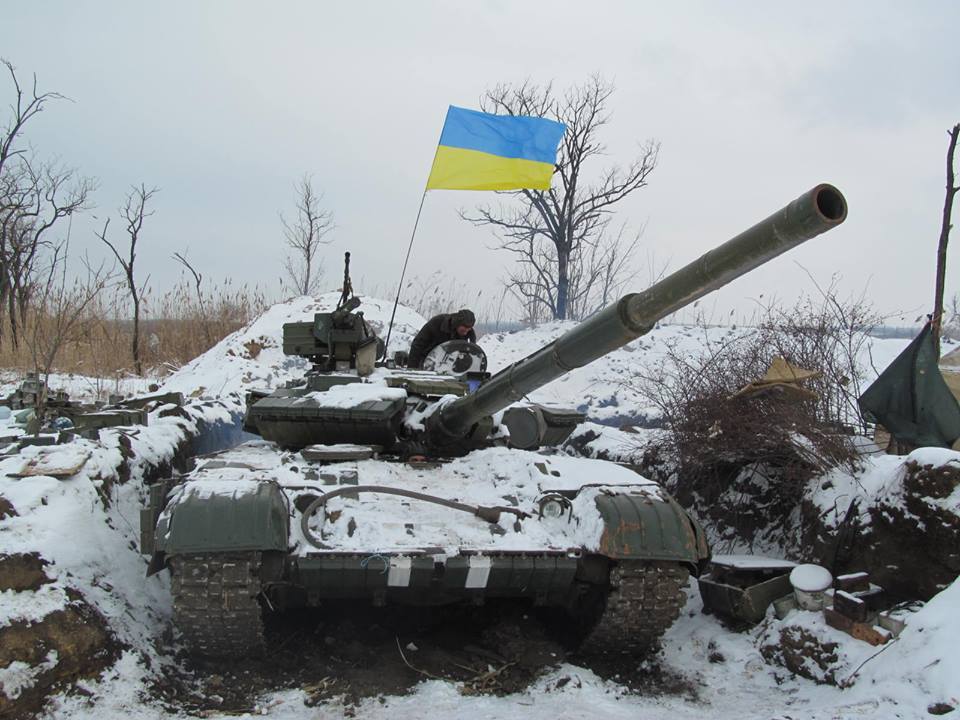
Fierce battles continued around the Donetsk Airport. The old terminal building has been destroyed almost completely. As of Sunday, December 7, this building was in the no-man’s land, being a live fire zone. On Sunday night, the enemy delivered another powerful artillery strike on the positions of the “cyborgs” [defenders of the airport]. The Ukrainian artillery made a retaliatory strike on the enemy’s original positions near Putilovka and in the Kuibyshev district of Donetsk.
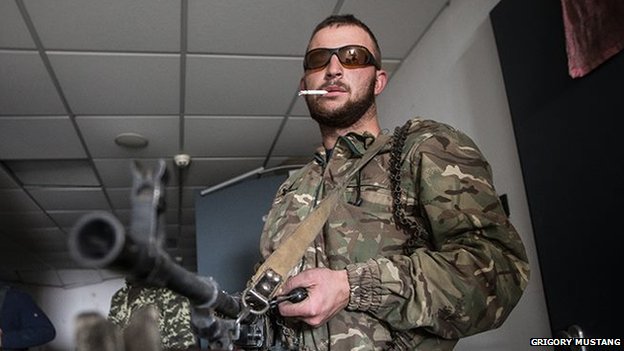
One of the “cyborg” defenders of the Donetsk Airport.
Photograph by Grigory Mustang
Counter-battery duels continued during the weekend near Volnovakha. Ultimately, Ukrainian artillery strikes forced the enemy to leave their front firing positions and pull their artillery units back, behind Olenivka and Dokuchajevsk.
In the area of Trokhizbenka, Schastya, and Stanytsia Luhanska, the enemy continues concentrated firing strikes on the positions of Ukrainian troops. Ukrainian forces continue holding the bridge near Schastya. The enemy mainly uses cannon artillery (we received reports of a minimum of 3 active batteries, one of them self-propelled), multiple rocket launching systems, and mortars.
The enemy continues heavy shelling of Debaltseve. Over the last two days, we received reports of heavy cannon and rocket artillery fire from the direction of Vuhlehirsk, Makiivka, and Chornukhyne. Mortar and howitzer fire is coming down on the village of Nikishyne.
In Horlivka, there are persistent rumors about an “SBU [Security Service of Ukraine] liquidation team” operating in the city. The rumors are circulated among the insurgents of Bezler [Ihor Bezler, codename “Bes” (“Demon”)] included in the new gang formation, the so-called “Army of Novorussia.” The insurgents believe that the database containing information about the city “militia” ended up in the hands of the SBU, and now, members of the Ukrainian special service planted on the occupied territory are methodically working to track down or liquidate the remaining “Bes’ fighters” in the city. Meanwhile, during the past week, three former commanders of Bezler’s gang were found showing obvious signs of violent death, and at least two more have gone missing.
Source: Dmitry Tymchuk FB
By Anton Shekhovtsov
12.07.2014
Edited by Voices of Ukraine
Those commentators in the West who did not support either the Euromaidan protests or, later, the revolution in Ukraine, often deprived Ukrainians of any agency. They would resort to imposturous Western “self-hatred” and talk about “Western imperialism” and how bad it was to expand Western-style democracy.
Against this background, Ukrainians were objectified into non-subjectivity: it was not them who rose up against the brutal regime in defense of their own dignity – rather, it was the West that manipulated the Ukrainian mobs against Russia.
The Ukrainian revolution won, because, contrary to all the Orientalist and patronizing rhetoric of Western cynics, the Ukrainian revolutionary movement was a subject, rather than an object, of the historical process. The revolution won because Ukrainians did have agency.
They largely lost it, however, after the annexation of Crimea and the Russian aggression in Eastern Ukraine. The introduction of the more-or-less significant Western sanctions against Russia implied the introduction of Western patronage over the weak (and, at times, non-existent) Ukrainian state. In the short run, it was useful for Ukraine: when the strong West stood up for the country that was much weaker in military and economic terms than the aggressor, the Russian invasion stumbled.
Yet in the long run, the loss of Ukrainian agency is destructive for Ukraine, because continuous patronage emasculates the civil society and reverts the gains of the revolution. Without regaining agency, Ukrainians cannot win. During the revolution, being a subject of the historical process implied being stubborn and determined. Today, to regain Ukrainian agency implies implementing uncompromising reforms. The choice is very clear: REFORM or SURRENDER to the aggressor. The West will not be “babysitting” Ukraine for long. The window of opportunity is closing.
Source: Anton Shekhovtsov FB
 By Anna Velichko
12.04.2014
Translated and edited by Voices of Ukraine
It has been almost a month since I came back from there. [I] spent two weeks. (I’ve got a father and an eldest daughter there, if someone doesn’t know).
Since then – I am silent even to myself about what I feel.
…We don’t see a lot of this from here. We see – what they write. And the writing is done either by paid assholes or by active lunatics…
I do not mean that everything is much better. Everything is much worse.
To us it seems one of two things:
It is neither one nor the other.
Not among the masses.
There are many, very many, a whole grey world of frightened people, who do not know what to think, so they do not think at all. They don’t think pro-government, or anti-government. They think in terms of daily life: the prices have risen, the wages haven’t, how to survive, aha, today like this, and tomorrow like that. Why all of this has happened, the reason why they have to struggle, by and large – not many are interested in that.
They do not need to look for explanations. They do not need to dig deeper. The surface layer: fear in front of their former brother Ukrainians, who suddenly FOR SOME REASON went crazy and FOR SOME REASON started hating Russians – this is given by the TV. It really is fear, they have scared them with us, and their unwillingness to know or understand anything is a defensive reaction to fear.
They do not need to look for answers to “why.” [In order] to dig deeper – the desire to know the truth – you need motivation. And how can someone be motivated to learn something bad about themselves? To understand that it is your government that attacked, annexed, that murders – and that since this is with your silent support – then it is you who attacked, annexed, and who murders…
There is a vanishingly small number of masochists with such motivation, obviously – there are generally not many masochists in the world.
– We can’t take in your refugees by day and shoot at you by night, right? It is illogical!
These cute, good, calm people talk, explain (first and foremost to themselves) that there are “no Russian troops” in Ukraine. People who do not hate Ukrainians at all. Who simply do not want to dig deeper, so that they do not accidentally run into their own conscience…
Who did I expect to see when I went there? Aggressive monsters from the web, probably. And to see, instead of these monsters… normal people who are not motivated to THINK – was unexpectedly more difficult.
So there will not be a Maidan in Russia. Even if the overthrow of Putin’s regime were an easy and safe task – there still would not be a Maidan. Those few who organize protest actions will remain few. The rest – the rest are not even outraged by their actively fighting fellow citizens. The rest simply prefer not to know about them.
…..
..But both my father and my daughter understand everything correctly about is. They are probably from among the rare masochists. And because of this, it is somehow easier for me.
Source: Anna Velichko FB

 Voices of Ukraine