Dmitry Tymchuk, Head of the Center for Military and Political Research, Coordinator of the Information Resistance group, Member of Parliament (People’s Front)
06.30.2015 Translated and edited by Voices of Ukraine
Operational data from Information Resistance:
The IR group states that the withdrawal of heavy combat equipment (first of all, tanks) from the contact line in Donbas “by June 26,” as “advertised” by the MoD heads of the “Normandy Four,” has unequivocally failed. Russian-terrorist troops actively employ heavy armaments banned under the Minsk Agreements (including combat equipment), and continue bringing them towards the front line.
In the seaside areas, in the vicinity of Shyrokyne, Lebedynske, and Berdyanske, terrorists continue actively shelling the ATO forces’ positions, including with the use of 120-mm mortars. Over the past 24 hours, insurgents in this area also made multiple 122-mm artillery strikes (employing the insurgent artillery group that the IR group had previously spotted on the southward march from Donetsk, through Krasnoarmiiske).
In the areas of Pavlopil and Chermalyk, insurgents fired small arms from under the cover of vegetation, and also employed AGS-17 grenade launchers (afraid of retaliatory fire, terrorists fired at random and from a long range, changing their positions immediately after short bursts of fire).
South of Donetsk, Russian-terrorist troops are carrying out a set of measures to conceal the concentration and deployment of new battalion technical groups (on the Mospyne – Komsomolske stretch; near Telmanove; and on the stretch between Olenivka and Dokuchajevsk). The IR group analysts believe that the above [arrival of reinforcements] is the real reason behind the increased use of 122-mm artillery on the positions of Ukrainian troops near Hranitne, Starohnativka, and south of Novomykhailivka (vicinity of Stepne). The arrival of several groups of insurgent armored vehicles on the front lines in these areas (terrorists used tanks and the cover of armored fighting vehicles to shell the advance ATO positions near Hranitne several times over the past 24 hours) should also be viewed in the context of the above deployment of new battalion tactical groups.
In the vicinity of Mar’inka, terrorists actively employed several mortar squads using 82-mm mortars and supported by AGS-17. Under this fire for cover, insurgents regrouped their advanced units stationed west of Oleksandrivka, south of Mar’inka, and on the stretch between Mar’inka and Krasnohorivka.
In the areas of Opytne, Pisky, Krasnohorivka, and south of Avdiivka, the insurgents actively employed heavy combat equipment. Several insurgent tank groups at once, after taking concealed and camouflaged positions on the front line, would open direct fire on the advanced ATO positions, under cover of ZU-23-2 artillery guns and mortars (82 mm and 120 mm). Then the tanks would quickly retreat deeper behind the lines, under cover of 76-mm and 30-mm weapons of BMP-1 and BMP-2 infantry combat vehicles, and heavy machine guns (on board of BTR-70 and BTR-80 armored personnel carriers). In the vicinity of Pisky and Opytne, terrorists also used 122-mm and 152-mm artillery (the enemy’s shelling follows the pattern of: 2-3 shots of trial fire, assessment, adjustment of fire, 5-6 shells “firing for effect,” followed by transfer of fire and a pause, then, once again, trial fire followed by fire for effect).
On the Svitlodarsk bridgehead, insurgents are using the “mortars + tanks” method “traditional” for this area. The strikes are mainly made on the ATO positions near Luhanske, Myronivske, and Novozvanka; less frequently, on the eastern outskirts of Popasna. At the same time, insurgents are progressively using short artillery attacks more often to accompany the “mortars + tanks” tandem, mainly using 122-mm caliber weapons (usually employing two “interchangeable” firing units, one with 122-mm D-30 howitzers, another with 122-mm 2S1 Gvozdika self-propelled guns; stationed on the positions west of Bryanka). On rare occasions, 152-mm caliber artillery is used (Msta-B howitzers, stationed between Verhulivka and Chornukhyne).
In the vicinity of Krymske and Novotoshkivka, insurgent sabotage and reconnaissance groups attempted to infiltrate and lift mine fields, working under the cover of 120-mm mortars and AGS-17 grenade launchers. Additionally, a group of four insurgent infantry combat vehicles shelled the advanced ATO positions near Krymske for 15 minutes. After several aimed bursts of fire from heavy machine guns, the armored group retreated.
Movement of terrorist personnel and weapons:
• In Stakhanov, insurgents established a temporary combat vehicle park at a local stadium. 15 MT-LBs (without weapons), 12 vehicles on wheels, two tanks, two BMP-2, 4 bowser tankers were observed. The equipment continues to arrive; in the last 24 hours, the arrival of five more vehicles has been recorded – a BAT [tow vehicle], two BTR-70, and two BMP-2.
• Several units of the “DNR army” in Horlivka received an order to provide “work teams” to unload ammunition (12-15 people from every company). Teams are formed to send off “to the Donetsk bases.”
• Several mobile brigades are formed on the basis of the Horlivka “ambulance” station to provide emergency assistance and evacuation to “militias” located at “combat areas” nearby.
• Two reinforced companies of terrorists deployed earlier to the area near Olenivka (the IR group reported about them) were reorganized and redistributed. Some went towards Donetsk (up to a company [in size] – eight BMP-1 and BMP-2, four tanks), others – towards Dokuchajevsk (seven BTR and BMP-2 and five tanks). The remaining [personnel] was transferred to the local infantry “battalion.”
• A battery of six 122-mm 2S1 “Gvozdika” self-propelled guns and up to 10 units of APCs – four BMP-1 and BMP-2, three BTR-80, and three MT-LB were transferred in the vicinity of Donetsk.
• In the Donetsk area near mine #12/18, a build-up of terrorist armored vehicles is observed – five tanks and four AFVs (three BMP-2 and a BTR-80). The equipment is dug in and camouflaged.
• In Yasynuvata, insurgents held [military] “exercises” using means of radiation, chemical, and biological protection (gas masks) near the local “Commandant’s office.”
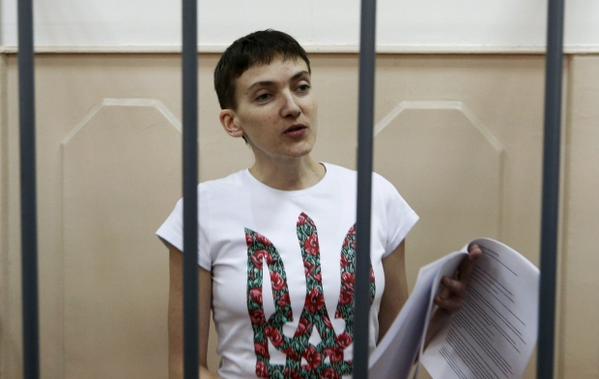
I have decided that on July 2, 2015, I will stop studying the materials of the criminal case [open against me], having studied them over a period of 1 (one) month, from June 2, 2015 to July 2, 2015.
I do not consider it necessary to spend more time in my life in prison studying [those materials].
I accept all responsibility for any procedural consequences, because I believe that the institution of the legal profession in Russia is pointless in essence, because the law does not work in Russia.
I fear for the life and freedom of my defense attorneys, Mark Feygin, Nikolay Polozov, and Ilya Novikov, in connection with their defense of me.
[His words from the tweet of her letter: “Just came from Nadiya Savchenko in prison. Here’s her statement.”]
Mark Feygin went on to clarify that this address does not mean that Nadiya is refusing the services of her defense:
“Perhaps, a clarification is required. Savchenko is not refusing the defense of Feygin, Polozov, and Novikov. She decided to speed up the process planned for August.”
Видимо надо пояснить. Савченко не отказывается от защиты Фейгина, Полозова, Новикова. Она решила форсировать процесс предстоящий в августе
Dmitry Tymchuk, Head of the Center for Military and Political Research, Coordinator of the Information Resistance group, Member of Parliament (People’s Front)
06.26.2015 Translated and edited by Voices of Ukraine
Operational data from Information Resistance:
After a decrease in the activity of Russian-terrorist forces in Donbas on June 24, for the past day (25-26.06), an increase in insurgent attacks and armed confrontations with Ukrainian troops were observed. In addition to 120-mm mortars, 122- and 152-mm cannon artillery allegedly “pulled out” from the demarcation line and in spite of appeals by the foreign ministers of the Normandy Four to move tanks away from the line of contact by June 26, terrorists use heavy armored vehicles against ATO forces widely.
In particular, in the area of Mar’inka—Mayorsk—Troitske, insurgents used 120-mm mortars and armored vehicles in their attacks. In the vicinity of Mar’inka and Krasnohorivka, the IR network has identified a “roving” consolidated mortar battery (about eight 82- and 120-mm mortars) on vehicles. Near Pisky, north and south of Avdiivka, terrorists used the tactics of infantry “firing teams” trying to carry out concentrated fire from small arms and grenade launchers from the “neutral zone.” The enemy provided cover to the firing teams with ZU-23-2 anti-aircraft systems and mortars.
The positions of ATO forces in the vicinity of Shumy, Troitske, and Mayorsk were also attacked from 120-mm mortars and AGS-17 automatic grenade launchers. Armed provocations by insurgents were accompanied by their attempts to get closer to the advanced positions of the Ukrainian troops.
In the vicinity of Butovka mine, the settlements of Opytne and Vodyane, insurgents fired on the advanced positions of ATO forces from mortars (82-mm mortars were mostly used). In addition, several advanced armored terrorist groups operated in this area on the first echelon [of the front]. An insurgent tank group carried out between five or six aimed strikes with high explosive shells on the positions of ATO forces from the greenery in the vicinity of Pisky. Another armored terrorist group with several BMP-1 and BMP 2 and two BTR-80 has been observed near Opytne, firing from 73-mm weapons (BMP-1), 30-mm automatic guns (BMP-2), and Vladimirov heavy machine guns (APCs).
North of Krasnohorivka (closer to Pisky), an insurgent sabotage and reconnaissance group under cover of mortar and AGS-17 fire tried to infiltrate the tactical rear of the ATO forces. The group included 10 persons with anti-tank weapons; two strikes from RPG-7V grenade launchers were observed. As the result of an armed confrontation with advanced units of Ukrainian troops, the enemy sabotage and reconnaissance group returned to their beginning point.
In the coastal areas, insurgents used 122-mm artillery from new firing positions (the IR group previously reported on an artillery insurgent group that provided support to terrorist groups in the vicinity of Krasnoarmiiske changing its firing positions). Positions of the ATO forces in the vicinity of Shyrokyne and access routes to this settlement near Kominternove and Lebedynske.
In the vicinity of Krymske, Novotoshkivka, Shchastya, Luhanske, and Myronivske terrorists used mortars, small arms, and AGS-17. Insurgents opened fire using tank weapons from hideout shelters and laid ambushes. Near Shchastya, insurgents continue their attempts to probe the advanced line of ATO forces with sabotage and reconnaissance groups and small infantry units (up to a platoon in size), supported by mortar and ZU-23-2 fire.
In the vicinity of Stanytsia Luhanska, terrorists fired at the positions of ATO forces (mainly from a fortified area of defense near Mykolayivka). AGS-17 and mortars are used in continuous fire strikes from Vesela Hora.
Movement of Russian-terrorist forces:
• In the vicinity of Mykolaivka, the arrival of a howitzer battery (four D-30 units) has been observed;
• About 150 terrorists in army trucks were transferred to reinforce a group stationed near the Donetsk airport;
• A convoy of a “Lexus” SUV, two BTR-80, a command and staff vehicle, and a MAZ-537 trailer with the “Tor-M1” missile system proceeded through Shakhtarsk towards the East;
• A battery of three 2B16 “Nona-K” 120-mm towed artillery systems were observed on the march through Alchevsk to Perevalsk. Four “Ural” [military cargo trucks] with insurgents on board were observed in the same convoy.
• Three “Toyota” SUVs marked with “OSCE” moved through Shakhtarsk in the direction of terrorist positions ([they] stopped at an insurgent base). One [of the SUVs] had an orange trailer (1m x 1m in size). Sometime later, all three SUVs left the insurgent base without the trailer.
• Military equipment – tanks, IFVs, APCs continues arriving to the settlement of Kalynove for four days in a row. Currently, a total of over 20 armored vehicles have arrived (most of them arrive with infantry). Over the past 24 hours, four tanks and a BMP-2 have arrived.
• Armored vehicles (T-72BA tanks) were transferred through Kalinovka to Makiivka on trailers. The tanks are not tented – the tactical signs of a motorized infantry brigade of the Southern Military District of Russia were badly painted over on one [of the tanks].
Dmitry Tymchuk, Head of the Center for Military and Political Research, Coordinator of the Information Resistance group, Member of Parliament (People’s Front)
06.24.2015 Translated and edited by Voices of Ukraine
Operational data from Information Resistance:
Russian-terrorist forces in Donbas continue actively shelling the positions of Ukrainian troops and civilian objects, including with the use of heavy weaponry. There is no apparent unified concept behind the active operations of the “DNR / LNR” groups [Donetsk and Luhansk Peoples’ Republics, respectively], nor any obvious attempts to carry out tactical-level missions – only the insurgents’ desire to achieve tactical success in several areas. In most cases, shellings are chaotic in nature and designed to maintain destabilization along the demarcation line.
For example, in the vicinity of Opytne, insurgents are trying to force the advanced units of Ukrainian troops to move behind the Koltseva road [circular highway] by using heavy mortar fire from 82-and 120-mm mortars.
Between Pisky and Opytne, a maneuvering terrorist armored group consisting of several armored fighting vehicles was spotted once again. Insurgents have opened fire from APC [armored personnel carriers] and IFV [infantry fighting vehicles] weapons on the positions of the ATO forces several times over the past 24 hours.
In the vicinity of Mar’inka (on the front line), an armored group (two tanks and two AFVs) was also spotted, operating under cover of insurgent mortar units (only AFVs opened fire from 30-mm automatic guns). At the same time, enemy snipers opened fire on the positions of the ATO forces.
Activity by Russian-terrorist groups has been observed in the vicinity of the Svitlodarsk bridgehead. The enemy used ZU-23-2 anti-aircraft guns, large-caliber machine guns and AGS-17 grenade launchers (shelling the ATO forces positions near Svitlodarsk). Insurgents use 120-mm mortars in this area, as well as in the area between Luhanske and Rozsadky. Maneuvers by an enemy armored group (three or four ACVs, which did not fire [at the time]) were also observed in the vicinity of Luhanske.
On the stretch between Zolote and Novotoshkivka, insurgents actively use 152-mm artillery. Under the cover of artillery fire in this area, terrorists attempt to send their sabotage and reconnaissance groups into the tactical rear of ATO forces (checkpoint #29 – Novotoskivka). An enemy MLRS unit also continues to operate in this area.
In the direction towards Shchastya – Stanytsia Luhanska, terrorists actively shell the positions of Ukrainian troops in order to identify the firing system of checkpoints and the bases of ATO forces. Attacks are carried out from small arms and 82-mm mortar rounds, sometimes from 120-mm mortars.
In the coastal areas, insurgents use small arms, AGS-17 grenade launchers, and 82-mm mortars in attempts to provoke ATO forces’ advanced positions to retaliate with heavy weaponry. [Insurgents] are also firing from the “neutral zone.” Similar provocative fire strikes on the positions of Ukrainian troops have been observed immediately before the arrival of the OSCE inspectors to the front edge of the [frontline], which suggests that terrorists possess information about the movement of SMM OSCE patrols.
In the Kuibyshev district of Donetsk, an insurgent tank unit (four tanks) and a battery of 122-mm D-30 howitzers was observed moving along the “front line” towards positions to the north of the settlement.
Serviceman with a call sign “Cossack” demonstrates his tattoo. Source: Radio Svoboda.
An insurgent artillery division was observed moving towards Chervone (four 2S1 Gvozdika self-propelled howitzers). Three more 2S1 Gvozdika howitzers were seen on the march near the settlement of Komunarivka.
An operational and tactical command post was transferred from Yenakijeve towards Kayutyne – the convoy included a command and staff vehicle of Russian troops R-149BMR “Kushetka-B,” two KAMAZ military vehicle trailer systems, and an “Ural” [military cargo truck] accompanied by a BTR-80 armored personnel carrier.
An insurgent armored group was observed transferring from Antratsyt and Krasnyi Luch (six tanks and several IFVs, including a “Potok-2” command and staff vehicle).
In the vicinity of Horlivka, terrorist artillery was observed transferring towards the village of Holmivskyi (in groups of 2–3 weapons). Up to ten 122-mm D-30 howitzers and up to eight 152-mm “MSTA-B” units have been transferred over the past 24 hours.





 Voices of Ukraine