Die Fotoausstellung „Maidan. Gesichter und Geschichten“ dokumentiert beeindruckende Manifestationen eigener Selbstbestimmung im Herzen der ukrainischen Hauptstadt. Fotografen und Studenten der Kiewer Akademie für Film- und Theaterkunst Karpenko-Karogo haben seit Beginn der Proteste in der Ukraine Bürgerinnen und Bürger in ihrem Kampf für Demokratie, Freiheit und menschliche Würde porträtiert.
Im Mittelpunkt der eindrucksvollen Bilder stehen keine politische Kräfte oder deren Anführer, sondern die Menschen selbst, sowie ihr Engagement auf dem Maidan.
Mit ihren Kameras haben die Autoren die Gesichter und Geschichten der Ukrainer aus den verschiedensten Bevölkerungsschichten und ganz unterschiedlichen Teilen der Ukraine auf beiden Seiten der Barrikaden festgehalten. Studenten und Rentner, Künstler und Intellektuelle, Unternehmer und Arbeitslose, Ärzte und Volontäre, Journalisten und Fotoreporter, Veteranen des Afghanistan-Kriegs, aber auch die Streitkräfte der Regierung: Das sind die Charaktere der Szenen des sozialen Phänomens „Maidan“.
Es wurden über 100 Fotos von über 30 Fotografen gezeigt. Alle Fotos entstanden im Zeitraum vom 21. November 2013 bis zum 21. Februar 2014 in Kiew.
Die Fotoausstellung „Maidan. Gesichter und Geschichten” wird von der ukrainischen Gemeinde der Freien und Hansestadt Hamburg präsentiert (mit freundlicher Unterstützung der ZEIT-Stiftung Ebelin und Gerd Bucerius, des Bundes Ukrainischer Studenten in Deutschland e.V., der Vereinigung der Ukrainer Norddeutschlands e.V.). Die Ausstellung war vom 25.03.2014 bis 31.03.2014 in der Rathausdiele zu den Öffnungszeiten des Hamburger Rathauses zugänglich und wird in weiteren Städten Deutschlands und Österreichs zu sehen sein.
Dieser Film erzählt die Geschichte der Organisatoren.
The Psychological Service of Maidan, which has now established itself at McDonald’s on the main square in the country, has long been a part of Maidan culture. The numbers only serve to confirm this: within three months, almost 16 thousand people turned to the service for support.
Psychological Service self-organised on Maidan for the first time on December 2, 2013 – initiated by psychologists Volodymyr Pogoriliy, Galyna Tsyganenko and Nataliya Shaposhnyk: a crowded, unusual situation, fear and anxiety after the clashes – they had every reason to believe that people might need psychological help.
Now, the service has more than 300 volunteers working each day, they receive between 50 to 100 people daily at McDonald’s, the Ukrainian House and the Kyiv City Administration, at first aid locations, as well as at the posts of self-defence guard. In addition, a 24/7 helpline is at work.
Today the service is gradually growing into a pan-Ukrainian structure. Since every region has people that need support – these are Maidan participants themselves, relatives of the fallen and missing, and those who simply watched the events unfold on TV. Psychological service departments already exist in Dnipropetrovsk, Kharkiv, Sumy, Poltava, and Lviv.
“Psychological trauma has touched all of our population – the usual schemes changed, we could not cope with one shock before encountering another. We anticipate that there will be people who will cannot alone overcome the stress, although the majority will be able to succeed because of their own mental resources,” explains Natalia Shaposhnyk, the coordinator of the service.
Psychologists emphasize that they provide assistance to victims on both sides of the barricades.
Now the service is also beginning to offer psychological help to refugees from Crimea.
Top sign: “Psychological Help”
“The community is influence by completely varied experiences, but the base emotion, characteristic of so many, is anxiety,” says psychologist Galyna Tsyganenko. “Anxiety and fear for the integrity of the country, for what is to come next, whether there will be war, those are quite prevalent. Even the people who had nothing to do with Maidan or those who condemn it, suffer from anxiety.”
Even Crimeans who are genuinely celebrating that they will get Russian passports and that are euphoric at the moment, are suffering from anxiety as to what will happen next – however, for them it is as yet unknownwhat this celebration will bring.
To the question of what issues Maidan activists want to discuss with the psychological service now, Galyna Tsyganenko responds: “The main issues currently regard the search of one’s self, their place in life. These are problems of unemployment, conflict in the family, seeking family, they are anxious about internal tension and some associated aggressiveness, some experience difficulties with relaxation and sleep.
These problems can be considered peaceful, but they became activated during significant and long-term social and political uncertainty. In their daily lives, people don’t dare ask for help too often, they think that everything will solve itself over time. With people who lost their relatives or friends, or who are themselves victims, it’s a very big job, because they are extremely painful emotions and traumatic stress. These people need support, and the sooner they ask for it, the better.”
“This whole time the moods and the needs of the population have been changing. When people died, there was a lot of grief. Grieving is a natural process, a person has to endure it themselves, their body has to do its work, and we, the psychologists, can only support them by being nearby. Often, when the period of acute grief has passed, the person needs to express their feelings and here national traditions and rituals play a major role,” says the service’s psychologist, Tetiana Paliyenko. “The families of those who are missing, suffer the hardest – you know how people suffer the unknown. These people are experiencing great tension. The relatives of the fallen have to go a long way: first a shock state, then denial of what happened, then the phase of when they start blaming someone, and then the phase of acceptance.
There is a category of people who have been traumatized physically – their outlook on life has changed. It is important to give people who have been injured hope for the future, so that the loss does not become the center of their life, so that the person can realize themselves under new circumstances.
Those who survive combat, experience states when they continuously see the events repeat themselves in their heads. We tell them it is a normal reaction in such abnormal conditions. Frequently people suffer from problems with their sleep.”
Many Maidan activists experience difficulties in returning back to their cities and towns, to their normal, everyday lives.
“The people express anxious expectations as to what will happen in their lives, in the lives of their group. There are no clear prospects,” explains Volodymyr Pogoriliy. “Many of those who left and have returned [to their homes], have adaptation disorders, therefore they are trying to stay in groups, and they find it hard to readjust to peaceful life. The people who managed to unite with those similar to them on location, have it easier. Those who did not, they return. Some still find themselves here by performing specific functions – for example, guarding objects. Our psychologists say this is not a mass phenomenon, but there are people who still boast about having weapons, that they will still realize themselves more.”
At the moment, says Volodymyr Pogoriliy, more Maidan activists are using alcohol: “Not in all sotnyas, (they don’t have this at all in “Praviy Sector”), but alcoholism has increased. I can interpret that this comes together with the increase of anxiety. If a person did not learn to cope with their anxiety, then they will, as a rule, use alcohol in order to simply relax.
Sometimes, but less frequently, disillusionment comes and the person does not know what to do with it. But this usually happens when the depression emerges – and it is too early to speak of depression yet.”
The Kyivans who were not actively engaged in Maidan, also come to “psychological McDonald’s” more frequently – they constitute about 20-25% of those who ask for help. Psychologists explain that earlier these people had been able to control their anxiety by coming to Maidan, bringing food, and trying to help in some way.
Instead, the anxiety has become too far removed today – it relocated to Crimea and has become harder to deal with.
Overall, the psychologists say, psychological trauma and traumatic stress have affected everyone in various forms.
What will come next – stagnation, depression? Or maybe the entire country will take a more active role in considering the collective experience of overcoming hardship, and solidarity? Will the society return to the victim mentality – or will it consolidate new, heroic archetypes?
This is not a question for the psychologists – it is put to the people.
The Ukrainian Cabinet of Ministers has published a presentation explaining the drastic measures that will be taken to cut expenses on government maintenance.
“Please, tell everyone that we had no right to shoot anybody. Our military bases carry out internal services, not the guard service. The guards oversee the armory only. In the event of intrusion into the base, the serviceman must call the police. If he starts shooting, then he will face criminal charges.”
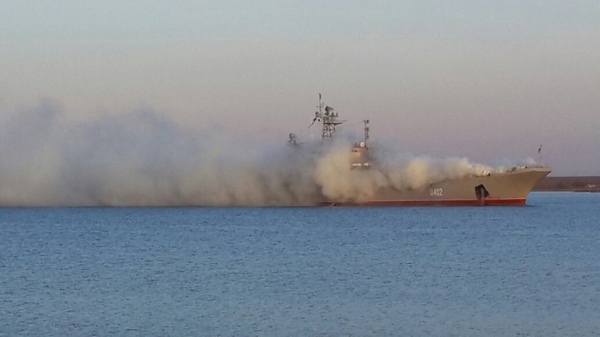
In Crimea they stormed the last ship “Cherkasy.” The last base of marines was seized as well. There has not been any contact with some of the commanders from our strongest units for a few days. Some sources say they are being persuaded to come over to the Russian side.
In their interviews, while they still were free, [Col. Yuliy] Mamchur (airfield “Belbek”), [Lt. Col. Dmytro] Delyatytskiy (battalion of marines in Feodosiya), and [Captain Dmytro] Kovalenko (ship “Konstantin Olshansky”) repeatedly said that they were not going to betray Ukraine and would standto the last.
Russian intervention was successful: all Ukrainian military sites have been either left under commanders’ orders, or were taken by special forces. Some of those who have been following events [in Crimea] have already managed to label the Ukrainian marines ‘traitors’ because they did not respond to the invaders’ with fire. Some think they should have sunk their ships so that the invaders’ could not get them.
Video taken by sailors of the minesweeper “Cherkasy”:
Servicemen have a different opinion in this respect.
“Please, tell everyone that we had no right to shoot, – the command staff officer of the Ukrainian Navy Sergiy Pidkopaylo said. – Some time ago, Tenyukh announced that we were ordered to use weapons, but the people who know nothing about military service don’t understand what it means. Our military bases carry out internal services, not the guard service. The guards oversee the armory only. In the event of intrusion to the base, the serviceman must call the police. If he starts shooting, then he will face criminal charges.”
Sergiy told [us] how the attack on the headquarters (Sevastopol) began.
“We received an order for an emergency muster and found out that our [military] base was starting to get blocked. We sat there for a couple of days until they blocked the headquarters of the Ukrainian Navy. We waited for directives, but never received them. So, we stayed and stayed … Every evening, around 10 to 11pm, we were released from the muster and went home, and the Russian military, as transpired, spent all that time sitting in barracks. It was clear what they were preparing for. And our commanders continued to dismiss us because the base wasn’t prepared to the highest degree of combat readiness.
Why did it happen this way?
In my opinion, – and I have 17 years of experience in the military – everything was planned so that we couldn’t resist effectively against what was happening in Crimea. In addition, we were not ready to provide the headquarters with food – we had to make sallies and then throw food over the fence. We were beaten by “self-defense,” but we had no choice.
When we were given an ultimatum, we received the command to hand over our weapons, and we handed them over to the armories by the order of the commander of the Navy, while Berezovsky was still in power. After that we handed over the weapons, we barricaded ourselves in the buildings, and were informed that if we did not leave in an amicable way, we would be attacked by special forces and “Berkut” [Ukrainian riot police]. Later, our commanders kicked Berezovsky out, who tried to persuade [them] to serve under the Crimean authorities, and the Cossacks who broke into the [base] territory.
We barricaded ourselves and started breaking sticks because we were not issued any weapons. As a result, we had to leave the base, and now I am waiting for the command to evacuate. Even though Turchynov said that the servicemen would be transported to the mainland, apart from the information posted online, nothing is being done. People who remained loyal to Ukraine are still waiting for their orders, but nothing specific has been communicated. And if I were to go to the mainland right now, I will be considered a criminal.”
“You know, everything that occurred here remains on the conscience of the military command in Kyiv. If they want us to maintain our patriotism, they should say something to us. They will have to evacuate our families, to guarantee that our children will be able to go to kindergartens and schools like other children…
Many [servicemen] already doubt [the military command] and lose their faith as the days go by.”
According to Sergiy as well as many other servicemen, Ukrainian authorities should have announced martial law as soon as Russian militaries and “the Crimean army” had arrived on the territory of Crimea.
“Martial law is introduced not only during the war, but also during instances of illegal paramilitary groups, terrorist threats, seizure of public authorities and local governments – which all happened in Crimea. [Ukrainian] Authorities didn’t assume responsibility for their inaction, and now we can be declared traitors. I protected my military unit as well as I could – with a stick.”
Video – Ukrainian sailors on the “Kostyantyn Olshanskyi” ship:
I managed to talk to the marines of Feodosiya battalion literally some hours prior to the attack by Russian special forces. Hereinafter, they did not communicate [with us], and the battalion commander, Dmytro Delyatytskyi, who until the very end repeatedly said that the unit was not handed over, has been taken in an unknown direction.
“We want to get through to the authorities so that they would make some decisions and not prolong this any further, – the deputy commander of the financial and economic work of Feodosiya marine battalion Oleksandr Lantukh said. – Will I stay in Crimea? I am definitely going to move. I took an Oath of allegiance to the people of Ukraine and I would like to serve in the Ukrainian army in the future.”
Video – Marines of the 1st Feodosiya battalion:
According to Alexander, he plans to move to another place on the mainland and continue his combat training.
“My spouse and parents are proud of me, – he smiles. – They miss me and worry a little. But my wife knows perfectly well who she married and handles all burdens and hardships well.”
“Is she afraid?” – I ask.
“What is there to be afraid of? Nobody is shooting yet …” – the marine said. Few hours later, shots were fired at the unit from helicopters.
“I tell her, everything will be fine,” – he added before leaving.
Anatoly Mozgovoy, the battalion officer, who became the topic of several “Ukrayinska Pravda” publications, considers staying in Crimea to serve a betrayal.
“Crimea is after all a part of Ukraine, – he says. – Of course, many [servicemen] were forced to join Russian troops, by intimidation. But I won’t be able to live with it on my conscience … I won’t be able to look at myself in the mirror. What will I tell my daughter, my wife, and my friends? That after all these events I will stay and live in Russia? You know, it’s as if they came to your house, took away a piece – like a torn finger. It hurts.”
In his opinion, Ukrainian authorities were afraid to undertake any actions because they thought they would be misunderstood.
“Why didn’t [they] evacuate us in time? Perhaps they hoped for help, or maybe thought that not everything was lost and there was still a chance to get everything back.” The next day, after the Feodosiya unit was disabled, captain Dmytro Kovalenko and twenty officers left the “Konstantin Olshansky” ship. They lowered the Ukrainian flag and performed the anthem, after which they were taken out of Donuzlav in an unknown direction. At this time they are all back in contact.
I managed to talk to the sailor, senior commander of the ship Artem Shureberko, who left “Olshansky” a day before its seizure.
Video – Ukraine is with you:
“I served on “Olshansky” for three years, it was my first [military] experience. It’s like family to me,”– sadly smiles Artem, looking at the tugboat towing the well-known ship away.
Storm of “Olshanskyi”
“We had a solid team, no arguments. However, in the past three weeks we were going a little crazy already. The small spats, hardly noticeable before, began to develop into bigger fights over time. Fights started. But still, all of us stood under the Ukrainian flag to the very end.
Approximately 1/10th of crew, locals from Crimea, supported annexation to Russia, and Ukrainians were against it. But the leadership did not force anyone to take sides.
The captain tried to keep us united to the end, and he let us make our own choices – to leave the ship or to stay.
I chose the first option: I have a wife, a small child, and I would not be able to do anything had shots been fired.
Our ship has no capacity against special forces; Russians are much better prepared. It’s one of my shots against their two shots. I would have been killed right away.”
Storm of “Olshanskyi”
The sailor is still upset with the Ministry of Defense: during all this time, he only saw information about heroic “Hetman Sahaydachniy” who managed to fight back the Russian trawlers, and the warrant officer shot to death in Simferopol. “I feel as if I have been left behind,” – he says.
His spouse, the Crimean, tried to talk Artem into going to serve for Russia, but he was able to persuade her to move from the peninsula to mainland Ukraine.
According to the sailor, the decision to leave the ship without a fight was the right decision.
“We waited for the order from Kyiv until the last minute, but no order ever came through. How long could the ship crew last? We were not on land, the food would be gone sooner or later. We were stuck in a tuna can.”
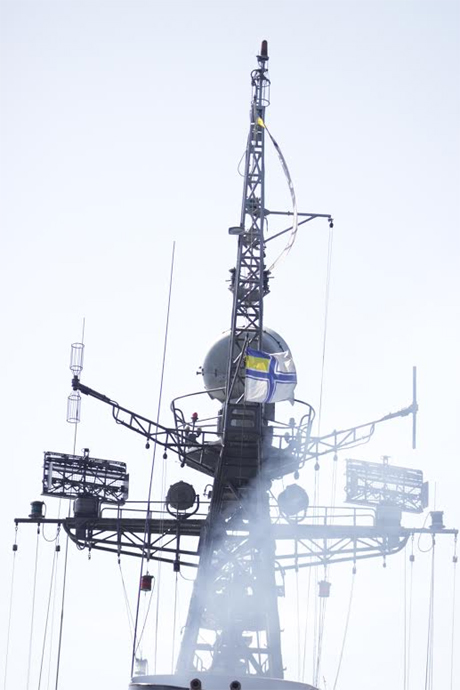
Flag of Ukrainian Navy on minesweeper “Cherkasy”
Soon after “Olshansky’s” seizure, there was an attack on “Cherkasy.” Just like with other Ukrainian ships, special forces got on a trawler and removed the crew. Now all the ships will be used by Russian militaries. What awaits Ukrainian servicemen who decided to stay on the peninsula, is still unclear. How they will be accepted by Ukraine? Is it their fault that there is nothing to protect in Crimea anymore?
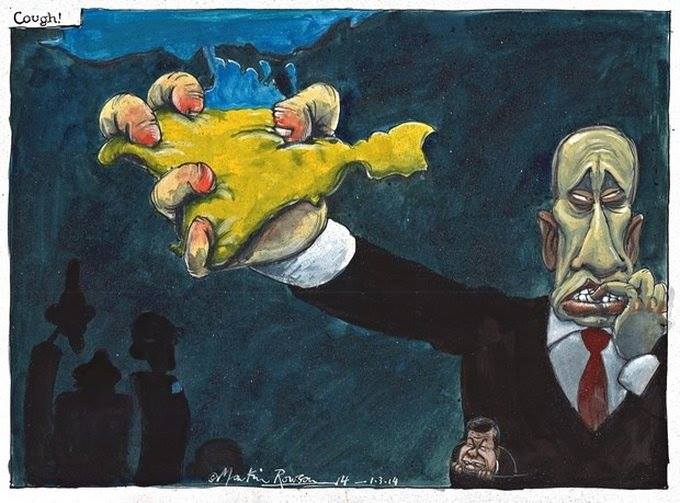
Today’s world politics are largely dominated by Vladimir Putin, the authoritarian leader of a country with nuclear weapons and a tremendous amount of energy resources, and his desire to stay in power forever. Putin sees two forces endangering his ability to remain in power – the West and the Russian masses.