 By Vitaly Portnikov
03.31.2014
Translated and edited by Voices of Ukraine
Source: http://lb.ua/news/2014/03/31/261351_duel_nevidimok.html
After Saturday’s party congress, it finally became clear that the main battle for the country’s presidency will unfold between two longtime political rivals, Petro Poroshenko and Yulia Tymoshenko. Even a few months ago, few could imagine such a confrontation. Tymoshenko seemed to be safely hidden in a hospital room by her primary opponent – Viktor Yanukovych, who started his inglorious reign by taking a sweep against his recent rival for the presidential elections. Poroshenko did not look like a real contender as well. Even during Maidan, his suggested run for Ukraine’s president was perceived more as the whim of a businessman, trying to make applications for his own political influence along with a place in the parliamentary elections – but certainly not to win.

MP Petro Poroshenko
But his absence among the “top three” of Maidan served as his pass into the big political league. Yulia Tymoshenko was absent from the Maidan stage, and now she can argue with a clear conscience for a more radical approach to the protest – which is easily evidenced by her unwaveringly radical addresses to those who have been on Maidan since December 1. And Petro Poroshenko was on stage, but he played the role of an “additional leader.” At first, just like many other oligarchs, he was quite cautious and waited to see where the protest would go. But when his cautious approach was replaced by his outright partisanship in the protest, Poroshenko’s possible role elicited jealousy from the existing threesome of opposition leaders and as a result, the Maidan troika did not grow into a quartet. Arseniy Yatsenyuk, Vitali Klitschko and Oleh Tyagnybok held all negotiations with Yanukovych without Poroshenko, who is the former Secretary of the National Security and Defence Council. Poroshenko did not become a new Speaker [of the Ukrainian parliament], because the responsibility for the [new] government logically fell on the Batkivshchyna party. Neither did he become the First Deputy Prime Minister, as he was already looking into the presidency when the new government had been formed and would rather see his own men in the government instead of busying himself with the current thankless job. Therefore, his involvement in the protest – coupled with the lack of real responsibility for its outcome and consequent actions of the newly appointed government – became for him a good starting point for participation in presidential elections.
However, there is another, and possibly the most important factor that helps Poroshenko’s presidential campaign, and that is the fear of Tymoshenko felt by the majority of [Ukrainian] society and especially by some of the “oligarchs.” These oligarchs view Tymoshenko as a person they could never negotiate with on equal terms or for the longterm, whereas Poroshenko is considered to be a person who is ready to compromise. But in fact, we can’t be sure how politicians will behave once they are elected. Tymoshenko always negotiated as a leader. The fact that it was either hard to find a common language with her or that deals made with her always implied an element of her own elevation, started to make sense when she became the Prime Minister.
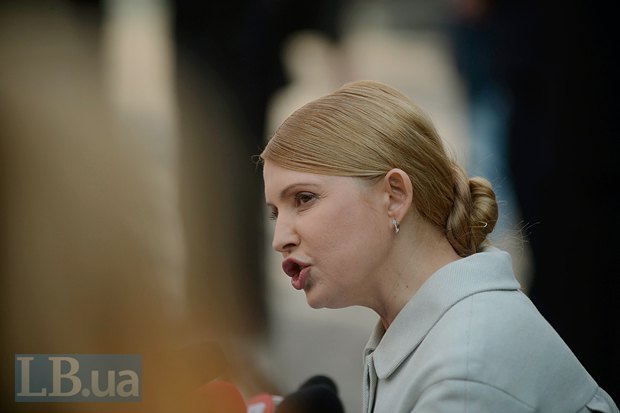
Yulia Tymoshenko
Poroshenko always negotiated in the position of a secondary player. He was not a leading figure in Yuschenko’s presidential campaign, and that is exactly why, even though he aspired to be the next Prime Minister, he was forced to be content with the lesser position of being Secretary of National Security and Defense Council, which did not become an alternative government of Ukraine. His controversial dismissal from the government turned him into a compromise and not the most influential figure. And that is why Poroshenko could become the Minister of Foreign Affairs in the last government of Tymoshenko – and roll with Yuschenko – and be the Minister of Economy in the first cabinet of Mykola Azarov, when Yanukovych took the reins.
This is undeniable flexibility, and an inflexible person cannot become a big businessman in Ukraine. The question is how this flexibility will last if Poroshenko becomes president of a parliamentary republic, and whether he, who lacks his own strong support in parliament, will be less inclined to compromise than Tymoshenko, who can count on her faction [Batkivshchyna]. Tymoshenko as president will have a lot of adversaries to fight in business but none in politics. Poroshenko can rely on support from some oligarchs, but will have to struggle politically in difficult conditions – when the United States and the West in general will support Arseniy Yatsenyuk’s government and rely on the president to adequately understand the tasks of the Cabinet, such a struggle could be disastrous for Ukraine’s future.
Another serious issue for any new head of the state is a complete lack of trust among the main players. The construct of “Poroshenko backed by Klitschko” is enthusiastically accepted by the RosUkrEnergo faction and that’s why even Serhiy Lyovochkin, the mastermind behind the previous authoritarian regime, did not hesitate to publicly support this combination, since it’s pretty obvious that what Firtash likes, cannot be liked by Akhmetov, and vice versa. And it’s, as we see, not only in response to the nomination of Poroshenko for the presidency and the rejection of Klitschko’s balloting, but that Akhmetov’s faction did not allow both Serhiy Tihipko and Yuri Boyko to run as Party of Regions’ presidential candidates, and instead virtually eliminated the party from meaningful participation in the fight by nominating Mykhayilo Dobkin.
Thus we come to a fair picture of the presidential elections on May 25. This is not a fight between Poroshenko and Tymoshenko. This is a “duel of the invisibles,” between the collective of Akhmetov and the collective of Firtash. In this, Akhmetov is not a big fan of former prime minister Tymoshenko, and I am not even inclined to think that he will support Tymoshenko. But he will do everything possible to weaken contenders he believes to be nominees of his main competitor. The Firtash group will do their utmost to help Poroshenko win, and make Tihipko and Boyko look like worthy presidential contenders. Akmetov, for his part, will try to prevent it. And Tymoshenko will use this split among oligarchs to score points and win in a situation that even for many of her supporters seems hopeless.

Oligarchs Rinat Akhmetov (L) and Dmytro Firtash (R)
What awaits us if one or the other candidate wins? Confrontation. If Poroshenko becomes president, he will not be able to get out of that system of agreements he becomes hostage to from the campaign in the absence of Klitschko – so he will have to make Herculean efforts to weaken the role of the government and strengthen his own executive authority – which not everyone will appreciate, because other groups will resist this, and remind the new president that his tasks are ratification of credentials and the armed forces, rather than financial flows. If Tymoshenko becomes the president, she will continue to work towards weakening the Firtash group positions and those who associated themselves with her political commitments during the campaign, which will lead to accusations of authoritarianism, concentration of power in the hands of one political force and attempts to prejudice public opinion against obviously unpopular reforms.
To avoid all of this is not possible. I’ve already written that the main result of Maidan was the dismantling of the criminal republic and the return to the oligarchic state. Wether it is possible to transition from the oligarchic state to a civilized economic, political, and most importantly – moral model of Ukraine – remains open. But, who of the leading contenders for the presidency will facilitate this transition Ukrainian voters will decide by themselves – and the voters themselves, as has happened more than once, will work out all the bugs after the elections.