By Miriam Dragina, specially for UP
04.23.2014 12:01
Translated and edited by Voices of Ukraine
Source: http://www.pravda.com.ua/articles/2014/04/23/7023346/

Dmitry Halko
Dmitry Galko is a journalist for the Belorussian publication “Novy Chas,” he has been in Ukraine for a month and half. He told Ukrainska Pravda about his trip to Sloviansk, the only blue and yellow flag, his illegal detention and Ukrainian troops who are guarding a checkpoint under the Russian three-colored flag.
Sloviansk is the centre of the Bermuda triangle which is now in Donbas. We got there from Donetsk at about 8 o’clock in the morning. The town looked eerie and ghostly at that time: no one was out, the streets were completely empty, the only people around were on the check points.
– What people?
That depends. They were all different, it is not clear if they were local or not. They were dressed and armed in various ways. Clubs, slingshots, knives. And there were also real military units and groups.
– Supporting Ukraine?
“No, there is nothing Ukrainian left in Sloviansk except for a Ukrainian flag on the Donetsk teachers training college. There are no Ukrainian police there any more.
There was a statement from the Ministry of the Interior that there were no witnesses to our detention, or witnesses of our presence in Sloviansk. It was strange for me to hear that, since no one from the government had been in contact and there were no police in Sloviansk at all. So there could not be any case or investigation.
– “You talk about troops, did they have any distinguishing insignia?”
“Of course I cannot be completely sure that they were Russian troops. But there were situations when it was possible to exchange a few words with them and we asked: “So where are you lads from?” What was going on? But no one said they were from Sloviansk. One of them said he was from Donbas, but Donbas is a big place.
Literally all the local people said these people had come from somewhere else, as if they had fallen out of the sky. But they were not from in town.”
– “Tell us a bit more about what happened in Sloviansk.”
“There was no one around the town hall, it was barricaded and impossible to get in. We went into the SBU building. There was an impressive barricade there, one man in camouflage was guarding it with a Kalashnikov in his hands, there was also a man in civilian clothes, he had a beard and was wearing an orange T-shirt. We asked him if it was possible to go in. He took the passports from the foreign journalists and said he would ask his commanding officer what he could do.
By the way, the bearded man in the T-shirt said his mother lived in Rome, they keep in contact, but he was staying there outside Russia. He went off to his commander and came back with him half an hour later.
The Commander looked like a Russian and talked like one. He showed us around the position for twenty or thirty minutes. They had armoured vehicles there, I don’t know if they had been captured or taken without a fight. The commander showed the equipment with great pride and said it would cross the Dneiper and storm Kyiv.”
– “What sort of military hardware did they have, and how much of it was there?”
“I think there were four combat vehicles. At that time only two vehicles had crews. At the entrance to the SBU building four armed people dressed in black came in. He categorically told us not to photograph these people, they would open fire if we did.

Separatists in Ukrainian combat vehicles near the SBU in Sloviansk. Photo: Anastasia Bereza
– “Black uniform?” “Like the Alpha group?” [Russian special forces]
“Yes, the special services uniform.”
The commander walked around with us for an hour and half then said that the audience was over, we should leave. He looked like a high ranking officer, almost a general. I asked if he could give us permission to go around the town and take photographs. He said we couldn’t. He only had authority in that area and his authority did not extend to the other places.
One interesting observation: the people who were there, about whom we just wanted to know who they were and why they were there, answered in a soldierly fashion: “We are not authorized.”
In Kyiv it was possible to talk with anyone who was in the mood for talking and no one ever answered: “I’m not authorized.” At Maidan everyone came with their own idea of things, and here, people just answered like soldiers.
These people are copying the Maidan. They have barricades just like the Maidan. And they also try to serve tea and some food.
Here there were women who, when they knew we were foreign journalists, started to kick the drunks out. There were quite a few drunks. They started to shoo them out of there so as not to spoil the picture. They offered us tea and coffee and we had a great time and felt perfectly relaxed. To no avail, it seemed.
After that we wanted to go to the area where the Roma were crowded in. We wanted to know if there had actually been pogroms. We walked a long time, we talked along the way with the people we met. When we went over the big bridge into Sloviansk we photographed a placard that said “Mines.” We did not take any more photographs, not even of the checkpoint that we went through.
People in camouflage appeared. I call them “amateurs.” They were not soldiers. One had a rifle or sawn-off shot gun. Another had a knife. I don’t remember what the third one had.
They came up to us and said we were spies and were taking hidden film. I answered that we were not doing anything of the sort. I invited him to look at our photographs. But they still answered that we should wait and they would check it out.
A car came and they pushed us into the back seat and took us to a third checkpoint.
“Who is with you?”
An Italian photographer, Cosimo Attanasio and a French journalist and photo correspondent Paul GOGO, both freelancers.
“They took us off but a group of ten people surrounded the car and pushed their masked faces into the window. They asked who we are, they wanted us to give them our camera they threatened to take and break it. They were extremely unpleasant. The others were very frightened, and so was I.”
– “Did the others not speak Russian? Did you translate for them?”
“No they don’t speak any Russian, I was their only translator.”
They took our passports and cameras to check them. They took us out and then, without documents and equipment told us to stay there. They walked about fifteen metres away from us. This was a group of people dressed in camouflage, not amateurs, they were armed with AKs, which looked like new models. I am not an expert but Cosimo said that these were not the usual AK-47, but a new model of Kalashnikov, which only the Russian army had.
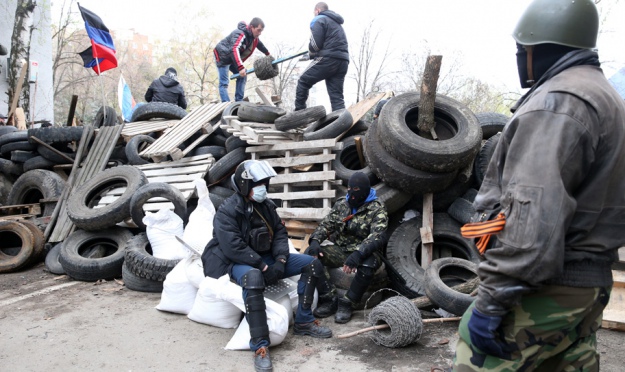
Barricade on one of the streets of Sloviansk. Photo ITAR-TASS/Mikhael Pochueb
In fact when the situation calmed down a bit we asked what the weapons were. They said they had been given them temporarily, but gave no further details.
Suddenly, as if on command their attitude towards us changed. Either someone gave them an order or they found out that this was the policy for behaviour with foreign journalists, basically they suddenly became concerned about their image. And they decided to show how they were all very nice: “Please excuse us, this is a war situation, etc…” And they let us go.”
– “Did they give back your passports and cameras?”
“Yes, they gave everything back. So we thought everything was all right now and carried on the same route, over the bridge. But they stopped us at a checkpoint on the other side.
We can’t call it arrest, they just took us, we showed them the photos we took on the third checkpoint. We told them that they had looked at everything, checked us and let us go.” And they answered: “We don’t know who checked you. We are independent. If you don’t have permission from our authorities, get out of here! Or you can get it at the City Council!”
About the City Council. I heard from many journalists, including Paul GOGO who tried unsuccessfully to get into the building three days before, that it was impossible to get permission. At the same time the Moscow Times journalist, Oleg Sukhov had been detained as a member of the “Right Sector.” They even took him to a room where Sergey Lefter (the Ukrainian journalist who had been kidnapped earlier – ed) was sitting opposite him. His hands were tied to the chair and a green man with a machine gun was guarding him.
Because, of course, we did not go for any fake authorization. That’s funny, there is no authority there, no one knew what was there.
And still on the way when we had already turned back from the second checkpoint at the bridge when a jeep, painted in the colours of the Russian flag, stopped beside us. There were people in a very new uniform, in masks, with arms and let’s say they looked at us very severely. That was the last straw, we decided to get out of there as fast as we could.
– “Did the jeep have Russian or Ukrainian plates?”
“I think the jeep didn’t have plates, but I could be wrong. And it was painted all over in the colours of the Russian flag.
By the way, about numbers. Not far from the SBU Building I saw a car with battered plates but with some sort of Russian license on the window, some sort of vehicle inspection. A paper with a Russian flag was stuck to the window. It was not just a sticker, but something official. Around the city I noticed some police cars, they looked Ukrainian, but the people in them had the same camouflage, and they were armed.
That is, they control the city completely, Sloviansk is occupied.”

Sloviansk “separatist.” Photo uainfo.org
– “And what are these armed people called?”
“They didn’t introduced themselves. They had “Donbas People’s Militia” written all over. But no one introduced themselves. No one said anything about themselves.”
The only person who talked to us was a civilian without a mask and with a ribbon of St. George who was at the checkpoint. Some sort of Orthodox fundamentalist. It wasn’t clear who or what he was: local, he even showed his passport, he kept his Soviet passport, under “nationality” was written: “Russian.” He was proud of it. And said that we were all Russian Orthodox. That is, we don’t want any “European infection.”
He was the only one who talked with us normally, he even talked about his motives. A lot of people had beards, not just because they hadn’t shaved for several days, but they did actually have big beards as if they were some sort of Orthodox group. Maybe they were from Sloviansk, I don’t know.
There were a lot of openly fringe looking people, drunks, criminal elements. That was the second group.
And the third group were soldiers. One hundred percent soldiers. With military bearing all in order.
– “So the Russian army is on Ukrainian territory?”
“I would say so. I’m afraid so. They would have told us if they had wanted to deny it. But they did not say anything about themselves, they did not show their passports, they did not introduce themselves. They don’t even dare to say they are from Sloviansk.
What can we think, then? Only one thing to think. Particularly as the locals don’t consider them to be locals.”
– “Do they support them?”
“You know, they look on them as like some sort of bad weather. Some sort of thunderstorm: what can you do about it? They don’t support them, they just have to put up with it.
Several people said the same thing: “Everything was all right before they came.” Which amounts to supporting Ukraine. Ukraine is really weak. No one is going to fight for that and they’ll even resign themselves to it if their territory is occupied.
But all the same I didn’t meet a single person who said: “Yes, they are defending me, they are here for us. And you filthy Europeans can get out of here!”
No one said that.
– “Did you meet anyone?”
“We crossed the road without any problems, took a taxi and went to the station where, by coincidence, we met the last Roma in Sloviansk.
He was terribly frightened. He had come back to get some children’s things, he was in genuine horror. I stopped him and asked him to tell me what was happening.
The whole Roma community had left town the day before. He said it was because they had fired on the houses from the street. All the community leaders received threats that they would be totally exterminated, including children, if they did not leave. He said that the armed people only want Russian speakers to stay in the town.
This did not just affect Russians. He mentioned that his neighbours who speak Ukrainian also received similar threats.
Someone from the Gypsy community asked us to help him get to Rinat Akhmetov, he said he wanted to talk to him.
That is Rinat Akhmetov is here taken as some sort of arbitration tribunal and de facto governor. Although, for example, separatists in the Donetsk administration considered it traitorous that in the last Dynamo – Shakhter match the Shakhter fans were flying Ukrainian flags. They believe that Akhmetov has betrayed them in some way. But they still acknowledge him as a Tsar or prince.
We missed the train so we took a taxi to Kramatorsk. On the way at a checkpoint on a dust road there was an obvious fringe group who said we are European Union spies. They complained about the Frenchman and the Italian because of their passports, although it was the first time they had ever seen a French or Italian passport.
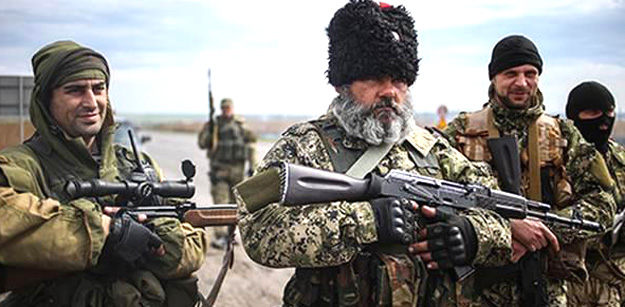
Further on, 16 kilometres from Donetsk, I saw a very strange checkpoint. It looked like Ukrainian troops were standing with the so called citizen militia under a Russian and St. George flag.”

Cossacks keep the defense at one checkpoint. Photo: Ekspert.onlayn
– “I want to check about the soldiers: did they have any identifying signs?”
“Yes, they had Ukrainian chevrons. That’s suspicious. What sort of antiterrorist operation can we be talking about?
The Bermuda triangle, Sloviansk, is spreading everywhere. And we have to do something fast, otherwise it will turn out badly.”
– “For how long were you in Sloviansk?”
“Overall we were in Sloviansk for about ten hours. And they detained us no more than two hours.”
– “Did they beat you?”
“No, at first they restrained our hands, but that was all.
– “Have you been in Ukraine long?”
“I’ve been in Ukraine since March 8 [2014]. At first in Kharkiv, then Donetsk, Dnipropetrovsk, Odesa, Kherson, Zhytomyrshchyna, Novohrad-Volnynksi, Kyiv, Kharkiv, Donetsk.”
– “Have you been to Crimea?”
“After my conversation with the SBU in Donetsk at the start of March I realized that I have a very clear pro-Ukrainian position, even though I am a journalist. Then I realized it was better not to go to Crimea. Especially after I met some people who were in captivity for two weeks in Crimea, who had stayed on during operations in Kherson.
In Donetsk there was a story with me – I was detained by the SBU in Donetsk. I lived in one room with an SBU agent, it was still Ukraine then. But that SBU detention, I don’t know, it was not a big deal, I calmed down very quickly, there some services were working, they indicated someone, some bombs.
But it’s difficult to say what’s happening there now.”

 Staunton, April 26 – Tatar organizations in the Middle Volga have nominated Mustafa Dzhemilev, the longtime leader of the Crimean Tatar national movement, for the Nobel Peace Prize, a step that calls attention to Dzhemilev’s efforts to defend his land against Russian aggression and growing ties between the Tatars of Crimea and the Tatars of the Middle Volga.


 @BBCr4today