By Jonathan Barrow, Brit on the Barricades
06.01.2014, Maidan, Kyiv
Edited by Voices of Ukraine
This post has been written by our contributor who lives in Kyiv. Jonathan Barrow is originally from Britain but has been living in Ukraine for many years now and spent much of February on Maidan.
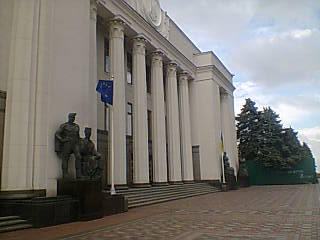 1: The EU flag flies outside the Verkhovna Rada [Ukrainian Parliament] (a statement of intent?) alongside the Ukrainian one. No protests there, all is quiet and tidy.
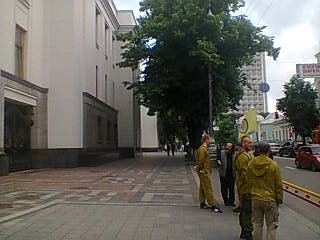 2: A few Self-defense members are still around the Rada; unlike any time in the past, the public can now freely walk past the Rada on this footpath. In the past, there have always been guards preventing public access. Perhaps this is what the Self-defense are ensuring.
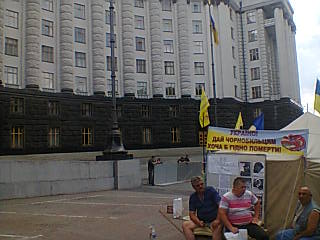 3. The camped-out guys are ex-Self-defense members; also pensioners. They told me they are camping outside the Cabinet of Ministers building in some kind of unpaid pension protest. The building guards, in the background, are young army national servicemen. No scowling at the public, I was happy to note.
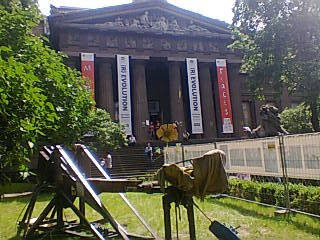 4. At the Ukrainian Art Museum, on Hrushevskiy Street, there is a ‘Revolution’-themed display. In the foreground you can see the big catapult which I saw arriving on Maidan on I think Friday on February 21 (when it was clear to me that Yanukovych was finished). At the time, I was concerned they would actually start using it–it could easily have killed police and started smashing up public buildings. Never used though.
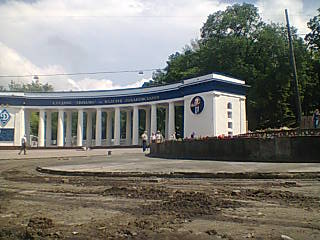 5. The entrance to Dynamo Stadium has been fixed up–this was a charred wreck. Stripped paving in the foreground, but Self-defense have gone.
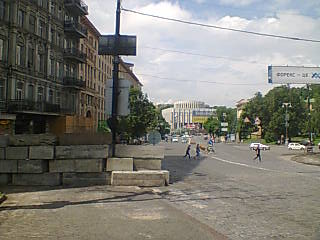 6. All that remains of the barricades at Hrushevskiy St. (here looking toward European Square) are some large concrete blocks–these are post-protest.
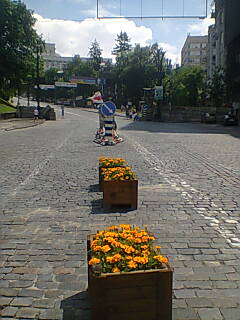 7. Looking up Hrushevskiy St., towards the Verkhovna Rada. There is a shrine to the Belarussian, Mikhail Zhyzneuski, who was killed [shot dead] early on–you can see a Belarus flag here. Like many others, I had a rifle trained on me here–they were trying to scare people.
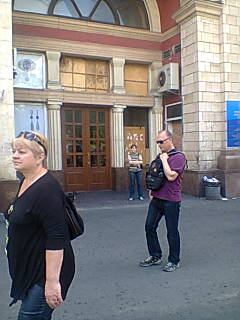 8. This was the Hrushevskiy medical centre, before the Berkut stormed it, which resulted in it getting smashed up. Now it has a new door. Quite a few people are still visiting Maidan from elsewhere in Ukraine–it’s still a place of national pilgrimage. Often you see groups of maybe six to ten late middle-aged to elderly people, who have travelled to Kyiv and are going around all the key sites. I’ve also seen elderly North Americans doing this.
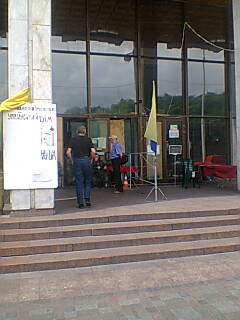 9. The entrance to Ukrainian House, on European Square. This is now HQ for the First Kyiv National Guard Battalion. They would not let me in at first, but I managed in the end. I asked a girl working in the Info Centre how long they were planning to stay there: the reply–‘as long as we need to.’ Quite honestly, it didn’t look like there was much going on–a few people dozing and there were remnants of some of the old Self-defense stuff.
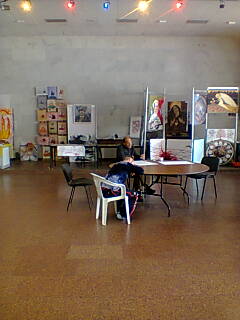 10. Inside Ukrainian House. I think this is probably the recruitment desk. I once asked about joining the National Guards. They said you have to speak fluent Ukrainian (for communication purposes). I actually think this is a strategic mistake–both sending a certain message and preventing Russian-only speakers (like many in Kyiv) from signing up.
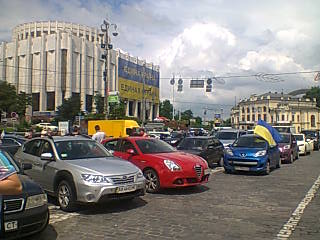 11. Cars parked up at the top of Khreshchatyk St.–they had come for a ‘Viche’ (public meeting).
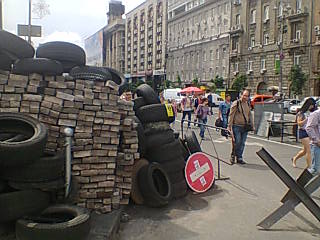
 12. Barricades are now mainly made of paving bricks and tires–most of the detritus has disappeared. These neat piles of brick were not a feature of the protest-period barricades; they appeared just after.
 13. The area now features art displays (rear), stalls selling souvenirs (left) and some burned-out cars.
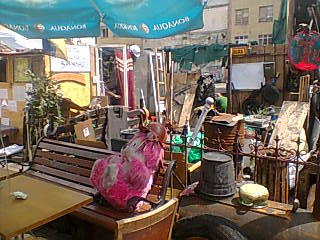 14. A small and eclectic museum, with a collection of Maidan stuff. One feature of local design is quirkiness (see pink rabbit to the front); also colourful folk art–which was a feature throughout the protest period. I once slipped into the large titushky camp in Mariinskiy Park, and the absence of this artistic flair was quite noticeable. It’s really a feature of the west and parts of the centre of the country. I could distuinguish titushky (who were bussed in from certain parts of the east–notably Donbas) and protestors (skewed towards the west) a mile off. The former never wore natural materials; the latter liked leather workboots and woolly jumpers.
 15. Protestors organised themselves into camps based on regions (here Donetsk) or social groupings (like Afghan veterans). Though all were welcome, and I once spent a cold and snowy night staking out Berkut HQ with a guy from Simferopol, the city of Lviv was always heavily over-represented. I always had the impression that the west, being less Sovietized, had a greater sense of liberty.
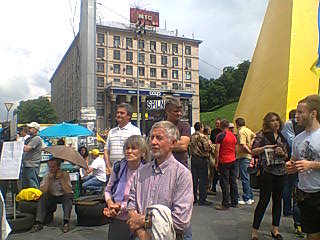 16. Today there was a Viche on Maidan central square. Note the people’s faces. One misassumption that I often come across is that the protest was predominantly a student/young people’s movement. You can trace events back to the tax demonstrations in 2010 (which I took part in–the tax reform was a clear attempt to create commercial monopolies); and the same kind of people were at the first big demo on European Square in November of 2013. At 44 years old, I was one of the younger faces in both events. The student and youth element, while noisy and colourful, is only part of the story. I would say that during the long, cold winter of 2013–14 the heart of the protest movement rested with 5,000 to 10, 000 mainly middle-aged guys. They found themselves trapped on Maidan–afraid to leave, fearing a knock on the door if they returned home. The Yanukovych government repeatedly failed to end the protests when they could quite easily have done so: instead, preferring attacks, clampdowns on freedoms and absurd lies.
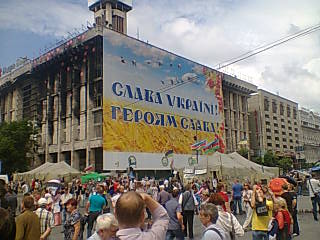 17. Today’s Viche, about 3,000 to 4, 000-strong, looking towards the Trade Union Building–which is now covered with a large poster. I struck up a conversation with a satellite engineer, who has lived in England. He filled me in on the main points. In essence, people were calling for representatives of the government to come to Maidan next Sunday, to inform the public about their achievements to date and their strategy for the future. They believe that the government is failing to give out clear information. I fully agree with this–there is still a habit of secrecy, and propogandizing. This will be one of the hardest fights–reversing the attitude of the state towards the public. For this reason, I think Maidan–a focus and a tool of threat–must stay; I do not even think the main road (Khreshchatyk) should be re-opened. A further point being made was that, apparently, of 72 bills presented to the Rada–to reform the state–only two have been passed. In my view there is an increasingly pressing need to have new Rada Elections, or the old bunch (in essence, still there) might just regroup and re-solidify.
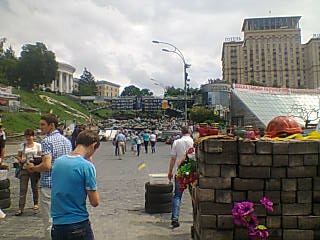 18. Looking up the hill, at the bottom of Instytutska Street. Further up this road, the trees, lamp-posts and the corner of the Ukraina Hotel (to the right) are pock-marked with bullet holes. Someone I knew (from work) got shot and killed here. I remember body after body being brought out on Thursday, February 21–though at the time I did not realise the number of deaths (neither did many others–you could be at the Bessarabka barricade [Bessarabska Square] and have little idea what was going on at Instytutska St.).
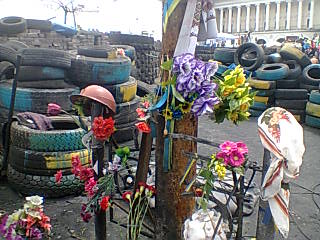 19. A typical small shrine; these still dot the area. A small wooden chapel has been built on Instytuska, near the top of Khreshchatyk metro exit, right on the scene of the greatest number of deaths. However, the general funereal atmosphere on Maidan is now disappearing.
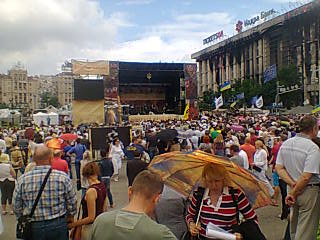 20. The main stage on Maidan, with today’s speakers (not sure who). I once appeared on here, with some Democratic Alliance people (not UDAR). I have been told that it’s pretty hard to get on the stage now–which has led to some conflict but may have been necessary (to stop constant loud speechifying). Other, smaller platforms have popped up elsewhere.
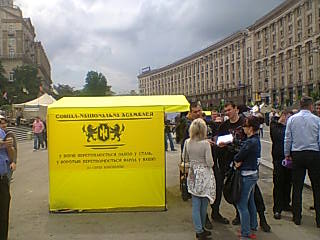 21. This looks like a ‘Socialist National Congress’ tent. Have not seen this particular lot before–but the swastika-like symbol in the middle is familiar. I have not checked out this symbol’s historical significance much; but of course this kind of thing has fed the grains of truth in Russian propaganda. I also saw swastika tattoos on some people, on Maidan. These totalitarian types were always in a small minority, but did at certain times become especially noticeable. I was as wary of them as Yanukovych and his gang–after all, have a similar mentality. The whole idea of ‘fascism’ seems to me even more abused here than in the West–though it carries a rather different significance. Here, ‘fascist’ often meant ‘enemy of the state’–hence, in some quarters, may have become a kind of protest symbol (perhaps like the hammer and sickle in the West).
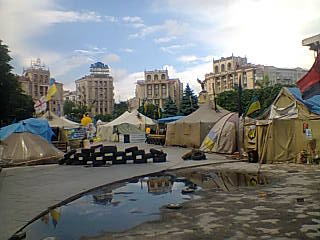 22. The scene on the main part of Maidan.
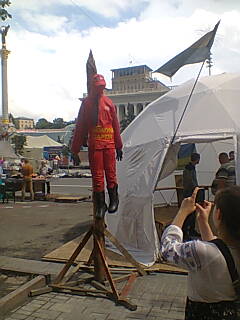 23. A hanged communist effigy. I am not in favour of banning the party, much preferring that it just dies a natural death–as I think it now will. To me, one large and already-achieved consequence of Maidan has finally been to end the post-Soviet era (except, perhaps, in Donbas). Ukraine was far more integrated into, and damaged by, the USSR than ‘occupied’ countries like Poland and Czechoslovakia. When James May started his quest to get recognition for the Holodomor–he arrived here in 1990–the whole subject was taboo, and widely unrecognized. This is a part of their history that Ukrainians need to understand and learn from.
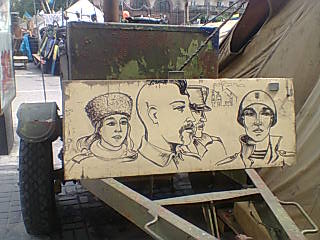 24. This kind of artwork is common on Maidan.
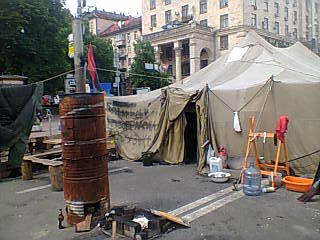 25. Protestor’s camp.
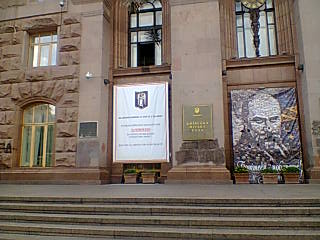
 26. Kyiv City Hall (where the Mayor is based); still shut down. Klitschko is trying to move in, but as yet without success.
 27. Looking up Khreshchatyk, towards Maidan. I would estimate that there are still maybe 300 to 400 Self-defense people scattered around. Some seem to be intent on seeing events through, distrustful (rightly so) of the government; others have little to go home to; still others (from Donbas/Crimea) may be unable to return.
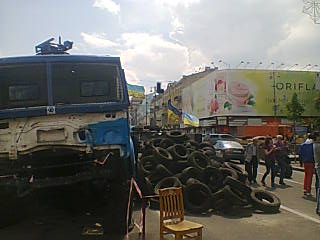 28. The Bessarabka barricade.
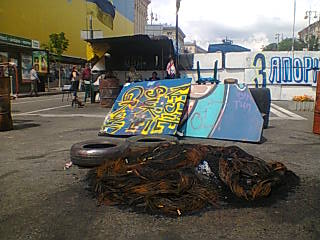 29. Looking towards the Bessarabka barricade, from outside. Akhmetov’s department store project (swathed in a Ukrainian flag) is on the left. The burned area in the foreground is one of a few spots in this area where fires were set yesterday, to prevent municipal workers from starting a clean-up (under Klitschko’s instructions). I am a bit undecided about this. I’m starting to feel that quite a few Kyivites want at least most of Khreshchatyk cleaned up–so maybe a designated area on Maidan is the best way forward. I once read an interview about the Lithuanian experience of dealing with the same issue (have looked, but can’t find the link now).
Read More:
New Tasks of Maidan
http://www.day.kiev.ua/en/article/topic-day/new-tasks-maidan
Kyiv’s Mayor-Elect Klitschko on Maidan (June 2):
http://online.wsj.com/articles/kievs-mayor-elect-klitschko-reverses-call-to-quit-maidan-protest-camp-1401654378
KyivPost: Kyiv cleans up Maidan (June 1):
http://www.kyivpost.com/multimedia/video-2/ukraine-news-one-kyiv-cleans-up-maidan-protest-camp-350231.html
Marta Dyczok, Toronto Star (June 1): “What’s Next for Ukraine’s Maidan Protesters?”
http://www.thestar.com/news/world/2014/06/01/whats_next_for_ukraines_maidan_protesters.html
Organization for Security and Cooperation in Europe (OSCE) report of the
Special Monitoring Mission to Ukraine (June 1):
http://www.osce.org/ukraine-smm/119403?utm_source=feedblitz&utm_medium=FeedBlitzRss&utm_campaign=oscelatestnews
Chrystia Freeland, Maidan and Ukrainian Oligarchs:
http://www.politico.com/magazine/story/2014/06/the-search-for-an-honest-oligarch-107543_Page2.html#.U5RqfMalKlI

 Mokruschyn und Melnykow




 Voices of Ukraine