Dmitry Tymchuk, Head of the Center for Military and Political Research, Coordinator of the Information Resistance group, Member of Parliament (People’s Front)
02.04.2016 Translated and edited by Voices of Ukraine
(See end of post for acronym glossary)
Operational data from Information Resistance:
Active shelling by Russian-terrorist troops in Donbas continues to involve the use of the allegedly “withdrawn” weaponry, including 120-mm mortars and MLRS.
During the past 24 hours, militants fired on the ATO forces’ strongholds near Pisky, using small arms, grenade launchers (including at least ten rounds from SPG-9’s), as well as 82 mm and 120 mm mortars.
Terrorists fired heavy machine guns, AGS-17’s and SPG-9’s at Ukrainian troop strongholds near Opytne, the “Zenith” [position], the Butovska [mine] and the eastern outskirts of old Avdiivka. A militant BMP-2 fired from its on-board 30-mm automatic cannon from positions near Spartak.
In the vicinity of Krasnohorivka, militants used 120 mm mortars (firing from the northern outskirts of Staromykhailivka). A terrorist sniper group operated near Mar’inka from the “Crocodile” waste bank and from further right. The enemy is using a “shelling– target location” technique: either a heavy machine gun starts firing or a small enemy infantry group enters the neutral zone – an ATO forces’ unit takes up positions – and a militant sniper then goes into action.
Near Horlivka, militants fired at the ATO forces’ stronghold northeast of Novoselivka from the southern outskirts of Shyroka Balka, using 82 mm mortars (three pieces). An armed gang positioned on the waste banks near Poselok6-7 and near Hornopromyslova Street continues shelling the ATO forces’ stronghold south of Mayorsk, including with 120 mm mortars (with both Ukrainian troop positions and private residence areas coming under fire). A similar situation is observed in the Zaitseve–Zhovanka area, with militants using AGS-17’s and heavy machine guns from the southern part of the settlement and the waste bank north of Terykonna station. Recently, this locality has also come under enemy fire from 82 mm and 120 mm mortars fired from the direction of Holmivskiy, and machine gun fire from the waste bank at the western edge of the settlement.
Militant small arms fire from the neutral zone was noted near Rozsadky. Near Troitske, SPG-9 and small arms fire came from the direction of Kalynove. Near Hranitne, militants directed AGS-17 fire and unsighted small arms fire towards Ukrainian troop positions.
In the Mariupol direction of operations [toward the coastal areas], militants deployed “Grad” BM-21 MLRS. Namely, a terrorist BM-21 “Grad” MLRS battery (3 systems) operated from the direction of Kominternove, previously brought to this area from positions east of Dzerzhynske. East of Sakhanka, two militant tanks were spotted being transferred northwards, while a terrorist armored vehicle group of six BMP-2’s and MT-LB’s has taken up positions in the same area.
“DNR” militants are being withdrawn from Sanzharivka (Artemivskyi district, Donetsk oblast) as part of a troop rotation – six to seven trucks of personnel per day. For some unknown reason, the units are being taken to “LNR” territory. Part of the personnel has been transferred to Alchevsk (at least one terrorist battalion is billeted there at present). Additional personnel are being deployed to the vicinity of Luhansk.
Militant artillery near Horlivka has been redeployed, with the arrival of a 5-piece battery of D-30 and D-30A howitzers (without the gun crews) near the Mykytivka station. The howitzers are on trailers, and the gun crews are being transferred separately.
A terrorist armored group of three T-72 tanks and four IFV’s (three BMP-2’s, one BMP-1) has been spotted east of Yenakijeve. The armored group is transferring northwards, towards Vuhlehirsk.
Dmitry Tymchuk, Head of the Center for Military and Political Research, Coordinator of the Information Resistance group, Member of Parliament (People’s Front)
02.02.2016 Translated and edited by Voices of Ukraine
(See end of post for acronym glossary)
Operational data from Information Resistance:
After a period of accumulating forces and equipment in the “Horlivka Garrison” (as regularly reported by the IR group), Russian-terrorist forces stepped up their active efforts in the Horlivka – Artemivsk direction of operations. Namely, there has been a sharp increase in shellings of the ATO forces’ positions near Zaitseve and Mayorsk, including with the use of armaments that should remain withdrawn from the demarcation line according to the Minsk Agreements (tanks and 120 mm mortars).
In the vicinity of Zaitseve and the Zhovanka river, terrorists deployed the previously-spotted battery of four 82 mm mortars and two mortar units transferred here earlier (six 120 mm mortars). Terrorists opened fire from the area of Poselok 6-7 on the ATO forces’ south of Mayorsk, multiple times, using mortars and AGS-17’s. A terrorist tank unit (3 tanks) was spotted in the area of Holmivskyi.
The situation in and around Donetsk remains “traditionally” tense. During the past 24 hours, militants fired on the ATO forces’ positions north and south of Krasnohorivka, from the direction of Zhylmaidanchyk [Zhylploshchadka] and Staromykhailivka (in addition to small arms and grenade, 120 mm mortars were used). On the stretch from Pisky to Avdiivka (Opytne, Butovska [Mine], the “Zenith” [position], the outskirts of old Avdiivka), terrorists’ fire was practically continuous. Terrorists mainly used small arms and grenade launchers; SPG-9’s were deployed near Pisky.
In the vicinity of Mar’inka, militants are firing continuously from the so-called “Crocodile” position [a natural elevation], using grenade launchers and machine guns; several shots from SPG-9’s were also recorded. Near Starohnativka, a militant mortar unit (three 82 mm automatic grenade launchers) shelled the ATO forces’ advanced observation point and stronghold flank.
The enemy advanced a new unit into the gap between the DAP and Pisky, towards Vesele. The unit consists of 50-60 personnel with four BMP-1’s and BMP-2’s. A battery of 82 mm mortars has been withdrawn from the area of the DAP further into Donetsk (possibly, as part of forces rotation).
South of Luhanske and east of Troitske, terrorists are using small arms, and, in several instances, AGS-17’s. Detonations of 120 mm mortar projectiles were recorded near Stanytsia Luhanska (up to 10 projectiles, overshooting the target) and fired from across the Seversky Donets river.
In the coastal regions, militants deployed ZU-23-2’s from the direction of Sakhanka and its eastern outskirts. The use of 82 mm mortars was also recorded.
On the stretch from Novhorodske to Novoselivka, militant ZU-23-2’s operated from several firing points simultaneously; militants also used two BMP-2’s (30 mm automatic on-board guns). Fire was directed at several ATO strongholds and observation points at the same time. Heavy machine guns were also actively used.
Between Styla and Dokuchajevsk, the enemy is regrouping their forces. Specifically, artillery – four batteries of “Rapira” MT-12 anti-tank guns – were transferred towards Dokuchajevsk under cover of dark. Two MT-LB’s were also transferred. At the same time, a militant infantry unit (up to 50 personnel) was moved from the area of Dokuchajevsk in the direction of Styla.
Dmitry Tymchuk, Head of the Center for Military and Political Research, Coordinator of the Information Resistance group, Member of Parliament (People’s Front)
02.01.2016 Translated and edited by Voices of Ukraine
(See end of post for acronym glossary)
Operational data from Information Resistance:
Russian-terrorist troops in Donbas continue shelling the ATO forces’ positions and civilian objects, using small arms, grenade launchers, mortars (82 mm and 120 mm), anti-aircraft guns, and armored vehicles. Militant activity has sharply increased at the front line, in terms of DRGs and terrorist infantry groups.
During the past 24 hours, militants actively shelled Ukrainian troop positions in the Donetsk direction of operations. Near Opytne, the enemy fired from the direction of the DAP and waste banks in the western outskirts of Spartak, using three heavy machine guns, AGS-17’s and SGP-9’s. Fire from two 82 mm “Vasilek” 2B9 automatic mortars was aimed at the ATO forces’ two strongholds in front of the Donetsk Bypass near Opytne, as well as at the “Zenith” position and Butovka [Butovska Mine].
The ATO forces’ positions in the vicinity of Pisky and the stronghold southeast of the town came under fire from two directions: from the private residences area at the Vtoraya Ploshchadka estate, and from an area north of Zhobunky, to where a militant group has advanced. Terrorists deployed heavy machine guns and grenade launchers (AGS-17, SPG-9, RPG-7, RPG-22, GP-22). A militant infantry group attempted to take advantage of the off-road terrain and approach the ATO forces’ observation point and stronghold south of Pisky. After the ATO forces’ battlefield security opened fire from automatic weapons and machine guns, the enemy fell back.
Near Mar’inka, the enemy fired from the high ground dubbed “Crocodile,” using SPG-9’s (six shots), small arms, and AGS-17’s. Sniper fire was also recorded. A militant armored group operating near Oleksandrivka (previously mentioned by the IR group) has been transferred to an area south of Mar’inka.
In the vicinity of Krasnohorivka, militants opened fire from heavy machine guns from the direction of the western outskirts of Staromykhailivka; the use of AGS-17’s and ZU-23-2’s was also noted (at least two of the latter were spotted). Following that, three or four 82 mm automatic grenade launchers (“Vasilek” 2B9 or similar) fired on the front line of the Ukrainian troops from positions north of the lakes in the Abakumivka district. The enemy also opened fire on the northern outskirts of Krasnohorivka (near Krupskoy Street), using 120 mm mortars (11-12 projectiles).
Militants fired on the ATO forces’ positions near Rozsadky and Skeleve from the 307.9 m high ground and from Nyzhnje Lozove. Terrorists actively used SPG-9’s and 120 mm mortars. In the same area, terrorists opened fire from heavy machine guns and automatic small arms, in multiple instances.
Terrorists fired on the eastern outskirts of old Avdiivka from the 251.2 high ground (near the Yasynuvata junction), using mainly AGS-17’s and 82 mm mortars. It should be noted that no Ukrainian troops are concentrated in this area.
Near Novhorodske and east of Novoselivka, terrorists actively shelled the ATO forces’ positions from small arms. We also recorded the use of at least two AGS-17’s, and shots from a SPG-9. A stationary ATO observation point and two advanced strongholds came under fire. In the same area, militants opened fire from BMP-2’s from the flank of one of the ATO forces’ strongholds. A pair of enemy BMP-2’s (under covering fire from AGS-17’s and a BTR-80, which remained at stationary positions) advanced into the greenery northwest of the Batmanovka river. From there, one of the BMP-2’s opened fire on the stronghold from its on-board 30 mm automatic gun. The other did not open fire, but was used for observation, fire direction, and to provide cover for the first BMP.
In the vicinity of the Zhovanka river and the village of Zaitseve, militants opened heavy fire from automatic small arms, several times. The use of 82 mm mortars was also recorded (a battery of 4 militant mortars fired from the southern outskirts of Zaitseve).
In the coastal regions, terrorists near Shyrokyne used a mobile firing group with a platform-mounted ZU-23-2 and a pair of 82 mm mortars to shell the ATO forces’ advanced positions.
The enemy opened small arms and grenade launcher fire in the vicinity of Stanytsia Luhanska, on the ATO forces’ right-flank positions. Mortar shellings were recorded near Troitske, from the direction of Kalynove (82 mm and 120 mm mortars). Near Sokilnyky, militants opened fire twice, from heavy machine guns (using the usual “two-point” scheme) and AGS-17’s.
In Donetsk, infantry and firepower are being transferred to the Petrovskyi district from other parts of the city. In total, some 20 KAMAZ and Ural trucks carrying personnel were moved over the past weekend (from different directions, mainly moving via Petrovskoho Street and Vuhlehirska Street). A concentration of enemy personnel and equipment is observed near Trudovski and Zhylmaidanchyk [Zhilploshchadka] districts. Notably, a mortar battery has also been transferred to this area (six vehicles with 120 mm mortars on trailers).
Militants continue reinforcing the Stakhanov group of the “LNR” forces. Additional firepower, combat equipment and personnel keep arriving for the two units deployed in the Alchevsk – Perevalsk area (resupplied to the strength of one reinforced battalion) and along the Polyove – Pervomaisk line. During the past 24 hours, up to 10 pieces of armored equipment and 100 personnel were transferred here.
By Anton Naumlyuk, photographer and Svoboda correspondent. All photos and video by Anton Naumlyuk
01.29.2016 Translated and edited by Voices of Ukraine
“I fear for every Ukrainian who comes to Russia.” As of January 29, 2016 – Nadiya Savchenko has been on her second hunger strike protest for 43 days.
Photo: Anton Naumlyuk
The trial of Nadiya Savchenko – the Ukrainian soldier seized by separatists in Donbas, and transferred to Russia, where she is accused in the deaths of VGTRK [All-Russia State Television and Radio Broadcasting Company] journalists Igor Korneliuk and Anton Voloshin – is nearing completion.
The defense side, as seen, has been at work over the past few weeks and is presenting “surprises” to the investigation and the court. Situated near the Ukrainian border, the Russian city of Donetsk, where the trial is held, has witnesses and experts coming from Ukraine for every session. According to lawyer Ilya Novikov, a month ago, he did not expect the finale to be so intense.
The Judicial Board, which examines Savchenko’s case, has refused to summon from Ukraine the witnesses proposed by the defense. First of all, these are former and current military of the Armed Forces of Ukraine (AFU) – from the 80th Brigade and the “Aidar” Battalion – who took part in the battle against the separatists in the self-proclaimed “Luhansk People’s Republic” on June 17, 2014. Potential witnesses – among them a former fighter from the “Aidar” Battalion, Alexander Godzyakovsky, whom the separatists captured when he was driving Vira Savchenko to help her sister – informed Savchenko’s lawyers of their preliminary consent to visit, but requested security guarantees. Such guarantees could be in the form of an official summons from the Donetsk Court through the Ministry of Justice of Ukraine. Incidentally, this is how all Ukrainian witnesses for the prosecution were summoned, including the head of the unrecognized republic Igor Plotnitsky. It is unlikely that the Ukrainian Ministry of Justice handed him a summons to the Donetsk Court, but the court did issue a formal summons with his name. In the case of the defense witnesses, the court was not so considerate.
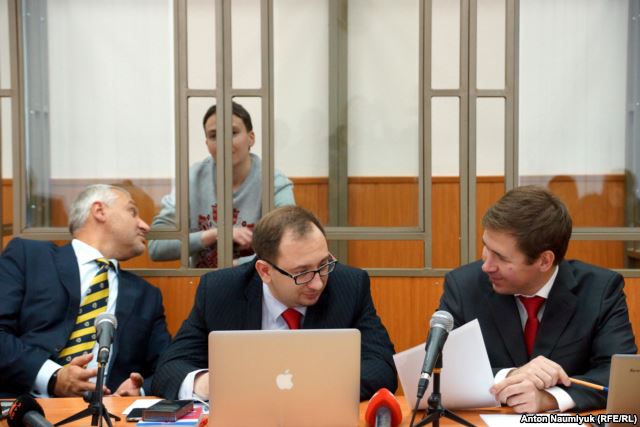
Savchenko and her lawyers in court in Donetsk, Russia.
“I fear for every Ukrainian that comes to Russia,” Savchenko said. “If the court can ensure their safe travel to the trial and back, then call them. If not, do not summon them.”
“People who came to Donetsk from Ukraine to testify as witnesses in Savchenko’s defense, did so in spite of the danger that threatens them in the Russian Federation” – tweeted lawyer Mark Feygin. The defense managed to attract several people from Ukraine as witnesses and experts. They came to Donetsk accompanied by consuls, with no summons, and the lawyers had to periodically prove to the court the need for their questioning. It is hard to say exactly, but it seems that security measures in and around the Donetsk court intensified during the visits of the Ukrainians: there were more police, and everyone who approached the court was inspected more carefully.
VIDEO: Savchenko’s Defense. The Court of Donetsk, Rostov region, in the trial of Ukrainian serviceman Nadiya Savchenko, ended consideration of the defense’s evidence. Emotions were taken to the edge, the judge threatened to remove Savchenko from the court, and in response she threatened to start a dry hunger strike. The court rejected most of the defense’s petitions. On Monday, Nadiya herself will give testimony, she and her lawyers are expecting a verdict by the end of February. All week, the trial was followed by Anton Naumlyuk, correspondent for Radio Liberty.
Savchenko’s defense team has been working simultaneously in several directions, each of which was to confirm the main thesis and the alibi of the Ukrainian first lieutenant: she was captured by Luhansk separatists a few hours before the shelling which killed Kornelyuk and Voloshin. Servicemen of the AFU who came under fire and were captured at the same time as Savchenko on June 17, 2014 could definitely confirm her alibi, but most of them considered it dangerous to go to Donetsk, and their written testimony taken down by the lawyers was ignored back at the investigation stage. Prosecution witnesses from Igor Plotnitsky’s “Zorya” battalion that captured Savchenko, of course, claimed that she was detained after the AFU’s shelling.
To refute their words, two former soldiers of the AFU’s 80th Brigade came to Donetsk – Ivan Rusnak, who spoke last week, and Yaroslav Hryhoriev, who was questioned at the last session. They both saw Savchenko on June 17, 2014, and, by piecing their stories together, it is possible to restore the battle’s timeline, which is especially important.
Defense witness Ivan Rusnak.
Shortly after 7 am, a few dozen fighters from the 80th Brigade received the order “all aboard,” they boarded three armored personnel carriers (APCs), and went to the Stukalova Balka area. They were supposed to meet up with an APC of the Special Forces Regiment, and, together, drive towards the golf club, where they were to take up the defense. For this purpose, they had to leave the main road, but the special forces’ armored vehicle broke away from the main group, and the other three APCs missed the turn. Ilya Novikov described the events quite eloquently: “The battle on June 17 was one big mistake.” Three armored personnel carriers were moving parallel to each other, taking up the entire width of the road. At about 8 am they came upon separatist fortifications near the Road Patrol Service post at the crossroads by the village of Metalist. The armored vehicles were fired on by rifles and RPGs. A grenade hit the middle armored personnel carrier; Rusnak was in it. His team, with several heavily wounded soldiers, managed to make it out into the roadside greenery.
The armored vehicle on the left managed to slip through and towards Luhansk, while Hryhoriev’s APC (on the right) was hit by a grenade that ricocheted and exploded underneath it. The vehicle was thrown, it swerved into the roadside “greenery,” ran over the separatists’ trench, crushing one of them in passing, and stalled. At this time, it was hit by a second grenade. Some of the soldiers were seriously injured, some of them tried to return fire until their ammunition ran out. After that, the separatists offered to them to surrender, saying that otherwise they would throw hand grenades into the broken-down APC. The driver, Valyavsky, was immediately shot, as revenge for the crushed separatist, and Hryhoriev was taken to the trench and left there for about 40 minutes.
Defense witness Yaroslav Hryhoriev.
At this point, several soldiers from the middle APC, including Ivan Rusnak, withdrew to the roadside forest and took up a defensive perimeter. They had two seriously wounded men, too injured to be safely moved. Telephones were turned off so as not to be discovered. Around 9:30am, they were found by Nadiya Savchenko, who arrived to the golf club on board of a tank, and went on foot from there, trying to find the wounded and conduct reconnaissance. She bandaged one of the wounded and went onto the road to use her phone and call for help for Rusnak’s soldiers. The connection was unstable, since the nearest phone towers (in Stukalova Balka and in the village of Metalist) were no longer operational. At this time, she was shot in the forearm. Savchenko got through to her sister Vira, who sent in her “Mini Cooper” with the two “Aidar” soldiers to evacuate the wounded. Then Savchenko advanced toward the broken and smoking APCs, to try to find survivors and help them.
The help did not make it to Rusnak’s team in time. The vehicle with Alexander Hodzyakovsky and Taras Sinyahovsky sped past them and fell into the same ambush as the three APCs had previously. Both fighters were taken prisoner, and Hryhoriev, who by then had been taken out of the trench and tied to a tree, saw them.
“In captivity, they all said that they were from the construction battalion and had fled from the AFU because of the harsh service conditions,” Hryhoriev stated. “Why did they say that?” – the Prosecutor wondered. “Because they’re smart,” – the witness replied, and everyone in the courtroom laughed. “If they had told the truth, they would have been killed.”
But even before that, Hryhoriev watched as they brought in captured prisoners from the 128th Brigade of the Armed Forces, the crew of the three IFVs that had been headed to help the team of the shelled APC. The defense read out the testimony of one of the prisoners, Vyacheslav Ponomarenko, during the previous court session, but the court disallowed attaching it to the case documents. Around 10 am, Hryhoriev saw Nadiya Savchenko, who was being led with their hands tied. She was dressed in a NATO-pattern uniform, but had neither a backpack nor a vest. On her neck was a bright yellow scarf and Hryhoriev at first did not realize that she was a woman. When she was being questioned, Hryhoriev was sitting tied to a tree, facing the other way, and only heard them yelling at her: “Are you a sniper?!” Later, the surviving prisoners were placed in the building of the Luhansk recruiting office, that housed the “Zorya” battalion. Savchenko was kept in the gym shower room, in the next room from where Hryhoriev was put. At night, she would be tied to the bed. Hryhoriev was held in captivity for 28 days and was exchanged by the negotiator Vladimir Ruban. Savchenko was on the same prisoner exchange list, but the separatists didn’t release her.
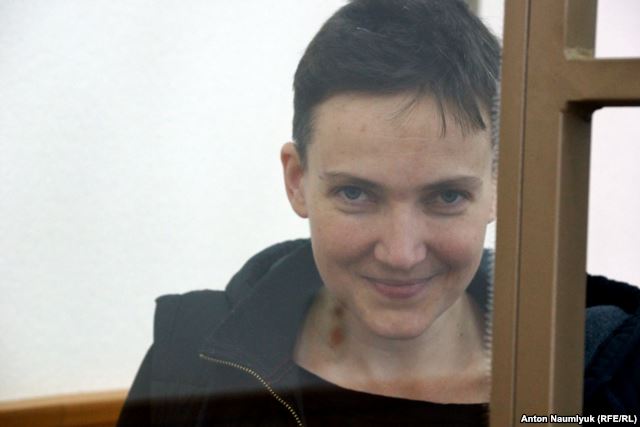
Nadiya Savchenko.
The main evidence of Savchenko’s innocence, which her lawyers announced even before the start of the trial, is the analysis of her phone billing. The cell tower in Luhansk recorded her signal at around 11 in the morning, long before the deaths of the Russian journalists. According to the investigators, Savchenko climbed a 40-meter communications tower in the region of Stukalova Balka, and directed Ukrainian artillery fire from here, then climbed down and was captured by the separatists. Expert Vyacheslav Zheleznyi took it upon himself to explain the discrepancy: why the communications signal was recorded in the city’s tower, while the phone user was outside the city limits. He worked for the “MTS [Mobile TeleSystems] Ukraine” company until the autumn of 2014 , and, being a communications specialist, provided a professional opinion. When asked whether the communication station in Luhansk could have caught Savchenko’s phone signal while she was much farther north, outside of the city, he replied – yes, with the caveat that this could have happened if other stations, which were closer to her, were damaged and were not operating. The lawyers pointed out that at the time of writing his professional opinion, Zheleznyi was no longer employed by MTS, and his using the company documents was not quite legal, but the court allowed his analysis into the case materials. At the same time, they did not ask Zheleznyi whether the [communications] stations in the northern parts of Luhansk were operational: the expert’s answer with the caveat was deemed sufficient by the prosecution.
Several experts on mobile communication arrived to Donetsk from Ukraine, to speak about the [comm] stations in Luhansk and the surrounding area. The total number of communication towers of “MTS Ukraine” and “Life” [life:) phone operator] in the area was a few dozen, but the relevant ones were the towers in Stukalova Balka and Metalist village, as well as those in the northern parts of Luhansk. The “MTS Ukraine” towers in the Luhansk oblast were under the purview of the specialist Andrei Ivanov, who not only monitored their condition, but installed some of them. According to Ivanov, the towers in Stukalova Balka and Metalist were out of order on June 17, probably as a result of the fighting. But all Luhansk towers were working without a hitch.
Andrei Ivanov.
“All of the stations in Luhansk city were operating normally,” – Ivanov summed up in his speech in court. “The stations at the golf club and in the village of Metalist were not working. Therefore, it would be fundamentally wrong to assume that the stations in downtown Luhansk (which is a valley) recorded the connection, servicing a phone user who was, allegedly, in the Metalist area. This cannot be.” Savchenko’s call was recorded in Luhansk at 10:44, an SMS from her [was recorded] at 10:46 – long before Kornelyuk and Voloshin came under fire.
The “Life” company stations in Luhansk also were functioning smoothly. This was confirmed by an expert, an employee of the company who asked to conceal his name out of fear for the lives of their family members remaining in Luhansk. Before the session, the lawyers asked journalists not to photograph the expert and, despite the fact that the session was broadcast with video, nobody did.
“Would you know if there was an accident at the station?” – lawyer Novikov asked the witness. “Yes, within the hour,” – said the expert. “If there was rain or snow, or if there were aggressively-minded people near the station, I would have warned the emergency teams of a state of emergency and said, ‘Guys, you’d better not go there.'” And did anything break down on June 17th?”- asked Novikov. “No, on that day I do not remember any trouble. There were no calls [about any emergencies],” – the “secret” witness stated.
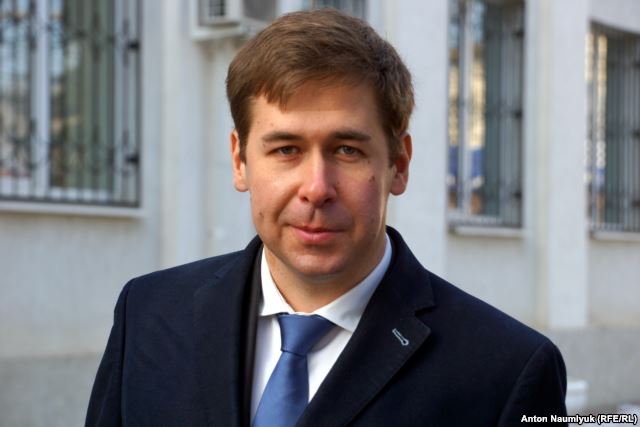
Attorney Ilya Novikov.
The prosecution had prepared a response to this also – by providing an opinion of the [“secret”] expert’s former colleague, Mykola Pomazan, who claimed that the station in Luhansk could have been experiencing problems due to power outages. The court declined to summon Pomazan, despite the [defense] lawyers’ requests, and the only identification presented of him was his ID as a “real estate manager.” Mark Feygin called Pomazan a “false expert” by submitting a response [to his query] from “Life” and its subsidiary “Astelit,” which stated that Pomazan never worked for them.
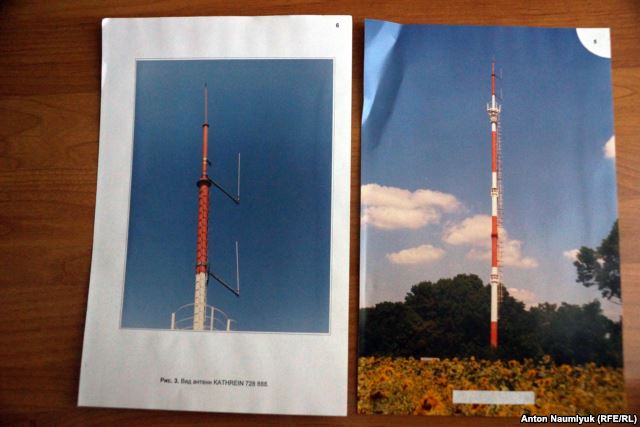
According to the investigators, to direct artillery fire for the AFU, Savchenko climbed a 40-meter radio tower standing in the middle of a field. By that time she was already wounded in the arm, but the investigators refused to take that fact into consideration. The latest court hearing in Donetsk was attended by two experts, employees of “Ukrtransnafta,” a company who owns the [radio] tower (listed on the company balance sheet as assets). The Head of Maintenance for the Pridneprovsk pipeline, Oleh Pulynets, brought photographs of the tower to court, but the court did not attach them [to the case materials]. Then the expert sketched the tower by hand to demonstrate that it has been designed with anti-vandal measures: the ladder leading up the tower begins at 6.8 meters above the ground, and getting to it without special equipment is impossible.
When Pulynets presented documents and photos, Nadiya Savchenko asked the court: “Your honor, please accept this document, since the prosecutor’s office and the prosecution are claiming I was on this tower, from where I supposedly directed fire at the poor journalists. It is important that you at least see what it looks like.” The court refused, citing the fact that the documents are drawn up in Ukrainian. This provoked a sharp response from the Ukrainian pilot: “Now we see how the prosecution is oppressing any other language other than Russian. I am Ukrainian, and I speak the Ukrainian language. They should bring translators. What kind of an excuse is this? This is an infringement of my human rights!” In response, the judge threatened to take Savchenko from the courtroom. “I have warned you before,” – said the judge. “And I warn you that if you do, I will start a dry hunger strike,” – Savchenko stated, and then said that she would direct a complaint to the Commissioner for Human Rights Ella Pamfilova, on the grounds of discrimination of language during trial.
Employees of “Ukrtransnafta” climb up the tower with the help of safety equipment and a special ladder, some 10 meters high. There has not been a single case of unauthorized persons climbing the tower. “Did you climb this structure? Well done for jumping six meters in the air!” – Savchenko’s lawyer Mark Feygin said jokingly, showing her a photograph of the tower.
Attorney Mark Feygin.
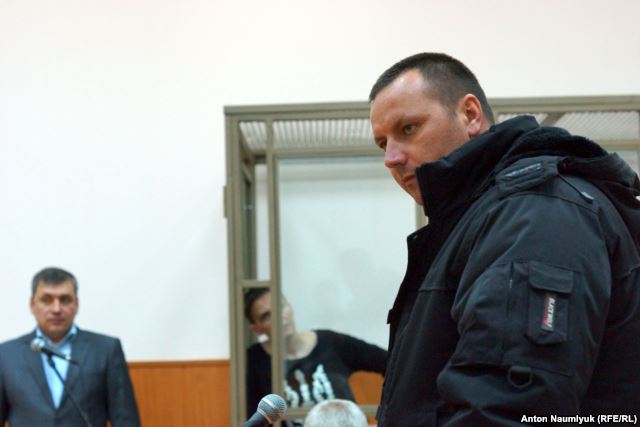
Radio-towerist Serhey Chapak, who is also an employee of “Ukrtransnafta” responsible for maintenance of the towers in the Luhansk oblast, testified at the last court session, despite the protests of the prosecutors. Chapak is the only person to climb the tower from which Savchenko, according to the prosecution, directed artillery fire.
“How far can you see from the tower platform, if you look in the direction of Luhansk? Is the Luhansk–Shchastya road visible from there?” – lawyer Novikov asked the expert. “No, you cannot see it behind the roadside greenery. It is visible further along. Nearby, the trees are tall, 5-6 meters,” – Chapak said. “And the Road Police post (at which the journalists were killed -Ed.), is it visible [from the tower]?” – Novikov asked again. The expert said no.
Witnesses for the defense, Oleh Pulynets and Sergey Chapak.
He also voiced his doubts as to whether the tower can be climbed with only one good hand or by a wounded person. Himself, he always used safety gear to climb, and it took him about half an hour.
“Can one climb the tower using only one hand?” – lawyer Nikolai Polozov asked him. “No,” – said Chapak. “Well then, why…” – the prosecutor said quietly and then asked loudly: “What if you hook yourself by your elbow joint?” – “That’s not impossible.” – “Why not?” – “You’ll fall,” – the expert said. “Well, what if you don’t?” – the Prosecutor quipped. Everyone laughed.
On Monday, February 1st, Nadiya Savchenko will be questioned again. Now she will be able to refer to all of the materials that have been studied in court. In fact, her testimony will begin the debate between the sides [defense and prosecution], then to be followed by additional arguments of the prosecutor and the lawyers. The defense fears that now that the prosecutors, according to Mark Feygin, “did not give any evidence linking Savchenko to the direction of fire or to the tower,” they might bring in another “witness” who will claim they saw the Ukrainian aviator climbing the tower. Now, this potential “witness” will have to explain how Savchenko managed to get up to a 6.8 meter height without special equipment or a ladder, and how she managed to see, among the greenery, the intersection where the journalists were killed.
The timeline of the battle on June 17, 2014, during which Savchenko was captured, has also now been reconstructed, down to each minute. But the testimonies of the AFU servicemen summoned by the defense witnesses are in contradiction with those of the separatists invited by the prosecution. In this case, the decision rests with the court, but the trend in their decision-making is quite obvious: during the second-to-last session, 11 petitions filed by lawyers were rejected.
“We are close to finishing. Next week, we are likely to complete our part,” assured Ilya Novikov. “We expect that the debate will start no later than mid-February, and by the end of February, there will be a verdict. We will be passing on a very good dossier to the Ukrainian and European negotiators who will be dealing with Nadiya Savchenko’s case [in the aftermath of the verdict]. They will not be accused of speaking up for a war criminal. Anyone who studies the materials of the case will say that Nadiya is innocent, and has no relation to the journalists’ deaths. Once the verdict is rendered, the ball will go over to the diplomats. All our hopes rest on the success of future negotiations and the promises given by the politicians.”
Nadiya Savchenko has been on hunger strike for 43 days [as at January 29th – Ed.].
By Economic Pravda posted in Reforms in Ukraine, which collects and posts all reforms in Ukraine since the Maidan revolution
11.12.2015 Translated and edited by Voices of Ukraine Reform enacted by: Economics Ministry
Ukraine has joined the World Trade Organization Agreement on Government Procurement (Government Procurement Agreement, GPA), which will allow Ukrainian entrepreneurs to participate in international tenders.
Deputy Minister for Economic Development Maxim Nefedov announced this on his Facebook page.
“The Ukrainian application to join the GPS (Agreement on public procurement) was unanimously approved by the parties to the agreement. The path which began in 2011 has finally reached its successful conclusion” – he said.
“This is a clear diplomatic victory of Ukraine, under the auspices of its accession to the WTO, which opens a reciprocal market access to public procurement” – said the deputy minister.
According to him, for Ukraine this is economically beneficial, “since our market has already been open to foreigners for many years.”
“In any case, even if it was not, foreign companies could afford to open branches in Ukraine and trade through them,” – said Nefedov.
He also noted that the markets of other countries were closed to our manufacturers – and it is hard to expect that the average domestic enterprise would open a branch in New Zealand or Norway.
“In fact we are joining under the scheme of ‘we are not changing anything in our legislation – but we are gaining access to your markets,’” – concluded the deputy minister.

 Dmitry Tymchuk, Head of the Center for Military and Political Research, Coordinator of the Information Resistance group, Member of Parliament (People’s Front)


 By Anton Naumlyuk, photographer and Svoboda correspondent. All photos and video by Anton Naumlyuk




 Voices of Ukraine