Information Resistance Assessment (Infographic): Threats in the East and South of Ukraine on April. #FreeSavchenko

information_resistance_logo_engDmitry Tymchuk, Head of the Center for Military and Political Research, Coordinator of the Information Resistance group, Member of Parliament (People’s Front)
04.22.2015
Translated and edited by Voices of Ukraine

From April 15 through April 22, 2015, an extremely high level of threat has been recorded at all essential positions in the Donetsk and Luhansk oblasts:

– A threat of terrorist attacks organized by “local” anti-Ukrainian forces, which are controlled by the intelligence services of the Russian Federation (RF);

– A “export of terrorism” from the ATO zone as a result of the imperfections of the entry/exit permit system and the inability to effectively control movement across the demarcation line of the parties;

– A threat of sabotage on the part of the Russian-terrorist sabotage and reconnaissance groups, which have infiltrated from the occupied territory of Donbas;

– Efforts by the Russian intelligence services to exploit the negative socio-economic situation and various negative information events in order to organize protests among the civilian population.

In Kharkiv oblast, the situation remains complicated, even though local authorities and law enforcement are taking measures to neutralize threats. In particular, significant efforts are being invested in anticipating critical situations. This includes tightened security measures (from expanding the video surveillance network to more intense street patrolling) and administrative decisions (such as the ban on unauthorized mass events until May 10). At the same time, the situation has been somewhat aggravated by the adoption of the decommunization law package (two weeks after the vote, unknown activists demolished 5 monuments to Communist leaders in Kharkiv alone; their actions were met with mixed opinions in the city). Anti-Ukrainian political forces continue their attempts to destabilize the situation in the context of social problems. Thus, on April 20, a meeting of the so-called “shadow government” of the “Opposition Block” took place in Kharkiv, followed by an information attack. Mykhailo Dobkin [former mayor of Kharkiv] even managed to call for the dissolution of the [Ukrainian] Parliament. Despite the official ban, separatist groups and anti-Maidan disciples are using social networks to invite Kharkiv residents to a rally on April 22. The declared agenda of the rally consists of social issues – protesting high [utilities] tariffs, rising prices, etc. We also expect events to commemorate Lenin’s birthday will be held [in the area].

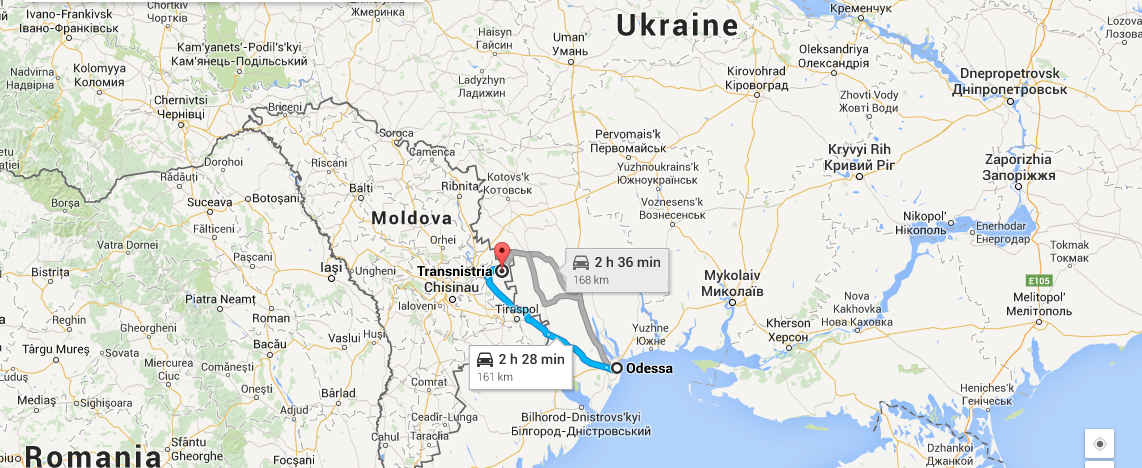
In Odesa oblast, the spectrum of threats has shifted, while their level remains at a generally stable negative. The mass detention of terrorist groups at the beginning of April has had a positive impact on the situation in Odesa, acting as a powerful “psychological” deterrent for anti-Ukrainian forces. Nevertheless, we forecast that attempts will be made to destabilize the situation (terrorist acts and provocations) by May 2. In this context, we are doubting the proactive effectiveness of local law enforcement officers, but it is offset by the relatively efficient work of the SBU [Security Service of Ukraine] – first and foremost, the “paratroopers” sent from Kyiv. Another positive factor is the Operational Headquarters of the patriotic forces in Odesa oblast, created by local patriotic organizations on April 16 (its positive impact is partially offset by the public disputes among pro-Ukrainian forces concerning the Operational Headquarters’ memorandum of establishment; this stimulates anti-Ukrainian forces). We observe a growing threat of infiltration by sabotage and reconnaissance groups from the territory of Transnistria. Plus, the threat of separatism from the “national minorities” (particularly in the border areas) has increased, given the unfavorable state of Ukraine’s information security in the region.

In Zaporizhya oblast, against the background of the negative socio-economic situation, we’ve observed a growing threat of protests which can be used by the Russian intelligence services to rock the situation. Anti-Ukrainian (pro-Russian) forces are becoming more active as well. Amongst the positive developments, is a strengthening of security for strategic facilities in the oblast (firstly, the Zaporizhya nuclear power plant, now supplied with an additional physical protection service and a department of corporate paramilitary security), as well as railway and automotive terminals, and 13 strategically important bridges (by the police and servicemen of the National Guard of Ukraine). A reserve fund dedicated to rapid response [to security threats] was created in the oblast budget. Among the negative factors is the increased threat of an “export of terrorism” from the ATO zone, in view of the fact that Russia has temporarily changed the focus of its efforts from the conflict zone in Donbas to attempts to activate terrorist acts in other regions of Ukraine, primarily those that border Donbas.

In other southern and eastern regions of Ukraine, the situation remains largely unchanged.

Infographic by Information Resistance

Infographic by Information Resistance

Source: sprotyv.info
Posted in Dmitry Tymchuk, English, English News, Pictures, South&Eastern Ukraine, War in Donbas | Tagged , , , , , , , , | Leave a comment

Information Resistance: Regarding the situation in Odesa and its region. #FreeSavchenko

information_resistance_logo_engDmitry Tymchuk, Head of the Center for Military and Political Research, Coordinator of the Information Resistance group, Member of Parliament (People’s Front)
04.20.2015
Translated and edited by Voices of Ukraine

Due to a developed monitoring system of the terrorist/separatist threat in the South and East of Ukraine, the IR group (project “Traffic Light”) in Odesa, alongside with [the IR] group in Kharkiv, have identified a “zone of special attention” (threat level – not less than 7 points on a 10-point scale). In this regard, the IR group coordinators made a trip to Odesa region to study the situation last week.

We observe the following trends:

In recent weeks, the SBU (including specialists that arrived “as reinforcement” from Kyiv), in cooperation with local law enforcement have developed and conducted a series of successful operations to identify and neutralize terrorist groups in the city. As a result, the level of terrorist threat in Odesa has noticeably decreased.

At the same time, it is necessary to take into account that by the “control” dates (May 2 and 9), Russian intelligence services and pro-Russian forces in the region will predictably exert considerable efforts to destabilize the situation by:

– Attempts to commit acts of terrorism and sabotage;

– Organizing meetings and rallies by ardent pro-Russian forces, as well as actions by separatist “national minorities” inspired by the intelligence services of Russia;

– Attempts of provocations during peaceful mass actions on May 2 and 9.

In this regard, we ask the local authorities to declare the 2nd of May (on the anniversary of the tragic events in Odesa) a day of mourning in the city and the region and to cancel all public events on this day (similar appeal has already been sent to the head of the Odesa Regional State Administration on behalf of the IR group coordinator, D.Tymchuk). According to our data, intelligence and law enforcement agencies will take enhanced measures to ensure the safety of public events on the May 9th – Victory Day.

To supplement these data, the IR group plans to intensify the monitoring of social networks and local media for attempts to organize illegal or provocative actions in Odesa and the region, with prompt relay of relevant information to Ukrainian intelligence services.

2. The probability infiltration of region by sabotage and reconnaissance groups from the territory of Transnistria remains high. At present, the “contingent” that can be used to form the sabotage and reconnaissance groups on the territory of Transnistria (including such staff groups of the Russian GRU) amounts, according to our estimates, to at least 1,000 people.

At the same time, measures to neutralize this threat are currently being actively carried out by the Security Service of Ukraine, the law enforcement agencies, the State Border Service and the Armed Forces of Ukraine.

  1. Odesa region has found itself at the forefront of the “information war.”

In particular, the ineffective use of radio frequencies and practically unlimited broadcasting by foreign stations have been observed in the region (from the territory of Transnistria, Moldova and Romania). As for the latter, the radio and television information product received in the region contradicts Ukrainian legislation in the majority of cases. For example, “RTR-Moldova” TV channel includes in its broadcast package [Russian] “RTR-Planeta” channel that is banned in Ukraine. The same situation applies to the “PRIME” channel. Russian TV channels banned in Ukraine (“First Channel. World Network”, “NTV World”, “Russia-24”, “RTR-Planeta”) are being broadcast in Odesa region from the territory of Transnistria.

The situation is aggravated by the fact that, according to preliminary estimates, only 70% of Odesa region receives “Ukrainian” digital signal. In some border areas, residents are unable to receive a Ukrainian TV product with a digital signal and instead watch only a foreign informational product. In particular, this situation is currently present in:

Reniyskyi district of Odesa region (practically in its entirety).

Kodymskyi district (in part).

Tarutinskyi district (in part).

Velykomykhaylivskyi district (in part).

Frunze district (in part).

Bolgradskyi district (in part).

According to the IR group, thanks to the efficient use of the capacities of Ukrainian concern RRT, currently it is possible not only to cover 100% of the Odesa region with a “Ukrainian” digital signal, but also to provide broadcasting of Ukrainian TV channels to the border areas of Transnistria, Moldova, and Romania without engaging budgetary resources. We will submit relevant proposals to the Ministry of Information Politics of Ukraine.

In Odesa, the “information” problem is less pressing. The majority of the local media maintain a pro-Ukrainian orientation, provide objective coverage of events and help normalize the situation in the city and the region. The exception to this rule is a pro-Russian site “Timer” that continues to applaud the activities of a little leader of the anti-Ukrainian party “Motherland,” I. Markov, who escaped to Moscow. Following the format of pro-Russian newspaper “Vesti,” not only does the anti-Ukrainian resource “Timer” directly violate Ukrainian legislation, but it also present a serious threat to the interests of the informational security of Ukraine at the regional level.

4. The bulk of the population in the city and Odesa region reject radical actions by political forces and social movements, regardless of their ideological platform. Therefore, we appeal to pro-Ukrainian forces with a request not to demonstrate their radical sentiments and actions in such a difficult period, especially on May 2nd and 9th.

Odesa urgently needs confidence in peace and stability. Only by demonstrating the ability to provide for them will you be able to earn the full trust of ordinary citizens.

5. To strengthen cooperation with local authorities, law enforcement officers and the media in Odesa and the region, the IR group presented our regional coordinator during a briefing in Odesa (coordinator “IR-South”). This is our colleague and collaborator, a military journalist, editor-in-chief of an Odessa TV channel “Media-inform” Serhiy Bratchuk. He will be responsible for our division in the region, as well as the  previously registered southern division of the IR group with headquarters in Mykolayiv.

Source: Dmitry Tymchuk FB

Posted in Dmitry Tymchuk, English, English News, Pictures, South&Eastern Ukraine, War in Donbas | Tagged , , , , , , , , | Leave a comment

Nadiya Savchenko’s lawyers: The Russian Investigative Committee and courts are guided by political will, not law or justice #FreeSavchenko

Vladimir Shreydler
04.17.2015
Translated and edited by Voices of Ukraine

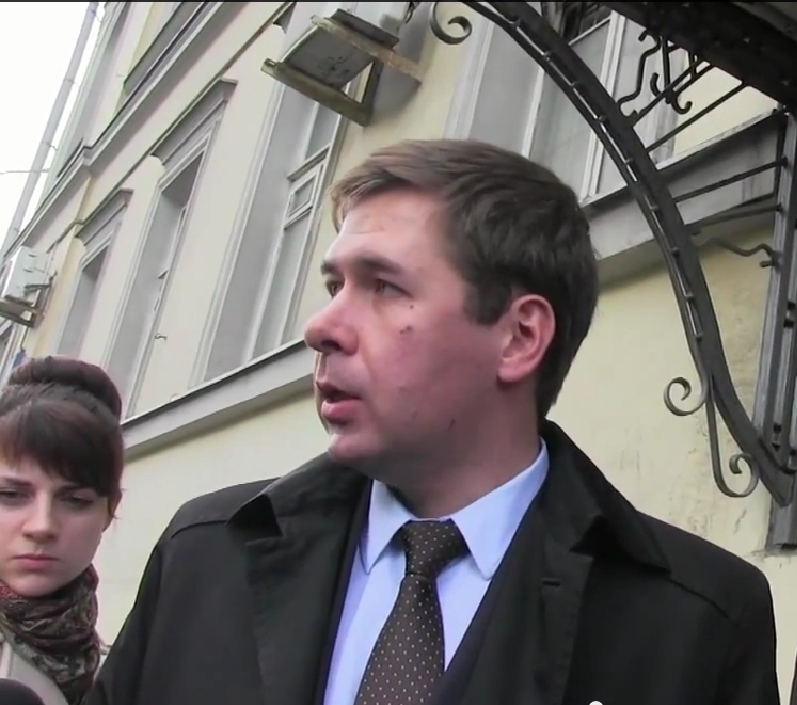
Vladimir Shreydler, reporter with the Russian NGO  Za Prava Cheloveka [For Human Rights] attended the hearing of Nadiya Savchenko in Moscow’s Basmanny District Court on April 17, 2015, and spoke with her, as well as her attorneys Nikolay Polozov and Ilya Novikov.

Photograph by UKRinVAT

Photograph by UKRinVAT

NIKOLAY POLOZOV, attorney: Today, the Basmanny District Court, in the person of Presiding Judge Levashova, has once again denied satisfaction to the appeal against the resolution of the investigation, filed by Nadiya Savchenko’s defense. Today, we were appealing the resolution that denied satisfaction to our petition to stop criminal proceedings against Nadiya Savchenko.

Over the ten months that Nadiya Savchenko has been kept in the Russian detention facilities, we, her defense, have gathered a large body of evidence that directly points to her non-involvement in the death of Russian journalists Kornelyuk and Voloshin, and proves that she has an alibi.

But the Investigative Committee, stubbornly, despite already having the evidence, continues this investigation with a presumption of guilt. Today, the investigator stated that they have, indeed, received a variety of evidence from the defense, but the Investigative Committee has not assessed it yet. And the Basmanny District Court is, essentially, once again abetting the investigators in conducting criminal proceedings in this case in an unlawful manner.

I am handing the floor over to my colleague now. He will talk about today’s hearing in more detail.

Watch the full video below (RUS audio) or scroll down reading the transcript

ILYA NOVIKOV, attorney: Today’s hearing had two important purposes. About the first one… As you have seen, our line of defense in the case of Nadiya Savchenko is always open and transparent. We always share our materials and explain what we are doing, how and when. The investigation is doing the exact opposite. They never explain anything, and never inform as to what materials they have or what they intend to do.

Therefore, there will be several hearings like the one today, before the case is submitted to the court with the substantive charges. Each time, we will provoke the investigators into explaining something to us – about their plans, their view of the situation. As of today, they are essentially refusing to speak. Their position remains that they will investigate Nadiya Savchenko’s case and keep her detained for as long as they see fit – which is, of course, wrong.

The second purpose of today’s hearing for us was to put a stop, at least on the conceptual level, to the talks about the alleged lack of Nadiya Savchenko’s immunity as a PACE delegate, or that her immunity is not valid in Russia. She has such immunity. We did not count on the court being on our side in this, but we got the opportunity to speak on the subject. And, despite the court’s position, we still believe that the Russian investigation should have dropped the case against her as soon as it became known that she is a PACE delegate. This is a delicate legal issue. It is not obvious and requires thorough research of the situation – but we have researched the situation, and we are confident in our position.

This is why today’s ruling will not be final. We will continue bringing up the issue of [Nadiya Savchenko’s] PACE delegate status – in Russian courts, in foreign courts, and before PACE itself. PACE is, first of all, interested in its delegates actually having the immunity to which Russia agreed when it joined the Council of Europe.

Today, we have driven another nail into the lid of the procedural coffin of the position held by Russian investigators. We have, once again, received proof that they do not want to admit that under which they have signed, and refuse to respect the privileges and immunities that Russia guaranteed back in 1996, upon its entry into the Council of Europe. This will not bode well for them – but may bode well for all of us.

Ilya Novikov, attorney

Ilya Novikov, attorney

NIKOLAY POLOZOV: I would like to add that soon, here at the Basmanny Court, there will be another hearing, held by Judge Arthur Karpov, dedicated specifically to Nadiya Savchenko’s status as a PACE delegate and her immunity. I hope that this hearing will be held shortly, as the PACE session starts next week. Perhaps the court hearing will coincide with that date.

ILYA NOVIKOV: We will certainly appeal this resolution. Moreover, in the passing of this resolution, the judge refused to call up representatives of the Ministry of Foreign Affairs and the Ministry of Justice. This is sufficient reason to address the Constitutional Court. We will let neither the investigation nor the court work in peace and quiet, in the way they would prefer to. We will harass them, daily and weekly.

VALERIY SHREYDLER: Do you think that the adversarial principle in this process has been violated? Can you feel the element of political pressure?

NIKOLAY POLOZOV: Concerning pressure and such. The investigation of this case is certainly being conducted unlawfully. We are observing a deep deformation of the legal field in the conditions of an authoritarian system. This is not the only case being investigated in this way. But this is the first case in the history of the Russian Federation, when an active member of the Parliamentary Assembly of the Council of Europe is being detained, without any grounds for that. This is a flagrant disregard of law, and I think that international authorities will, sooner or later, declare the actions of the Russian government unlawful. PACE has already issued a resolution to that effect.

VS: Is the date of the next hearing known already?

NP: Not yet.

VS: Please tell me what is going on here. We have not heard a single valid explanation why the appeal is being denied. Why?

NP: There can be no valid explanation, because there are no lawful grounds for the denial. There is a political will that dictates how the Investigative Committee and the courts should act. Not the law, not justice – but political will.

Let me remind you that, a year ago, a special administration for the investigation of cases related to the unlawful means and methods of warfare was created as part of the Investigative Committee. This administration only investigates cases related to Ukraine. No country in the world, no authority had departments that would only investigate crimes related to one specific country or one specific person.

Here, we can see a progressing degree of lawlessness, and pin-pointed repressions that can eventually become far from pin-pointed. The society is passive, and has no trust towards the court system, but the gentlemen from the Basmanny court are not bothered by that in the slightest. They know that the government will cover up for any unlawful resolutions they pass.

Nikolay Polozov, attorney

Nikolay Polozov, attorney

VS: Nikolay, there was a reason I asked about the adversarial principle. Given the current political pressure, have you been left with any possibility to fight fairly and with dignity, to stand up to everything that is going here?

NP: Let me say this. In a situation of complete lawlessness, when the prosecutor’s office, the investigation, and the court are all working exclusively on the side of the prosecution, the only bearer of law and the only flash of light is the attorney. Therefore, however pointless our work may seem, even if it looks like we are hitting our head on a wall to no effect – I hope that one day, quantity will turn into quality. While there still are defense attorneys who are not afraid to stand up against the system, maybe not all is lost yet.

VS: Nikolay, one last question. None of the journalists asked about Nadiya Savchenko’s state of health. I am not a regular journalist, I don’t work for federal channels. Tell me, how is she feeling, physically? After all, this long hunger strike had to affect her health. Is it true that she is ready for the fight that awaits her, from the medical point of view?

NP: First of all, I must say that Nadiya has a very strong body and health, and, most importantly, she has courage and fortitude. Those are things that allow people to withstand hunger strikes without burning out and self-destructing. She is accepting small amounts of food. Being faced with the choice to be hospitalized and force-fed, or eat at least something and remain in the current conditions, I think it is a reasonable compromise. Secondly, her state of health lets us stay hopeful. Her health is satisfactory, without any significant pathologies, and I hope that the current state of things will help her hold on for a long time. Another matter is that being detained based on unsupported charges, after being kidnapped from her country and thrown behind bars in another country – that is difficult, morally. But you can see that she is holding on. She is holding on, and she deserves all the respect and glory for that.

VS: As your old acquaintance, I would like to ask you to say a few words for Ukraine. You and I are Russian citizens, but this report will be seen in Ukraine. Please look at the camera and say a few words to Ukrainians – from the President to every worker, to the guys in trenches.

NP: Dear Ukrainians! Do not give up! Keep fighting! Nadiya’s fate also depends on you. Glory to the Heroes!

VS: Glory to Ukraine! Glory to the Heroes!

Watch Nadiya Savchenko’s speech in court on April 17, 2015 here (ENG subtitles):

(Please click on “Settings” to enable subtitles.)

Source: Vladimir Shreydler FB

Posted in #Free Savchenko, English, English News, News, Opinions, Pictures, War in Donbas | Tagged , , , , , , , , , , | Leave a comment

Nadiya Savchenko at the Hearing in Basmanny Court, Moscow – VIDEO w/Eng subtitles #FreeSavchenko

Vladimir Shreydler
04.17.2015
Translated and edited by Voices of Ukraine
Video subtitles by Voices of Ukraine

Photograph by UKRinVAT

Photograph by UKRinVAT

On April 17, 2014, Vladimir Shreydler, a reporter with the Russian NGO  Za Prava Cheloveka [For Human Rights] attended the hearing of Nadiya Savchenko in Moscow’s Basmanny District Court, and spoke with her, as well as her attorneys.
Read the interview with the attorneys Nikolay Polozov and Ilya Novikov here.

Nadiya Savchenko has been detained by the Russian authorities since June 2014, on charges of being complicit in the deaths of two Russian journalists during the war in Donbas. Despite a large body of evidence provided by Nadiya’s attorneys, which proves her alibi, the investigation refused to release her or even replace her pretrial detention with house arrest. To protest the continuing detention, Nadiya declared a hunger strike on December 13th. After 83 days of hunger strike (including ten days without glucose injections), she agreed to receive small amounts of food to sustain her life. According to her attorneys, her state of health is satisfactory at the moment.

Photograph by UKRinVAT

Photograph by UKRinVAT

Nadiya Savchenko is a PACE delegate and, as such, has immunity that makes her ongoing detention illegal. During the latest hearing, the court refused to recognize her immunity and continued her detention.

Please click on “Settings” to enable subtitles.

Source: Vladimir Shreydler FB

Posted in #Free Savchenko, English, News, Pictures, Video, War in Donbas | Tagged , , , , , , , , , , , | 1 Comment

The secret of the Rostov burials

By Andrew Kaushik (Rostov-on-Don) and Vladimir Dergachov.
All photographs are by Andrew Kaushik.
04.01.2015
Translated and edited by Voices of Ukraine

Gazeta.ru correspondent investigates whether the military casualties in Donbas are being buried in cemeteries in Rostov-on-Don

Photographs of fresh graves in Rostov-on-Don cemeteries, where Russian volunteer soldiers killed in Donbas were allegedly buried, have been circulating the Internet and were published in the major Ukrainian media. Gazeta.ru’s correspondent went to the Rostov cemetery and investigated the situation on site.

“…I could have gone to prison for this for a long time”

There were rumors of secret burials even three years ago: some civil activists thought that the authorities underreported the number of casualties from the floods in Krymske by several times. Referring to the anonymous statements by “emergency service workers,” they insisted that over a thousand people died, not 171. They looked for their graves in the adjacent Slovyansk district, but no evidence was submitted.

2

It seems that it is possible to hide anything in the North Cemetery in Rostov-on-Don, one of the biggest [cemeteries] in Europe, even a battalion or a division. The head of the administrative department for city cemetery services, Valeri Zykov, says that the area of the churchyard is more than 400 hectares. Half a million people have been laid to rest here over 40 years. This is the only active cemetery out of eight city cemeteries; the others are only used for very close relatives.

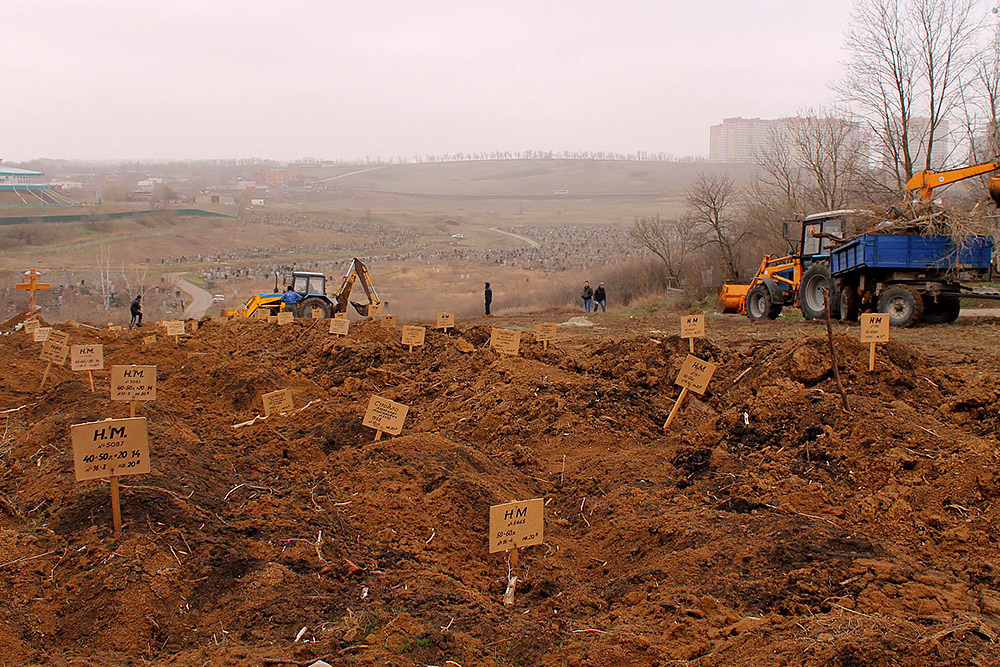
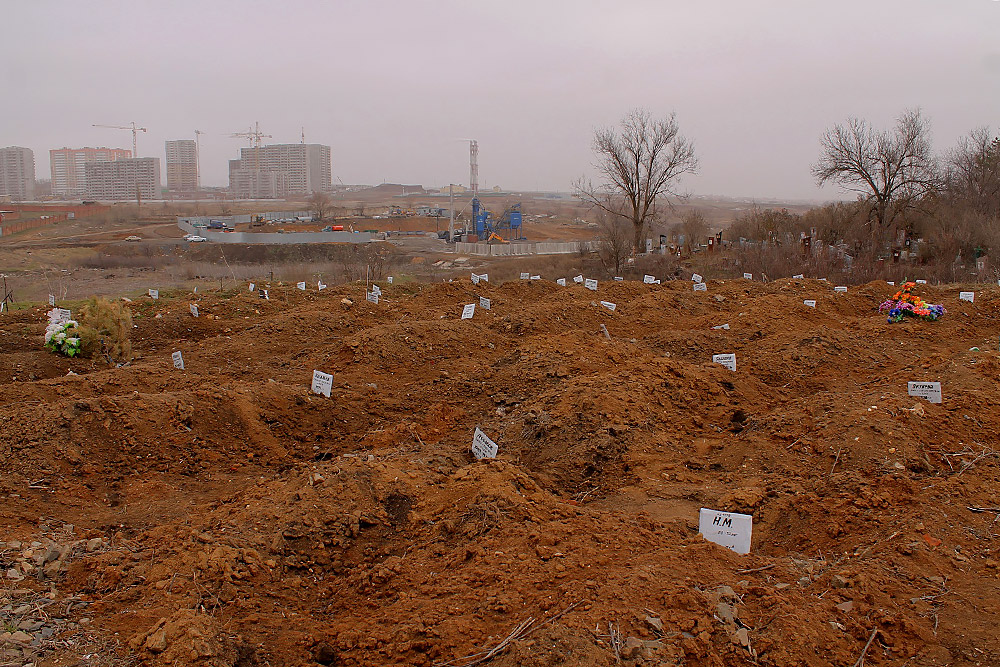
“The unknown ones are buried over there.” Valeri brings us to the rows of fresh piles of red soil, lot “31a.” Judging by the construction scattered around on the horizon, these are the photographs of “suspicious” graves that have found their way onto the Internet. “All is in accord with the documents that the morgue provides.”

We don’t have this here, to bring them and secretly dump and bury them. I could have gone to prison for this for a long time. I will never agree to bury insurgents or anyone who has not been authorized.

Some white stones have the name and dates, others have a featureless “UM” (unknown male) and “UF” (unknown female), with an approximate date of death and age (“40-45 years,” “60-70 years,” “40-50 years”). There is a large range, from 30 to 80 years.

3

“Can the insurgents really be unknown?” The head of city burial services argues emotionally. “How can a 70-year-old grandfather or 60-year-old pensioner be useful in a fight? That’s nonsense.”

He admits that he has found some photographers here, but they are “just sick,” and when he goes to talk [to them], they run away for some reason.

In another lot, “20b,” the excavators are still buzzing in the trench as workmen stand to one side smoking. Some “unidentified” graves are fenced off, and are even marked with simple wooden crosses. Relatives are found according to last names, they pay their last respects, even if they are late.

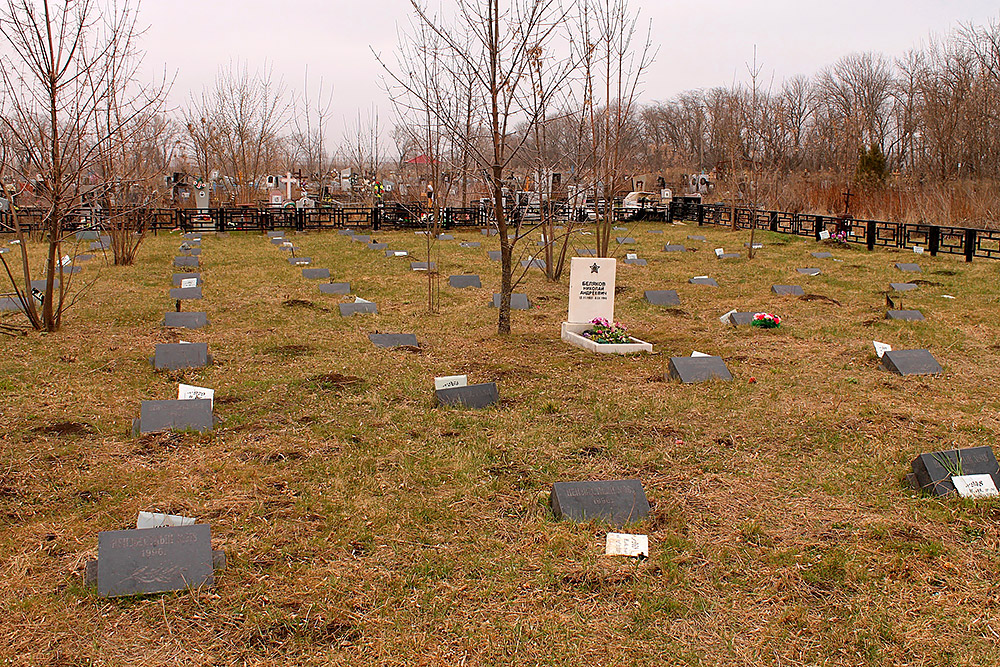
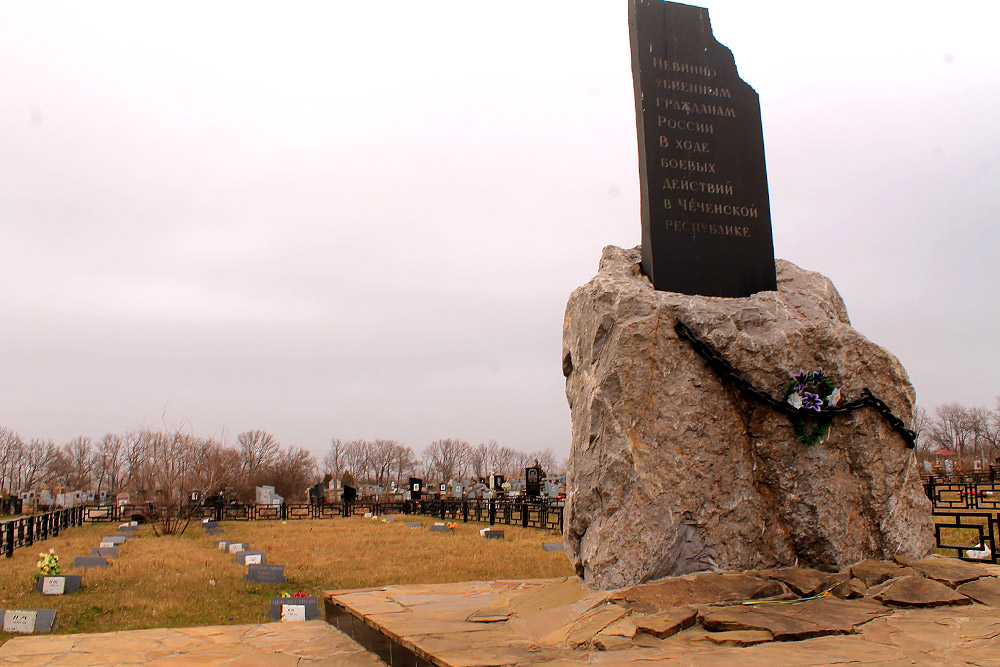
One separate part of the cemetery is a memorial to unknown soldiers killed in the first Chechen campaign. Several hundred separate graves with small headstones, like in American films.

The Avenue of Honor

“Then there was a war where the government participated officially. Today we are saying that the army is not fighting, but we do admit that there are volunteers and ‘tourists/ vacationers.’ In my understanding it is uncivilized,” says the head of the historical memorial of the Rostov section of the Russian Society for the Protection of Historical and Cultural Monuments, Aleksandr Kozhin.

“Here we called that war an ‘antiterrorist operation,’ a mirror image of the current situation in Ukraine. There is such a fork [in the road] towards Taganrog, and a mass of refrigerators with human remains coming from the Chechen war piled up on the railroads. We didn’t know what to do with them, the DNA lab could not manage. They probably decided at the government level to bury them here. They should be given their due, not in a mass grave but each separately.”

According to Kozhin, if Rostov volunteers are dying in Donbas, their comrades would not commit them to the earth in secret, but with honor.

“Recently, we looked into a story of a young man. He was a member of a search initiative, he was 25-26 years old. He sincerely believed in the ‘Russian World’ idea. I don’t know how long he fought, but he was killed,” the historian says. “His comrades from the search initiative turned to the administration of the Matveev Kurgan settlement with a request to inter his remains in the Avenue of Honor. I don’t know how they settled the issue.”

4He explained that the Don [area along the river Don] search staff went to Donbas several times. During one of their trips, the insurgents themselves detained another young man. They took him for a Ukrainian spy and almost put him up against the wall. After some other insurgents from the self-proclaimed republics “apologized profusely,” they let him go.

“It is possible to suppose that an insurgent left from Ukraine through Rostov and died here.”

Even the independent organization, “Women of the Don,” who deal with enlisted soldiers and monitor the situation with Donbas, do not know about the mass secret burials of insurgents who have fought in eastern Ukraine. The head of the organization, Valentina Cherevatenko, told Gazeta.ru that she had no information about the “suspicious” graves.

“I would start from what is called the presumption of innocence. In this situation, we immediately try to establish that someone is culpable for something, and we have to rectify it. But guilt must be proven. There is no evidence of mass burials,” Vladimir Artsibashev, the deputy head of Rostov administration, who is in charge of public utility issues, responds to Gazeta.ru. “The North cemetery has exhausted its resources. We are economizing every meter now, we are starting to cut the roads down; before, [the road] was four or five meters wide, now we leave a lane for one car, and carry out burials on the rest of the land. Woodlands are cleared, slopes and hills get leveled out. Rostov does not have its own land, we cannot choose a lot on the city’s territory for a new cemetery.”

The official confirmed that they regularly bury unclaimed bodies. If relatives are not found and the surname is not known, the headstones just show an approximate age and the letters UM or UF. It has always been like that, ever since the North cemetery was opened in 1972. According to him, the morgues themselves carry out tenders and identify a funeral organization. In one year, 436 people whose identity was not established were interred in a city with one million inhabitants.

To look at the situation theoretically, as described in the Ukrainian media, it would be more logical to bury soldiers somewhere near the border in remote areas where no one would see the graves. “It is incredibly difficult to do this in Rostov, there are no closed cemeteries, everything can be freely reached,” the deputy chief of the city continues. “There is a decision [made] by the local parliament and a resolution by the authorities whereby we only bury residents of Rostov or people who die in the city if their bodies are not collected by their relatives. It is possible to suppose that an insurgent left Ukraine through Rostov and died here. Then we have the right to bury him here. Such statistical analysis has not yet been conducted, but if there are instances like this, then you can count them on the palm of your hand, theoretically it is possible.”

The bodies are periodically removed once they accumulate.

The news about the arrival of 500 new graves was like a case of “Chinese whispers.” According to Artsibashev, in 2014 the authorities planned a road through the new Suvorovskiy city district (you can see it behind lot 31a), which went round the edge of the North cemetery. They needed 500 exhumations to do this. They abandoned the project after consulting the law in detail: it is not permitted to build anything on the cemetery, only plant trees.

5

The field commander of the self-proclaimed DNR, Oleg Melnikov, told Gazeta.ru that Russians who are killed are buried locally if their relatives could not be found, or under extreme circumstances. For example, [like it happened] last summer when Slovyansk was surrounded by the ATO forces.

“Then it was not possible to move the people out, we buried them in a cemetery under the names of their commanders. On my people’s graves, there was the letter ‘M,’ I knew where my men were to ensure their graves wouldn’t get dug up,” Melnikov says.

They take the bodies out of the morgue and transfer them over the Russian border only if they find relatives to whom they can give the deceased for burial, the commander confirms.

“We had one case, when Pavel, a 22-year-old policeman from Moscow, told his relatives that he was going on a work trip. Instead, he took a leave of absence; joined us and got killed. We moved him and gave [his body] to his relatives, the Interior Ministry helped us in every way they could. I very much doubt that they will carry out anonymous burials in Rostov. If I wanted to hide bodies, which we are not doing of course, why not bury them in Donetsk or Luhansk?”

Other insurgents that Gazeta.ru has talked to said that they themselves move their comrades’ bodies out and give them to relatives. Vladislav Brig, the head of the self-proclaimed DNR Ministry of Defense said that the Donetsk Ombudsman negotiates with relatives and controls the dispatch of the bodies of Russian volunteers to their relatives. According to him, the  bodies are periodically removed once they accumulate.

Source: Gazeta.ru

Posted in English, English News, Others, South&Eastern Ukraine, War in Donbas | Tagged , , , , , , | Leave a comment