Nadiya Savchenko taken to worst prison for criminals in Novocherkassk (VIDEO) #FreeSavchenko

By Informator Lugansk Media
07.26.2015
Translated and edited by Voices of Ukraine

Ukrainian pilot Nadiya Savchenko was taken to the remand prison of Novocherkassk, Rostov region [Russia], which contains the most dangerous criminals. Nadiya was brought in a special wagon, attached to a conventional passenger train, at 19:30 [EET] at the station in Rostov-on-Don. According to LifeNews, before opening the wagon car, officers of the Federal Penitentiary Service formed a human chain from the wagon to a Volkswagen Transporter minibus.

From Rostov-on-Don, the van went to the №3 Novocherkassk detention facility. Nadiya was transported to the detention center (SIZO) at 21:35 [EET].

Previously it had been reported by Radio Free Europe Radio Liberty that Savchenko was taken to a prison in Shakhty.

Sources: informator.lg.ua

Read also Russia’s Commissioner for Human Rights Ella Pamfilova’s statement in Interfax (in Russian), here: http://www.interfax.ru/russia/456045

Posted in #Free Savchenko, English, English News, Pictures, Video, War in Donbas | Tagged , , , , , , , | Leave a comment

Dmitry Tymchuk: Military update 7.24 #FreeSavchenko

information_resistance_logo_engDmitry Tymchuk, Head of the Center for Military and Political Research, Coordinator of the Information Resistance group, Member of Parliament (People’s Front)
07.24.2015
Translated and edited by Voices of Ukraine

Operational data from Information Resistance:

In addition to “traditional” shelling with 120-mm mortars as well as 122-mm and 152-mm artillery, Russian-terrorist forces in Donbas have stepped up the use of armored vehicles and air reconnaissance (at least 10 UAV flights recorded) during the past twenty-four hours. Active operations by “small groups” of militants in the “greenery” have not ceased, while terrorist sabotage and reconnaissance groups and raiding parties are active across the whole of the Luhansk sector (especially along the Severskyi Donets river).

The situation has intensified the most in the Donetsk and Horlivka areas, where the bulk of the shelling and armed provocations by militants occurred in the past day. In addition to the sector from Mar’inka to the northwestern outskirts of Horlivka, another area of especially heightened enemy activity consisted of the settlements of Svitlodarsk, Luhanske and Mironovskyi.

So, in the past twenty-four hours, militants repeatedly carried out fire strikes using 122 mm and 152 mm artillery in the ​​Shyroka Balka – Novhorodske area.  The enemy opened fire with 82 mm and 120 mm mortars on the advanced positions of Ukrainian troops from Ozeryanivka and the eastern shore of the Horlivske reservoir, at the same time as terrorists made active use of AGS-17 automatic grenade launchers along the demarcation line close to Leninske – Shumy.

Near the Donetsk airport and the settlement of Opytne, militants used several armored groups (each with 5-6 AFVs–armored fighting vehicles – IFVs–infantry fighting vehicles or APCs–armored personnel carriers). These armored groups opened intensive fire from their on-board weapons on the advanced positions of Ukrainian troops. The militants used 122 mm artillery to provide cover fire for their armored vehicles as the latter took firing positions. Firing was by two batteries of D-30 howitzers – one from the vicinity of Spartak, the other – from beyond the settlement of Vesele, and south of Stratonavtiv Street (Donetsk city).

Militants shelled the southern suburbs of Avdiivka, Opytne and Pisky using 120 mm mortars.

In the area of Mar’inka, Krasnohorivka and Lozove, the movements of small terrorist infantry groups, under cover of the “greenery,” were recorded. In particular, the enemy tried to approach the ATO forces’ positions in order to scout out the front edge of the Ukrainian troops. These groups opened small arms fire randomly to provoke retaliatory fire from ATO forces and in this way identify their firing positions.

Shelling from 82 mm mortars was recorded near the settlement of Luhanske. An enemy armored group was also operating in this area – fire strikes from tank guns were directed at the advanced ATO forces’ positions.

In the direction of Alchevsk, a militants’ mortar group (six 82 mm mortars and three 120 mm mortars) kept shelling the positions of ATO forces near the settlement of Krymske.

Armed clashes among the “greenery” were recorded in the Zolote, Orikhove, Vesela Hora and Shchastya sector and near the settlement of Stanytsia Luhanska. Near the settlement of Shchastya, the enemy used AGS-17 grenade launchers several times.

In the coastal direction (near Shyrokyne and east of Hnutove), militants operating as infantry groups opened fire several times using small arms.

The number of militant troops and armored vehicles continue to grow south of Donetsk and towards the coast. A manoeuvring of part of the Russian-terrorist troops and their materiel was recorded towards the Kulykove–Shevchenko–Kozatske sector from the Komsomolske–Starobesheve district. At least two additional units of “motorized rifle-company” strength (totaling 160-180 men) accompanied by eight tanks and 16-18 AFV–armored fighting vehicles (mainly IFV-1 and IFV-2 armoured fighting vehicles and 1 MT-LB multipurpose light-armoured transporter) have been observed moving to the front line. Both units arrived from the north through Telmanove. Some arriving forces are in the process of deploying to the east of this sector as a tactical reserve (in particular, another subunit of a combat tank company of up to 8 tanks and a company of infantry troops unaccompanied by armored vehicles on Kamaz\Ural trucks).

Another tactical terrorist group has been spotted in the Bezimenne – Patriotychne –Samsonove area. It consists of 10 tanks, 25-26 AFV–armored fighting vehicles and up to 30 trucks and other transport vehicles.

To the east of Highway T0508, several militant artillery units (two 4-gun batteries of 122 mm D-30 howitzers, as well as six SAU 2S1 “Gvozdika” [self-propelled guns] have been identified. A terrorist two-battery BM-21 “Grad” MLRS division is being deployed near the settlement of Huselshchykove.

North of Luhansk (in the area of Vesela Hora – Khristovo – Pankivka) a new militant armored group has been spotted (10 tanks and 9 APCs–armored personnel carriers, including four of the latest Russian APC-82A model). The armored vehicles are being camouflaged and dug in.

The IR group concludes, based on operational information, that the terrorists are currently forming two large tactical strike forces: the first in the Volnovakha direction (south of Donetsk) in the section from Olenivka to Hranitne and Staromarivka. And the second, directly in the coastal area itself from slightly north of Bezimenne to Pavlopil and Chermalyk.

Photo: Ministry of Defence of Ukraine

Luhansk border. Photo: Ministry of Defence of Ukraine

Source: Dmitry Tymchuk FB

Posted in Dmitry Tymchuk, English, English News, Pictures, South&Eastern Ukraine, War in Donbas | Tagged , , , , , , , , , , , , | Leave a comment

Dmitry Tymchuk: Military update 7.23 #FreeSavchenko

information_resistance_logo_engDmitry Tymchuk, Head of the Center for Military and Political Research, Coordinator of the Information Resistance group, Member of Parliament (People’s Front)
07.23.2015
Translated and edited by Voices of Ukraine

Operational data from Information Resistance:

Russian-terrorist troops in Donbas continue heavily shelling the ATO forces positions and civilian objects, employing 120 mm mortars, 122 mm and 152 mm artillery, and armored vehicles.

In the areas west and northwest of Donetsk, along the entire stretch between Mar’inka and the northwestern outskirts of Horlivka, militants are using heavy armaments for virtually uninterrupted bouts of shelling.

Over the course of the past 24 hours, militants in the vicinity of Donetsk Airport opened fire from the on-board armaments of tanks, APCs and IFVs, trying to engage Ukrainian troop advanced positions. The militants’ armored groups are operating under the cover fire of 120 mm mortars and ZU-23-2 anti-aircraft guns. In addition, enemy infantry groups were active in this area over the past 24 hours, attempting to find positions in the surrounding ruins and vegetation that would be best for firing at the positions of Ukrainian troops.

Militants used 120 mm mortars and 122 mm artillery to fire on the ATO forces positions east of Opytne, on civilian objects near Avdiivka (Chapaeva and Lenina streets), and the eastern outskirts of Vodyane. Fire was conducted from positions in the vicinity of Mineralne and Spartak. The enemy’s sabotage and reconnaissance groups were also active in this area.

Militants also opened intermittent “harassing” mortar fire on areas northeast of Avdiivka (Novobakhmutivka, Novoselivka, Vesele).

The settlements of Novhorodske, Pisky, Leninske, and Lozove were shelled from 120 mm artillery.

The ATO forces position in the vicinity of Luhanske were shelled from 120 mm mortars. Terrorists used the shelling to support their infantry groups operating in the greenery, who, in turn, were trying to suppress the ATO forces’ firepower on the front line. In addition, militants resumed using the “roving tanks” tactic during nighttime. The tanks, operating under the fire cover provided by 120 mm mortars and AGS-17 grenade launchers, are shelling the positions of Ukrainian troops with high-explosive shells, from firing positions prepared in advance.

In the stretch between Berezove, Stepne, Taramchuk, and Novotroitske (an area of Dokuchajevsk), terrorists continue shelling with the use of 82 mm and 120 mm mortars. Occasionally, 122 mm D-30 howitzers are used, from firing positions behind Dokuchajevsk (2 batteries).

Dense terrorist shellings with the use of small arms, 82 mm and AGS-17 grenade launchers were recorded in the following areas over the past 24 hours:

– vicinity of Mar’inka;
Krasnohorivka – Lozove stretch;
– vicinity of Luhanske;
Krymske – Sokilnyky stretch;
– south and southwest of Svitlodarsk (area of Vuhlehirsk thermal power plant);
– individual areas near Popasna, Zolote, Orikhove, and Novotoshkivka.

Individual enemy snipers and sniper groups are recorded in the areas of Shyrokyne, Chermalyk, north of Hranitne, near Mar’inka, between Luhanske and Myronivske, near Krymske, Schastya, and Stanytsia Luhanska.

The transfer of the forces and equipment of the terrorist “brigade” continues, from the Mospyne – Komsomolske line directly to the “front line.” The Volnovakha direction is receiving reinforcements: a “motorized infantry battalion” (part of the brigade), together with a tank company and anti-aircraft equipment has transferred to the Novobesheve – Starobesheve – Styla – Komunarivka area. Some of the forces (14 armored vehicles, including 6 tanks and 10 motor vehicles) were transferred south, through Telmanove, to reinforce terrorist tactical groups deployed near Novoazovsk and north of the town (opposite Chermalyk – Pavlopil).

In Donetsk, militant armored vehicles and artillery are being concentrated in several “combat vehicle parks.” The group operating in the direction of Avdiivka is receiving reinforcements. We recorded transfer of two batteries of 122 mm D-30 howitzers. Two tank companies advanced east of Panteleimonivka, total strength of up to 20 tanks, plus several APCs and IFVs.

A militant tank company (7 tanks), escorted by trucks carrying ammunition and suppliers (4 trucks) was transferred from Komsomolske in the direction of Starohnativka.

Large deliveries of ammunition (122 mm rocket projectiles for BM-21 Grad MRLS) are moving in the direction of Frunze and Zholobok, transported along the Bakhmut motorway (11 trucks of ammunition over the past 24 hours).

110-120 militants with small arms and mounted SPG-9 grenade launchers have been transferred to Stakhanov and Pervomaisk, moving through Alchevsk. The group includes three 120 mm mortars.

Ukrainian soldier with letter from child that reads: "We believe in you." Photo: Noah Brooks. Source

Ukrainian soldier with letter from child that reads: “We believe in you.” Photo: Noah Brooks. Source

Source: Dmitry Tymchuk FB

Posted in Dmitry Tymchuk, English, English News, Pictures, South&Eastern Ukraine, War in Donbas | Tagged , , , , , , , , , , , , | Leave a comment

What Ukrainian volunteers and their patrons can learn from their Jewish counterparts.

By Uriel Stern
05.2015
Translated and edited by Voices of Ukraine

Ukrainian society is currently going through a natural surge of charity: people are supporting each other, soldiers, wounded people, etc. So far this support has been spontaneous. This spontaneous intention to help those near and far away has a real chance of growing into a habit. And even into a national tradition.

No community has collected as much money to help those in need as the Jewish community. These old traditions of collecting money are connected with the word itself. We do not understand the word “charity;” we have the word “Tzedakah.” “Tzedakah” comes from the word for “justice,” and in our community, helping the needy is one of the foundations of society.

Helping one’s neighbour is a commandment from the Torah. The Bible says: “Do not let your brother be poor.” People should be helped, and you should not let them become beggars, but help them into work. And this is to help the needy, those who do not have the chance to work at this time. If life has given one person the chance to earn his living, then he must understand that he has an obligation before the world to act justly and share his living.

It is our tradition to collect money every day. The members of the community have money boxes at home. Some have them for each member of the family. And we do try to give money every day.

Who are we helping? There is no policy of giving commands; we ourselves decide who we are going to help. Whole books have been written about how to give and who to give to. I shall try to explain with an example. There was a terrible tragedy in Nepal recently. People asked who they should support? Help the Nepal victims or refugees from Donbas?

The Jewish tradition would be to help the neighbour, the refugees from Donbas. According to the rules, one must first of all help one’s parents. The inhabitants of one’s city. One’s country. There are twenty points listed in order of priority, who to help, who to give money to. A foreign country comes in 19th place! The land of Israel and Jerusalem are in 19th place, central places in the life of every Jew! Relatives are in first place.

The recommendations of respected rabbis are also considered with regard to charity. For example, in New York there is a diamond district whose inhabitants came from Holland. All big donations are collected through the letters of recommendation of rabbis who are trusted.

So support and charity are a centuries-old habit, and no one has feelings of pride because he is helping.

Because everyone is doing it. People do not like to boast about it and they do not like their name to be remembered. If the giver’s name has to be given, then they usually write the name of their mother and of her father. This way it is not possible to distinguish who has given.

I notice that in Ukraine here we do not have a habit of giving every day. That there should be a money box in the home and that everyone puts in at least 25 kopeks when they go to work. Why has a tradition of charity not developed here?

The Soviet Union de-humanised people. The understanding was created in society in which there were no poor or rich people in the land. After the revolution in Tsarist Russia, a famous rabbi said that this regime would not last very long. Why? Because according to Judaism, helping the needy is one of the basic tenets of the universe. It is written in the Bible that there will always be poverty until the end of time. Anyone can fall into poverty and when he does, his neighbor should help him. Once the Communists levelled out the system of rich and poor, there was no one to help. It is written in old books–the Talmud, for example–that if the whole country does not help, then war and hunger will start.

I believe that it was a miracle that the Maidan won in Ukraine, because for the first time in the country’s history, a huge number of people appeared who are ready to help others selflessly. And they were opposed by a group which never helped anyone. The ones who wanted to give were victorious over the ones who wanted to take.

After the conflict in the East started, many Ukrainians began to make contributions to the army. But it should not be forgotten that giving to the army is not charity. Any person collects money to save his home.  That is logical. To defend their country, people will contribute to their army. To help ATO soldiers is a sincere, normal process. But to help the wounded in hospital is charity.

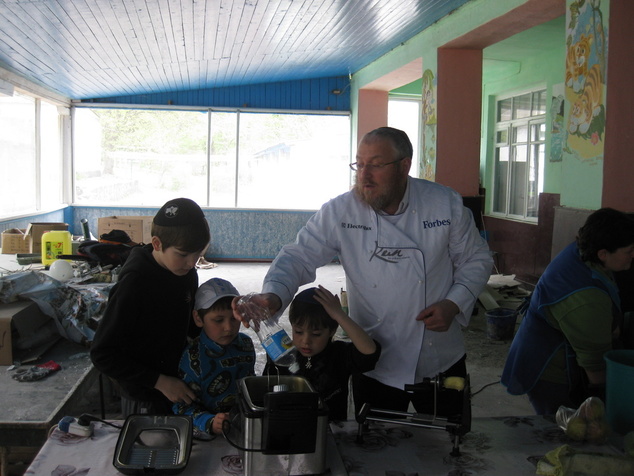
Uriel Stern and child refugees from Luhansk make potato chips in the boarding house for migrants for the town of Shpola.

So far, charity in Ukraine has been spontaneous. Anyone from the tertiary sector of the economy will say that a spontaneous process cannot be subject to planning or control. Everything is done on feeling. This is still not a valid process; not everyone is aware that he absolutely has to give 25 kopecks from each pay packet. Why is it happening like this? Because no one here is lobbying for charity. There are a million refugees in the country. But where are they? What is happening to them? Where can we find out where they are? Who is looking after them?

For 23 years, no one has implanted the idea in Ukrainians’ consciousness that it is necessary to help people. Yes, there were always people who contributed to religious organisations, schools, and hospitals. But overall society is only learning real charity.

For example, every year there are conventions for all the charitable organisations in the world. In 2014, there was one such convention in Holland.

It cost 3000 euro per person to participate in it. I found free tickets for people who wanted to go. But no one wanted to go from Ukraine. Russia was there. This just goes to show that the Ukrainian tradition of charity is only just starting.

There is also the problem of distrust. Many people in Ukraine prefer not to notice the problems of neighbours and people far away, and feel that only cheats ask for charity. So no one has to give to charity.

People here who have been given the mission of charity can go around on social media showing what a good time they are having on some tropical island–which hardly inspires trust in them. In USA, the biggest philanthropists live differently: Bill Gates drives an old car, Warren Buffet lives in an old house, Sergei Brin travels on the metro.  They do not buy flashy cars.

In our organisations throughout the world people can afford two things: expensive glasses, because you need to have good eyesight, and good shoes because you have to walk a lot and your feet have to keep up a furious pace.

Source: Association of Jewish Organizations and Communities of Ukraine

Posted in English, Opinions, Voices of Ukraine | Tagged , , , , , | 1 Comment

Dmitry Tymchuk: Military update 7.20 #FreeSavchenko

information_resistance_logo_engDmitry Tymchuk, Head of the Center for Military and Political Research, Coordinator of the Information Resistance group, Member of Parliament (People’s Front)
07.20.2015
Translated and edited by Voices of Ukraine

Operational data from Information Resistance:

Russian-terrorist troops in Donbas continue actively using artillery and heavy armaments to shell the positions of Ukrainian troops as well as settlements, including those controlled by the terrorists themselves.

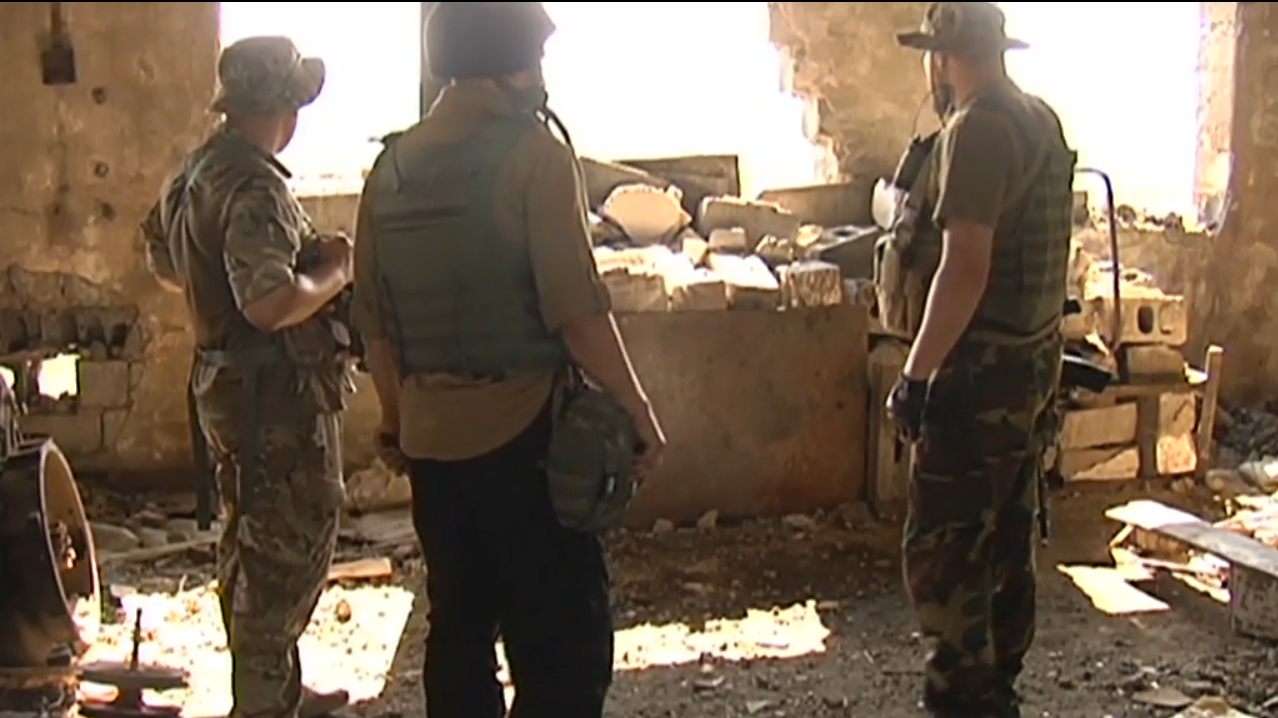
Ukrainian soldiers at Putilov mine, Avdiivka, survey shelling damage. Source: http://uatoday.tv/politics/east-ukraine-fronline-sniper-fire-rocket-shelling-continues-near-avdiivka-459104.html

Ukrainian soldiers at Putilov mine, Avdiivka, survey shelling damage. Source

The situation continues to be the most tense in the Donetsk sector. Terrorist fire is virtually uninterrupted on the stretch spanning Krasnohorivka – thenorth-west outskirts of Horlivka  Pisky – the northern outskirts of Avdiivka. Four militant artillery groups are active along the Pisky–Avdiivka line (26 cannon artillery units: mainly D-30 howitzers plus Msta-B howitzers; twenty-two 122 mm Gvozdika 2S1 and 150 mm Akatsiya 2S3 self-propelled guns deployed as several batteries; as well as six to eight Grad BM-21 122 mm MLRS systems constantly maneuvering along this sector of the front). Additionally, four militant armored vehicle groups have been reported on the front line (16 tanks operating across the entire sector, and 22-24 armored combat vehicles of various types, while the bulk of the heavy armaments has been slightly withdrawn to the rear and collected in several “armored vehicle parking lots” on the premises of local businesses, logistics centers, and warehouses). These armored vehicle groups are constantly firing on the ATO forces’ strongholds from camouflaged positions prepared in advance. The arrival of armored vehicles to their firing positions and [their] subsequent retreat after shelling is always carried out under cover of fire from the advanced enemy infantry groups using heavy machine guns, 82-mm and 120-mm mortars, AGS-17 grenade launders and ZU-23-2 auto-cannons.  The crews and armored vehicles comprising the “advanced” enemy armored groups are continuously rotating.

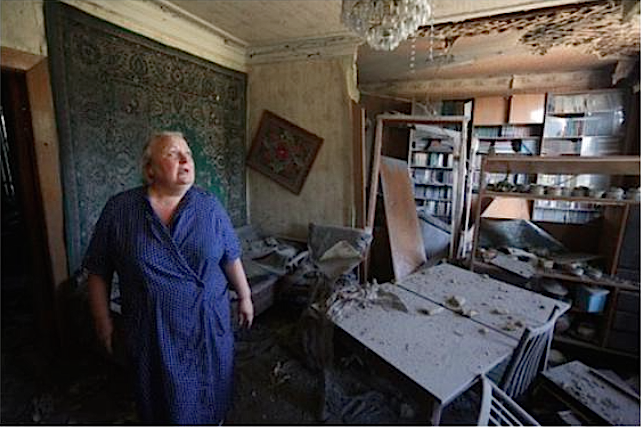
In Donetsk, a woman assesses the damages to her house from shelling on July 19, 2015. Photo: Aleksey Filippov, AFP. Source: https://twitter.com/molodyko/status/623146475032313856

In Donetsk, a woman assesses the damages to her house from shelling on July 19, 2015. Photo: Aleksey Filippov, AFP.

In the past 24 hours,  militants in this sector repeatedly used cannon artillery, shooting mainly from the area of Spartak, from firing positions east of Panteleimonivka and in Donetsk – between Voronykhina and Yurjeva streets (near Shcheglovske cemetery). Over the past 24 hours, shelling was carried out by a total of four militant cannon artillery batteries and at least six self-propelled artillery guns. Fire strikes were made on advanced positions of Ukrainian troops as well as on objects and targets in the tactical midst of the ATO forces (up to 10 km inward from the separation line). The enemy is clearly trying to disrupt the ATO forces’ command and control systems in this sector.

In the Luhanske, Troitske and Zaitseve areas of the Svitlodarsk bridgehead, the enemy opened fire several times, using small arms and grenade launchers (AGS-17 and SPG-9). The fire strikes were brief, intended more to harass our troop units than to engage any targets.

The “war in the greenery” continues, with sabotage and reconnaissance missions, patrols and raids by “small groups” on both sides. In the past 24 hours, several skirmishes were observed between sabotage-reconnaissance and infantry units of both sides: between the settlements of Zolote and Orikhove (a militant sabotage-reconnaissance group stumbled upon the concealed combat security of the ATO forces); near Schastya (a firefight between patrols), and near Krymske (a militant group stealthily entered the “neutral strip,” but was spotted by Ukrainian troop look-outs, and was forced to retreat after a short skirmish involving grenade launchers).

The “sniper war” is gaining momentum. Both sides make use of individual snipers as well as specially trained sniper groups. Snipers are the most actively used in the areas of Mar’inka, Pisky, Shumy-Kirovske, Chermalyk-Shyrokyne, Novotoshkivka-Krymske, Schastya and Stanytsia Luhanska.

Militant artillery and mortar units are stepping up their activity south of Donetsk, near Hranitne and Starohnativka. The enemy is using both 82 mm and 120 mm mortars and cannon artillery. In the past 24 hours, shelling was carried out by one battery of Gvozdika 2S1 122 mm self-propelled guns (rotating with an Akatsiya 2S3 battery positioned west of Starobesheve) and one battery of 122 mm D-30 howitzers.

Militants are transferring engineering and sapper equipment to the areas of Mospyne (Prydorozhnje), Oleksandrivka and Horbatenko, to clear minefield installations. Three IMR-2 (combat engineering vehicles) and one BAT-2 (armored track layer) units have been identified in the areas. Some of the terrorist tanks deployed south of Mospyne (Byryuky – Mikhaylivka – Svitle) are being equipped with detachable mine-clearing implements and practicing to traverse passageways through minefields.

Municipal garbage truck in Donetsk repurposed by militants as mortar carrier. Source.

Source: Dmitry Tymchuk FB

Posted in Dmitry Tymchuk, English, English News, Pictures, South&Eastern Ukraine, War in Donbas | Tagged , , , , , , , , , , , , | Leave a comment