Court rules that Putin decree classifying casualties remains in force. #FreeSavchenko

By Yuriy Vendik, BBC Russian service
08.13.2015
Translated and edited by Voices of Ukraine

Defense Minister Sergei Shoigu, and President Vladimir Putin. The authorities explain that the decree to classify deaths was prompted by the Ministry of Defense.

Defense Minister Sergei Shoigu, and President Vladimir Putin. The authorities explain that the decree to classify deaths was prompted by the Ministry of Defense.

On Thursday, Russia’s Supreme Court dismissed a complaint filed by a group of public figures and journalists challenging President Vladimir Putin’s decree that classifies casualties in special operations during peacetime as secret.

Initiators of two similar complaints – civil activist Denis Vostrikov and a group of human rights activists and journalists – argued in court that President Putin, by classifying special operations during peacetime, in his decree of May 28th this year, made too broad an interpretation of the Law on State Secrets, which categorizes as secret, information on only the numbers of troop units.

The President’s representatives objected that he has the necessary authority and, besides, the focus is on “special operations” and not on troop deaths in any circumstances.

Handing down his ruling, Supreme Court Judge Yuri Ivanenko promised to explain his reasoning to both sides later.

Over the seven or so hours of the sitting, only one person mentioned outright what was really being disputed, and then only once.

Davydova’s plain speaking

“I believe that this decree was issued for the purpose of classifying as secret the illicit use of Russian citizens in so-called illegal “special operations” during so-called leave of absences in Ukraine,” Svetlana Davydova stated in her concluding remarks. She is accused of divulging secret information about the movements of a Russian military unit on supposedly Ukrainian territory.

“Whatever we call them, whatever their status – servicemen, draftees, professionals, “little green men,” “polite people” or militias – they are citizens of Russia. Society needs to know about the casualties suffered by Russian society in order to prevent such losses in the future, ” Davydova continued.

All the others – both the applicants and the lawyers representing the President – carefully avoided any mention of Ukraine. Even the member of the Pskov Regional Legislative Assembly and “Yabloko” political party Leo Schlossberg, the first person in Russia last summer to publish details about the burial of Russian troop victims who, according to indirect information, died in Ukraine (officials deny this), never once pronounced the word “Ukraine ” in his testimonies.

Ivan Pavlov

Lawyer Ivan Pavlov promises to continue the fight against the decree classifying troop deaths in peacetime.

Lawyer Ivan Pavlov promises to continue the fight against the decree classifying troop deaths in peacetime.

“Any negative outcome is still a result. Publicity is quite an amazing thing. I wasn’t expecting much and to say I was expecting a favorable outcome to the petition would not be true, of course,” said Dennis Vostrikov to the BBC Russian service in his comment on the court’s decision.

“In such cases, which are by their nature of public importance, the court has not only a judicial function. It also has a special public function, which is now in almost all government agencies at each level of power vertical. We realize that we placed the court in a very difficult position, ” said another applicant, lawyer Ivan Pavlov.

According to Pavlov, he and his colleagues intend to apply to the Constitutional Court to test the Law on State Secrets on which the president’s representatives relied to defend the new decree in the Supreme Court.

“Not unless the entire army dies”

The applicants in the case explained that Article 5 of the Law on State Secrets contains a closed list of the types of information that can be declared secret, including troop numbers. However, details of casualties on their own do not reveal any numerical secrets about troop units or of the entire army.

“Not unless the entire army dies,” Ivan Pavlov said ironically.

“In item ten of his decree, President […] in effect introduced a new category of classifiable information that is not specified in Article 5 (Law on State Secrets). We believe that this does not correspond to current legislation and that this provides a basis for acknowledging that this item is inapplicable,” stated lawyer Daria Sukhikh.

Ministry of Defense Lawyer Natalia Elina, representing President Putin in the proceedings, constantly emphasized in her reply that we are talking about participants in special operations.

“The personnel involved in special operations during peacetime – “the Ivanovs, the Petrovs, the Sidorovs” – and correspondingly, their physical, mental, moral, and psychological condition, some missing without trace, some injured, some dead – constitute information that constitutes a state secret, because information about them as participants in special operations already constitutes information that constitutes a state secret, ” said Elina.

The applicants argued that Russian legislation does not clarify what a “special operation” is. Elina claimed that a special operation is a type of counter-terrorist operation, which is defined in the law on combating terrorism.

Unintended witnesses

Would persons revealing information about troop deaths and unaware that these occurred during “special operations” be prosecuted for divulging state secrets? No answer was given to this question.

The disputed document was signed on May 28th. According to the decree, casualties among Ministry of Defense personnel in special operations taking place in peacetime, now become state secrets.

The decision has upset journalists, who suspect that the decree is designed to conceal the participation of Russian troops in the armed conflict in Ukraine.

The petitions were filed by Denis Vostrikov and a group of Russian journalists, politicians and human rights defenders: Vladimir Voronov, Svetlana Davydova, Timur Olevskiy, Pavel Kanygin, Arkadiy Babchenko, Ivan Pavlov, Leo Schlosberg, Grigoriy Pasko and Ruslan Karpuk.

The President’s press secretary, Dmitriy Peskov, denied these allegations, saying that the decree has nothing to do with Ukraine, and that Russia is not intending to conduct any special operations on the territory of a neighboring state.

Source: BBC Russian service


Creative Commons License
This translation work is licensed under a Creative Commons Attribution-ShareAlike 4.0 International License. The rights pertaining to the original work remain unaffected.

Posted in English, Pictures | Tagged , , , , , , , , , , | 1 Comment

Dmitry Tymchuk: Military update 8.14 #FreeSavchenko

information_resistance_logo_engDmitry Tymchuk, Head of the Center for Military and Political Research, Coordinator of the Information Resistance group, Member of Parliament (People’s Front)
08.14.2015
Translated and edited by Voices of Ukraine
Photographs by Noah Brooks, reprinted by permission

Operational data from Information Resistance:

In addition to the intense shelling of the ATO forces positions and civilian objects (including with the use of heavy armaments), Russian-terrorist troops in Donbas are using sabotage and reconnaissance groups (SRG) en masse, on different sections of the front line. The SRG are staffed with military servicemen of the Russian Armed Forces, as well as local militants and Russian mercenaries who have undergone training in “training centers” under Russian Armed Forces instructors. The enemy’s SRGs are particularly active in the vicinity of Avdiivka, Mar’inka, the Svitlodarsk bridgehead, in the coastal areas, and in the Shchastya – Stanytsia Luhanska stretch. In addition to this, the enemy is widely using reconnaissance equipment (aerial drones, electronic intelligence stations, electro-optical equipment).

Over the past 24 hours, terrorists continued carrying out “harassing” fire and purposeful fire strikes. In the area northeast of Horlivka (Kodema – Semyhirya), militants employed a battery of six 152 mm Msta-B guns to make two fire strikes on the ATO forces’ strongholds. Mortars were used to fire on the positions of Ukrainian troops near Novoluhanske – Zaitseve – Dacha. During one of the fire strikes, two militant infantry groups were spotted moving towards the ATO forces’ positions, through the “greenery.” One of the groups opened fire on the positions of the Ukrainian forces battlefield security, while the other attempted to covertly infiltrate the rear of the ATO forces’ stronghold. Both of these groups were stopped and thrown back by Ukrainian troop fire.

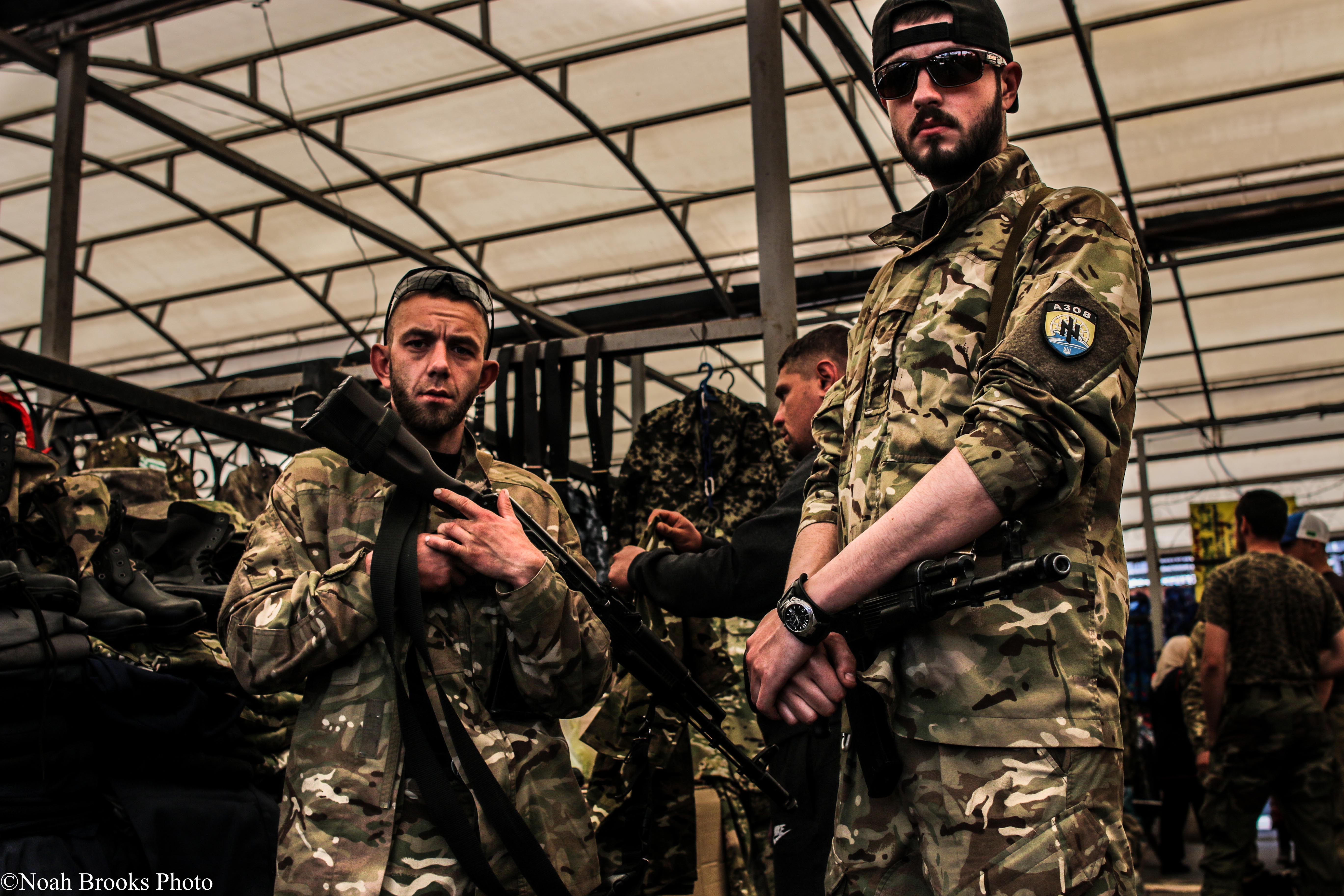
Volunteers from Azov Battalion shop for boots in Mariupol. Photo: Noah Brooks.

Volunteers from Azov Battalion shop for boots in Mariupol. Photo: Noah Brooks.

In the stretch between Avdiivka – Shumy, the enemy used mortars (82 mm and 120 mm), 122 mm artillery (three batteries operating), AGS-17 automatic grenade launchers, and ZU-23-2 anti-aircraft units mounted on transport platform.

In the areas of Krasnohorivka – Lozove, and near the settlement of Opytne, the enemy used armored vehicles in addition to artillery (4 tanks and 6 armored combat vehicles), firing from tank guns from positions that were spread out, equipped, and camouflaged.

The maneuvers of enemy infantry groups in the “greenery” were spotted in the vicinity of Mar’inka and Krasnohorivka. Units with 82 mm mortars and AGS-17 grenade launchers were recorded transferring to this area.

Terrorists continue shelling the ATO forces’ positions near Pavlopil, Chermalyk, and Orlivske. In these areas, militants mainly use 120 mm mortars; strikes from 122 mm artillery and BM-21 Grad MLRS were also recorded.

The IR group’s network in this area reports the presence of a powerful militant artillery group, which includes units operating 122 mm cannon artillery, 152 mm 2S19 Msta-C self-propelled guns (six guns), and a battery of BM-21 Grad MLRS. Every day, the enemy uses no more than one or two artillery units from this artillery group, while other units remain on camouflaged positions.

Near the settlements of Starohnativka, Talakivka, Hranitne, and Berezove, the enemy continued carrying out harassing artillery fire during the past 24 hours, and made purposeful powerful artillery strikes on the positions of Ukrainian troops. The enemy mainly used 152 mm artillery; strikes from BM-21 Grad MLRS, 120 mm mortars, and 122 mm artillery were also recorded.

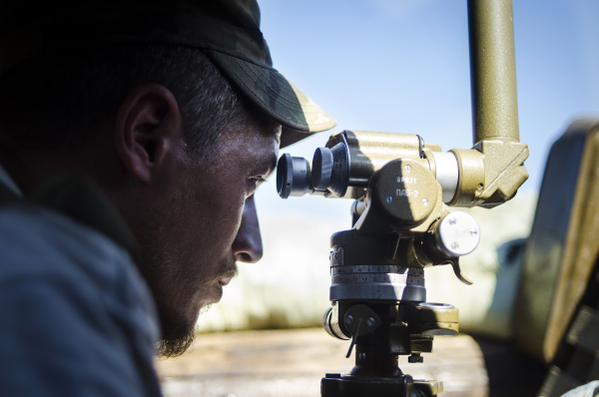
A soldier waiting at a block post behind some trees near Mariupol while continued shelling targets their position. Photo: Noah Brooks

A soldier waiting at a block post behind some trees near Mariupol while continued shelling targets their position. Photo: Noah Brooks

The enemy continues transferring reinforcements to the vicinity of Novolaspa and Starolaspa. Over the past 24 hours, the terrorist battalion already concentrated in this area was joined by a reinforced infantry company (seven armored combat vehicles, including two BMP-2, MT-LB, and BTR-80 armored personnel carriers), and a tank platoon (4 tanks).

Several militant groups operating BM-21 Grad MLRS (2-3 units in each, up to 10 systems in total) were spotted maneuvering. These groups had previously fired on the settlements of Opytne, Vodyane, Pisky, and the Kyivskyi district of Donetsk.

Reinforcements were recorded arriving for the militants’ artillery group in the “Horlivka Garrison.” Additional three D-30 howitzers, escorted by two BTR-80 APCs were transferred to this area.

Militants continue “combat training” near Lutuhyne (in the so-called “Lutuhyne Camps“). In the context of “preparing for repelling the Ukrainian troop offensive,” a large portion of the “field center” personnel and combat equipment  (10-11 tanks and at least 14 other armored combat vehicles) has transferred to an area north of Luhansk. At this time, a militant motorized rifle unit, reinforced by an artillery battery, is practicing inter-unit cooperation organization in the “training center.”

Source: Dmitry Tymchuk FB 

Creative Commons License
This translation work is licensed under a Creative Commons Attribution-ShareAlike 4.0 International License. The rights pertaining to the original work remain unaffected.

Posted in Dmitry Tymchuk, English, English News, Pictures, South&Eastern Ukraine, War in Donbas | Tagged , , , , , , , , , , , , | Leave a comment

Dmitry Tymchuk: Military update 8.13 #FreeSavchenko

information_resistance_logo_engDmitry Tymchuk, Head of the Center for Military and Political Research, Coordinator of the Information Resistance group, Member of Parliament (People’s Front)
08.13.2015
Translated and edited by Voices of Ukraine
Photographs by Noah Brooks, reprinted by permission

Operational data from Information Resistance:

Attacks by Russian-terrorist troops continue intensifying in Donbas, including with the use of heavy weapons (2/3 of the attacks were recorded in the Donetsk oblast). Throughout the day, terrorists increased the use of rocket artillery. Simultaneously, on many sections of the front line, the enemy is engaging in active intelligence efforts (aerial, land, and electronic reconnaissance), conducted by formations of local militants and Russian mercenaries, as well as units of the Russian armed forces.

During the day, the enemy carried out massive attacks from 120 mm mortars on the areas of Verkhnotoretske, Troitske, Novhorodske, and Leninske, trying to inflict fire damage on the ATO forces’ advanced units west of Horlivka.

Militants also used 82 mm and 120 mm mortars to fire on the positions of Ukrainian troops northeast of Pisky and in the area of Avdiivka (on the southern and northern outskirts of the settlement).

The enemy fired on the ATO forces’ positions from 122 mm artillery in the area between Lozove and Krasnohorivka, and the Opytne – Vodyane stretch.

The ATO forces’ stronghold in the area of Krasnohorivka was shelled with BM-21 Grad MLRS (multiple rocket launching systems). Overall, during the past day, militants have made a series of fire strikes using rocket artillery (122 mm BM-21 Grad MLRS) on the positions of Ukrainian troops, namely in the area between Vodyane and Opytne (and in the vicinity of the latter), in the area of Pisky, and between the settlements of Novhorodske and Troitske.

The strengthening of Russian-terrorist troops continues on the right flank of the Svitlodarsk bridgehead. In the area of Holmivskyi, Zaitseve, and Novoluhanske, the enemy, has repeatedly made attempts to covertly move their advanced infantry groups into the “greenery” in the neutral zone (under heavy cover fire of 82 mm and 120 mm mortars), trying to move within the effective range of fire of the ATO forces’ advanced units. After several brief small arms attacks, the enemy quickly retreated to their original lines. On two occasions, the enemy in this area also opened fire from 152 mm artillery.

After a brief pause, militants renewed their activity in the area of Krymske and Novotoshkivka. In particular, during the day, terrorists made multiple attacks in the vicinity of checkpoint N29, opening fire from the “greenery” with small arms and hand grenades. Near Krymske, one of the ATO forces’ strongholds was shelled by mortars. In the area of Popasna, militant infantry groups have been actively attempting to approach the advanced units of the ATO forces, moving through the “greenery” and trying to position themselves within effective fire range for subsequent attacks.

Near Shchastya and Stanytsia Luhanska, “traditional” attacks were observed, as terrorists used small arms and AGS-17 automatic grenade launchers.

During the last 24 hours, the enemy used armored vehicles on three occasions:

•  In the area of Mar’inka, several shots were fired from tank guns using HE shells, at the advanced positions of the ATO forces (an armored group with two militant tanks and two BMP-2 infantry fighting vehicles in the first line);

• Near Opytne and DAP [Donetsk Airport Terminal], a previously recorded armored group of terrorists continues to operate. 2 tanks and 3 armored combat vehicles opened fire from pre-equipped firing positions;

The "Karpatska Sich" battalion keeps an eye on the Donetsk airport. Photo: Karpatska Sich FB

The “Karpatska Sich” battalion keeps an eye on the Donetsk airport. Photo: Karpatska Sich FB

• Near Starohnativka, Bila Kamyanka, and Novolaspa, several militant tanks and AFVs [armored fighting vehicles] (6 units in total) opened long-range fire from on-board weaponry on the ATO forces units that had gained a foothold in this area.

The enemy used 152 mm artillery and 120 mm mortars to deliver virtually uninterrupted artillery fire on the ATO forces positions and towns in the Stepne – Berezove stretch, in the vicinity of Starohnativka and Hranitne, as well as the southeast of Dokuchajevsk.

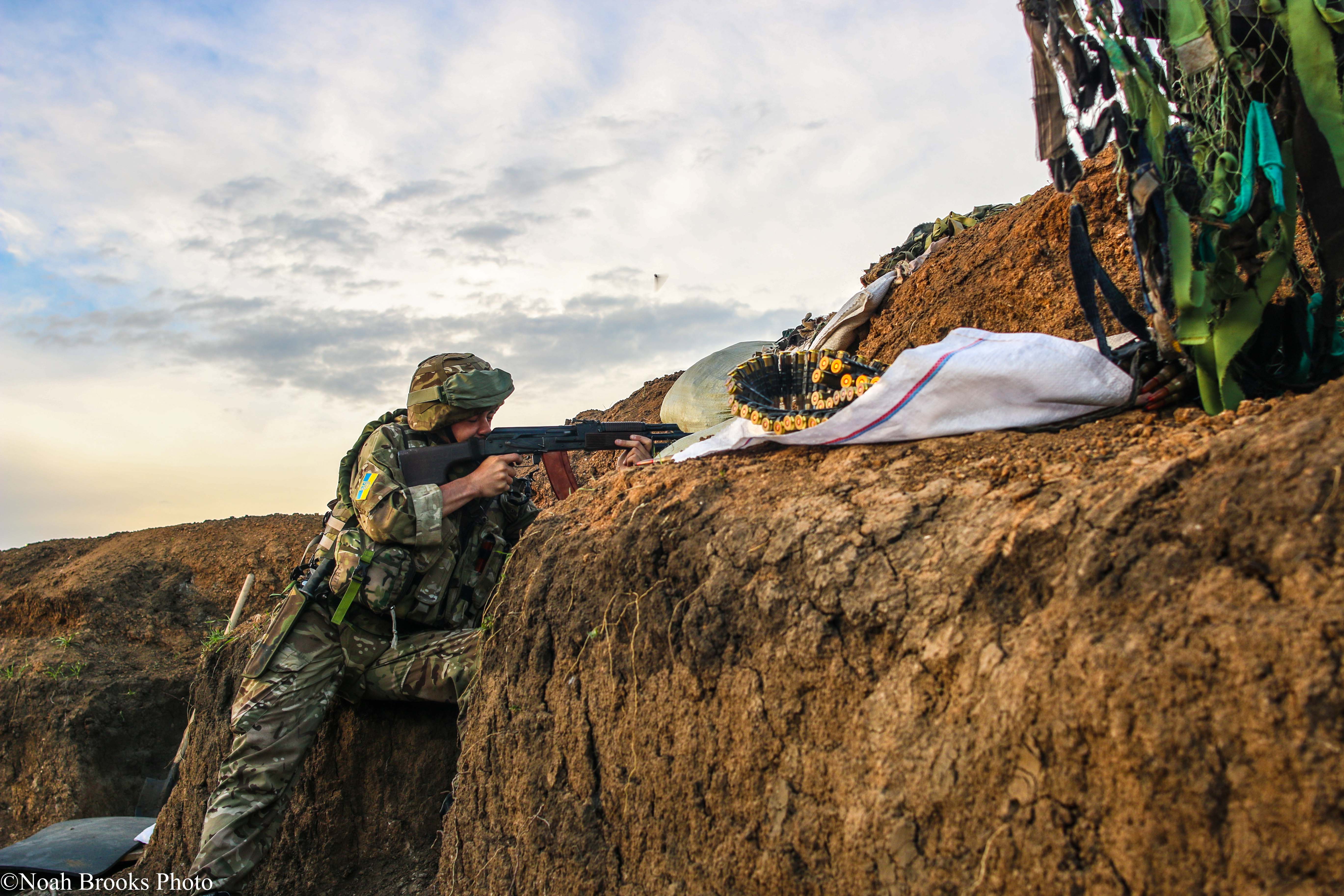
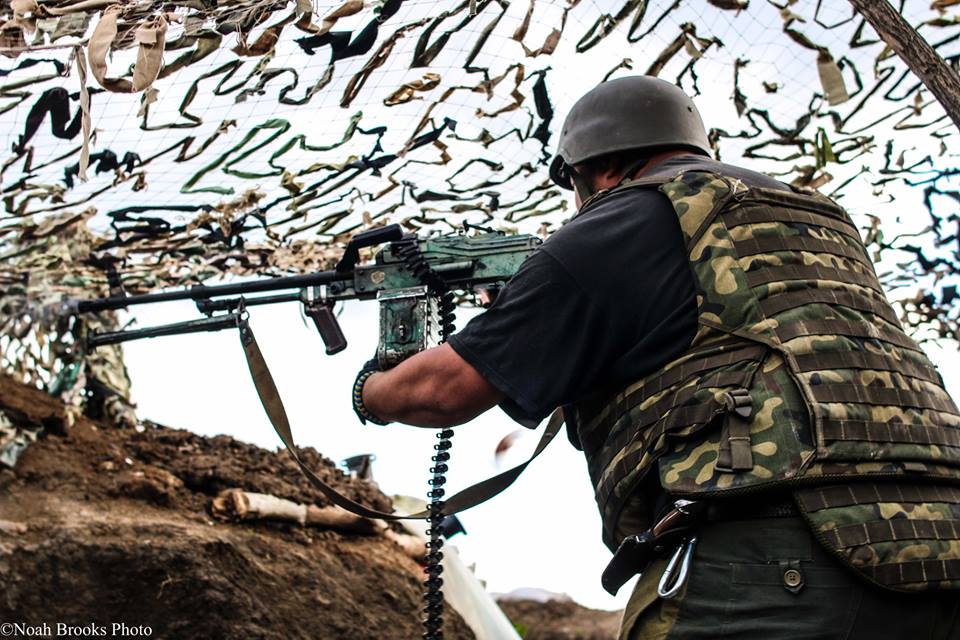
An Azov Battalion volunteer in a firefight with separatists near Mariupol. Photo: Noah Brooks. Source: http://ink361.com/app/users/ig-938895707/modernwarcollective/photos/ig-986906468568208136_938895707

An Azov Battalion volunteer in a firefight with separatists near Mariupol. Photo: Noah Brooks.

Russian-terrorist formations are stepping up their activity in the coastal direction, having shelled the positions of Ukrainian troops near Chermalyk and southwest of Pavlopil from 152 mm and 122 mm artillery.

The enemy continues actively regrouping and transferring personnel and combat equipment.

In the Novolaspa direction, militants completed the formation of two composite artillery groups (each up to a division in strength), totaling 22 cannon artillery guns (122 mm and 152 mm), eight 2S1 “Gvozdika” and 2S3 “Akatsiya” self-propelled guns, and eight Grad MLRS. One of the artillery groups is positioned south of Komsomolske, while the other one is being deployed in the vicinity of Krasnopillya – Kamyanka.

A composite mortar squad (twelve 82 mm and 120 mm mortars) has been redeployed from Donetsk towards the southern areas.

An armored group has been transferred towards Vesela Hora from the direction of Luhansk. It includes tanks (at least two of them T-72) and MT-LB trucks, up to 10 units in total.

The enemy continues reinforcing their tactical group operating in the coastal direction. Two tactical groups have been transferred to the area of Sakhanka (55-60 personnel in one, 90-100 in the other). The groups also include six armored vehicles (mainly APCs and MT-LB), as well as several jeeps and off-road vehicles, while most militants are being transported on board of army trucks.

Source: Dmitry Tymchuk FB 

Creative Commons License
This translation work is licensed under a Creative Commons Attribution-ShareAlike 4.0 International License. The rights pertaining to the original work remain unaffected.

Posted in Dmitry Tymchuk, English, English News, Pictures, South&Eastern Ukraine, War in Donbas | Tagged , , , , , , , , , , , , | Leave a comment

Dmitry Tymchuk: Military update 8.12 #FreeSavchenko

information_resistance_logo_engDmitry Tymchuk, Head of the Center for Military and Political Research, Coordinator of the Information Resistance group, Member of Parliament (People’s Front)
08.12.2015
Translated and edited by Voices of Ukraine
Photographs by Noah Brooks, reprinted by permission

Operational data from Information Resistance:

The conflict in Donbas continues to escalate due to a sharp increase in activity by Russian-terrorist troops carried out under the pretext of delivering “pre-emptive strikes” to counter an imaginary “offensive by Ukrainian troops” in the run-up to Ukraine’s Independence Day [August 24th]. The terrorists are making use of practically all their front-line weaponry (various types of armored vehicles and artillery, including rocket artillery) on several sections of the front line simultaneously, both in Donetsk and Luhansk oblasts.

In the areas of Novomykhailivka, Stepne and Berezove, militants are actively utilizing 120 mm mortars and 122 mm artillery to shell the advanced positions of the ATO forces, as well as a number of strongholds in the tactical depths of the Ukrainian defenses. Four mortar batteries and three 122 mm artillery detachments (totaling twelve 120 mm mortars distributed among several firing groups, plus twelve 122 mm cannon artillery guns) were identified in these localities. Within this area, militants established centralized artillery firing control for all mortar and artillery detachments (the presence of a single artillery command post was noted).

Active shelling by Russian-terrorist troop formations was also observed in the vicinity of Krasnohorivka, Lozove, Pisky, Opytne, and Avdiivka. In addition to the usual “traditional” shelling from 82 mm and 122 mm mortars, AGS-17 automatic grenade launchers, and ZU-23-2 anti-aircraft systems, militant became more active in their use of artillery. Brief fire strikes on the advanced positions of the ATO forces, from 122 mm and 152 mm artillery, were recorded in the vicinity of Opytne; up to a dozen shells were fired at the settlement of Krasnohorivka (in the vicinity of the brick plant).

At the same time, the enemy used several armored groups over the past 24 hours, which operated in a number of sectors.  Thus, a group of militant tanks (three units), supported by four armored fighting vehicles (two BMP-2 infantry fighting vehicles and two BTR-80 armored personnel carriers), was active to the northwest of Donetsk Airport, from the direction of Spartak.

Militant armored vehicle groups using the “tank + mortar” scenario continue to operate in the Svitlodarsk bridgehead.

Around Popasna and Novozvanivka, active firefights were noted, where militants employed small arms. In the vicinity of Krymske, Shchastya, Stanytsia Luhanska, Starohnativka and Novolaspa, militants used 120 mm and 82 mm mortars, as well as AGS-17 automatic grenade launchers.

A Ukrainian soldier smoking on the beach in Mariupol. Just a few miles away, a battle was taking place as separatists tried to capture the city. Photo: Noah Brooks. Source: http://ink361.com/app/users/ig-938895707/modernwarcollective/photos/ig-1038982617997447827_938895707

A Ukrainian soldier smoking on the beach in Mariupol. Just a few miles away, a battle was taking place as separatists tried to capture the city. Photo: Noah Brooks. Source

In the vicinity of Bohdanivka (the coastal direction), militants fired some 40 full magazine salvoes from 122 mm BM-21 Grad multiple rocket launch systems, firing from six MLRS units in succession, over a period of several hours.

Over the past 24 hours, Ukrainian troop units reinforced their positions along the new line to which they advanced after the fighting on 08.10.2015 (high ground 209.7 – Bila Kam’yanka), firing from their new positions to repel the militants’ attempts to dislodge the ATO forces units from their high ground. During the past 24 hours, the enemy subjected this area to continuous shelling, using 152 mm and 122 mm artillery in an attempt to engage the advanced ATO troop positions, communications lines in tactical depth, as well as command and control points and supply points. In the past 24 hours, small infantry groups of militants (each up to a platoon strength of 25-30 men) resorted to active maneuvering and made three attempts to penetrate the rear flanks of the ATO forces’ tactical groups that manned the new forward edge. As a result of the armed clashes, the enemy was driven back to their starting lines.

At the same time, militants moved additional artillery detachments to an area in the vicinity of Starohnativka and Novolaspa. These consist of two 152 mm artillery detachments (according to our preliminary information, one of them is a self-propelled howitzer artillery battery (GSABtr) from the “Kalmius” separate artillery brigade, and the other, a 152 mm Msta-B gun battery from the 1st Separate Motorized Rifle Brigade (OMSBr) of the “Army of the DNR”). The 122 mm artillery units of the DNR Army’s 5th Separate Motorized Rifle Brigade (OMSBr) from Telmanove (D-30 gun battery) are currently taking firing positions, and partially re-equipping some of them. A division of BM-21 Grad MLRS (6 systems) was observed moving out of Starobesheve.

Militant manpower and equipment are being actively transferred to the LNR and DNR, to “repel the strike” by an imaginary “tactical strike force of Ukrainian troops.”

In areas north of Luhansk, as well as on the Mykolaivka – Stanytsia Luhanska stretch, terrorist combat and transport vehicles are actively on the move. In the Luhansk – Stukalova Balka – Khrystove sector, up to 20 armored vehicles and weapons were transferred (six tanks, two 152 mm SAU 2S3 “Akatsiya” self-propelled artillery units, three trailer-mounted 122 mm D-30 guns, seven armored fighting vehicles, mainly BMP-2 and some BMP-1 infantry fighting vehicles).

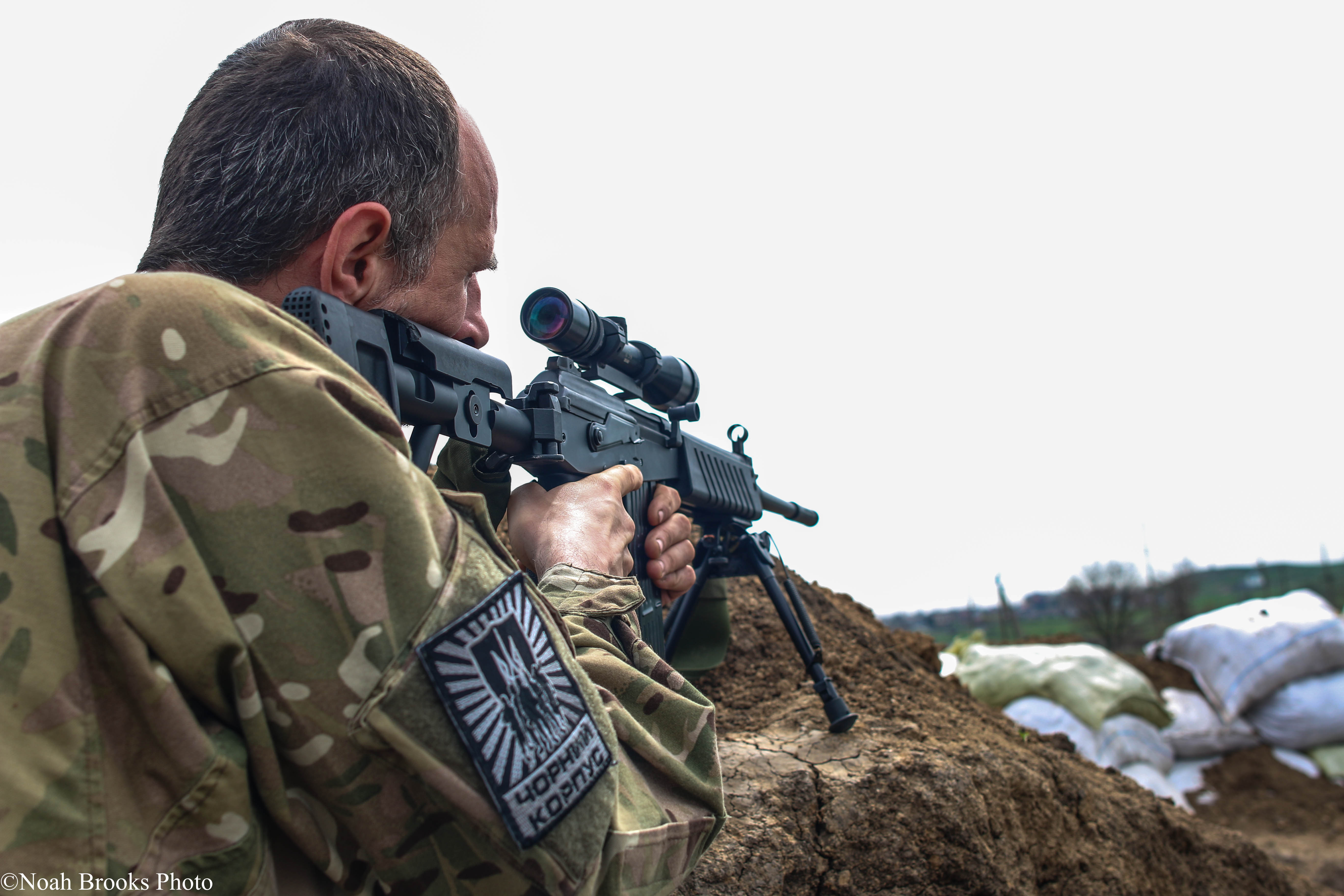
An Azov Battalion sniper takes aim on the front line. Photo: Noah Brooks. Source: https://twitter.com/NoahBrooks99/status/625456092940734465

An Azov Battalion sniper takes aim on the front line. Photo: Noah Brooks. Source

Over the past 24 hours, up to 10 tanks, six BMP-2, and 22 transport vehicles (six of which carried D-30 and Msta-B artillery guns) were moved along the Bakhmut motorway in the direction of Zholobok and Slovyanoserbsk.

Four SAU 2S1 122 mm self-propelled artillery units were moved from the Petrovskyi district of Donetsk to the Olenivkyi district.

A militant armored vehicle group was spotted approaching Oleksandrivka. It was formed of eight tanks and eight armored fighting vehicles (BMP-2 infantry fighting vehicles and BTR-80 armored personnel carriers, including at least two units of the latest Russian BTR-82A model).

The terrorists are also actively transferring armored combat equipment to both flanks of the Svitlodarsk bridgehead (two companies of tank troops have been spotted in the vicinity of Holmivskyi, 10-12 tanks in each).

A militant motorized rifle detachment (nine armored fighting vehicles, mainly BTR-80 armored personnel carriers and MT-LB light-armored multi-purpose transporters) has been transferred to the area south of Pervomaisk (the area of Irmino-Bryanka).

Source: Dmitry Tymchuk FB

Creative Commons License
This translation work is licensed under a Creative Commons Attribution-ShareAlike 4.0 International License. The rights pertaining to the original work remain unaffected.

Posted in Dmitry Tymchuk, English, English News, Pictures, South&Eastern Ukraine, War in Donbas | Tagged , , , , , , , , , , , , | Leave a comment

Nolan Peterson: A Toast In Memorium to Daniel Kasyanenko. #FreeSavchenko

By Nolan Peterson, Foreign Correspondent at The Daily Signal and former USAF special ops pilot
08.07.2015
Reposted here with permissions of the author

A toast…

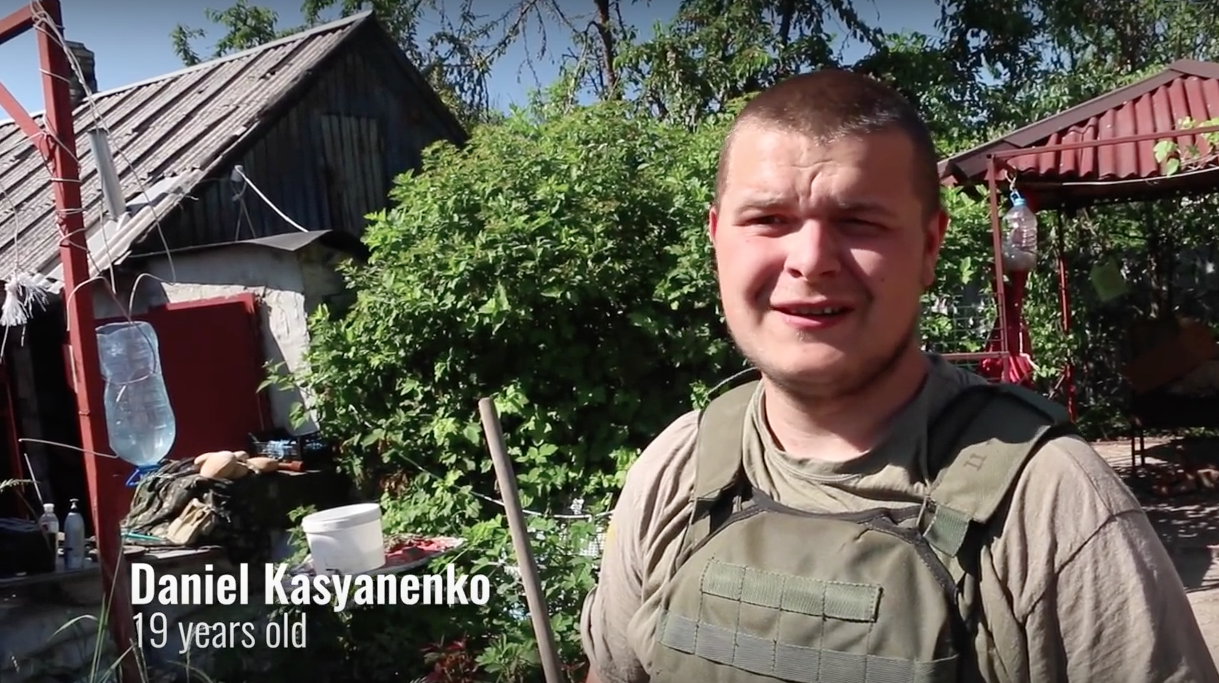
This morning I heard that Daniel Kasyanenko was killed in action during a mortar attack outside the Donetsk Airport. He was only 19, and he was a friend. He was a young man who was aware, more aware than most of us, of how the war was affecting him. He was afraid it would ruin his spirit, and that, at 19, he was already running out of time.

I wrote this about Daniel in one of my articles. And in the video below, you can hear Daniel in his own words. We should all listen to what he had to say.

Still from video: "This Is What the Ukraine War Looks Like: 8 Days on the Front Line" (below, in full).

Still from video: “This Is What the Ukraine War Looks Like: 8 Days on the Front Line” (below, in full).

“We were sitting around the table one night after dinner when Daniel came by for a visit. It was dark when he arrived, hours past when he was supposed to have left his post. He had been in a battle that evening, he said, a bad one.

There was sniper and machine-gun fire and artillery falling all around. He wasn’t even able to shoot back, he said, because it was so intense. He could only low-crawl through the trenches to find cover and wait it out. Yet, when describing the battle, he said: “It was really awesome. Really awesome.” He gave a thumbs up and smiled broadly.

He looked tired, though, and when he sat down he chugged several glasses of water and then juice. He filled his plate with food and ate well. He glided easily into the conversation as if he were a 19-year-old just getting home from afternoon sports practice rather than a day of combat.

Daniel had a soft, tanned face, small dark eyes, and patchy young man’s beard, which he had let grow around his neckline and upper lip like many other young Ukrainian soldiers. He wore a cross on his wrist.

He spoke English in a staccato, halting way, sometimes staring off when he was stuck on a word, either because of the translation or because he was explaining an idea that is hard to express in any language. Daniel was unique in his ability to put the toll of the war in context. Even at his age, he already understood the unalterable changes occurring in him. He recognized that he was spending the formative years of his manhood in a place where all that life owed him—years, love, family, career—all those things could disappear any second in a white flash and red heat and dark nothing.

Soldiers such as Daniel escape death by seconds and inches every day. Others get it. Yet, time after time, they survive. You are either one of the lucky ones, or a name that you make a toast to before dinner with a sad shake of the head.”

[Editor’s note: Daniel Kasyanenko was with the Ukrainian Army’s 93rd Mechanized Brigade stationed in Pisky].

Source: Nolan Peterson FB

Creative Commons License
This translation work is licensed under a Creative Commons Attribution-ShareAlike 4.0 International License. The rights pertaining to the original work remain unaffected.

Posted in English, Eyewitness stories, Pictures, South&Eastern Ukraine, War in Donbas | Tagged , , , , , , | Leave a comment