
 The newspaper “Ostrov” published a transcribed fragment of instructions for Russian special groups (Spetsnaz) of the Main Intelligence Directorate (GRU).
View original post 673 more words
The newspaper “Ostrov” published a transcribed fragment of instructions for Russian special groups (Spetsnaz) of the Main Intelligence Directorate (GRU).
View original post 673 more words
By Thomas Theiner
 Augstein, main publisher of Der Spiegel, channeling his inner Ribbetrop
Der Spiegel, already a lie spreading, propaganda spewing, sorry excuse for a “journalistic” product, which once had some ethics, morals and professionalism is sinking so low so fast, that one can barely follow its decent down the drain into the sewers.
Yes, I am furious and there is a reason for that: Today Der Spiegel published an extremely tendentious piece linking the Ukraine government to Syrian jihadists, which I thought would be hard to top with its malicious content… but Der Spiegel managed to do just that and in less than three hours!
The new piece is by Jakob Augstein, who usually publishes uninformed barely logical ramblings with anti-Semitic undertones. This time he write about Ukraine… or as he says it “worthless Ukraine.” His argument is that Ukraine isn’t worth risking a confrontation with Russia, so the…
View original post 501 more words
By Yuriy Butusov, Chief Editor at Censor.NET
04.01.2014
Translated and edited by Voices of Ukraine
Source: http://glavcom.ua/articles/18608.html
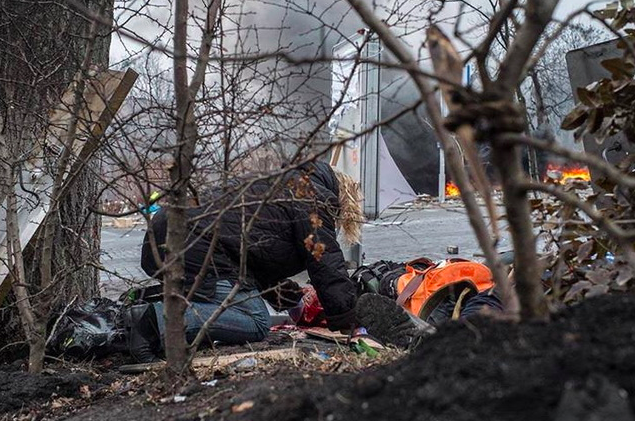
How happy I was that we managed to find her! An awesome photo by the famous French photographer Eric Bouvet has become one of the most vivid impressions of the tragic and heroic day of February 20, 2014. Snipers began shooting at unarmed people on Instytutska Street [in Kyiv, Ukraine]. Maidaners [protesters on Maidan Nezalezhnosty or Independence Square] did not leave their people behind – they tried to get everyone out, but the murderers kept shooting at those trying to pull the wounded people out. And when the men were killed, this woman came to the rescue of the wounded – without a helmet, shield, or bullet-proof vest, with her hair down. She had no protection whatsoever. Nothing but her whole-hearted courage, love for the people, a sense of duty, and God’s providence.
But she didn’t have a name. On March 11, I wrote an appeal to help find this unacknowledged heroine.
And now, after one month and over 4,000 shared posts, Facebook produced a true miracle–kind people helped me to contact her. Meet Maria Matvijiv, an emergency nurse at “Lviv regional center for medical care and disaster medicine,” in the town of Busk in Lviv Oblast [region]. Maria knows nothing about the hype around her feat on the Internet, and her world-famous photograph on Instytutska Street. She has no account in the social networks, nor an e-mail address, nor time to surf the news. She has a 12-year old son Dmytryk, husband Petro, mom Myroslava, and such a regular, hard job–to save lives. I wrote down her story, very simply and completely devoid of picturesqueness and narcissism.
“I came to Maidan five times during the revolution. My sister and husband came with me every time when it got dangerous on Maidan. We were always on the front lines. I knew that Maidan was our chance to change our life for the best, and I did not have questions as to what had to be done and what didn’t. What is the point of living in fear? We always lived in the tent of our Busk Sotnia [company]. We were at home in Busk on February 18, 2014, when we saw horrifying pictures from events in Kyiv, dozens of dead and injured people, we were shocked. But in the evening, my husband and I gathered our things and came out to the [town] square where the bus was leaving for Kyiv. Here was the first time I saw how scared many men were–there weren’t too many volunteers. 30 of us left for Kyiv, and I was the only female.
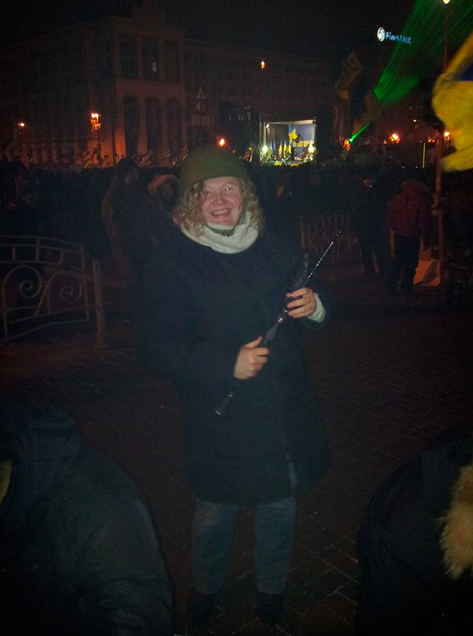
We arrived on Maidan at 3:30 pm on February 19. I exited the bus, and was so happy–I saw a lot of people, I saw that Maidan will not give up no matter what, and Maidan gave me strength. Later my husband said that he had a completely different impression from what he had seen on Maidan–he saw what I didn’t pay attention to–that the last line of defense ran under the stage, they did not have enough fuel, and there were few Molotov cocktails left. We immediately started to pour Molotov cocktails and pass them to the frontline. We worked all day and all night this way. I had already started helping the wounded, and began to cook food. We found out about the truce on the morning of February 20, and as soon as the police left Maidan, we decided to get some sleep. Just as I dozed off, our guy from Busk ran into the tent – he said that our people were shot at near the October Palace, and that they urgently needed medics.
I ran towards the October Palace – I did not have a helmet or a bullet-proof vest. I decided not to put on the Red Cross cape. Sniper shots easily pierce through this armor. Ever since the confrontations on Hrushevskiy Street, I saw how medics in bright uniforms could become targets, and that’s why I did not want to attract unnecessary attention. On the road above me, I saw how they had started shooting at people on Instytutska Street. The hail of fire was very dense, the roar of shots went on continuously. At first, I helped one young man with a light wound. Then I crawled towards the fighter who got wounded in a leg. But cries for help were coming from the very top of the barricade. I crawled upwards. Here, snipers would not let people approach the wounded.
I stopped for a minute. I remembered my [son] Dmytryk, my life, people I am close to, everyone I love. But the cries for help were louder than the shots. And so I crawled to him.
The guy in a photo was shot when I was already quite close to him. When I approached him, I saw that he had a severe head wound. The hole from a bullet entrance was about 2 centimeters [.8 inches] in diameter, and the blood kept pouring out in a forceful stream, just like from a faucet. All I could do immediately was to stop the bleeding. As soon as I put a bandage on him the orderlies ran over and carried him out. Then, another man by a tree got wounded in his stomach–a very severe wound. The bullet literally ripped him open and also spurted blood like a fountain. The young medic could not give him a shot– people kept falling around, bullets were whistling, screaming, blood. But I have the [necessary] experience–my hand did not tremble. Other people already put bandages on him and took the wounded man. Time seemed to no longer exist, and I did everything on autopilot, and saw nothing but wounded and dead. The man from Kolomya covered me with a shield–I only remembered him the next day, when he reminded me of the day before. I looked around–others could no longer be helped, and the guys were dragging the bodies out.

Overall, I participated in saving four people that morning. Two of them surely remained alive. I saw the fighter with a head wound later–unfortunately, already lying lifeless among the bodies laid out by the “Kozatska” Hotel. Judging by the nature of the injury, the fighter with the bullet to his stomach unfortunately had very little chance to survive… I came back to Kyiv to commemorate them for nine days. When will I be in Kyiv again? I don’t know. People seem to be going there in May, and maybe even in a year… But, my mom corrects me that if there is war, then I will have to go [there] again. Of course, Mom, of course I will go. Now that we’ve managed to liberate the land [from Yanukovych], we will manage to protect it.”
I told Maria, that thousands of people are proud of her, and admire her. That I was ready to invite her and her family to Kyiv, that we would pay for her transportation and board, that talking to her is a great honor. But … and I haven’t heard a drop of affectation or showing off–she refused, because she has “a lot of work.” She has everything of course. How do you reward a person whose feat is immeasurable in medals? I hope Faceboook will prompt us in this. I said the following,
Thank you, Maria Matvijiv. Glory to Ukraine!
Die wahren Gründe für den bewaffneten Konflikt in Slowjansk unterscheiden sich möglicherweise grundlegend von denen, die der Kreml verlautbart.
Möglicherweise ist Schiefergas der Schlüssel dazu, warum ausgerechnet Slowjansk (russ. „Slawjansk“) zum neuen Hot Spot im Gebiet Donezk wurde. TSN.Tyschden‘.

Ist Gas der Grund für die Aktionen russischer Saboteure in Slowjansk? Quelle: tsn.ua
Grundlage für diese Vermutung bilden eigene Recherchen der Journalisten von TSN zu dem Geheimprojekt „Jusiwka“ (russ. „Jusowka“, nach John James Hughes, Gründer einer metallurgischen Fabrik in der ursprünglich nach ihm benannten ukrainischen Stadt Jusowka, dem heutigen Donezk). Über dieses Projekt wird in der Ukraine nur ungern gesprochen, da es gigantische Ressourcen birgt, die die Energiekarte der Welt verändern könnten.
Die Umstände weisen darauf hin, dass im Donbass gar kein Kampf für Minderheitenrechte, Föderalisierung, Schutz der russischsprachigen Bevölkerung und der „Patrioten“ von Slowjansk gegen irgendwelche mystischen „Bandera-Faschisten“ und die vermeintliche Kiewer „Junta“ stattfindet. Das alles sind nur Stereotypen, die in den Büros des Kremls erdacht und in die Köpfe der einfachen Menschen im Donbass gelegt wurden, um das wahre Ziel der russischen Spezialoperation zu verschleiern.
So gibt es in der kleinen Stadt Slowjansk weder wichtige Produktionsstätten noch Bergwerke noch Armeestandorte oder wissenschaftliche Institute. Doch die Stadt liegt genau im Zentrum des Gebiets des „Jusowka-Projekts“ – einer Lagerstätte, in der konzentrierte Vorkommen des modernsten Energieträgers des 21. Jahrhunderts vermutet werden – Erdgas, in Tonstein gespeichert, besser bekannt als „Schiefergas“.

Die Gesamtfläche der Schiefergas-Lagerstätte „Jusiwka“ in der Ostukraine beträgt fast 800 000 ha.
Die gigantische Lagerstätte erstreckt sich über Teile der Oblaste Donezk und Charkiw. Nach Expertenangaben könnten die Gasreserven in diesem Gebiet die Energiewirtschaft nicht nur der Ukraine, sondern ganz Europa grundlegend verändern.
„Laut den letzten bestätigen amerikanischen Quellen handelt es sich um 3,6 Billionen Kubikmeter, die klar identifiziert sind und nach Stand der Technik gefördert werden könnten. Das ist eine bedeutende Menge. Denn wenn die Ukraine ihre Förderrate nur um 15 bis 20 Milliarden Kubikmeter erhöht, wird sie bereits zum Erdgasexporteur“, berichtet Oleksandr Chartschenko, Leiter des Forschungszentrums für Energiewirtschaft.
Die Regierung bewacht dieses Projekt mit Argusaugen und wählt ihre Worte bezüglich der Perspektiven des Projekts mit äußerster Sorgfalt. Doch selbst bei dieser Zurückhaltung spürt man den hohen zukünftigen Nutzen für die Ukraine.
„Die Vorkommen sind beachtlich. Es sind mit die größten auf der Welt und in Europa. Nach den vorliegenden Einschätzungen könnten wir unsere Gasfördermenge um 30 bis 40 Prozent erhöhen. Das sind heute 20 Milliarden, rechnen Sie mal, also um ungefähr 10 Milliarden könnten wir sie steigern“, so Juri Prodan, ukrainischer Minister für Energiewirtschaft.
Das Thema ist ein Geheimnis mit sieben Siegeln. Den Vertrag über die Erschließung der Gaslagerstätten unterzeichnete Wiktor Janukowytsch, und die Fäden aller Aktivitäten liefen bei seinem Energiewirtschaftsminister Eduard Stawyzky zusammen. Der ehemalige Präsident und seine Umgebung wollten sich illegale Einnahmen aus den alternativen Gasvorkommen erschließen. Es ging um Milliardensummen. Deswegen möchte das Thema heute keiner der beteiligten Experten aus dem Ministerium kommentieren.
Auch das Förderunternehmen hüllt sich in Schweigen. Im Falle der Lagerstätte von Slowjansk ist dies das holländische Unternehmen Shell. Eine Anfrage der Journalisten wurde förmlich beantwortet, wobei Shell nicht verbirgt, dass das Unternehmen in nächster Zukunft bis zu 200 Millionen US-Dollar für die Aufnahme der Arbeiten an den Schiefergaslagerstätten investieren wird. In einer ersten Stufe sollen 15 Bohrungen vorgenommen werden.
„Die ersten noch geringen Gasmengen könnten schon im nächsten Jahr gefördert werden. Das werden einige Millionen Kubikmeter sein. Die großindustriellen Fördermengen in den Milliarden, auf die der Markt derzeit wartet, werden voraussichtlich in 4 bis 5 Jahren erreicht“, erklärte der Experte Oleksandr Todijtschuk, Präsident des Kiewer internationalen Vereins für Energiewirtschaft.
Und genau davor fürchten sich auch die russischen Gasmonopolisten. Das ukrainische Schiefergas ist für Gasprom wie die Nadel für den russischen Koschtschei – eine für Gasprom lebensgefährliche Achillesferse.
Schiefergasvorkommen sollen nicht nur im ukrainischen Osten, sondern auch im Westen erschlossen werden – im Oblast Lemberg. Dank dessen würde sich die Ukraine schnell des Erdgas-Klammergriffs des Kremls entledigen, da sie dann selbst über die viertgrößten alternativen Gasvorkommen in Europa verfügen würde.
„Dies versteht auch Gasprom sehr gut. Gasprom führt schon lange eine zielgerichtete Kampagne, die das Thema Schiefergas in Europa ein für alle Mal beerdigen soll. In diese Kampagne wurden Dutzende Millionen Dollar investiert. In Informationskampagnen, aber auch in den Kampf um Förderrechte. Gasprom kennt seinen Feind, bereitet sich darauf vor, ihn zu vernichten und vernichtet ihn. Und das äußerst erfolgreich“, so Chartschenko.
Unterdessen tötet Russland schon ganz unverhohlen unsere Mitbürger auf unserem eigenen Boden. Wobei die Aggressoren das gar nicht als unseren Boden, als irgendjemandes Vaterland ansehen, sondern einfach nur als Territorium, in dem Bodenschätze lagern.
„Der Kampf um diese Territorien … ist letztendlich auch ein Kampf um einen Markt, den man verlieren kann, insbesondere um den Erdgasmarkt“, sagt Todijtschuk.
Moskauer Zeitungen haben mehrfach darauf hingewiesen, dass der Gewinn der Erdgasfirmen unmittelbar in die Taschen von Wladimir Putin und seinem Umfeld fließt. Somit führt die Abtrennung von Teilen des Donbass aus der Ukraine direkt zu den prallsten Taschen Russlands und hat nichts mit „slawischer Einheit“ zu tun.
Wie zuvor berichtet, hatten Bewaffnete im Donbass drei Mitarbeiter des ukrainischen Sicherheitsdiensts SBU entkleidet und gefoltert. Die blutverschmierten Mitarbeiter der Einheit „Alpha“ wurden russischen Journalisten auf einer von dem russischen Terroristen Igor Strelkow geleiteten Pressekonferenz vorgeführt.
Quelle: TSN.Tyschden‘.
Übersetzung aus dem Ukrainischen: Tobias Ernst – Fachtexte für Profis
Erste Veröffentlichung der Übersetzung auf ukraine-nachrichten.de
Update 29.4. – Achtung: Die Demonstration wurde auf 14:00 vorverlegt und findet jetzt am Potsdamer Platz statt
Liebe Freunde!
Im Angesicht der äußerst schweren Situation in der Ukraine organisieren wir eine Großdemonstration „Marsch der Demokratie“ in Berlin. Es muss Tausende von uns geben. Wir laden jede/-n von Ihnen ein und bitten Sie so viele Bekannte einzuladen, wie möglich.
Bitte schreiben Sie, wer bereit ist einen Bus aus Ihrer Stadt zu organisieren.
Sa, 10.05.2014, 14 Uhr
Potsdamer Platz
Organisatoren: Ukrainer und Freunde der Ukraine aus Frankfurt am Main
Facebook-Event: https://www.facebook.com/events/1501111306775765/
Quelle: http://euromaidanberlin.wordpress.com
BUS AUS FRANKFURT https://www.facebook.com/events/447311015372066/
BUS AUS KÖLN https://www.facebook.com/events/261228370722390
BUS AUS LEIPZIG https://www.facebook.com/events/600635186680614/
BUS AUS MÜNCHEN https://www.facebook.com/events/229633980578843/
BUS AUS HAMBURG https://www.facebook.com/events/1381178508832894
BUS AUS HANNOVER https://www.facebook.com/events/656736761060540/
Dear friends!
Due to the very hard situation in Ukraine, we are organizing a great pro-Ukrainian demonstration „March of Democracy“ in Berlin. There have to be thousands of us!
We’re inviting each of you to come and please to invite as many friends as possible! Let’s save democracy in Europe!
Please write who would be ready to organize bus transportation from your city!


