Dmitry Tymchuk: Updates from the “ceasefire zone,” 10/06

information_resistance_logo_engDmitry Tymchuk, Head of the Center for Military and Political Research, Coordinator of the Information Resistance group
10.06.2014
Translated and edited by Voices of Ukraine

Operational data from Information Resistance:

Starting at 02:00 am, last night passed without any shelling of the positions of Ukrainian troops by Russian-terrorist forces.

In total, over the past day, to 02.00 of 10/06/2014, gunmen realized more than 50 attacks on the forces of the ATO [anti-terrorism operation]. Twice, militants tried to storm the Donetsk airport, and assault actions and clashes were reported in the districts near Nykyshyn and Popasna. All terrorist attacks were successfully repulsed.

Throughout Sunday 10/05/2014, there was massive bombardment of the ATO forces positions:
• 6 times, the terrorists carried out ​​fire raids on the units of Ukrainian troops near Shchastya and Ridkodub;
• 4 times, the insurgents fired at the positions of Ukrainian troops in the area of Nykyshyno;
• 3 times – on the positions of Ukrainian forces in Novobakhmutivka;
• 2 times, artillery strikes were inflicted on the towns of Krasnohorivka, Nevelske, Tonenke, Starohnativka, Pisky, Chornukhyne, Vuhlehirsk.

The rotation of Russian troops in the Donbas continues. According to our estimates, to date, on the territory of Donbas there are about 3 thousand Russian soldiers.

Another batch of Russian armored vehicles (up to 10 units) was brought to the Donetsk airport area, transferred by servicemen of the Russian Federation to  local militants indicating for them “to protect the equipment.” Also, up to 10 units of Russian armored vehicles were deployed to the area of Avdiivka.

There is a concentration of units of the regular army of the Russian Federation in the area of ​​Dokuchaievsk–Novotroitsk–Olhinka and Novoazovsk–Kominternovo. Having been transferred here earlier, divisions are enhanced by armored vehicles and artillery, which goes hidden amongst the build-up of reserves in these areas.

The arrival of the Dokuchaievsk supply convoy – up to 30 trucks – was recorded.
Groups of local terrorists operating near Donetsk, require “winter clothes” from the management of the DNR and the Russian command security, threatening to start “withdrawal” of warm clothes from among the local population.

In the village of Stanytsia Luhansk clashes were observed between the various terrorist factions, using both light weapons (SALW) and heavy weapons. In skirmishes involving the LNR [so-called Luhansk People’s Republic] troops, the Russian Cossacks, and a group of local terrorists not under the control of the management of the LNR. Also present is a unit of “Chechens” who do not participate in the confrontations.

In the Sverdlovsk Raion [district] shootout between groups of local militants and the Cossacks, who arrived from Antratsyt, was observed.

In the area of ​​Pavlopil–Hnutove–Klyuchevoye–Hranitne, over the past days an increase in subversive enemy reconnaissance groups [DRG] was witnessed. Special activity of the DRG enemy was noted in an area of ​​the Mariupol -Donetsk route marked H20.

Source: Dmitry Tymchuk FB 

Posted in Dmitry Tymchuk, English, English News, South&Eastern Ukraine, War in Donbas | Tagged , , , , | Leave a comment

Russian Commander saves 90 wounded Ukrainian fighters

By Tanya Tereshchenko, journalist, TRC Studio 1+1
10.05.2014
Translated and edited by Voices of Ukraine

Heard a story from our front-line medic about how one Russian commander, risking his life, helped him to save about 90 wounded Ukrainian fighters. He personally explained where there were still other wounded, he called the separatists and his own personnel, warned that the International Red Cross is coming for the injured, then told our medic to stay silent and without opening his mouth to collect the wounded into a car. Then, during the transportation of the heavily injured into a Ukrainian hospital, he personally ran ahead before separatist checkpoints and ordered them not to fire. He gave clear instructions how not to run into other separatist checkpoints.

I have very strong opinions of our “brotherly” people right now. And that is putting it mildly. But stories like these need to be heard and told.

Then, after the Victory, these stories will help us to remain Human.

This heroic medic of ours will be on today’s Brave Hearts. And a couple of other complete surprises that showed up right in the studio.

Source: Tanya Tereshchenko FB

Posted in English, English News, South&Eastern Ukraine, War in Donbas | Tagged , , , | 2 Comments

Terrorrepubliken in der Ostukraine: Schreckliche Wahrheit über die unmenschlichen Gräueltaten der Terroristen

(Video von ICTV)

Nur 18+!
Das Original: http://dyvys.info/suspilstvo/strashna-pravda-pro-nelyudsku-zhorstokist-terorystiv-video.html

Übersetzung zum Video

Titelzeile: Zivilverteidigung

Misshandlungen von Geiseln, zur Schau gestellte Erschießungen, ausgeklügelte Folter, Triumph der unmenschlichen Grausamkeit in den „Volksrepubliken“ Donezk und Luhansk.

„Dies sind keine Menschen mehr, sie sind wie Tiere. Völlig gesetzlos“.

Diese ethischen Invaliden posieren mit verstümmelten Leichen ukrainischer Militärangehörigen.

Der bebrillte Mann: „Ich nenne das – Augenzeuge und Regisseur in einer Person“.

Psychisch gestörte Täter, die sich „Freischärler“ nennen.

Die veranstalten eine Hexenjagd und zwar auf alle, die mit ihrer sog. Politik nicht einverstanden sind.

Titelzeile: Zivilverteidigung

4 Uhr morgens. Eine falsche Bewegung, eine Wasserbewegung können diesen Flüchtling Terroristen verraten. Sein Ziel: Am Checkpoint der Terroristen vorbei und dann 30 km zu Fuß. So lautete der Fluchtplan Serhiys aus besetztem Luhansk. Seiner Plan ging auf, obwohl der Junge genau wusste, was auf dem Spiel stand.

„Vor allem hatte ich Angst, gefangengenommen zu werden – dann wird man verprügelt, Lösegeld verlangt. Es gab einen Fall, wo in Gefangenschaft einem Jungen Schädel gebrochen wurde. Die 2 „Freischärler“, die diesen Jungen überwachten, wollten ihn erschießen, weil sie sich für „menschenfreundliche Personen“ hielten und ihm weitere Qualen ersparen wollten“.

Sogar hier, in Sicherheit will dieser Patriot nicht Tacheles reden. Seiner Meinung nach, wird jetzt in Luhansk eine regelrechte Hexenjagd veranstaltet. Jeder der unter Verdacht gerät, Sympathisant der Ukraine zu sein, läuft die Gefahr der Inquisitionsfolter. Die Überlebenden erzählen von unmenschlicher Grausamkeit der Terroristen.

Aleksey Kovzhun, Referent des Gouverneurs des Gebiets Donezk:
Nägel, die in Knien eingeschlagen wurden, Fersen, die durch Löteisen abgesengt wurden, zerschmettere Zehen und Nadel unter den Fingernägel …

Die berühmte „Stimme Donbass“ verstummt immer mehr und zwar durch die Schreien der dort gefolterten ukrainischen Patrioten.

„Na haste diesen beinahe überfahren?“

Diese Szenen beobachtet man mit Entsetzen und Scham.

Der bebrillte Mann: Ich nenne das – Augenzeuge und Regisseur in einer Person.

Der Russe Dmitriy Gritsiuk aus Sankt Petersburg posiert mit den durch eine Explosion verstümmelten Leichen ukrainischer Fallschirmjäger im Vordergrund. Die Fotos hat dieser Terrorist ins Netz gestellt.

Höhnische Stimme: „Na wasissen das für eine?“

Die Aufnahmen der Terroristen erinnern an Horrorfilme. Der Zynismus und Unmoral der „Freischärler“ kennt keine Grenzen. Die russischen Massenmedien halten mit denen Schritt:

Schlagzeilen:

PEH-TV – H24:
Die Unabhängigkeitsparade. In der Stadtmitte Donezks stellen die „Freischärler“ das eroberte Kriegsgerät aus.

Ein Terrorist ruft die Mutter des getöteten Soldaten an.

Der TV-Kanal PEH – H24 strahlte diese Story als Exklusiv aus (Die Übersetzung dieses Clips ins Deutsche ist bei uns vorhanden)
Sowohl die Donezk-Terroristen, als auch die russischen Journalisten haben weder moralische Werte noch Mitleid.

Aleksey Kovzhun, Referent des Gouverneurs des Gebiets Donezk: Erschreckend u.a. ist die Tatsache, dass viele Terroristen einfach Spass daran haben. Also geht es nicht nur darum, dass eine Vernehmung durchgeführt werden soll, sondern einfach darum: Lasst uns mal foltern! Schrecklich!

Früher, wenn solche Szenen sogar in einem Spielfilm vorkamen, musste man Augen schließen. Jetzt stellen die Terroristen solche Clips einfach ins Netz und zwar gewürzt mit Serienlügen: Die ukrainische Armee setzt unsere Zivilbevölkerung unter Beschuss, sie kann nichts anderes tun.

Und hier sehen sie eine blanke Erschießung, die durch den bekannten Folterknecht – Igor Bezler – redigiert wird:
– Laden!
– Feuer!

Und hier sehen unseren Soldaten, der in Schachtarsk gefangengenommen wurde.

Schlagzeilen: De facto Intervention. Russische Truppen sind drei Kilometer ins ukrainische Gebiet eingedrungen.
Die Vernehmung leitet eine Person, die Hochrussisch spricht. Er versteht Ukrainisch sehr schlecht, es wird von Zeit zur Zeit gedolmetscht.

– Also wo ist euer Kommandeur, der euch abgesandt hat?
– (Ukrainisch) Irgendwo weggefahren

– Hier gefahren?

Dolmetscherin: Irgendwo weggefahren!

Der verwundete Soldat wurde mehrmals vernommen. Ein Separatist versucht, den Verwundeten mit dem Stock zu töten:

– Falls du, Gott uns hütet, überlebst!
– Ach wo, der überlebt nicht lange!

Die Donbass-Terroristen pochen darauf, dass sie ihr Zuhause verteidigen. Ihre Grausamkeit ist allerdings zum Kotzen. Dabei filmen diese Folterknechten ihre Gräueltaten ohne Scham und Reue und stellen ihre „Heldentaten“ prahlend ins Netz:

Titelzeile: Zivilverteidigung

„Ich wurde auf der Straße überrascht.“ Dieser Einwohner Awdijiwkas war einfach unterwegs, als die Terroristen ihn überfielen und zum Sklaven machten.

„Ich wurde in einem Keller zusammen mit den weiteren 10 – 15 Personen eingesperrt. Jeden Tag kamen weitere Personen hinzu“

Männer wurden gezwungen, ganzen Tag lang Verteidigungslinien aus Sandsäcken zu errichten. Die einzige Überlebenschance bestand in vollständiger Unterwürfigkeit und im Schweigen.

„Dies sind keine Menschen mehr, sie sind wie Hunde. Völlig gesetzlos. Es gibt keine Erklärungen, kein Erbarmen. Die verprügeln dich einfach halb tot …“

Die Unfügsamen wurden zu Tode verprügelt. Als die Terroristen schon weg waren, wurde diese Leiche entdeckt. Dieser Mensch war offensichtlich ein Zivilist. „Höchstwahrscheinlich widersprach er diesen Banditen“, meint dieser Ex-Geisel

Titelzeile: Zivilverteidigung

Die Angaben dieses Einwohners des Dorfs Zaytsevo haben uns alle geschockt. Der Spion der Terroristen gab an, dass an ihren Checkpoints ständig ermordert und vergewaltigt wird:

Frage: Wurden die „gelieferten“ Mädchen von allen vergewaltigt?
Die Antwort unklar.
Frage: Die Leichenwurden auf einem Lkw abtransportiert? Wohin?
Antwort: Ich weiß es nicht.
Titelzeile: Zivilverteidigung

Svetlana Zelenko zeigt uns das neue Zuhause ihrer Familie: Hier schlafen wir alle. Hier wird gegessen und dort gekocht. Hier wird geschlaffen. Es ist ziemlich eng, aber sicher.

„Wir kommen aus Makejewka, Gebiet Donezk, wir flohen, als unsere Stadt voll von diesen besoffenen Terroristen mit Maschinengewehren war“
„Gestern saßen sie voll besoffen vor einem Kiosk und heute laufen sie schon mit Maschinengewehren stolz herum“

Svetlana erzählt, dass sogar die glühendsten Anhänger der „Volksrepublik“ Donezk sehr schnell verstanden, mit wem sie zu tun haben …

Svetlana Zelenko, Flüchtling aus Makejewka: „Mit uns kam hierher eine Oma Valia aus Slawiansk, die erzählte: Vielen Unterstützern der „Volksrepublik“ Donezk gingen die Augen auf, als sie sahen, wie diese besoffenen „Republikaner“ Hochhäuser aus Jux beschießen.

Den Rückgrat der Terroristen bilden die Outdrops: Kriminelle, Gangs und – wie kann es anders sein – ihre Freunde aus Russland, also die Leute, die in allen Herren Ländern eine Bedrohung für die Gesellschaft darstellen. Hier wurden sie bewaffnet und mit der Macht über Menschenleben ausgestattet …
Titelzeile: Zivilverteidigung

„Diese Bestien müssen getötet werden! Sie kommen hierher um uns – friedliche Donbass-Einwohner – zu töten!“

Dies sind die Studenten aus Afrika. Die Terroristen haben sie schon als die US-Söldlinge eingestuft:

Das Plakat auf der Wand: Donbass-Volkssturm.

„Das sind sie, ganz bestimmt. Jud-Freimaurer. 100%“.

Aleksey, ein Flüchtling aus Luhansk, erzählt: In Luhansk haben die Terroristen eine regelrechte Safari Jagd auf Afrikaner eröffnet. Einzelne gefangengenommene Afrikaner wurden in die Nato-Uniformen gesteckt, gefilmt und später als „die Nato-Söldner der Kiewer-Junta“ präsentiert und zwar unter dem Motto: Stehe auf, Donbass. Verteidige deine Heimat – die Nato ist schon da!

Hier prahlt ein Terrorist namens Babay damit, dass er einen afrikanischen Studenten in den Selbstmord getrieben habe. Der Afrikaner konnte weitere Folter nicht mehr durchstehen.

„Na ja, ich habs versäumt, diesen an Obama zurück zu schicken“.
Titelzeile: Zivilverteidigung

Zum Höhepunkt der Barbarei, Grausamkeit, Sittenlosigkeit wurde die sog. Parade der Kriegsgefangenen im besetzten Donezk. Das russische Fernsehen war auch dabei!

Life News. Live Donezk: Die Unabhängigkeitsparade. In der Stadtmitte Donezks stellen die „Freischärler“ das eroberte Kriegsgerät aus.

„Das ist eine direkte Anspeilung auf den „großen vaterländischen Krieg“, als nach der Vorführung von deutschen Nazi-Kriegsgefangenen die Straße gewaschen wurde“

Wird die Ukraine je imstande sein, den russischen Journalisten und Staatsangehörigen so etwas verzeihen zu können?

Diese Journalisten und Terroristen pfeifen allerdings auf die Weltmeinung.

Ein EU-Diplomat: „Es ist nicht hinnehmbar und verletzt die internationale Gesetzgebung, die vorsieht, dass kein Mensch einer Behandlung, die die Menschenwürde erniedrigt, ausgesetzt werden darf“.

Dennoch betrachtet Sergej Lawrow, Chef des russischen Außeministeriums, die Handlungen der „Freischärler“ während der „Parade der Kriegsgefangenen“ in Donezk nicht als Mißhandlung. Er beihnahe beführwortet diese Show. Kein Wunder! Russland selbst zeigt ein Beispiel und fordert seine Söldner zu Gräueltaten in Donbass.
Titelzeile: Zivilverteidigung

Man versucht ein Mythos „Die gerechten Freischärler“ zu kreieren. Die Fakten belegen allerdings den Terror der kriminellen Banden, Outdrops und Psychopathen.

„All diese Leichen sind die Soldaten der ukrainischen Armee“

Sie haben in sich weder Gewissen noch Ehre …

Halsabschneider aus Chechenien, Kasaken aus Kuban, menschlicher Abschaum aus Russland kommen zu uns, um für Geld Krieg zu führen – das ist diese Armee.

Sie haben keine moralischen Werte, ihr „geistiger Kern“ besteht nur aus russischen Geldspritzen – so ist der Meinung von Augezeugen.

Unser Kampfgeist und die Gewissheit, dass wir für eine gerechte Sache kämpfen, helfen uns, unsere Heimat von diesen Untoten zu befreien!

Posted in Deutsch | Tagged , , , , | 1 Comment

Dmitry Tymchuk: Information Resistance report on the liberated territories

information_resistance_logo_engDmitry Tymchuk, Head of the Center for Military and Political Research, and the Coordinators of the Information Resistance group
09.29.2014
Translated and edited by Voices of Ukraine

Friends, I present the report of the Information Resistance [IR] Coordinators on the situation in the so-called liberated areas. This is the “open part” of the report–it does not include moments that reveal some of the activities of our intelligence services and ATO [anti-terrorism operation] headquarters, and our recommendations. The full text of the report has been submitted to the NSDC [National Security and Defense Council of Ukraine]. There is also an economic part [of the report]–which we will detail separately.

Liberated territories: the terrorist front at our rear (the IR report)

(…). The Coordinators of the Information Resistance group have been working in the settlements of Donetsk region, liberated from the terrorists of the DNR [“Donetsk People’s Republic]. The main purpose of the trip was to study the situation in the so-called “liberated raions [districts],” by hearing the reports of the representatives of the “illegal network” of the Eastern Division of the IR in the field, communicating with local residents and journalists of the local media, activists from the local social movements, mid-level businessmen, police officers and representatives of special services, in particular, the SBU [Security Service of Ukraine], intelligence agencies, the military and representatives of the ATO headquarters.

As a result of the work of IR, the Coordinators point out a few highlights regarding the socio-political situation in these regions. In particular, the socio-political situation in the “liberated areas” remains tense and shows a tendency to exacerbation that requires immediate, appropriate action by government agencies.

The main reasons for the negative state of affairs:

1. The lack of comprehensive and purposeful informational outreach by government agencies, targeting the local population, allows the network of the DNR representatives and their supporters in the region to effectively carry out their outreach work.

In particular, the terrorists created a global “information network” in the spreading of rumors, which allows them to reach out to almost every local resident (with targeted work of its representatives responsible for specific areas, neighborhoods and even individual homes). In the latter case, actively making use of “pro-Soviet” and pro-communist minded locals, mostly seniors, in populated areas.

We observed the frequency of the “waves” of rumor, the main thrust of which is to destabilize and demoralize the local population, to intimidate pro-Ukrainian-minded residents and activate that part of the population which is sympathetic to the separatists (according to our estimates, this percentage of local residents numbers from 30 to 70% in different localities). In particular, the main themes of the rumors are the weakness of the Ukrainian Armed Forces and the National Guard, who allegedly cannot resist the Russian-terrorist forces; the “betrayal” of Russia’s Donbas by Ukrainian authorities; the inevitable “return” of the terrorists and DNR with reprisals against pro-Ukrainian activists; the propensity of Ukrainian troops (primarily of volunteer units and the National Guard) to banditry and looting, committing other crimes; the impending strong social assistance from Russia to the population at the areas controlled by terrorists, etc.

This creates a very negative information environment in the region, with a number of contributing factors. In particular:

a) The locals do not trust official sources of information about the ATO (this refers to official sources in Kyiv, who disseminate information through the mainstream media).

Official sources, in their opinion, previously discredited themselves by giving false reports on the progress of the operation [ATO] (in particular, concealing the massive Russian military invasion in late August of this year, about events in Ilovaisk–about the concealment of losses among the troops and disclosure of clearly inflated losses among the terrorists, a belated recognition of the removal of Ukrainian troops from some sections of the “front” under the onslaught of Russian-terrorist forces since the beginning of September of this year, and others.).

The situation can be corrected with targeted work–the provision of objective information and the formation of a sense of stability in the situation through regular formal and informal meetings of the security forces (from the ATO headquarters) with local activists, members of the public, non-governmental organizations and businesses. Since the people still put the greatest trust in the people in uniforms (in the first place–to the servicemen in the rank of officers), this should be actively used to neutralize the informational work of the DNR in the “liberated areas.”

(…) The ATO headquarters has considerable potential as a structure for educational work (virtually every company of the AFU has an officer for educational work), whose work does not make much practical sense in the context of the AFU participation in active combat. These officials could act as “officers of Public Relations” in the liberated areas, conducting regular meetings with representatives of the public and non-governmental organizations, covering a large part of the population.

Also, the Ministry of Defense of Ukraine has a Department of Social and Humanitarian Policy, one of the main objectives of which is to organize cooperation between the army and the public, and to form a positive image of the armed forces within society. We have not found traces of this powerful structural unit of the Ministry of Defense in the “liberated areas.”

b) There is a saturation of the information space with information from pro-Russian and Russian media.

Some local media (if necessary, we can provide the list) do not show loyalty to the Ukrainian government and the ATO forces and conduct a pro-Russian course [of action], although they work in a manner so as not to be directly accused of supporting terrorism (the format of the newspaper “Vesti”). This is due to the fact that these media outlets are controlled by pro-Russian sympathizers (the majority of whom were members of the Party of Regions in the recent past).

Local businesses that are managed or belong to pro-Russian sympathizers, publish the newspapers  (i.e., “factory newspapers”)  that bear signs of pro-Russian and separatist propaganda (for example, just the title of an article in the latest issue of the newspaper of Novokramatorsky Engineering Works says it all: “Donbas–the industrial heart of Russia.” Issue 12 for September of this year).

In Volnovakha [Donetsk Oblast], local residents have ample opportunity to watch DNR TV and Russian TV, which broadcast from Donetsk in an analog format. The “suppression” of the TV signal from Donetsk requires the involvement of units of radio-electronic suppression and electronic warfare of the Armed Forces of Ukraine in the area. 

Meanwhile in Kramatorsk, there is the technical capacity to “insert” regional news summaries and commentary into the radio programs that are broadcast in the region because of TV and radio transmission capabilities (by pro-Ukrainian sympathizers). This only requires the permission of the central executive agencies of Ukraine–the above mentioned individuals are ready to take on the task of the newscast production. (…)

c) For the reasons given above, no informational work is currently underway to interpret and explain government initiatives regarding Donbas to local residents.

As a result, the “Law on the special circumstances of local governance in the separate districts of Donetsk and Luhansk regions,” is perceived by the local population primarily as a “discharge” of the territories captured by DNR and LNR [Luhansk People’s Republic] from the responsibility of Ukrainian authorities to Russia and the insurgents. This greatly enhances the effect of pro-Russian and Russian propaganda.

The main objective of the “information front” should be the forming of beliefs in the local population about the stability of the situation in the “liberated areas,” and the ability of Ukrainian troops to prevent the return of the DNR to these areas. These beliefs should be formed through the media (primarily local, linked to local content), networking between the military structures with the public, the active participation of military personnel in local communities (meeting with students, businessmen, civil servants and employees, joint organization of the various military patriotic activities, the conduct of military parades). It is imperative to demonstrate that these areas are under heavy military guard, which can ensure the safety of civilians.

2. Leaving the managers who actively supported the creation of the DNR and were noted for their cooperation and support for terrorists, in their positions in law enforcement agencies, local authorities, institutions, establishments and enterprises at the local level.

This problem exists in practically all localities in the “liberated territories,” and has an exceedingly negative impact on the situation in the region.

Thus, in Sloviansk, the local pro-Ukrainian minded population and activists are amazed at the fact that the leadership of the local police, who openly support the DNR, remain in office. The official explanation is that  conducting an official investigation against those officials found no corpus delicti in their actions. If this is really true (which raises serious doubts), then it is worth publishing the materials of the investigation, and explaining who, and in what way, conducted [the investigation].

In Kramatorsk, it is the same situation with the leadership of one of the biggest businesses in the city, “Novokramatorsky Engineering Works,” where the terrorists launched the production of mortars issued for the insurgents during the occupation of the city. Moreover, as mentioned above, the management of the plant personnel conducts active campaigning among the plant employees, which contains the signs of separatism and terrorism propaganda. The situation is similar with the leadership of the city police department in Kramatorsk.

Not surprisingly, the local police ignores requests by pro-Ukrainian individuals to respond to the constant threats against them by the DNR activists. For example, in Sloviansk, such threats have become the norm, not only towards the local leaders of pro-Ukrainian social movements, but also towards the employees of the local library, who demonstrate a pro-Ukrainian disposition–in particular, moral and psychological pressure and threats to life and health have increased significantly since the opening of Ukrainian language courses for local residents at the library.

In Kramatorsk, during the local youth initiative to paint the Lenin pedestal in the colors of the Ukrainian flag (local authorities refuse to dismantle the monument itself, arguing a lack of funds, although local activists offer to do it for free), police officers carried out attempts to detain the activists. This was averted only by the intervention of the SBU [Security Service of Ukraine].

Even worse is the fact that those policemen, who arrived at the region locales as part of their business trips “to provide reinforcement” from other regions, quite often exhibited inappropriate behavior. For example,  some of the Kyiv policemen, who arrived to Izyum and Sloviansk wearing uniforms with chevrons of the disbanded “Berkut” unit, strongly criticized the events on Maidan in the winter of 2013-2014 and the current Ukrainian authorities in their conversations with local residents.

All of this adversely affects the foundations of statehood in Ukraine and the authority of the Ukrainian government in the region, as well as destabilizes the situation, suppresses pro-Ukrainian-minded citizens and activists, and helps popularize the ideas of the DNR and LNR. We must immediately demonstrate Ukraine’s ability to protect itself from the enemy within, and [we] should start by giving an objective assessment to the actions of officials (first of all–in local government, local law enforcement agencies and businesses) who actively supported the DNR, and without whose initiative and assistance the terrorists could not have taken control of the towns in the region this spring. (…)

–The Coordinators of IR.

Russian troops and mercenaries in Donbas.

Russian troops and mercenaries in Donbas.

Source: Dmitry Tymchuk FB
On Information Resistance website

Posted in Dmitry Tymchuk, English, English News, War in Donbas | Tagged , , , , , | 1 Comment

An Analysis of Russian Public Opinion Polls: 84 by 16

By Lyudmila Petranovska, psychologist, blogger, author of several books, the creator of the Institute of the Family Unit
09.24.2014
Translated and edited by Voices of Ukraine  
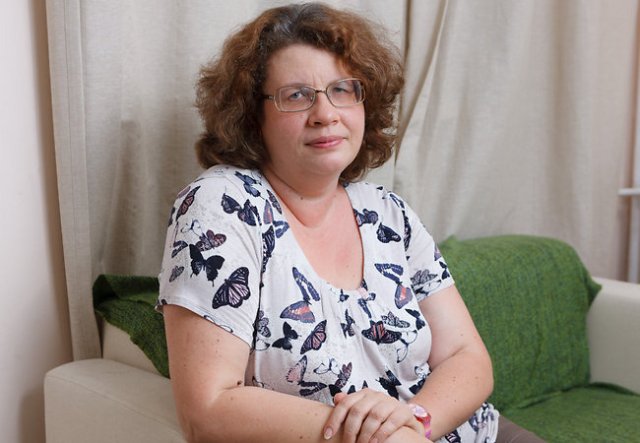
Photo by Eugene Razdobarina

Lyudmila Petranovska. Photo by Eugene Razdobarina.

This figure from the public opinion polls has become a symbol of the current sorry state of Russian society. 84% support the regime. They are happy with annexed Crimea. They hate Ukraine and Europe. They are unafraid of sanctions. They welcome the witch hunting of those who think otherwise. They are ready to do anything for the “Russian world.” The opinion surveys repeat, the number varies a little, but the conclusion is the same: the overwhelming majority of the population supports the continuing madness. Those who are against, are in a clear minority.

It is enough to get depressed, is it not? It is timely to recall the tale of the city in which there was not even a dozen righteous citizens to be found, and it was destroyed, and there was only one solution for the decent man in this situation: to leave without looking back. Let them face Judgement Day, the wheels of history or the invisible hand of the market, they have themselves to blame, since they are participants in the crimes. And let us stop talking about the deceived and hurt people. They are bastards, not people. This point of view is presented, for example, in quite a mild form by Matveii Ganopolskiy, and in not a very mild form by Viktor Erofeevyi and in a multitude of openly hysterical blog posts.

For now, let us put aside, or rather into a separate category, the issue of the feelings of the Russian liberal intelligentsia towards the Russian people; there is a lot there that is complex and multi-layered, and it deserves a separate topic. But for now, I think, it is useful to apply the intellectual’s critical faculty and to look, actually, at this number – 84%. What and who is behind it? Is everything really so hopeless?

Many believe that these surveys are falsified, that they are simply written inside the cabinets at the regime’s request. I do not think so. Maybe, someone twisted the truth, more likely, certain results are achieved by the wording of the questions, but it is doubtful that they are outright lies. People do reply roughly like that.

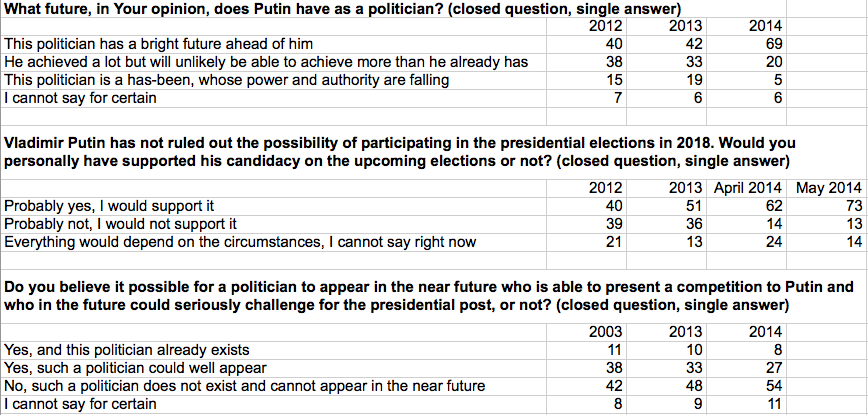
[the survey conducted by VTsIOM in June 20, 2014]
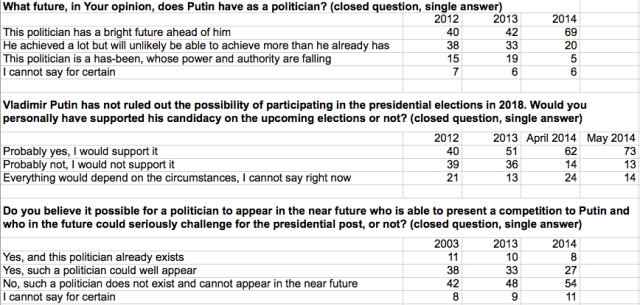
On the other hand, someone wrote me not long ago in the heat of a debate: “You’d better think about why 84% of the population does not like you.” I honestly sat down and thought. And no, I do not notice this. As far as I can tell, I am on good terms with at least 84% of people I know, even though I do not hide my position. Those who do not like me are either completely hard-nosed imperialists, or those paid by the authorities.

Something is not right here

84% is a lot of people, it is at least very, very different individuals, they simply cannot be a homogeneous group. Even our remaining 16 percent are not at all homogeneous, not to mention about 100 million adults in Russia (that is roughly what you get if you take away minors and dissenters). Let us try and see what, and who, they consist of. Are there any simple explanations of this unity that do not need hypotheses about “the culture of slavery,” “rotting entrails” and other horrors?

In my view, on the surface there are at least three reasons for the “popular consensus.”

Milk, the daughter in law, and politics

Remember this May? A nightmare happened in Odessa, war broke out in Donbas, separatists captured Mariupol, every day we expected an invasion by Russia. Stormy days. And during these same days, my eldest went with his girlfriend to visit her relatives in a city by the Volga, a moderately industrial city, not from the criminal or depressive sorts, but quite well-educated and cozy. They were there for almost 10 days, and when they returned, my husband and I of course, asked them: so what do people say there about the events in Ukraine? It was interesting to find out the opinions of people outside the capital. The folks, on hearing the question, looked at each other in puzzlement. And in that moment we realised that during the past ten days they not only never participated in a single discussion “about Ukraine” (in our house it was constantly in the background) but completely forgot about it all. They helped the granddad to dig a garden at the dacha, they fried meat with the uncle and went to the sauna, they ate pies made by the mother and walked along the banks of the Volga River. Yes, the TV was sometimes on there, they were saying something about the terrible events and one of the women, looking past, may have raised her hands and said: “Those poor people, how awful!” – completely without linking this sympathy to any considerations of politics and especially geopolitics. The dead, injured, destitute – poor people, whomever they may be. And then they’d carried on with their own affairs.

For the majority of people the events are happening there, inside the television. Almost like in a series. Maidan, Donbas, Obama, Putin – it’s all there, in the TV. Sanctions, indexes, ratings – this is all also there, in the television. And in the meantime they are building houses, fixing cars, running their business, planting blackcurrants, marrying off their children, playing with their grandchildren, looking after their elderly. They do not have the time or any particular interest to delve into the situation, the ashes of this battle are not knocking in their hearts. Should we blame them for it? Well, do we lose sleep knowing what is happening now in Iraq? Do we spend hours talking about it? We read about it in the news, get horrified, shake our heads – how awful – and then carry on working or resting.

In a strange way these people in the province are much more separated from the state than Moscow’s supposedly independent intelligentsia. Their standard of living is more dependent on the potato harvest and on whether their child will get accepted into college on a government-funded or private stream, than [it is] on blue-chip indices. Their well-being in old age depends much more on their relations with their grown-up children, than on the state of the Pension Fund. Over many years they have gotten used to adapting to changing living conditions, to depend first of all on themselves and on their family and they view the government like the weather: whatever it may be, you still need to live with it.

At the same time, if you come to them at some moment with the question: “do you support the current foreign policy of the Russian government?” – what would they have said? “Yes, of course we support them, how can we not?” Do they believe that Russia should help the DNR and LNR [Donetsk and Luhansk People’s Republics]? “Yes, of course we need to help, look how the people are suffering.” Sorry, I need to go, my milk is boiling over, my daughter-in-law is giving birth, the seedlings need planting, the boiler is acting up, the granddaughter has come to visit – actually, loads of events and things to do that are more important than your politics.

And what, these people are the “rednecks”? Accomplices in crime?

Is it these people that you are saying we should stop talking to, us righteous and evolved individuals? Their way of living their lives is less worthy than our sitting around, reading blogs? Are you serious? And how in this sense are Russians different from the inhabitants of any other country? Does the average individual of a small German, Australian, Mexican town spend a lot of time thinking about his country’s foreign policy?

Of course, non-participation and the reluctance to delve in has its price, and they will pay it in due time, along with the rest of the country. But their “approval” is rather the usual distancing from something that you do not have the power to affect, rather than a conscious support of the actions of the government.

Photo: RIA Novosti/Scanpix

Photo: RIA Novosti/Scanpix

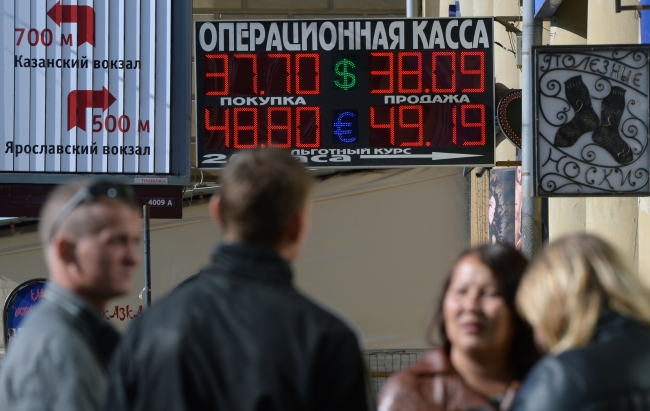
When it comes to something that affects their lives and interests, people become much more involved. For example, everyone is following the Ruble exchange rate – that is why they are not letting it plummet. When coffins started arriving in the province, filled with real neighbours’ kids – there was an immediate response, and the regime got scared, started covering its tracks, buying off the relatives, and generally slowed the war down. People have nothing against Putin going on television to send his televised money and weapons to some “brotherly Russian” rebels from the television. But as soon as they were asked directly: “Should Russia send troops into Ukraine?” – only 9% replied “Yes.” Because that is not “they are on the television,” that is – our houses that will receive first the draft orders and later, coffins. And 84% immediately turns into 9% – like Cinderella’s carriage turns into a pumpkin.

Human beings

Psychologists are very annoying creatures. They always find out something about human nature that makes us uncomfortable. For example, in the famous experiments of Solomon Ash, participants were offered to answer a simple question: which of three lines are equal in length. In every group there were seven people, but the real test subject was only one of them, and he answered last. The others were decoys, who were asked by the scientists to give the wrong answer. An obviously wrong one, because the lines were clearly different in lengths. So, in this situation, 75% of the subjects show conformism – they agree with the opinion of the majority, contrary to their own perception of the situation. They believe, not their eyes, but other people. And those 25% who were able to withstand the group pressure, and ended up saying what they saw with their own eyes, said that they experienced intense discomfort, right up to feeling physically unwell. Although in theory it was clear that there was nothing to fear – they were surrounded by cultured people.

Ash’s experiment, illustration from wikipedia.org

Ash’s experiment, illustration from wikipedia.org

The experiment is a little upsetting, but we have what we have. Humans are social creatures, group cohesion and the associated conformism is necessary for the survival of our species, we have to stick together and think alike, in order to survive in a world of far stronger predators, and most importantly – in a world of foreign cohesive human groups. The number of conformists in a population is quite a stable quantity, this guarantees the stability of small and big groups and their ability to act in unison. If everyone were a conformist, the group would lose in a competitive struggle, being unable to generate novel decisions. If there were less than half – the group would fall to pieces, shaken by crises and power struggles. So from two thirds to three quarters is just right.

Conformism is not silliness, it is not a sin nor infantilism – it is simply a natural programme. We can, of course, resist it when it is not just about comparing lines, but about matters of value, but the process of resistance is stressful and costs a lot of mental energy (no wonder that those who have ended up among the 16% now feel like they have spent all summer dragging weights or have survived poisoning).

Did not Russia’s propagandists create exactly this situation? The very possibility of a different point of view has been uprooted from the television and from popular newspapers, mass rallies are staged in support of the regime, hordes of Kremlin Internet trolls are kept on the payroll whose main job is specifically to generate group pressure, to create a feeling of “I am the only one out of line.” It is not an accident that the favourite line of pro-regime propagandists is: the people have decided thus, and you are what, against the will of the people?

What does the 84% figure tell us in this situation? Only that the customer has almost unlimited resources to recreate Ash’s experiment on the scale of a whole country, and that we are human beings. If you were to take away from the 84% the hardcore imperialists and pro-Putin people (those 9% who are #PutinSendInTheTroops) you will get about that 75% from the total number. The majority of Russians, it turns out, are of the species “human,” with typical levels of conformity. Amazing, what a stunning conclusion, we must immediately fall into despair.

What’s interesting is, that in these same experiments, the percentage of those who “withstand” rises sharply if even one of the stooges is allowed to answer correctly. Even one case of dissent greatly weakens the grip of group pressure. And if there were two of them, the number of answers given in spite of the obvious decreased very much.

Do you still think that “there is no use in talking to them”?

Do not anger ‘the dad’

In the experiments of Ash the participants were in safety. Can the same be said about Russians in the current situation?

Imagine that you live with a drunkard psycho-father who sometimes goes into a rage and starts to brutally beat everyone in the household. Now, of course, it is not so bad, but back when he was younger and stronger… when he just has a hangover, he is unhappy about everything, he lashes out at everyone and no-one can say a word against him. At best he just sleeps, mumbling something and stinking of alcohol.

Only rarely he is kind and cheerful – when his favourite football team is playing. He is an ardent fan and also plays football betting. The outcome of the match determines his mood for the next three days: if the team wins, he might buy a cake and stroke you on the head. If it is defeat – await a beating, because you are in the wrong place at the wrong time and did not support the team hard enough. Now tell me, honestly, will you not root for this very same team? Without pretending – but really, genuinely support it?

And, let’s be honest, is this situation not similar to the relations between the Russian people and their government for the past 500 years? The dad is kind only when our guys are winning. In the Olympics or in some war on the periphery. And if we are not winning, then woe betide the one who ends up being a scapegoat.

This is called Stockholm Syndrome, or identification with the aggressor, and has been repeatedly described using hostages as an example. Having unwillingly ended up bundled up with the aggressor, completely dependent on him, the victim starts to share in his demands and wishes, and starts to genuinely see his worries as their own – because that is their chance to survive.

You do not need to be very attuned spiritually to be able to recognise that the Ukrainian crisis is very important for the regime. The Kremlin has put virtually all their eggs into this one basket, it is their desperate attempt to renegotiate the social contract with the population, because it can no longer guarantee stability or a growth in living standards – everything has been stolen, spent, nothing new was created. A defeat in Ukraine will mean a collapse of Putin’s regime and, by the looks of things, a fall of the Russian imperial idea in general…

Quiet! The dad is watching the very very final match! He bet everything he has on the outcome. You have to be a kamikaze to mention at that moment that our guys are playing unfair. And that, actually, they deserve a red card and a penalty for their insolence. Who will dare to even think, let alone say, such a thing? Maybe he won’t kill you this time, after all he is a bit old now, this daddy of yours. But what if he remembers his old days? It is better to cheer on with him and to shout “down with the ref!” when he gives the other side a penalty.

Intimidation happens constantly, directly and indirectly. Remember the demonstrative sacking of the university professor for the “wrong” position regarding Crimea? The arrests after people unfurled a Ukrainian flag? And what other purpose is served, for example, by the ridiculous witch-hunting of [Andrei] Makarevich, as if deliberately made up on the spot: so the guy sang for some refugees, where is the crime in that? If the aim is to intimidate then everything is correct: a famous person is chosen, who before was quite loyal to the regime, an obviously absurd excuse – and attack, attack! So that everyone remembers: the daddy is a psycho, it is unclear what and when he imagines something, and there are no untouchables among us when the stakes are this high. Well, this communication channel is quite well-developed among the population, there is no need to repeat it twice. We were there before, we know all this. We already love “the insurgent Donbas” and hate “the Kiev junta.”

About a third of the participants of social surveys admitted that they are afraid to answer questions “about politics.” All of their inter-generational (and among the older generation, their own) memory is terrified of the process itself: someone is asking you about your loyalty to the regime, and are writing down your answers into some official papers. The Stockholm Syndrome is a vile thing, but everyone is affected by it, simply because of human vulnerability and the ability of the mind to adapt to anything, including violence. If someone has enough resources to stay strong – great, but to despise and vilify those who do not have enough strength – what right do we have to do that? The last thing should be to blame the victim for the consequences of aggression. That means becoming an ally of the one who made them a victim.

*  *  *

So what is left of the huge 84%? Something obviously remains. True believer imperialists, fanatics of the “Russian world,” adepts of the “strongman” philosophy, those who developed the tag “Putin, send in the troops,” those who spend far more time thinking about NATO bases than about their own house. They are not people who get on with their lives, not peaceful conformists and not victims. Specifically these people – some for money, some because of a calling of the soul – they give the impression of “all the people in unison.”

How many of them are there? Maybe, the same 16%. Maybe 9 – those who supported the idea of a direct invasion. Maybe more. But certainly not an overwhelming majority. The story of the 84% is like the old joke about a stir in a brothel: “Yes, it’s terrible. But not like terrible, terrible, terrible!”

In agreeing with the myth of national unity, we agree with pseudo-patriots, who for some reason claimed for themselves the right to speak in the name of the country and in the name of the people. We agree that the dirty game with public opinion that was started by the government is not only successful (that in itself is hard to deny) but has a right to exist. Moaning about the 84% is not our private matter, it locks people in a trap of conformity and victimization, making the situation self-sustaining. Our society becomes less aware and less free – with our participation. And I believe that is not really the job of the intelligentsia.

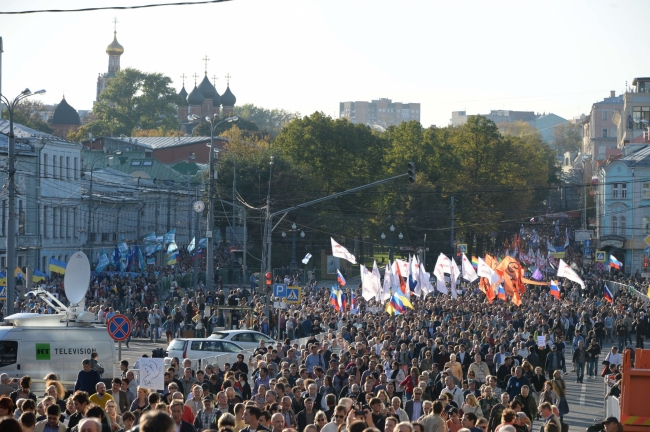
P.S. Last Sunday, September 21, there was a “Peace March” in Moscow, before which the net was full of fears that it will be attended by at most a couple of thousand people, and there were loads of calls to government supporters to stage a counter-rally and to stigmatise the “traitors.” On Sunday we saw a never-ending stream of people on the “Peace March,” many said that there were not this many people on any previous event. I know that this march was attended also by people who before had not been to a single rally.
The participants of the “Peace March” in Moscow on September 21, 2014. Photo: AFP/Scanpix.

The participants of the “Peace March” in Moscow on September 21, 2014. Photo: AFP/Scanpix.

Source: Spektr – Journalism without borders and censors
 

Posted in Analytics, English, English News, Others, Pictures, War in Donbas | Tagged , , , , , | Leave a comment