By Taras Shamajda
March 13, 2014
Translated by Mykyta Mykytovych and Edited by Voices of Ukraine
Source: http://texty.org.ua/pg/article/editorial/read/52448/
Many people are talking about the referendum in Crimea: Some condemn it, some support it, and some boycott it. There is even an impression that some of the opponents really consider that this will be a referendum, i.e., that the residents of Crimea will take part in the decision-making concerning the future of the peninsula. However this is not the case. On March 16 there will not be any referendum.
I would like to stress: There will not be any referendum. There will be a farce organized by Russia to create the impression that the occupation of Crimea is by the “people’s will.”
There are at least 10 reasons not to consider manipulations of the Russian occupants as a referendum:
1. Breach of the Ukrainian Constitution. A secession of any part of Ukraine cannot be a matter of a regional referendum. The territory of Ukraine can be changed only via the decision of the whole – a Ukrainian referendum.
2. Breach of international law. The integrity of borders is a fundamental principle of international law. Therefore all countries of the world, except for Russia, as well as most reputable international organizations declared that the referendum on the 16th of March will not be recognized.
3. There is no law concerning the regional referendum. A referendum can be held only according to the law. This is determined by the Constitution of Ukraine. However, the law regulating a regional referendum does not exist in Ukraine. This means in practice that there is no possibility to hold any regional referendum in Ukraine.
4. Illegal appointment. The Crimean Parliament exceeded its commission and the appointment of a referendum was recognized as illegal by a court. Moreover, the Crimean Parliament did not make the decision concerning a referendum in a proper way.
A meeting of MP’s, which voted for the referendum, was held in premises captured by Russian armed forces. Only those considered suitable by the invaders and their associates were allowed to enter the premises. Information concerning the quorum is contradictory. The voting was held in an isolated room, where armed men were present but no independent journalists were allowed.
5. Manipulations of the date and the formulation of the question. The referendum was originally scheduled for the 25th of May. However, the Crimean Parliament has already changed the date twice (30th of March and then 16th of March). The formulation of the question has been changed as well ranging from contractual relationships with Ukraine to Ukraine’s integration with Russia.
Thus, moving the referendum to the 16th of March, the Verkhovan Rada (Parliament) of the ARC (Autonomous Republic of Crimea), voted on March 7th to join Crimea to Russia without any popular vote. On March 11th they also adopted a declaration on the independence of Crimea, noting that Crimea would be declared an independent state provided residents of the peninsula vote (!) for entry into Russia.
This kaleidoscope of illegal, mutually exclusive, and impressively absurd decision making is evidence that the surrogate occupiers do not intend to learn the true will of the people. Their goal is to continuously adjust the date and phrasing of the referendum according to the Kremlin’s command.
Although Moscow has managed to occupy the region, the non-standard behavior of the Ukrainian military, a strong international reaction to aggression and increasing anxiety of Crimeans have forced Moscow to speed up events and to change the scenarios on the go. As a result of these manipulations, an already illegal referendum turns into a complete farce.
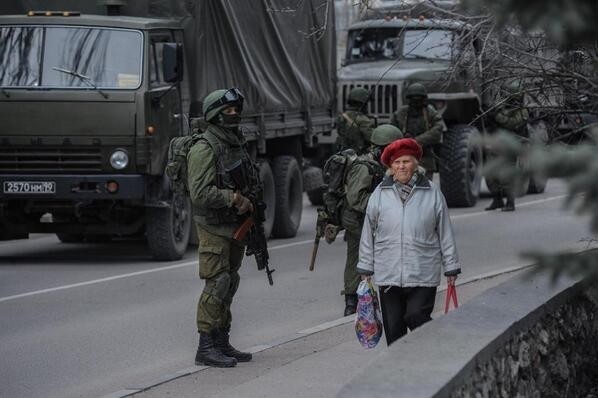
“Referendum” under the barrels of semi-automatic guns.
6. A poorly designed electoral commissions and polling stations. The referendum, as is known, is run by the election commission, and the vote takes place at polling stations. If there is no law, then who and what procedure establishes and releases off-site facilities in order to vote? Who forms the electoral commission (which is many thousands of people)?
And all of this took place over, not the usual 2-3 months, but in a week. Representatives of Aksenov’s collaborating “government” declared that it will work with the voting commission from the last elections. And this is on what basis? What if those people are not willing to take part in the commissions? Not to mention if someone dies or gets ill.
7. Uncontrolled ballots. How many ballots will there be? How will they be delivered? Can ballots be faked? No one knows, we can only rely on the declarations of the Head of the Crimean Central Electoral commission, Mr. Malyshev. But even his declarations are contradictory.
At first Mr. Malyshev declared that there are 1.8 million voters and 2.2 million ballots will be prepared. However, several days later he declared that there are 1.53 million voters and 1.55 million ballots will be prepared. The ballots will be delivered starting from the 12th of March to voting places. No one knows who controls these places.
8. Lack of voter lists. Clearly, one of the most important issues in any poll is accurate voter lists. The point is that there is no such list for the Crimean “referendum.” Because of the illegality of the Crimean “referendum” Ukraine ‘s Central Election Commission has blocked access to the register of voters so the separatists cannot get the actual lists, even if they wanted to.
Therefore the “government” of collaborators declared that the referendum will be held according to the lists of voters from 2010. It is clear that these lists of voters are currently very inaccurate, and it is not even clear when these will be available for the electoral commissions. Given that preparation for the referendum was only a few days instead of several months, neither members of the electoral commissions nor voters have the time to physically check the accuracy of the lists. Apparently, the organizers do not set this as a goal of the referendum.
9. Lack of free choice. A real referendum is not just about coming to a polling station and marking an ‘x.’ A referendum provides for free campaigning – for and against, and freedom of expression. What kind of campaign is it if there are only a few days left before the voting starts? What kind of campaign when armed supporters of Russian invaders launched a reign of terror against anyone willing to support the choice of remaining in Ukraine?
Those campaigning against are being threatened and beaten. Leaflets are being destroyed and information channels are brutally blocked. How can there be freedom of choice under the muzzles of Russian guns?
The very wording of the ballot itself is openly mocking. You cannot vote for the current status quo [ARC staying under the Constitution of Ukraine], because they don’t provide an opportunity to vote against both items on the bulletin. You can only vote for one item (entry into Russia or the so-called Constitution of Crimea, 1992) and the consequences of voting for either of these questions are almost identical.
10. Lack of control over voting and summarizing. No matter how many voters take part in the farce of March 16th, and of the tick they put on the ballot, you cannot control who and how to actually vote and how those votes will count.
Given that all law-abiding citizens of Ukraine do not recognize the legitimacy of the referendum vote, those organizing it are supporters of the Russian occupation. Independent observers are out of the question: local opponents of the referendum are persecuted as undesirable aliens and Ukrainians from outside of the peninsula of Crimea are simply not allowed to enter.
In addition, international organizations, which recognize the “referendum” as a farce, officially refused to send observers. It is at best naive to expect that people engaged in an armed seizure of the territory of Ukraine, having announced in advance the accession of this territory to Russia, will count the actual votes and honestly fill out reports. What sense would this make since the law that would regulate and summarize the results of the referendum doesn’t exist?
Under what circumstances is a referendum valid? How many people must come to the polling station? How many people have to vote “for” (though, to vote “against” anything is impossible, as was already mentioned above)? How are ballots counted and the result established? What are the legal implications of the results? One can ask all these question only of the “little green men” with guns.
Thus, there is no reasons to believe the show that Moscow is organizing on the 16th of March, is a referendum. Because this action is not only illegally appointed and organized, it does not have anything to do with free choice and objective ballot counting.
Taking into account the traditionally low election turnout in Crimea (the turnout for the last parliamentary election in 2012 was 49%) and calls by the opponents of the occupation for a boycott of the referendum, most probably much less than half of the population will take part in the referendum.
It is also unclear whether electoral commissions will function everywhere (some local authorities did not recognize the referendum). But the organizers of this farce do not care. The results of the “national self-determination” has long been known to them, it remains only to fill out the reports.
How many Crimeans actually come to vote and how they vote, we will never know. Instead, under the conditions of a military occupation of Crimea and its isolation from the rest of the world we see on screens of Russian television channels huge queues at polling stations and ballot piles of checkmarks for “reunification with Russia.”
It is definitely anything but a referendum.
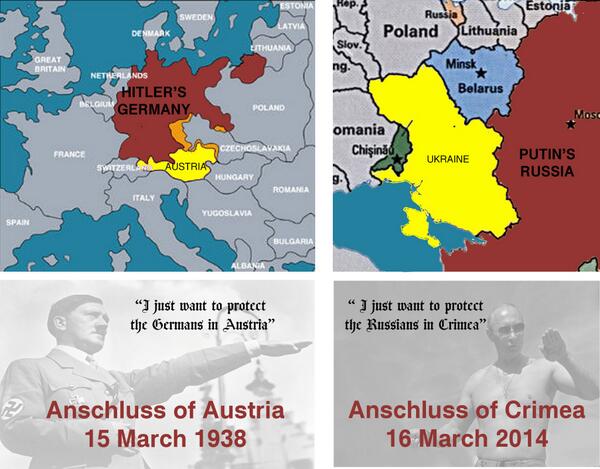
This is not the first time such farces have played out. The most obvious analogy is March of 1938. Adolf Hitler occupied Austria to “protect fellow German-speaking countrymen” and obtained 99% of the Austrian vote at gun point for the reunification of Germany. How many of those votes were in fact reality, no one will ever know.

 Voices of Ukraine
Reblogged this on Euromaidan PR and commented:
Why the Crimean “Referendum” is a manipulation – 10 facts you should know!
This is a typical Stalin era referendum. His philosophy was that it did not matter who voted but who counts the votes. This whole fiasco is just a farse. They might just as well had a count of hands.
Reblogged this on rovitothis201 and commented:
Ten dismal facts on the Crimean referendum; “It is definitely anything but a referendum.” The article also has a analogy between the Anschluss of Austria and the “Anschluss of Crimea.
One word: Kosovo.
Every reason you mention here is also present in that “democratic decision”.
Reblogged this on Zenobiusz.
11th : total lack of free campaign, democratic debates, balanced information, etc
Reblogged this on European Perspective.