Kyiv, 16 May 2014
Ladies and gentlemen,
This is my third visit to Ukraine since the start of the crisis. It coincides with the launch by the Office of the United Nations High Commissioner for Human Rights of the second report on the human rights situation in Ukraine, which is based on the findings of the UN Human Rights Monitoring Mission in Ukraine. The reports lays out the progress made, but also the current human rights challenges in Ukraine, particularly in the East and the South of the country.
Yesterday, I had the opportunity to discuss the report and its recommendations with Government officials, the Ombudsperson, and representatives of civil society.
My discussions have been constructive and we have been able to exchange views on a number of concrete ways in which the Government can take immediate steps to implement these important recommendations. I have stressed that it is critical for the Government to react immediately to the recommendations in order to contribute to the de-escalation of tensions ahead of the presidential elections.
The first report issued by the Office of the United Nations High Commissioner for Human Rights on 15 April, was based on my two previous missions and the first weeks of monitoring by the UN Human Rights Monitoring Mission in Ukraine. We tried to reflect the larger picture, focusing on root causes of human rights violations, including the long-term failure to respect the rule of law, lack of accountability of the security forces, corruption, mismanagement and its impact on economic and social and rights. We also raised the importance of accountability for Maidan protest-related violations and other human rights violations at the time, especially in Crimea and in the East. The previous report also contained quite broad, short and, long term recommendations.
In this second report, being released today, we first and foremost focus on current human rights challenges in the East and the South of Ukraine, and developments with regard to recommendations made in the first report. It also contains its own concrete recommendations, which are especially important ahead of the forthcoming presidential elections.
The report describes the deeply disturbing deterioration of the human rights situation in the East and South of the country: the increase in the number of armed groups undertaking illegal acts – the Human Rights Monitoring Mission in Ukraine has been informed of 112 cases of unlawful detention, of which we are still concerned for the whereabouts and condition of 49 people. Such abuses clearly indicate the breakdown in law and order in this part of the country. In addition, according to our information obtained through Government and civil society sources, during violent clashes and the security and law enforcement operations in the East and South, 127 people have been killed. This is deeply disturbing.
Why is this happening? Although the number of protesters has not sharply increased – we are still speaking of only a couple of thousands in a few cities – there are more and more armed people around such protests, and more weapons available.
All too often, the police are either inefficient or take no steps to prevent the clashes. In Odesa, it seems to have contributed to the tragic events of 2 May. The death of 48 people should, and could, have been prevented. I am calling on the authorities to investigate who are the direct perpetrators of the killings, and why security forces did not act in a more timely and decisive manner: this tragedy requires full clarity and broad accountability. In a number of other, fortunately less dramatic cases, the lack of a specific law regulating the exercise of the freedom of assembly exacerbates the situation, as any limitations placed on the freedom of assembly become at times arbitrary, and thus more controversial. However, there is a clear difference between peaceful assembly and what can only be characterised as violence, constituting a clear threat to security and public order. Peaceful demonstrations must be permitted, as a matter of international law, and law enforcement officers must receive adequate training for handling rallies and protests in line with international human rights standards. On the other hand, the use of force by the Government, when absolutely needed, is strictly regulated by international laws and standards.
In the East, there seems to be a mutual reinforcing effect between hate speech inciting violence, and the ensuing violence, which then serves as a justification for further hate speech. This is a vicious cycle that must be broken. Since the beginning of the crisis in Ukraine, going back to the Maidan protests (from November 2013 to February 2014), and including the situation in Crimea, the current illegal acts of the armed groups and the response of the security and law enforcement operation in the eastern regions, as well as the 2 May violence in Odesa – the UN Human Rights Monitoring Mission has received information that about 250 people have been killed, including local residents, national security forces and armed groups.
Any further arming of protesters and their transformation into paramilitary groups must immediately stop. Armed groups should be urgently disarmed. All who have influence on these armed groups should use their influence constructively in order to prevent further violence. Whoever incites violence and arms protesters, transforming them into paramilitary troops, can be held accountable for the tragic consequences.
From the beginning, I have continuously raised the need to urgently curb the use of hate speech. This becomes doubly important ahead of the forthcoming Presidential elections on 25 May. I am calling on all Presidential candidates to use the days remaining until the Presidential elections to send the message of peace and reconciliation to the people of Ukraine.
Constitutional amendments that were announced and the intention to discuss them through national consultations is the right approach to de-escalate tensions and create an atmosphere conducive to the implementation of the Geneva agreement. However, as civil society representatives whom I met yesterday conveyed to me, these national consultations should be inclusive and open to civil society, including peaceful representatives from the East of the country, critical of the Government.
The Government, as well as the international community, should send a clear message that there will be accountability for crimes committed, regardless of the ethnicity or political affiliation of the perpetrators. In this current situation everyone is losing: be they ethnic Ukrainians or Russians, Russian or Ukrainian speaking, with wider negative regional consequences. However, I firmly believe that the point of no return has not been reached, and we cannot allow it to be reached. The UN stands with all Ukrainians, regardless of their ethnicity and political affiliation – to help to prevent such an outcome.
The report also contains a chapter on the situation in Crimea, in light of the UN GA resolution 68/262 on the territorial integrity of Ukraine. From a human rights perspective, it is essential that resident of Crimea are not negatively affected by the implications of the changing effective legal framework on their human rights. No matter their citizenship, people who live in Crimea should have equal access to employment, education, health and other social services.
Special attention should be paid to the situation of the Crimean Tatar people and their rights as an indigenous people. Yesterday I had the opportunity to speak to Mr. Jemiliev, the historical Tatar leader. It is highly important that their 70th anniversary commemoration of their forceful deportation from Crimea, scheduled for 18 May, remains calm and that their right to freedom of assembly is fully respected. All those involved should use restraint: the situation is already difficult enough.
Over the next few days, I plan to travel to Donetsk and to Odesa, before returning to Kyiv on 19 May. This will enable me to follow-up on some of the serious human rights violations that have been highlighted in this report, as well as some human rights concerns that have arisen since the 6 May – the cut-off date for the report of the UN Human Rights Monitoring Mission.
It is highly important to diffuse tensions after the unlawful referenda in the regions of Donetsk and Luhansk, and ahead of the presidential elections.
The next public report on human rights in Ukraine is due in June. It will, inter alia, highlight any progress made in the human rights situation, as well as any negative consequences of the political and security tensions on social and economic rights for those who live in Ukraine, especially in the East of the country.
Thank you, and I stand ready for your questions.
Source: Office of the United Nations High Commissioner for Human Rights
RELATED INFORMATION:
Full text of the Office of the United Nations High Commissioner for Human Rights Report on the human rights situation in Ukraine 15 May 2014

 Rally in Simferopol. Photo via Крим SOS facebook page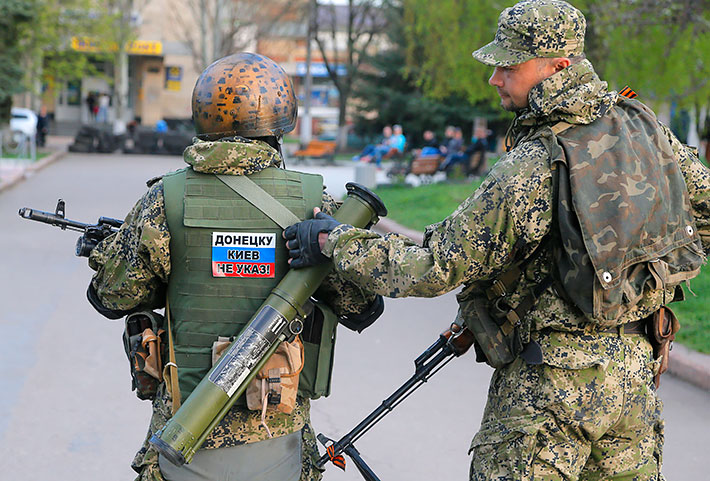


 Voices of Ukraine