Dmitry Tymchuk: Military updates, 12/26 (17th “Day of Silence”)

information_resistance_logo_engDmitry Tymchuk, Head of the Center for Military and Political Research, Coordinator of the Information Resistance group, Member of Parliament (People’s Front)
12.26.2014
Translated and edited by Voices of Ukraine

Operational data from Information Resistance:

Despite the “peace talks,” Russian-terrorist forces continue to carry out attacks on the positions of Ukrainian troops, although the number of fire strikes has decreased considerably. Meanwhile, the enemy continues to regroup its forces.

As such, an enemy armored group (4 tanks, 6 armored combat vehicles) set out in the direction of Trokhizbenka. Also in this area, the enemy delivered fire strikes onto the positions of Ukrainian troops. The firing was conducted from mortars.

The movement of arms and military equipment has been observed in the vicinity of the Bakhmut Highway. The transfer of a battery of self-propelled artillery units, (SPA) 2S1 “Grozdika,” was recorded. During the past 24 hours, these SPAs changed their positions several times, but did not open fire.

From the district of Dokuchajevsk, the enemy sporadically carries out artillery strikes towards the settlement of Stepne. An artillery group opens fire – supporting the actions of a task force of Russian-terrorist forces who are operating in this area (earlier, the IR group reported on the arrival of this formation to Dokuchajevsk).

From the vicinity of Horlivka, Russian-terrorist troops have been firing at the positions of Ukrainian troops for several days in a row. These attacks are carried out by a 122-mm howitzer D-30, and resume at nightfall. On the evening of December 25, 2014, an enemy supply convoy arrived from the direction of Ozeryanivka into Horlivka (12 cargo trucks) with several armored vehicles, including 5 tanks.

Parallel with the arrival of Russian army units and groups of Russian mercenaries, a process is underway to reduce the number of so-called “Cossacks.” In Alchevsk and Perevalsk [Luhansk region], posts were set up to send Russian “Cossacks” back to the territory of the Russian Federation. The “Cossacks” were transported on buses in groups. A large number of “personal items” has been recorded leaving for Russia.

In the settlement of Krasnyi Luch, work continues to establish a “transshipment and evacuation hospital” for Russian mercenaries.

A “special operation” by Russian-terrorist troops aimed at the search and neutralization of “Ukrainian subversives” has moved from Horlivka to Yenakiieve. The city streets are heavily patrolled, all checkpoints are holding indiscriminate searches.

Amongst “DNR” insurgents, rumors are vigorously spreading about the agreements with Ukrainian authorities regarding amnesty. According to the terrorists, amnesty would apply to certain gangs, regardless of the quantity and severity of the crimes of individual fighters.

In Makiivka, there are renewed conflicts between the Russian mercenaries who arrived from the Caucasus (“Kadyrov’s men”) and local insurgents. During the conflicts, several instances of the use of small arms was recorded; there are wounded on both sides.

Source: Dmitry Tymchuk FB

Posted in Dmitry Tymchuk, English, English News, South&Eastern Ukraine, War in Donbas | Tagged , , , , | 2 Comments

Dmitry Tymchuk: Military updates, 12/25 (16th “Day of Silence”)

information_resistance_logo_engDmitry Tymchuk, Head of the Center for Military and Political Research, Coordinator of the Information Resistance group, Member of Parliament (People’s Front)
12.25.2014
Translated and edited by Voices of Ukraine

Operational data from Information Resistance:

In the Kuibyshev District of Donetsk, a command of Russian-terrorist troops is actively conducting a rotation of personnel from units that operate in the Pisky Avdiivka stretch. Both tented cargo trucks and civilian vehicles transport the personnel. The arrival of Russian paratroopers has been observed in the vicinity of Spartak, and south of this area.

In the area between the settlements of Krasnohorivka and Pisky, the arrival of Russian army officers, who introduce themselves as representatives of a group to establish the so-called “demarcation line,” has also been observed. These Russian servicemen move freely [through the area], including in the vicinity of Ukrainian troops. In the meantime, officers of the Russian military intelligence (GRU of the General Staff of the Russian Federation) have been identified among these Russian representatives.

The accumulation of Russian-terrorist formations continues in the vicinity of Trokhizbenka. The arrival of another enemy task force to the area of Alchevsk, formed of local insurgents and mercenaries from Russia, was also recorded. The task force consists of about 150 people; it also includes 4 tanks and 6 armored fighting vehicles (AFVs). Also noted was the arrival in the area of 2 100-mm anti-tank guns MT-12 “Rapira” (which had undergone repairs), as well as 6 tented cargo trucks with ammunition.

During the past 24 hours, a repeated opening of fire by the enemy has been reported in Horlivka and Mayorsk. Cannon artillery has been predominantly used (4-cannon battery of 122-mm howitzer D-30), also MLRS “Grad” and mortars have been used.

An extraction (exfiltration) of a sabotage and intelligence group (DRG) of the Russian-terrorist forces has been reported from the vicinity of Debaltseve into Horlivka. During a raid, this DRG lost 2 commandos who were killed, a third – was wounded. All with shrapnel wounds.

In the vicinity of Zuhres, Russian-terrorist units underwent “artillery live-fire exercises” led by Russian officers. Units operating in the area of Starohnativka bridgehead took part in these “exercises.”

In Luhansk, the “Zarya” gang (personally led by “LNR” head I. Plotnitskiy) received reinforcement from Russia – both in manpower and equipment. The arrival of 6 tanks was noted. Also observed was the quartering [cantonment] of several Russian transport divisions in the city (in the northern and eastern parts of Luhansk). Within their composition, the units have vehicles for the transport of heavy machinery.

In the area of Putylivska Junction [Donetsk region], beyond a previously established insurgent checkpoint, the Russian-terrorist troops continue to set up a permanent observation post furnished with special equipment for conducting optical reconnaissance.

On the route between the settlements of Yasynuvata and Yenakiieve, the transfer to the front of the Russian radar system of intelligence and fire control “Zoo-1,” [a radar complex] designed for the reconnaissance of enemy weapons systems, was recorded.

In Crimea, the instruction of mercenaries for Donbas continues at the training camps of Russian secret services. The southern division of IR [Information Resistance] identified the head of one of these camps as the former commander of Internal Troops of the Ministry of Internal Affairs of Ukraine Lieutenant-General S. Shulyak, who has been previously put on the list of persons involved in the mass murder of Ukrainian citizens on Maidan in February of 2014 by the Prosecutor General’s Office.

Source: Dmitry Tymchuk FB

Posted in Dmitry Tymchuk, English, English News, South&Eastern Ukraine, War in Donbas | Tagged , , , , | Leave a comment

OSCE Observer Mission at Russian Border Checkpoints Gukovo and Donetsk: Weekly border crossings

This report is for the media and general public
Based on information as of 10:00 (Moscow time), 24 Dec. 2014

SUMMARY

Kamensk-Shakhtinsky, Russian Federation. The Observer Mission (OM) continues to operate 24/7 at both Border Crossing Points (BCPs). Overall cross-border traffic flows increased at both BCPs. The OM continued to observe a significant number of persons in military-style clothing crossing the border in both directions. Train movements at the Gukovo BCP have increased in frequency and became a daily occurrence.

DETAIL

OM’s arrival, establishment and observation work

The OM is currently operating with 16 staff members, consisting of 12 permanent international observers (including the Chief Observer), three temporary international observers and one administrative assistant. Seven international observers are currently on leave.

Cross-border movements common to both BCPs

The profile of the people crossing the border remains unchanged and can be categorized as follows:

  1. Families on foot or by car with a lot of luggage;
  2. Elderly people with few bags;
  3. Adults (usually of younger age) with no luggage or empty cars;
  4. People wearing military-style clothes, some with backpacks.

The average number of entries/exits increased from 6,663 to 7,112 per day for both BCPs during the reporting period. More people entered Ukraine than the Russian Federation. The average net flow (i.e. the balance of entries and exits) was minus 268 (i.e. exits from the Russian Federation) per day for both BCPs. The Donetsk BCP continued to experience more traffic than the Gukovo BCP. The cross-border movements registered at both BCPs accounted for 35 percent of all entries/exits in the Rostov region. The majority of the vehicles crossing the border have number plates issued in the Luhansk region, including the long-distance coaches commuting between Luhansk and cities in the Russian Federation.

Common observations at the BCPs

The situation at both BCPs remained calm. The OM continued to observe that the Russian Federation border guard and customs service conducted checks and controls.

Regular local and long-distance bus connections continued to operate between the Luhansk region and cities in the Russian Federation.

During the reporting period, the OTs observed 739 men and women in military-style dress crossing the border in both directions, predominantly into the Russian Federation. These people have been crossing individually or in groups. These border crossings occurred predominantly at the Donetsk BCP in both directions. The OTs continued to observe several Cossacks, who were identified by their traditional fur hats, as well as by Cossack insignias. OTs also observed a number of ambulances crossing the border in both directions at the Donetsk BCP.

The OTs continued to observe an increased number of cars with “DPR/LPR” stickers on their licence plates replacing the Ukrainian flag. In addition, the OTs observed “DPR/LPR” flags displayed on car dashboards.

Two Russian convoys

On 19 and 21 December 2014 two Russian convoys crossed into Ukraine through the Donetsk BCP.

On 19 December at 22:10 a convoy consisting of six trucks arrived at the gate of the Donetsk BCP. The livery of the trucks included popular motifs associated with celebration of New Year, and taglines such as “From Russia with love” or “New Year of Donbass children”. The vehicles stopped at the customs control area and the trucks were opened and inspected by the Russian Federation border guards and customs officers. According to Russian officials at the BCP, the trucks were carrying gifts, toys, chocolates, cakes and candies. The OM did not see any Ukrainian officers present during the inspection. By 22:25 the convoy had left the BCP towards Ukraine. This convoy was not observed crossing back into the Russian Federation by the time of drafting of this report.

On 21 December at 07:45 the OM observed the arrival of another Russian convoy at the gate of the Donetsk BCP. This convoy consisted of 92 vehicles. All but one cargo truck bore the inscription “Humanitarian help from the Russian Federation”, the other “Gifts for the children of Donbass”. The vehicles stopped at the customs-control area and the cargo trucks were opened and inspected by Russian Federation border guards and customs officers. The OM saw that Ukrainian officers were present during the inspection process. By 09:41 the convoy had left the BCP towards Ukraine. At 20:55 the convoy returned, lined up at the customs area and was inspected by Russian Federation officers. The OM saw Ukrainian officers on site as well. By 21:42 all 92 vehicles had returned and crossed back into the Russian Federation.

These were the 10th and 11th Russian convoys crossing through the Donetsk BCP since the arrival of the Observer Mission (OM) at the Russian BCPs.

Military movement

At the two BCPs the OM did not observe much military movement, apart from vehicles of the Russian Federation border guard service.

Observation at the Gukovo BCP

The traffic flows at the Gukovo BCP increased compared to last week. A daily average of 2, 469 entries and exits was recorded, which accounted for approximately twelve percent of all entries/exits in the Rostov region. Compared to last week more people exited the Russian Federation than entered. The net flow went from plus 9 (i.e. entries to the Russian Federation) to minus 38 (i.e. exits from the Russian Federation) on average per day.

During the week, the OM observed a total of 33 persons in military-style clothing crossing the border at the Gukovo BCP, 15 of them left for Ukraine while 18 entered the Russian Federation.

The OM continued to observe high numbers of dumper trucks transporting coal from the Luhansk region to the Russian Federation. As reported previously, the observers saw Russian Federation customs officers verifying that the trucks were empty while leaving the Russian Federation.

On two occasions the OTs heard a number of assault rifle shots fired from a nearby shooting range, which is located on the Ukrainian side of the border as described in OM’s previous reports.

The OT observed an armoured personnel carrier (APC), identified as BTR-90, being installed at the BCP. BCP officials explained that this was a routine BCP reinforcement in anticipation of the holiday season.

The OTs picked up a sound of a train passing by the BCP on twelve occasions during the reporting week; the OTs were able to visually observe the trains on three different occasions. Observation on other occasions was impaired by the trees that are between the BCP and the train tracks. In all twelve cases, the OTs were able to estimate the direction of the trains: six went in the direction of Ukraine and six went towards the Russian Federation. On four occasions the OTs were able to recognize the noise of cargo wagons.

On 22 December, the OT observed on two occasions a helicopter flying above the BCP and twice the OT observed lights of a helicopter. The helicopter made a few rounds and disappeared towards the east.

Observation at the Donetsk BCP

During the reporting period, the activity at the Donetsk BCP increased. The daily average of 4,643 entries and exits accounted for approximately twenty three percent of all entries/exits in the Rostov region. The net flow changed from minus 118 (i.e. exits from the Russian Federation) to minus 230 (i.e. exits from the Russian Federation) on average per day.

The OT observed 706 persons in military-style clothing crossing the border at the Donetsk BCP individually and in groups, 369 persons entered the Russian Federation while 337 left for Ukraine.

Source: OSCE Observer Mission at Russian Checkpoints Gukovo and Donetsk 
Posted in English, English News, Others, South&Eastern Ukraine, War in Donbas | Tagged , , , , | Leave a comment

The Museum of Ukrainian Culture in Donetsk

By Batkivshchyna [Homeland] Battalion
12.18.2014
Translated and edited by Voices of Ukraine

Somehow in Donbas: Culture, hate and the power of the Ukrainian spirit…

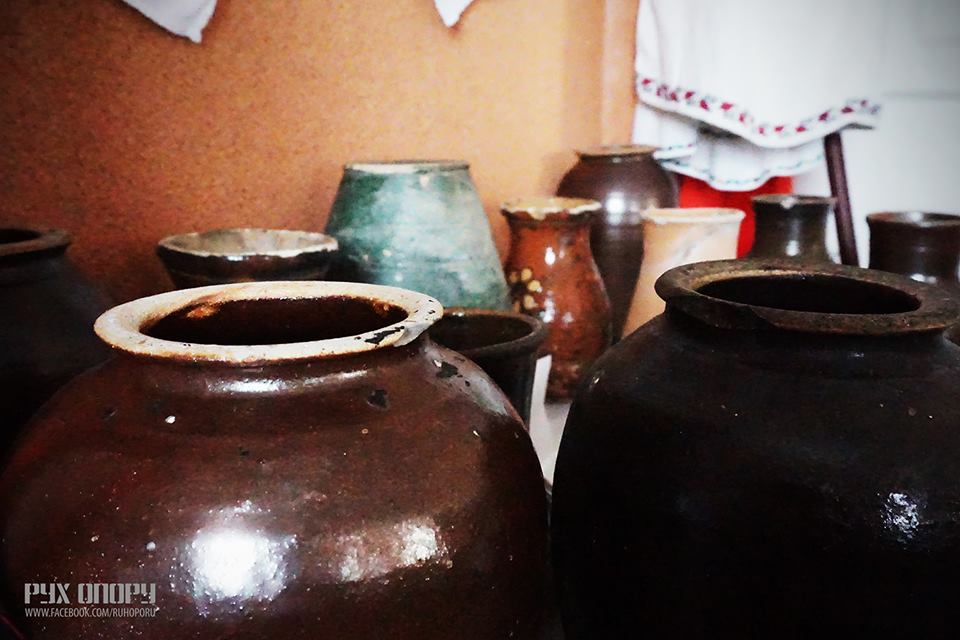
The Museum of Ukrainian Culture is in the village of Oleksandro-Kalynove in the Donetsk Region [north of Donetsk, inbetween Highway 20 and the Kalynivka River].

Local residents have equipped it themselves, bringing in pieces which would be the envy of pretentious metropolitan museums. What kind of Ukrainophobia and Russification may be involved when farmers, for lack of anything native or Ukrainian, begin to revive the culture of their own people here themselves?

Every item was brought here from families who, for years, kept it as a historic relic. Needless to say that a tiny piece of Ukrainian culture was like a splinter in the eye of local separs [slang word for the so-called “separatists”]?

People have been threatened, and told that both the Museum, and their farms, will be burnt. But they haven’t come to do it yet. Too quickly, they fled from the advancing Ukrainian army.

And the museum survived. And will continue to stand. Here, the soldiers of “Batkivshchyna” often come to visit – to spend a few minutes amongst Ukrainian antiquities and to be transported in their thoughts away from the war – to their native homes, where parents, children and grandchildren wait for them.

Source: Batkivshchyna [Homeland] Battalion FB

Posted in Culture, English, English News, Eyewitness stories, Pictures, South&Eastern Ukraine, War in Donbas | Tagged , , , , , | Leave a comment

Dmitry Tymchuk: Military updates, 12/24 (15th “Day of Silence”)

information_resistance_logo_engDmitry Tymchuk, Head of the Center for Military and Political Research, Coordinator of the Information Resistance group, Member of Parliament (People’s Front)
12.24.2014
Translated and edited by Voices of Ukraine

Operational data from Information Resistance:

During the past 24 hours, the arrival of Russian-terrorist “reinforcement” troops has been observed in the Petrovskyi district of Donetsk – about 100 Russian contract soldiers (the majority of them – conscripts who just signed their contracts). Russian servicemen are equipped as “DNR” fighters.

In the vicinity of Snizhne, the movement of up to 400 Russian mercenaries heading in the direction of Donetsk was recorded; these mercenaries have been trained in a “boot camp” in Rostov-on-Don (Russia). Mercenaries are unarmed (their equipment and weapons are transported separately); armed soldiers of the Russian Federation accompany them. The team leaders have been given strict instructions to avoid drinking alcohol and abstain from other misconduct for the duration of the trip.

A transfer of up to 5 armored fighting vehicles (AFVs) and an enemy supply convoy for tactical groups of Russian troops concentrated in the area has been recorded on the Bakhmut highway (one is the airborne tactical group and another is from the motorized infantry compound, both [groups] were reinforced with tanks and artillery).

In Horlivka, a “special operation” is underway to find and neutralize “Ukrainian subversives.” The “search” is conducted by units under the personal command of “DNR” leader A. Zakharchenko, as well as a unit of “Makiivka’s commandant’s office” of Russian-terrorist forces, which has several armored vehicles (APCs) at its disposal. “Russian experts” from the FSB have been observed to be on the teams conducting the raids. As a result of night raids, in which terrorists used weapons without warning, at least one local resident has been killed, and several others were injured.

In the area of Krasnodon, Russian military are expanding a staging base for artillery munitions which arrive from the territory of the Russian Federation and are then distributed to sites at the “front.” In particular, a consolidated specialized unit for maintenance of this base has arrived from Russia. The unit is staffed with contract soldiers and warrant officers from various divisions of the Russian Armed Forces. Besides storing other artillery ammunition, the base also houses the “Krasnopol” high-precision 152-mm artillery ammunition manufactured by Russia (the Armed Forces of Ukraine don’t have such munitions in their service).

In the settlements of Antratsyt and Krasnyi Luch, in effect, dual power has been installed – to control territories claimed by Russian “Cossacks” and “LNR” fighters. Russian army units stationed here remain “neutral” and intervene in conflicts between “Cossacks” and local terrorists only if there is a danger of direct armed confrontation. However, there is a constant showdown between the “contenders for power” – in particular, the “Cossacks” are seeking to get financial assistance from the “LNR” and access to the distribution of “humanitarian aid” from Russia. At the same time, some of the “Cossacks” were observed leaving the territory of Donbas for Russia throughout last week.

In the vicinity of Novoazovsk, a Russian sabotage and reconnaissance group (SRG) was ambushed while moving through territory controlled by the insurgents, after the former’s exfiltration from territory controlled by Ukrainian troops. As a result of armed confrontations with a unit of Ukrainian guerillas, several Russian servicemen were killed, and the commander of the Russian SRG was seriously wounded by a shot from a 40-mm GP-25 [under barrel] grenade launcher.

Source: Dmitry Tymchuk FB

Posted in Dmitry Tymchuk, English, English News, South&Eastern Ukraine, War in Donbas | Tagged , , , , | 1 Comment