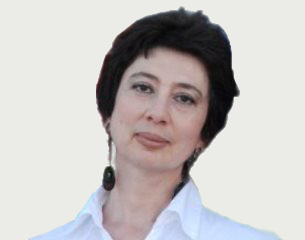
By Natalia Tverdohleb, columnist
06.06.2014 Jewish.ru
Translated and edited by Voices of Ukraine
It is impossible to look into the future. I do not know how much longer the current situation I’m in can continue. All attempts to get out of talking, to not discuss Ukrainian events with Israeli friends are fruitless.
A typical conversation goes like this:
“Hello! How are you?”
“The usual, no change. Is it warm there now?” (I try to steer the conversation to the weather.)
“Yes, it’s hot here. How long are you going to stay there with all those thugs? What are you waiting for? Pogroms?”
“You’re on about that again? What thugs?”
And we go round in a circle again: the ad nauseam answers (that everyone knows…) about [Dmytro] Yarosh and the Right Sector, about [Vadim] Rabinovich who does not understand his place, about the Ukrainian army that will not leave the residents of Donbas in peace. It is difficult to answer; to answer people who will not listen is obviously very hard. All the conversations are the same: there are different versions for different people, but they are all the same.
I do not want to lose any more friends, I look for the words but cannot find them. My Ukraine has become a Jewish rift—a point of no return to life as it was before, to the usual relationships. For me, relations between Jews before Maidan, the annexation of Crimea, and before the terrorists came to Donbas, were never black and white. There were shades of gray. But you never had sparks flying between different poles.
Whatever disagreements we had, it seemed the most important was what united us, our opposition to evil. Not long ago, we celebrated Passover—the holiday when we talk about captivity and we feel the pain of the Egyptian whips after a hundred generations and the real happiness of liberation. That is our suffering, our struggle and our joy. It might be a revelation for some, but the Ukrainian people, like the Jews, has its right to struggle, victory, and freedom. The simplest of course, do not think and repeat the trite phrase about the “dismantling of the Slavs,” so as not to consider the facts and notice the obvious. To analyze and compare is difficult and imbued with other people’s fears and worries. It is far easier not to crawl out of the shell and to live by stereotyping.
Israeli friends do not understand; they hesitate and are confused. But friends from Kyiv are sorry and delighted. What are they sorry about? That the Ukrainian army is still a long way from the Israeli army. What are they delighted about? Israel (!). The patriotism, courage, and solidarity of the Jews. My friends from Kyiv sometimes paint an idealistic picture of Israeli life, but I am not disagreeing, and am pleased to hear it. I overheard a conversation between two women talking in Ukrainian on a bus in Kyiv:
“Let this wretched Donetsk People’s Republic be, let people live how they want with their terrorists and local petty princes [war and drug lords]. Just don’t let our soldiers get killed.”
“If they thought like that in Israel, there would be no state. I went there last year, I looked around the country, it’s heaven on earth. But they are surrounded by enemies, they have gone through so many wars, and now they have no peace.”
Then they talked about 1948, the six-day war, Jerusalem, rockets from the Gaza strip, how Israel protects itself from terrorists, everything that this woman had heard about during her trip.
“You understand?” she asked the other woman all the time. “That’s what we have to do. We need to learn from them.”
I must confess that, forgetting the rules of decency, I eavesdropped on them openly and missed my stop. That evening, as if by design, there was a program on television about Israel and the same examples were given. One of the analysts, there are a lot of them around now, submitted that it is impossible to make that comparison—it is a small country, it has special conditions, a different political situation. For “different political situation,” I remembered how the thugs terrorizing Donbas put the women in front of them in order to shield them from the Ukrainian National Guard. For Israelis these are familiar circumstances.
I think our biggest desire is not wanting to change. Situations which seem paradoxical are perceived with difficulty and sometimes with hostility. Many people find it paradoxical that Jews are participating in the latest events in Ukraine. The Banderite stereotypes turn out not to be incompatible with Vadim Rabinovich winning more Ukrainian votes in the [presidential] election than both candidates from the radical parties combined, or with Governor Ihor Kolomoyski protecting Dnipropetrovsk Oblast from terrorism, or with the co-founder of the citizen platform New Country, Valeriy Pekar.
Our relationship has gone into a new phase. I understand: it will not go back to what it was before. And while I am looking for a way out, I choose my words and arguments, I get another Skype call.
“Hello! How are you?”
“How are you?”
———————————
Author’s autobiography:
I wrote my first novel when I was ten. It was a success among friends in our backyard, and it was awaiting failure in school. I have not written novels since then. But I have published a book of stories. I graduated from the Leningrad Polytechnic. For many years, I wrote software programming languages. Today I work in medical journalism, and live in Kyiv.
Source: jewish.ru

 Voices of Ukraine