

27.01.2014, Nashi Groshi
Translated by Maria Stanislav
Source: http://nashigroshi.org/2014/01/27/labirynt-zaharchenka/
“Nashi Groshi” [Our Money] followed the Trybushany trademark registered with the Head of the Ukrainian National Police Service, Vitaliy Zakharchenko, and found two banks, the 112 TV channel, and airports in Odessa and Simferopol.
If there was one thing that the Ukrainian journalists underestimated about Minister Vitaliy Zakharchenko, it was his transparency. Usually, officials hide their property in offshore bank accounts or under figurehead owners – but here, the head of the police, openly and without any hiding, registered the Trybushany trademark as his.
We remember that registering ownership of a trademark means confirming that whomever the nominal owners may be, the company only has one real master.
Just a reminder – here, by “company” we mean Marmurovyi Karier Trybushany (Trybushany Marble Quarry) PSC. We’ve already mentioned that its first owner was the minister’s wife Lyudmila, owning it through Girnycho Rudni Tekhnologii (Mining and Ore Technologies) CJSC. If you haven’t seen it – it was in a TV story shown on Nashi Groshi.
However, this story isn’t about the Trybushany marble quarry, or even the Muzhiyev gold mine (also included in the minister’s family’s sphere of interests). It’s about other, more important businesses.
The interesting thing is that the title of the official owner of Girnycho Rudni Tekhnologii CJSC (and therefore, the owners of the Trybushany marble quarry) belonged, in turn, to Lyudmila Zakharchenko, Star-Polis Insurance Company PJSC, and the Dutch company Stichting administratiekantoor LVV (which owns GRT CJSC to this day). While Minister Zakharchenko has held the rights to the Trybushany trademark, all this time. Therefore, neither the insurance company nor the Dutch firm are random strangers to the minister. They merit a closer look.
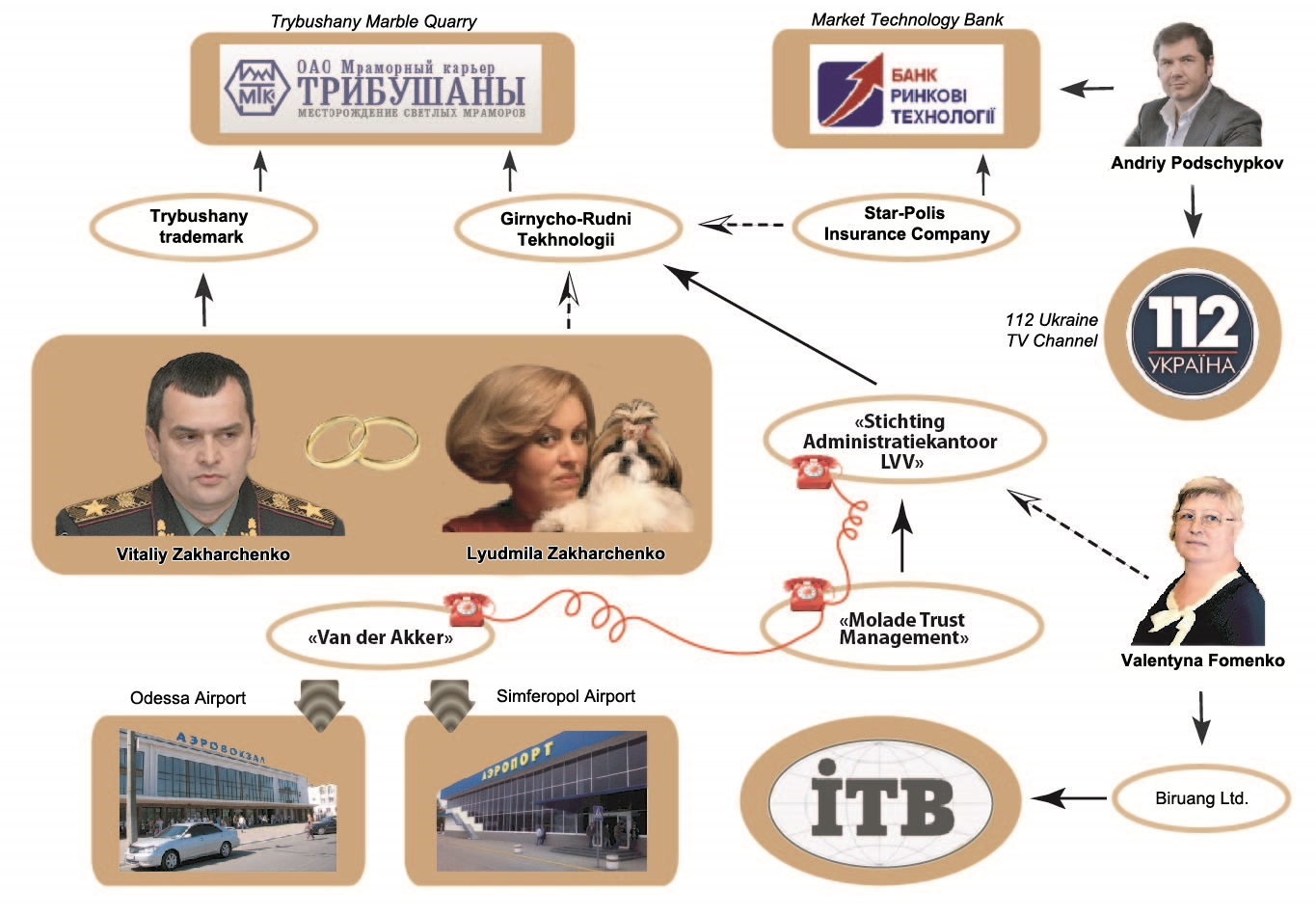
The Labyrinth (Nashi Groshi)
First, let’s talk about Star-Polis. Last year, this company starred in a scandal involving the State Migration Service (coordinated by the Minister of Internal Affairs, Zakharchenko). At the time, it was discovered that employees of OVIRs (visa and registration departments) forced people to pay for unlawful insurance sold by Star-Polis and VUSO in the process of applying for foreign passports.
But once again, this isn’t the main story. Star-Polis is more interesting because of its corporate connections. In 2010, after the elections that brought victory to the Party of Regions, this company founded Bank Rynkovi Tekhnologii (Market Technology Bank). By 2012, however, its ownership share in the bank dropped from 100% to 40%. Where the rest of the bank’s shares went – that is unknown. But wherever they went, there were still plenty of Star-Polis managers in the bank’s governing bodies.
Bank Rynkovi Tekhnologii PJSC turned out to be an amazing success. Even though it was founded by a tiny insurance company, and its business model was so peculiar it surprised many analysts, its results were nothing short of astounding.
For example, when summarizing the results of the 2013 financial year, the Ukrainian Bank Association named the banks with the highest asset growth. It’s worth quoting a fragment of its report: “The jury members determined the banks that multiplied their assets the most. The two main contenders were Vseukrainsky Bank Rozvytky (Ukrainian Development Bank) and Bank Rynkovi Tekhnologii.”
The leader of the banking system was VBR owned by Olexander Yanukovych [son of President Yanukovych], and BRT came in second.
This means that the real owners of BRT dumped so much cash into their financial organization that the only one who could best them in this delicate matter was the President’s son himself.
And yet, it wasn’t the bank’s success story that caught our attention, but its mysterious employee – namely, Andriy Podschypkov, counselor to the Chairman of the Board. He’s better known to the wider public as the owner of the new 112 TV channel, whose recent investments into equipment made a huge impression in the media circles.
There are many things that make his personality mysterious.
First of all, it’s entirely unclear where Podschypkov got the money to open and run a very expensive channel. His own business is nothing special, a few mobile phone shops in Poltava – and even that was ten years ago, followed by working in some analytical center. That’s all there is to know. Even on his personal website, the only positions worthy of note are Counselor to the Chairman of the Board of the Market Technology Bank, and Counselor to the President of the Kyiv River Port.
Another honorific of Podschypkov’s is ‘President of the Ukrainian Association of Martial Arts Oriental in the Poltava region’. But that’s hardly a lucrative post, either – not in a civilized country, anyway. Nevertheless, Podschypkov’s contribution to the statute capital of Partner TV Ltd., which owns the channel, was one million US dollars, or over eight million hryvnya. Let’s not even get started on the running costs.
Secondly, what mystical powers helped a newborn TV channel to procure digital licenses? That was one unique operation, even for Ukraine. Out of the blue, five competition winners handed their licenses over to the newborn channel – and the National Council in the Issues of Television and Radio Broadcasting allowed that just fine. Even though the licenses in question were regional, and then came together to become a national license. All that happened at the time when other TV channels couldn’t get their hands on any permit to be on air after January 1, 2015.
Therefore, it’s not surprising that starting from November 2013, Vitaliy Zakharchenko was already referred to as the real beneficiary of the channel, and the channel’s journalists found themselves in a number of scandals during the Maidan events.
Now, let’s set the TV channel aside and return to more system-level businesses.
Along the labyrinthine path that leads away from the Trybushany quarry, there lies another bank, quite a fresh one – the Investment and Trust Bank. To find it, we have to look at the current owner of Girnycho-Rudni Tekhnologii. Previously owned by the minister’s wife Lyudmila Zakharchenko, it now belongs to the Dutch company Stichting administratiekantoor LVV, which, in turn, is owned by the Molade Trust Management trust, also Netherlands-based. We’ll get back to that last one in a moment.
Stichting administratiekantoor was founded in 2011, by Valentyna Fomenko, a resident of Lugansk.
Volumes can be written about that lady. For instance, the attempt to monopolize the assessment services market comes to mind. 2012 saw the first attempt to lead multimillion cash flows to 12 companies connected to the director and the head of the legal department of the NGO called Association for Facilitation of Legal Work – Valentyna Fomenko and Igor Kushnaryov, respectively. Oh well, water under the bridge, right?
Recently, Valentyna Fomenko, together with 10 partners, founded a company called Biruang Ltd.
In August 2013, Biruang proceeded to create Investment and Trust Bank, investing UAH 129 million into its statute capital. The Board was chaired by Olexander Podolyan, previously advisor to the Chairman of the Board of none other than the Market Technology Bank. Another co-owner was Oleksiy Karmazin, a member of the Market Technology Bank’s review from Star-Polis as the shareholder. Therefore, the banks weren’t strangers. In the end, there were far too many coincidences in their stories, and they didn’t go unnoticed. Journalists didn’t hesitate to classify Investment and Trust Bank as one of “pocket banks”.
All in all, the founders of Biruang are in the middle of a spiderweb of business connections. For example, companies with such descriptive names as Ukrainian Tax Audit (Podatkovy Audit Ukrainy PJSC) and Audit of Ukrainian Taxes and Fees (Audit Podatkiv ta Zboriv Ukrainy PJSC) specialize in tax consulting. They were created in September 2011, when Vitaliy Zakharchenko was running the State Tax Administration.
We’re going to stop wandering through the labyrinth for now. It’s far too vast to be described in one article. The one last stop we’ll make is a dark corridor that led us to a whole new business – namely, lease of state airports.
Last year, the Simferopol airport got a new administrator – a Dutch company called Van den Akker Holding. The competition held to appoint it lacked even a shred of transparency and became a shock for many. The winning company couldn’t boast much transparency, either. Registered to a Dutchman no one knew, with staff of one and a cheap website, the only noticeable thing about it was its phone number. It turned out that the number + 31 20 6402803 is owned by another Dutch company – none other than Molade Trust Management. In case you forgot – that’s precisely the organization that owns the Trybushany quarry today.
The word “Trust” in the title implies that the organization provides services to various clients. But it can also only serve one. Ultimately, this can be checked by local state financial inspectors. Even more so that it’s not just one state airport we’re talking about. It’s two.
A Dzerkalo Tyzhnya investigation showed that one of the project presenters on behalf of Van den Akker Holding was Oleksiy Kochanov, the director of Odessa Airport Development Ltd., an organization that got the run of the Odessa airport with the same amount of scandal as happened in Simferopol. The company’s owner is unknown – a nominally British company, with a Cypriote founder and local figureheads.
Therefore, even though people say that the real beneficiaries of the Odessa scheme were the local businessmen Granovsky and Kaufman, we remain unconvinced. To get in on the scheme we described, you have to be a member of a highly exclusive VIP club, the kind that doesn’t take in new members lightly.
To wrap up, we’ll say that we’re not making any statements as to whether some or other organization is 100% owned by a specific person. Working through volumes of information, we found that many structures that have a great influence on the Ukrainian economy, really do have corporate management. Call them co-operative societies if you like. The problem is, that their membership is just as exclusive, and they hardly ever include more than 5-6 people. We’re not going to say their names. Even as journalism students, we learned that stating the obvious is often in bad taste.

 Voices of Ukraine